

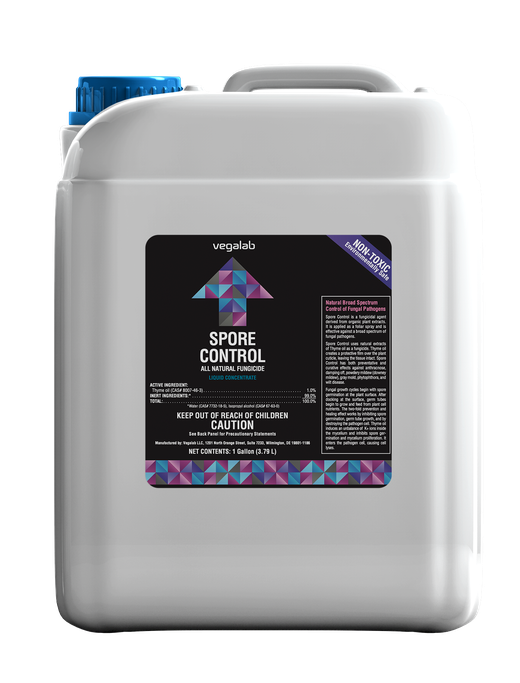
Spore Control
Spore Control is a natural fungicide powered by thymol (1%) from thyme oil that controls a broad range of crop diseases - anthracnose, damping off, downy and powdery mildew, gray mold, phytophthora and wilt. It disrupts fungal spores and growth on contact across fruiting and vegetable crops, with a low-residue profile.
All-natural broad-spectrum fungicide · Broad-spectrum, Protective film.
- Zero REINo re-entry wait
- Zero PHIHarvest the same day
All-natural broad-spectrum fungicide from Vegalab Crop Science, powered by Thymol 1% (Thymus vulgaris oil). Spore Control targets Anthracnose, damping off, downy & powdery mildew, gray mold, phytophthora, wilt.
Shipping $20 + $5 per gallon, calculated at checkout. Online orders up to 50 gallons; contact us for larger loads. Not available for delivery to Canada.
Secure checkout on Shopify. Each store keeps its own bag.
Thymol from Thymus vulgaris creates a protective film over the plant cuticle and inhibits spore germination and mycelium proliferation. It induces K⁺ ion imbalance in fungal cells, causing cell lysis. Best applied at first sign of disease.
| Active | Thymol 1% (Thymus vulgaris oil) |
|---|---|
| Targets | Anthracnose, damping off, downy & powdery mildew, gray mold, phytophthora, wilt |
| Dilution rate | 1:1,000 · 1 mL/L (3.8 mL/gal) · 0.5–0.75 L/ha (6.9–10.4 fl oz/acre) |
| Application | Foliar spray at first sign of disease |
| Line · Category | Control · All-natural broad-spectrum fungicide |
- Anthracnose (Colletotrichum)
- Damping off (Pythium, Phytophthora)
- Downy mildew, Powdery mildew
- Gray mold (Botrytis cinerea)
- Wilt diseases
Which diseases does Spore Control treat?
Spore Control addresses a broad set of the fungal and oomycete diseases that cost growers most: anthracnose, damping off, downy mildew, powdery mildew, gray mold (Botrytis), phytophthora and wilt. Rather than targeting a single pathogen, it gives wide coverage in one product - useful where several diseases appear together or where the exact pathogen is uncertain but action is needed quickly.
How does thymol work against fungi?
The active is thymol (1%), a compound from thyme (Thymus vulgaris) oil with broad antifungal activity. Applied to foliage and fruit, it disrupts fungal spores and growth on contact, helping halt the spread of established infections and protecting new tissue. Its nature-derived chemistry breaks down rather than persisting, which keeps residues low and supports use in programs aiming for clean produce.
How and when should it be applied?
- Apply when
- At the first signs of disease, or preventively when conditions favour infection
- Conditions
- Warm, humid, still weather for many of these pathogens
- Method
- Foliar spray, including leaf undersides
- Rate
- 1:1,000 · 1 mL/L · 0.5–0.75 L/ha1:1,000 · 3.8 mL/gal · 6.9–10.4 fl oz/acre · Work out your rate
- Pack sizes
- 3.8 L, 9.5 L1 gal, 2.5 gal
- Area treated
- 3.8 L treats 5-7.6 ha; 9.5 L treats 12.6-18.9 ha1 gal treats 12.5-18.7 acres; 2.5 gal treats 31.2-46.8 acres
- Pre-harvest interval
- Zero - harvest the same day
- Re-entry interval
- Zero - no re-entry wait
Always read and follow the applicable product label.
Apply as a foliar spray at the first signs of disease, or preventively when conditions favour infection - warm, humid, still weather for many of these pathogens. Ensure thorough coverage of susceptible tissue, including leaf undersides and the fruit zone, and repeat under continued disease pressure. Early action is far more effective than trying to rescue a heavy, established infection.
Which crops is it for?
Spore Control has been tested on strawberries, cucumbers, tomatoes, grapes and chili peppers - high-value crops where disease can move fast and quality standards are strict. It suits both protected and field production where a broad-spectrum, low-residue fungicide is needed.
How does it fit a disease-management program?
Because it is broad-spectrum and nature-derived, Spore Control works both as a protectant under building pressure and as a rotation partner that helps reduce reliance on synthetic fungicides. Combining it with good airflow, canopy management and monitoring gives the most durable disease control.
Need a recommendation for your crop or pest?
Contact usCrop-specific solutions using this product
- Powdery mildew on grapes
- Downy mildew on cucumbers
- Botrytis / gray mold on strawberries
- Early blight on tomatoes
- Leaf mold on tomatoes
- Anthracnose on peppers
- Fire blight on apples
- Bacterial blight on peppers
- Late blight / Phytophthora on peppers
- Damping-off on tomatoes
- Soft rot on vegetables
- Rust on commercial crops
Frequently asked questions
What is the application rate for Spore Control?
1:1,000 · 1 mL/L (3.8 mL/gal) · 0.5–0.75 L/ha (6.9–10.4 fl oz/acre) Application: Foliar spray at first sign of disease.
Is Spore Control suitable for natural or organic programs?
Spore Control is a naturally derived input (Thymol 1% (Thymus vulgaris oil)) designed to fit low-residue and IPM programs.
What diseases does Spore Control treat?
Anthracnose, damping off, downy and powdery mildew, gray mold, phytophthora and wilt.
What is the active ingredient?
Thymol at 1%, from thyme (Thymus vulgaris) oil.
Which crops is it for?
Strawberries, cucumbers, tomatoes, grapes and chili peppers.
Can it be used preventively?
Yes · apply at first signs of disease or preventively when warm, humid conditions favour infection.
Is it low-residue?
Yes · the thymol active is nature-derived and breaks down rather than persisting, keeping residues low.
The evidence behind these actives
Reference pages on the actives this product declares - mode of action, limits and the published sources, written independently of the product listing.
Problems addressed
Pest & disease library
See all plant pests & diseases →
Reference links to identification and management guides. Claims and product availability vary by jurisdiction - always read and follow the product label.
Last updated: