

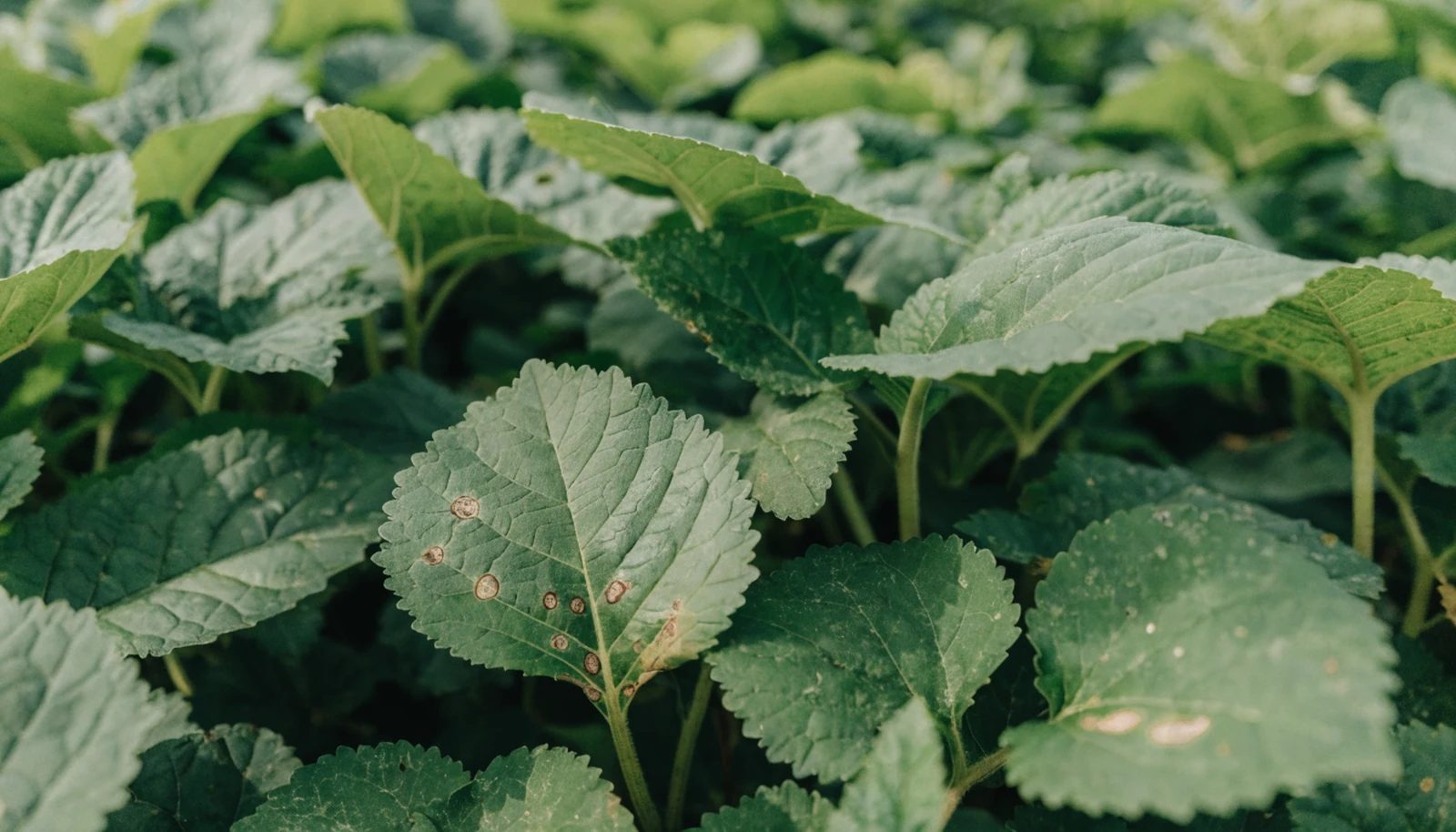
Crops affected
What is it?
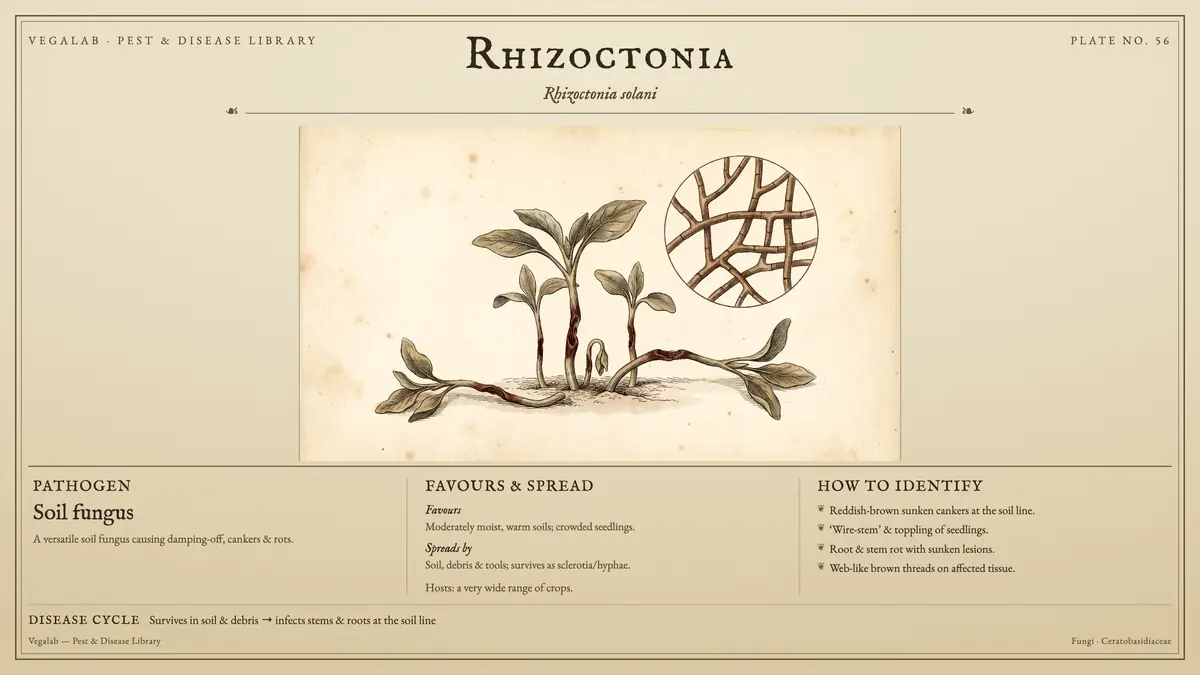
Rhizoctonia is a widespread soil fungus that attacks seedlings (damping-off), stems at the soil line (canker), roots and tubers, and turf (brown patch). It survives in soil and debris and is favoured by warm, moderately moist conditions.
How to identify it
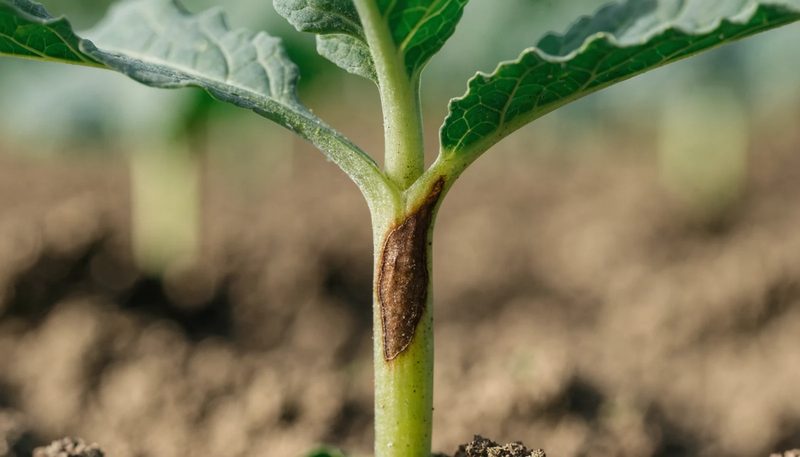
- Seedlings collapsing with reddish-brown, sunken cankers at the soil line (post-emergence damping-off).
- Sunken stem/root cankers and brown root rot; in potato, dark 'black scurf' sclerotia on tubers.
- Patchy stunting and uneven stands; in turf, circular brown patches.
- Web-like brown mycelium on stems/soil under humid conditions.
Life cycle & spread
Survives in soil and debris as mycelium and sclerotia; infects seedlings, stems and roots directly; favoured by warm soils and crop debris; spreads on contaminated soil, media and tools.
Conditions that favour it
Warm, moderately moist soils; crop debris; compacted or crusted soils; continuous susceptible cropping.
Damage and how it spreads
Kills seedlings (stand loss), cankers stems and rots roots/tubers (reducing yield and storage quality), and damages turf - with the biggest impact at establishment.
Monitoring & scouting
Watch emergence and seedling vigour; check stem bases and roots of stunted plants; assess soil debris and history in problem areas.
How to control it
- Use clean media and sanitation, manage residue and soil moisture, support a healthy/competitive root zone, and apply protectant programs preventively at the seedling stage.
- Established rot can't be reversed - focus on prevention and root protection.
How to manage rhizoctonia
- Do not rely on drainage alone. Improving drainage manages the oomycetes; Rhizoctonia needs different levers. This is the most common misconception about it.
- Plant into warm soil at the right depth. Shallow sowing and rapid emergence shorten the vulnerable window; deep sowing into cool soil extends it.
- Rotate with non-hosts and note that R. solani comprises many anastomosis groups with different host ranges - a rotation effective against one group may not be against another.
- Manage residue. The fungus survives as sclerotia and mycelium on crop debris; incorporation and decomposition reduce the inoculum available to the next crop.
- Avoid mechanical injury at planting and cultivation, which opens infection sites at the stem base and on tubers.
- Use clean, pasteurised media and sanitised trays in propagation, and clean seed where the pathogen is seed-borne.
- Build soil biological activity. Competitive colonisation of the rhizosphere by beneficial organisms reduces pressure over time; this is a programme measure applied before the crop, not a rescue.
- Remove affected plants and the medium around them promptly in propagation, since the fungus spreads plant to plant through the medium.
Rhizoctonia solani differs from the water moulds in a way that matters practically: it does not need saturated soil. It grows through soil as mycelium rather than swimming as zoospores, so it operates in drier, warmer conditions where Pythium and Phytophthora do not · and a dry tray or a well-drained field is no protection against it.
Because it spreads as mycelium through soil and along touching roots, Rhizoctonia produces expanding circular patches in trays and beds - a useful diagnostic distinct from the scattered losses of a physical or seed-quality problem.
The symptoms it causes, crop by crop
- Damping-off and wire stem: a firm, dry, dark, sunken lesion at the stem base of a seedling; the stem may remain standing and shrivelled rather than toppling, which is the 'wire stem' distinction from Pythium
- Black scurf on potato: hard black sclerotia stuck to tuber skins that cannot be washed off - a cosmetic downgrade that is the most visible sign of the disease
- Stem canker on potato: dark lesions on underground stems and stolons causing aerial tubers and rolled leaves
- Root rot and crown rot in beans, brassicas, sugar beet and many vegetables
- Sharp eyespot in cereals: lens-shaped lesions with dark margins on the stem base
- Brown patch in turf: circular patches with a darker 'smoke ring' margin in humid warm weather
- Belly rot in cucumber: lesions where fruit contacts infested soil
Black scurf on tubers is diagnostic and easy - the sclerotia are unmistakable. The seedling and root symptoms are much easier to confuse with other pathogens.
Rhizoctonia or Pythium?
- Moisture: Pythium requires saturated media; Rhizoctonia operates in drier, warmer conditions
- Lesion: Pythium gives a soft, water-soaked, mushy pinch at the soil line; Rhizoctonia gives a firm, dry, sunken, dark-brown lesion
- Roots: Pythium roots turn soft and the outer tissue strips off leaving a bare thread; Rhizoctonia roots show discrete brown lesions with tissue intact
- Mycelium: Rhizoctonia often shows sparse coarse brown mycelium at the lesion, sometimes webbing across the medium surface; Pythium shows none visible
- Pattern: both expand in patches; Rhizoctonia patches often have a sharper edge
- Products: oomycete-specific chemistry works on Pythium and does nothing to Rhizoctonia, and vice versa
These two are the most commonly confused pair in propagation, and because their chemistry differs - one is a true fungus, the other an oomycete - getting it wrong wastes a treatment.
See Pythium & Damping-Off and Damping-Off. Wet and mushy means Pythium; dry and firm means Rhizoctonia.
Why anastomosis groups matter for rotation
Rhizoctonia solani is not a single uniform pathogen but a complex of genetically distinct groups, conventionally called anastomosis groups (AG). Each has its own characteristic host range and disease expression, and this has a direct effect on whether a rotation will work.
AG-3 is largely associated with potato, producing black scurf and stem canker. AG-2 groups affect brassicas, sugar beet and turf. AG-4 has a wide host range across vegetables and field crops and is a common damping-off agent. AG-1 causes foliar blights in rice, soybean and beans.
The consequence is that a grower who rotates potato with a crop attacked by a different AG has not escaped Rhizoctonia · they have swapped which group is being favoured. Where the disease persists despite an apparently sensible rotation, identifying the group is what explains it, and it is a laboratory question rather than a field one.
This is also why general advice about Rhizoctonia rotation is unusually vague in the literature: the correct rotation depends on which group is present, and that varies by field.
Recommended Vegalab solution: Spore Control
Spore Control - natural broad-spectrum fungicide (thymol) used preventively where label-supported as part of a seedling-protection and soil-health approach. - Charge Bioboost - soil inoculant that builds a competitive, biologically active root zone to help suppress soil pathogens and support seedling establishment.
| Role | Product | Use |
|---|---|---|
| Primary control | Spore Control | |
| Also apply | Charge Bioboost |
Preventing it next season
Clean media/tools, residue and moisture management, healthy/competitive soil biology, rotation, and preventive protection at establishment.
Claims and product availability vary by jurisdiction. Always read and follow the product label.