

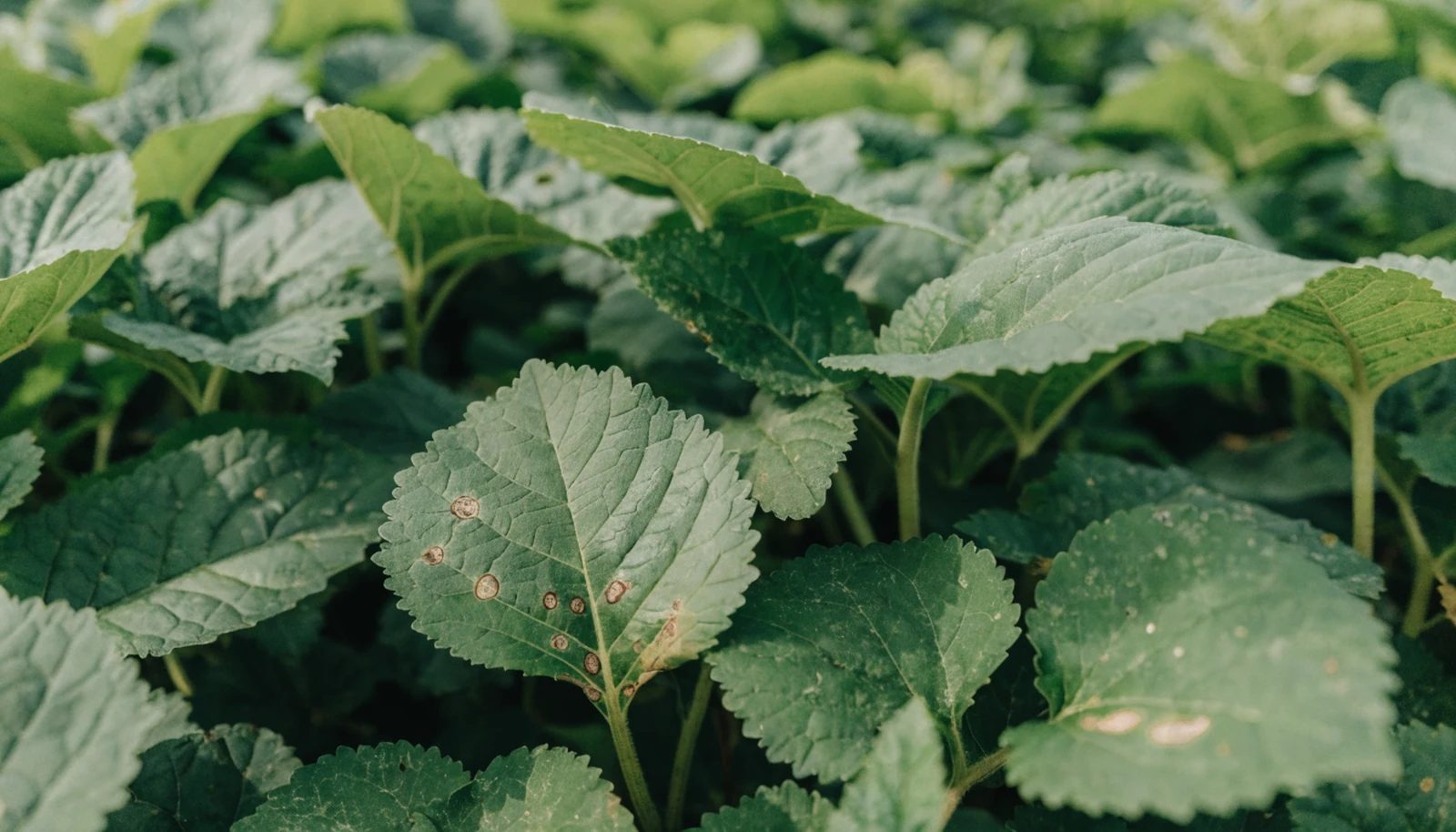
Crops affected
What is it?
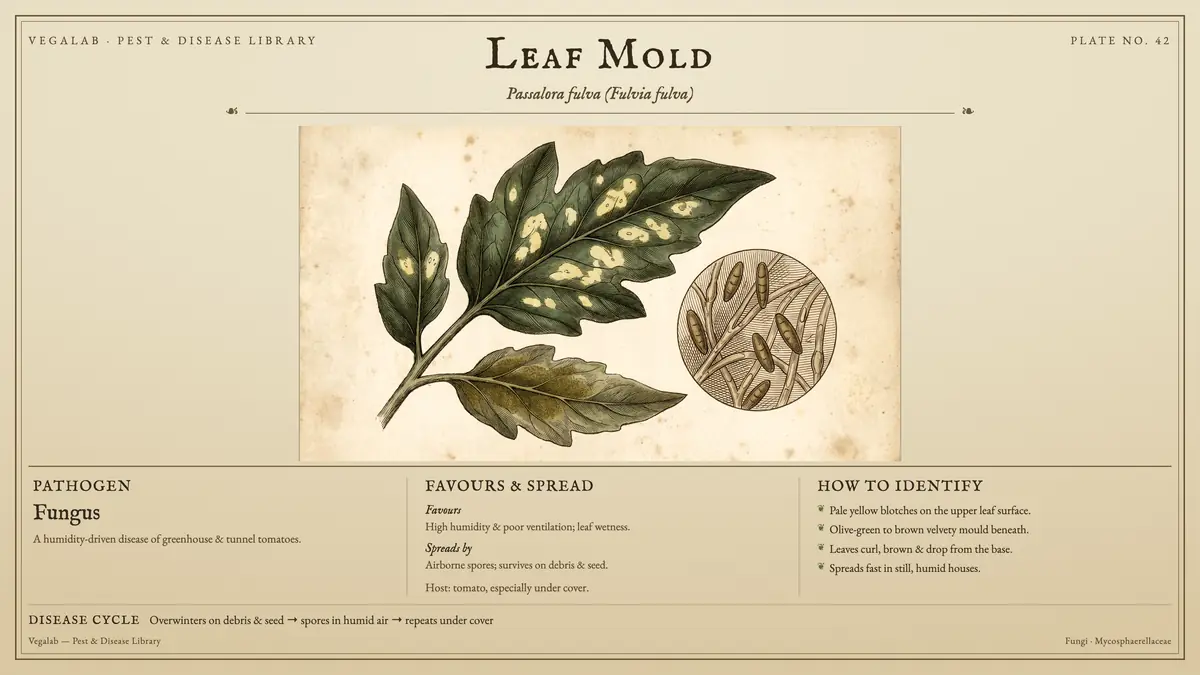
Leaf mold is caused by the fungus Passalora fulva (formerly Cladosporium fulvum). It thrives in high humidity and moderate temperatures, which is why it is especially common in protected culture. The fungus infects leaves and produces spores on the undersides that spread on air currents and splashing water.
How to identify it
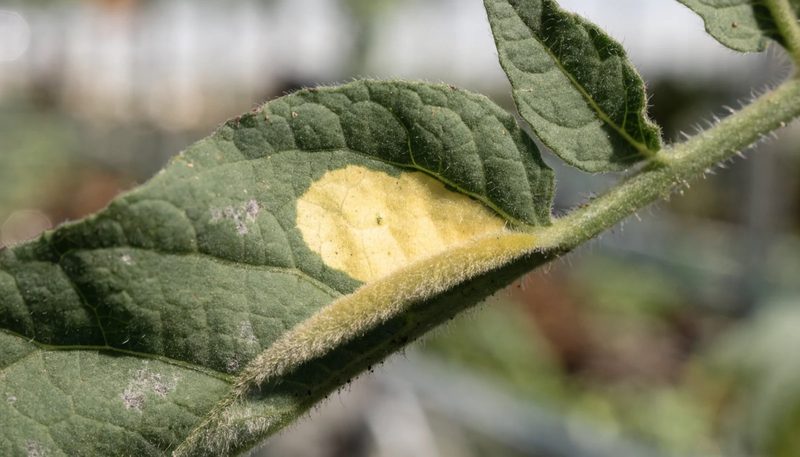
- Pale green to yellow blotches on the upper leaf surface
- Olive-green, gray, or brown velvety fuzz on the corresponding underside
- Yellowing, curling, and drop of affected leaves
- Worse in high humidity and poorly ventilated greenhouses and tunnels
Life cycle & spread
*Passalora fulva* (formerly *Cladosporium fulvum*, also *Fulvia fulva*) is a fungus almost entirely restricted to tomato, and almost entirely a problem of protected cropping. It survives between crops as sclerotia and mycelium in debris, on structures, on stakes and twine, and on seed.
Conidia are produced on the leaf underside and dispersed by air movement, on workers and equipment, and by water. They germinate and enter through the stomata, requiring high humidity - around 85% or above - but, unusually, **not** free water on the leaf. That distinction is what makes it a greenhouse disease.
Once inside, the fungus colonises the space between cells and produces the olive-brown velvety sporulation on the underside within one to two weeks. The cycle then repeats, and because the spores are airborne within an enclosed structure, it moves through a house quickly.
Conditions that favour it
High humidity is the requirement - above roughly 85% - together with moderate temperatures around 20–25 °C and poor air movement. It is therefore a disease of enclosed structures, and it is rare in open-field tomato.
Dense canopies, inadequate venting, night-time humidity spikes, crowded plantings and heavily leaved plants all raise risk. Because free water is not needed, growers who manage leaf wetness carefully but not humidity are still exposed.
Damage and how it spreads
By blotching and killing leaves, leaf mold reduces photosynthesis, weakens plants, and lowers yield - and in humid protected culture it can defoliate a crop. Because high humidity drives it, it recurs wherever air is still and moist. Ventilation plus protective treatment is the reliable combination.
Monitoring & scouting
Inspect the **undersides** of the older, lower leaves weekly. The upper surface shows only a diffuse pale yellow-green blotch with no defined margin; the diagnostic olive-brown velvety growth is underneath.
Monitor night-time relative humidity in the crop as the leading indicator, since the disease tracks humidity rather than visible wetness.
Note the progression from lower to upper canopy, and check whether the varieties in the house carry *Cf* resistance genes, since a resistance breakdown implies a new race.
How to control it
- Reduce humidity and increase ventilation, especially in greenhouses and tunnels.
- Space and prune plants for airflow; avoid overhead watering and wet foliage.
- Remove and destroy infected leaves and end-of-season debris.
- Apply a protective natural fungicide at first sign and through humid periods.
How to manage tomato leaf mould
- Manage night humidity actively. Heat and vent together in the evening to prevent the humidity spike as temperatures fall. This is the central control measure and the one most often neglected.
- Improve air movement. Horizontal airflow fans, adequate plant spacing and leaf removal in the lower canopy all reduce the boundary-layer humidity at the leaf surface where infection occurs.
- Use resistant varieties. Multiple Cf resistance genes are available and are the most reliable protection. Be aware that the pathogen produces new races that overcome specific genes, so a variety that held last season may not hold this one.
- Remove and destroy lower and affected leaves, taking them out of the house rather than dropping them on the floor - the spores are airborne and the floor is inside the structure.
- Sanitise thoroughly between crops. Remove all debris and disinfect structures, stakes, twine, benches and tools, since the fungus overwinters on them.
- Avoid overhead irrigation and drip carefully to keep humidity down.
- Protect through high-risk periods where a programme is warranted, rotating modes of action - this pathogen has a history of developing fungicide resistance.
Tomato leaf mold is primarily a greenhouse or high-tunnel disease favored by sustained relative humidity around or above 85%. Reduce nighttime humidity and leaf wetness with ventilation, air movement, heating where appropriate, drip irrigation, spacing, and sanitation.
Field tomato rarely gets leaf mould. If it appears in an outdoor crop, check whether the plants came from a propagation house, which is the usual source.
Recognising it · look underneath
- Upper surface: diffuse pale green to yellow blotches with no defined margin · vague enough to be mistaken for nutrient deficiency or early senescence
- Lower surface, directly beneath the blotch: olive-brown to greyish velvety sporulation · the diagnostic sign and the reason the disease is missed by growers who only look at the top of the leaf
- Progression: oldest lowest leaves first, moving upward; affected leaves yellow, curl, dry and drop
- On fruit: rare, but occasionally a black leathery rot at the stem end
- Not on stems in the way that many other tomato diseases are
The pairing of a vague topside blotch with distinct velvety growth underneath is unique in tomato. See Downy Mildew, which also sporulates on the underside but produces angular vein-limited lesions and needs free water.
Why resistance genes break down
Tomato leaf mould is a well-studied example of the gene-for-gene relationship between a plant's resistance and a pathogen's ability to overcome it, and understanding it explains an experience many growers have had: a variety that resisted leaf mould for years suddenly does not.
Resistance in tomato is conferred by specific Cf genes, each of which recognises a corresponding molecule produced by the fungus. When the plant recognises the pathogen, it mounts a defence and infection fails. But the fungal population is variable, and individuals that have lost or altered the recognised molecule are not detected - those individuals reproduce freely on the resistant variety, and within a few seasons of widespread planting they become the dominant race.
This is why single-gene resistance to this pathogen has repeatedly been overcome, why varieties carry stacked combinations of Cf genes, and why a resistance breakdown is a population-level event rather than a failure of an individual plant. It also means that when resistance fails, the correct response is to change variety to a different gene combination and to lean harder on humidity management - not to assume the variety was mislabelled.
The same dynamic explains resistance breakdown in downy mildews and rusts. It is a reason to treat varietal resistance as a renewable decision rather than a permanent solution.
Recommended Vegalab solution: Spore Control
Vegalab Spore Control (Thymol) protects against leaf mold by forming a cuticle film and inhibiting spore germination and mycelium proliferation. Apply as a foliar spray at first sign of disease, diluted 1:1,000 (1 mL/L), covering leaf undersides where the fungus sporulates, and keep up coverage during humid spells. Humidity control makes the program far more effective.
| Role | Product | Use |
|---|---|---|
| Primary control | Spore Control | Broad-spectrum protective fungicide |
| Companion / broader pressure | Armour Boost | Silica for tissue resilience |
By crop
See crop-specific solutions
Preventing it next season
Manage humidity and ventilation aggressively in protected culture, space and prune for airflow, avoid wet foliage, remove debris, and protect preventively in humid weather. Resilient foliage helps - support it with Armour Boost.
Claims and product availability vary by jurisdiction. Always read and follow the product label.