

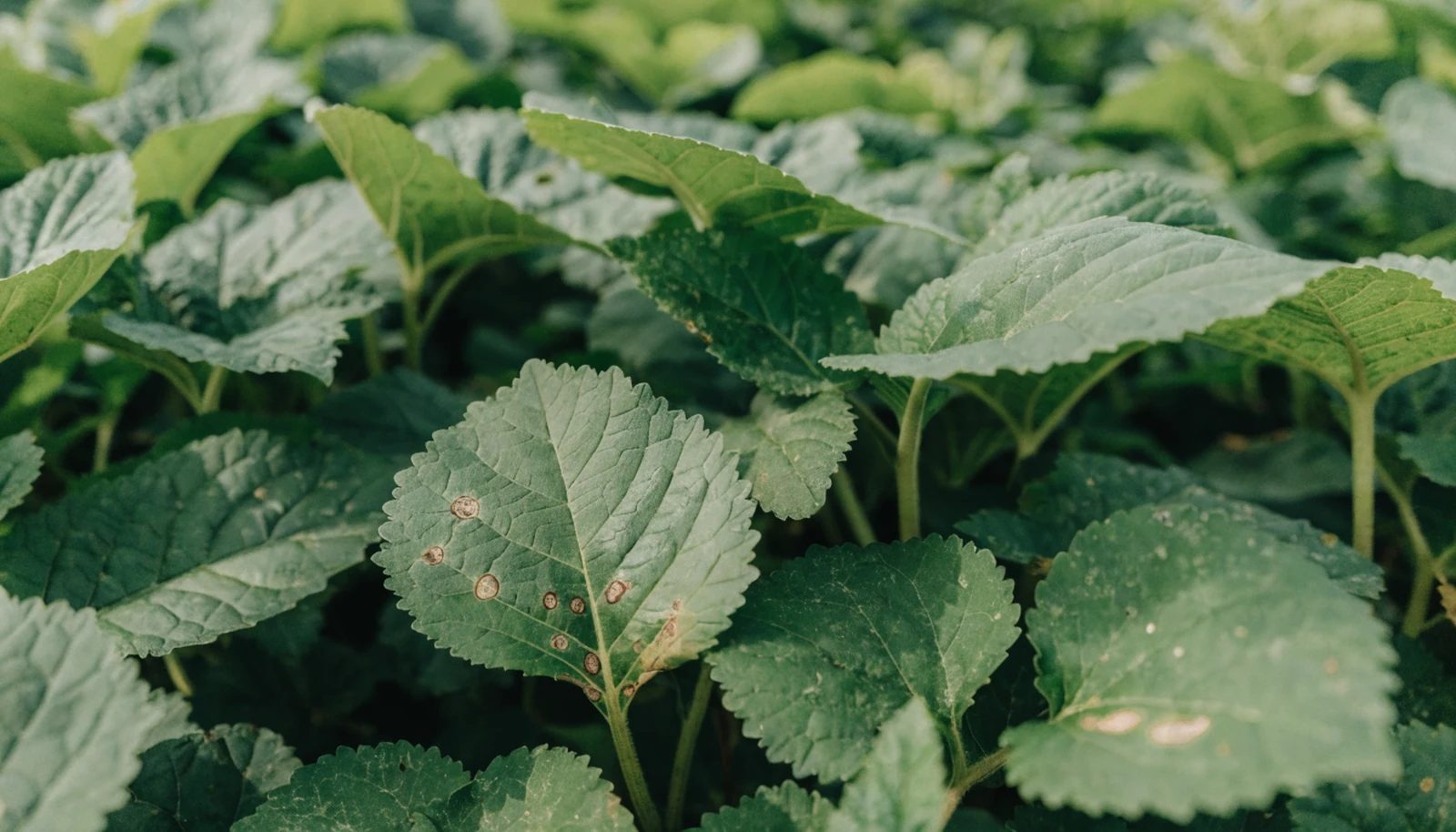
Crops affected
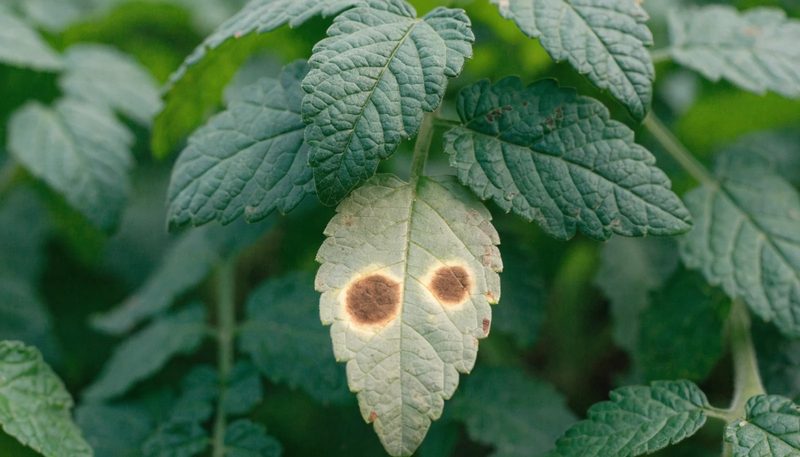
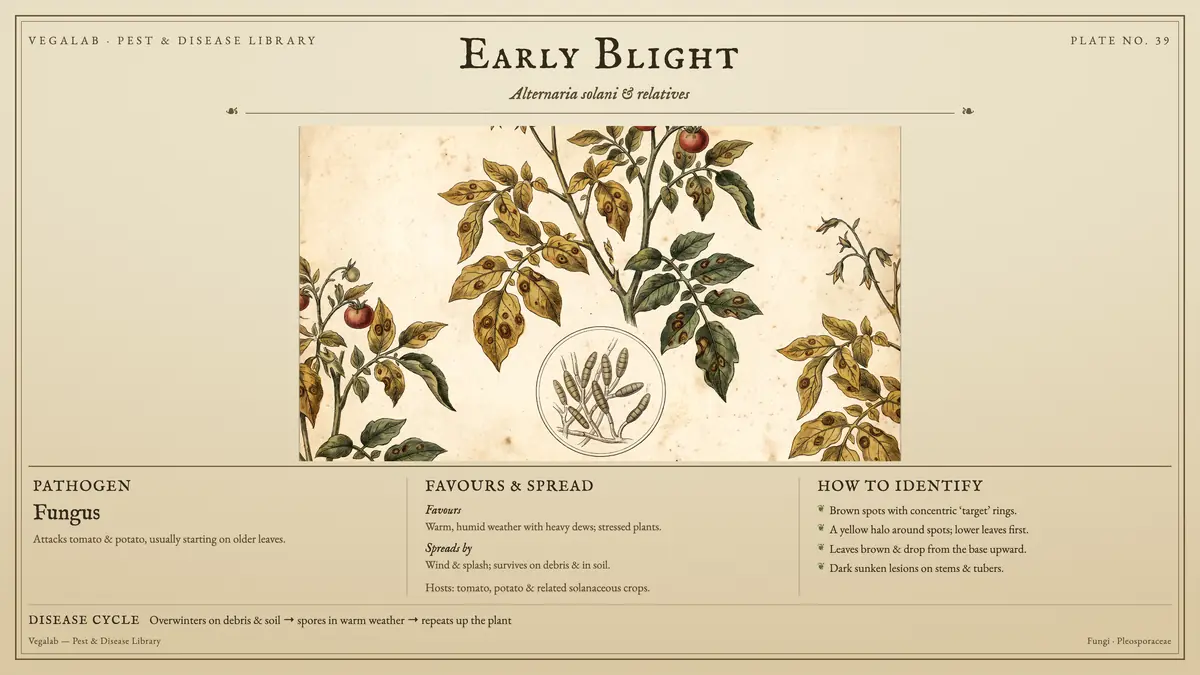
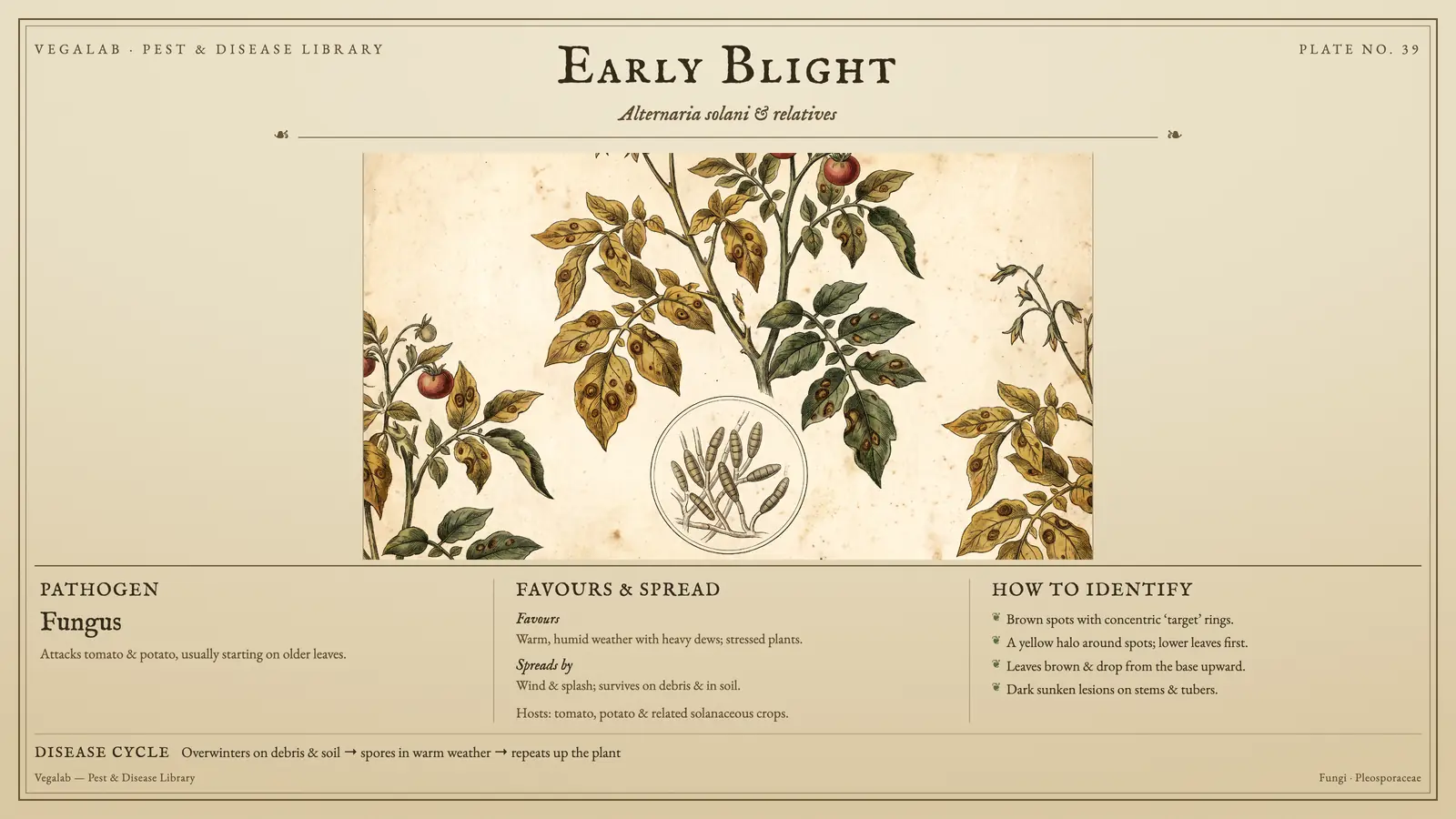
How to identify early blight
- Leaves brown & drop from the base upward.
What is it?
Early blight is caused by Alternaria fungi. It survives in soil and crop debris and spreads in warm, humid weather via splashing water and wind. It typically appears first on older, lower leaves and progresses upward, and it is favored by plant stress and crowded, wet conditions.
How to identify it
- Dark brown to black spots with concentric rings (a target-like or bullseye look)
- Yellowing around the spots, starting on the lowest, oldest leaves
- Progressive defoliation moving up the plant
- Dark, sunken lesions on stems and fruit or tubers in severe cases
Life cycle & spread
*Alternaria solani* overwinters on infected crop debris in and on the soil, on volunteer plants and solanaceous weeds, on tubers, and on seed. Because the debris is where it starts, the disease reliably appears first on the lowest leaves - the tissue closest to the inoculum.
Spores are produced on that debris and on active lesions, and are moved by wind, splashing rain, irrigation and machinery. Infection needs leaf wetness and warmth; lesions become visible in roughly five to seven days and begin producing spores of their own, so each cycle compounds.
The pathogen strongly prefers physiologically older and stressed tissue, which is the key to the whole disease. Foliage nearing senescence, plants short of nitrogen, and crops carrying a heavy fruit load are markedly more susceptible than young vigorous growth - which is why early blight so often accelerates just as the crop begins to fill fruit.
Conditions that favour it
Warm and wet, with alternating wet and dry periods: roughly 24–29 °C with leaf wetness from rain, dew or overhead irrigation. Alternating cycles favour it more than continuous wetness, because sporulation and dispersal both need a dry interval.
Crop stress is a genuine risk factor rather than a footnote. Low nitrogen, drought stress, heavy fruit load, root damage and nematode pressure all bring the disease forward. Dense canopies and overhead irrigation extend wetness; short rotations and unincorporated debris raise the starting inoculum.
Damage and how it spreads
By defoliating the plant from the bottom up, early blight reduces photosynthesis, weakens plants, and exposes fruit to sunscald and tubers to infection - cutting both yield and quality. It returns from soil and debris each season, so sanitation and protective treatment are key to keeping it in check.
Monitoring & scouting
Start on the lowest leaves as the crop approaches first fruit set - that timing and position is where early blight appears, and catching it there is worth more than any later intervention.
Confirm on the lesion: dark brown spots with **concentric rings** in a target pattern, usually with a yellow halo, on angular patches bounded by veins. Lesions also appear on stems as dark elongated cankers and on fruit at the stem end as sunken leathery patches.
Track defoliation percentage on the lower third of the plant rather than counting spots. Defoliation is what costs yield and what indicates the programme is behind.
How to control it
- Remove and destroy infected lower leaves and end-of-season debris.
- Mulch to reduce soil splash, and rotate away from tomatoes and potatoes.
- Stake and space plants for airflow; avoid overhead watering.
- Apply a protective natural fungicide at first sign and through warm, humid weather.
How to control early blight
- Keep nitrogen adequate. This is the distinctive one. A nitrogen-deficient crop senesces early and early blight follows the senescence - under-fertilised crops get hit harder and faster.
- Mulch, and remove the lowest leaves. The inoculum is at ground level and moves upward by splash; a physical barrier and the removal of the first infected tissue both interrupt that.
- Irrigate by drip, in the morning. Overhead irrigation both wets the leaf and splashes spores upward.
- Stake, prune and space for airflow so the canopy dries quickly after rain and dew.
- Rotate two to three years out of solanaceous crops, control solanaceous weeds and volunteers, and incorporate or remove debris after harvest.
- Protect through wet periods once the crop reaches fruit set, renewing after rain and after significant new growth. Applications are preventive and will not clear established lesions.
- Manage the fruit load and root health. A crop carrying a heavy load on a compromised root system is a crop losing its lower canopy to early blight.
- Use tolerant varieties where available · tolerance rather than resistance, but it meaningfully slows defoliation.
Early blight rewards attention to crop stress in a way most diseases do not. Because the pathogen favours older and weaker tissue, keeping the crop growing well is a control measure in its own right, not merely good practice.
Early blight is rarely fatal and frequently costly. The loss is progressive defoliation, which reduces fruit size, causes sunscald on exposed fruit, and shortens the productive season.
Early blight, late blight and target spot
- Early blight (Alternaria solani): dark spots with concentric rings, yellow halo, starting on the oldest lowest leaves in warm wet weather. Progresses steadily upward.
- Late blight (Phytophthora infestans): large, irregular, greasy grey-green patches, no rings, with white sporulation at the margin on the leaf underside in humid conditions. Favours cool wet weather and moves through a crop in days, not weeks. This one is an emergency.
- Target spot (Corynespora cassiicola): also concentrically ringed and easily mistaken for early blight; more common in humid tropical and protected production, and it attacks the whole canopy rather than working up from the bottom.
- Septoria leaf spot: many small spots with grey centres and black pinprick pycnidia, no concentric rings, and it rarely touches fruit.
These three are confused constantly, and the distinction changes the urgency more than anything else. Late blight can take a crop in a week; early blight erodes it over a month.
See Late Blight (Phytophthora) and Septoria Leaf Spot. Concentric rings plus bottom-up progression in warm weather is early blight.
Early blight in potato: tubers and timing
In potato the disease follows the same rules but the economics differ. Foliar defoliation cuts bulking directly, and the loss shows up as size and total yield rather than as a visible defect. Lesions on tubers are shallow, dark and sunken with a slightly raised margin, and they mostly develop from spores washed down to tubers at harvest - so lifting in dry conditions and allowing skins to set genuinely reduces storage losses.
Timing is the practical difference. Early blight pressure in potato rises sharply after tuber initiation, exactly when the canopy begins to age and the plant's resources shift to the tubers. Nitrogen management and irrigation scheduling through bulking are therefore doing double duty, and cultivars differ substantially - earlier-maturing varieties senesce sooner and are hit sooner.
Also affects tomato, aubergine and pepper. See the "Crops affected" links above.
Recommended Vegalab solution: Spore Control
Vegalab Spore Control (Thymol) protects against early blight by forming a film on the plant cuticle and inhibiting spore germination and mycelium growth. Apply as a foliar spray at first sign of disease, diluted 1:1,000 (1 mL/L), with thorough lower-canopy coverage, and maintain protection through warm, humid spells. Sanitation and mulch make the program more effective.
| Role | Product | Use |
|---|---|---|
| Primary control | Spore Control | Broad-spectrum protective fungicide |
| Companion / broader pressure | Armour Boost | Silica for tissue resilience |
By crop
See crop-specific solutions
Preventing it next season
Rotate crops, mulch, space and stake plants, remove debris, and start protective sprays before disease pressure builds in warm, humid weather. Keep plants unstressed and vigorous with balanced nutrition and Armour Boost.
Claims and product availability vary by jurisdiction. Always read and follow the product label.