

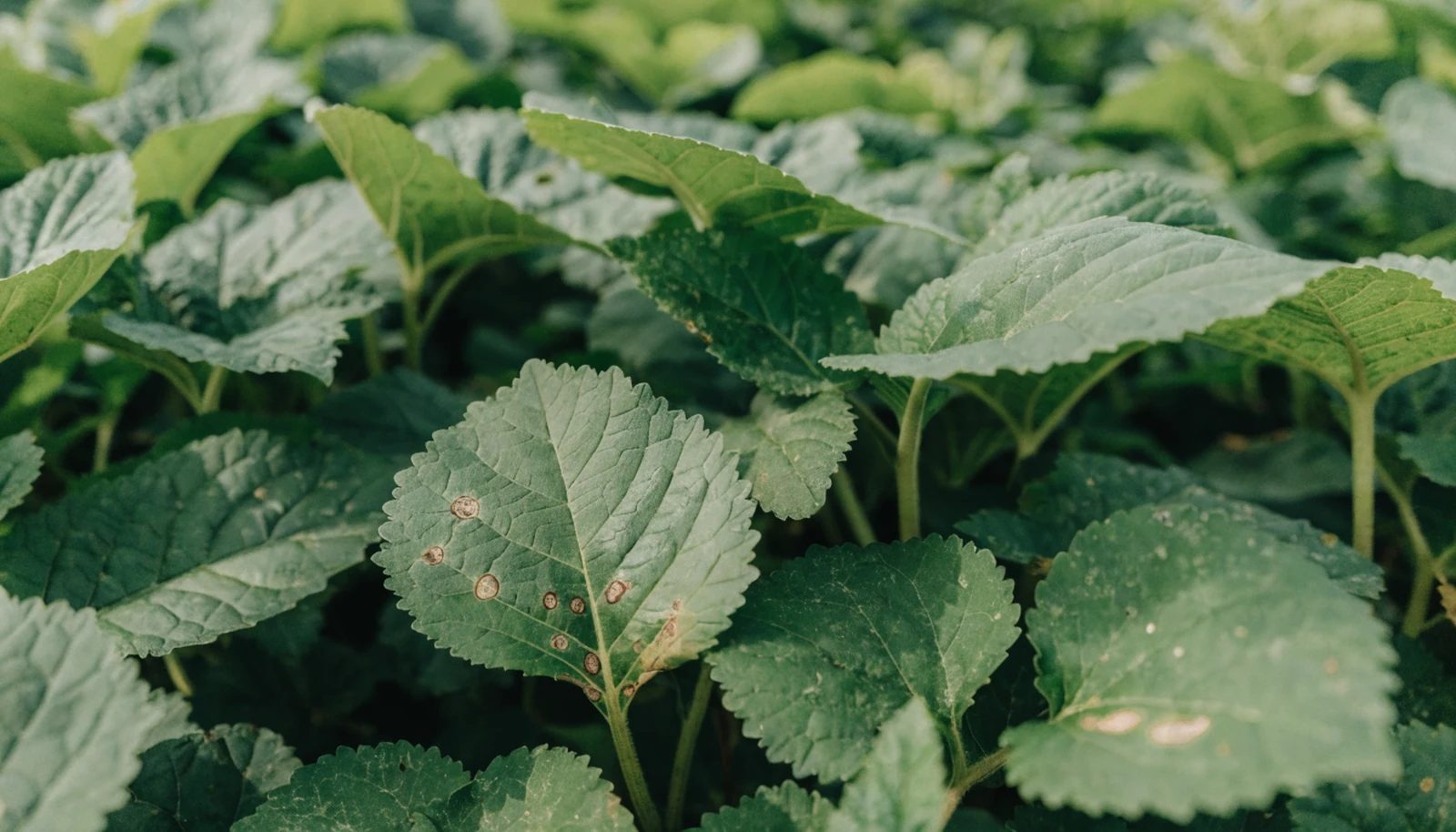
Crops affected
Downy Mildew at a glance
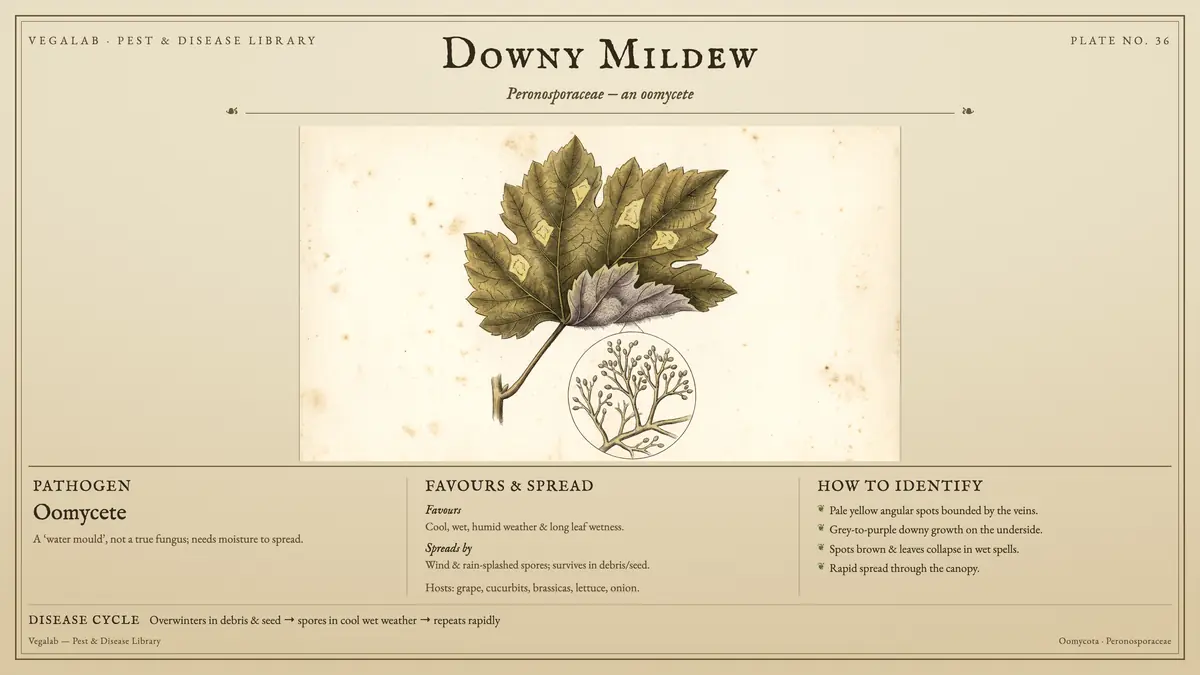
Disease cycle. Overwinters in debris & seed → spores in cool wet weather → repeats rapidly
What is downy mildew?
Despite the name, downy mildews are not true fungi - they are oomycetes (water moulds), more closely related to algae. They infect through leaf pores and grow inside the plant, then push spore-bearing structures out through the leaf underside. Because they live inside the tissue and depend on moisture, their management differs from powdery mildew.
How to identify downy mildew
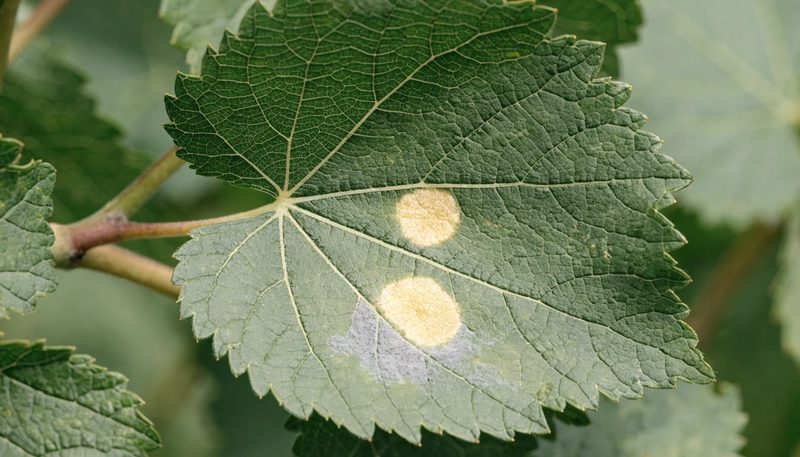
- Yellow or pale-green "oil spots" on the upper leaf surface, often bounded by veins so they look angular
- Grey, purple or white fuzzy growth on the underside - the "downy" layer, most visible in humid mornings
- Rapid browning and leaf death as spots merge; on grapes, shoots and clusters can be lost
Conditions that spread it
Downy mildew needs moisture: extended leaf wetness from rain, dew, fog or overhead irrigation, combined with mild temperatures, triggers rapid infection and sporulation. Dense, poorly ventilated canopies accelerate spread. Because it advances so quickly, preventive timing ahead of wet periods is far more effective than catching up after symptoms explode.
Controlling downy mildew naturally
Effective programs are preventive and coverage-driven: protect the canopy before rain, maintain airflow, and rotate modes of action. A rainfast, adherent, nature-derived fungicide suits this because it stays on the canopy through wet weather rather than washing off.
Life cycle & spread
Downy mildews are oomycetes - water moulds - not true fungi, which is why the products that work on powdery mildew often do nothing here. They are obligate parasites: they cannot grow without living host tissue.
Overwintering is by oospores in crop debris and soil, and in mild climates by mycelium in living hosts and volunteers. In spring, sporangia form on the underside of infected leaves and are carried by wind and splash. Given free water on the leaf they germinate within hours and enter through the stomata.
The cycle is extremely fast in favourable weather: from infection to new sporulating lesions in as little as four to seven days. That short cycle, plus wind-dispersed spores, is why downy mildew can go from a few spots to a lost canopy inside a fortnight and why protective intervals have to shorten when the weather turns.
Conditions that favour it
Free water and cool-to-mild temperatures are the requirement. Leaf wetness for several hours - rain, prolonged dew, or overhead irrigation - combined with roughly 10–25 °C and high humidity is the infection window. Unlike powdery mildew, dry conditions genuinely stop it.
Dense canopies, poor airflow, low-lying blocks and irrigating in the evening all extend leaf wetness and are the practical risk factors. Grapes have well-developed regional risk models built on exactly these variables; in vegetables, watching the dew-point and forecast is the equivalent.
Monitoring & scouting
Inspect the underside of leaves, and inspect the lower and inner canopy first - sporulation starts in the shaded, slowest-drying tissue.
The diagnostic is the pairing: an angular yellow patch on the upper surface, bounded by leaf veins, with a downy grey-purple or white fuzz directly beneath it on the underside. Angular-and-vein-limited is what separates it from most other leaf spots.
Track leaf wetness hours and dew events rather than counting lesions. By the time lesions are countable the infection that produced them is a week old, and the next cycle is already underway.
How to manage downy mildew
- Shorten the wet period. Canopy management, leaf removal in the fruit zone, wider spacing and switching from overhead to drip irrigation all directly reduce the hours of leaf wetness the pathogen needs.
- Irrigate early in the day so foliage dries before nightfall.
- Protect new growth through infection periods. Downy mildew attacks expanding tissue, and a canopy adds unprotected leaf area every few days in the growing season. Renew cover after rain and after significant growth.
- Use resistant varieties where they exist · this has moved fastest in cucurbits, basil, lettuce and grapes. Be aware that resistance-breaking races are common in this group of pathogens.
- Remove volunteers, weeds and infected debris, which carry the pathogen between crops in mild climates.
- Rotate modes of action. Oomycete-specific products are prone to resistance and several have lost effectiveness through repeated solo use.
Downy mildew is a protectant disease: you keep new tissue covered ahead of infection periods and you make the canopy a worse place to be. Nothing reverses an established lesion.
Because downy mildews are oomycetes rather than true fungi, many broad-spectrum fungicides and most powdery-mildew treatments - sulphur and bicarbonates included - have little effect. Product choice has to be oomycete-active.
Downy mildew is not powdery mildew
- Where it grows: downy mildew on the leaf underside beneath a topside yellow patch; powdery mildew on the upper surface and both sides as a surface coating
- Appearance: downy is a fine grey-purple or white fuzz; powdery is a dry white talc-like dusting
- Lesion shape: downy is angular and bounded by veins; powdery spreads as diffuse irregular patches
- Weather: downy needs free water and cool humid conditions; powdery thrives in warm dry weather with high humidity but no leaf wetness
- Organism: downy mildew is an oomycete (water mould); powdery mildew is a true fungus - which is why they need different chemistry
The two names are frequently swapped, and treating one as the other wastes the season. They differ in almost every respect that matters.
See Powdery Mildew. If it is on the underside and the patch above it is angular, it is downy.
Downy mildew by crop
- Grapevine (Plasmopara viticola) · oil-spot lesions on leaves and white sporulation on young bunches; the most economically studied form, with mature regional risk models
- Cucurbits (Pseudoperonospora cubensis) · angular vein-limited lesions; long-distance airborne spread means regional forecasting is genuinely useful
- Lettuce and leafy salad (Bremia lactucae) · highly race-specific; resistance breaks down as new races appear
- Brassicas (Hyaloperonospora) · worst on seedlings and transplants in propagation
- Basil (Peronospora belbahrii) · seed-borne and severe under protection
- Onion (Peronospora destructor) · pale elongated leaf lesions, worst in prolonged dew
The species matters for product choice and for whether a risk model exists: grapevine downy mildew has mature regional forecasting behind it, while the cucurbit and lettuce forms depend more on local dew and race monitoring. Crop-specific programmes are linked above where we have one.
Recommended Vegalab solution: Mildew Control
Vegalab Mildew Control (geraniol-based) and Spore Control are built on the nano-encapsulation platform: the capsule adheres to the canopy and resists wash-off, releasing its active on contact for rainfast protection with zero pre-harvest and zero re-entry interval. Their physical mode of action makes them practical rotation partners. Results vary by crop, region and disease pressure; claims and availability vary by jurisdiction - always read and follow the applicable product label.
| Role | Product | Use |
|---|---|---|
| Primary control | Spore Control | Broad-spectrum protective fungicide |
| Companion / broader pressure | Mildew Control | Geraniol fungicide for mildews |
| Plant support | Armour Boost | Silica for tissue resilience |
By crop
Claims and product availability vary by jurisdiction. Always read and follow the product label.