

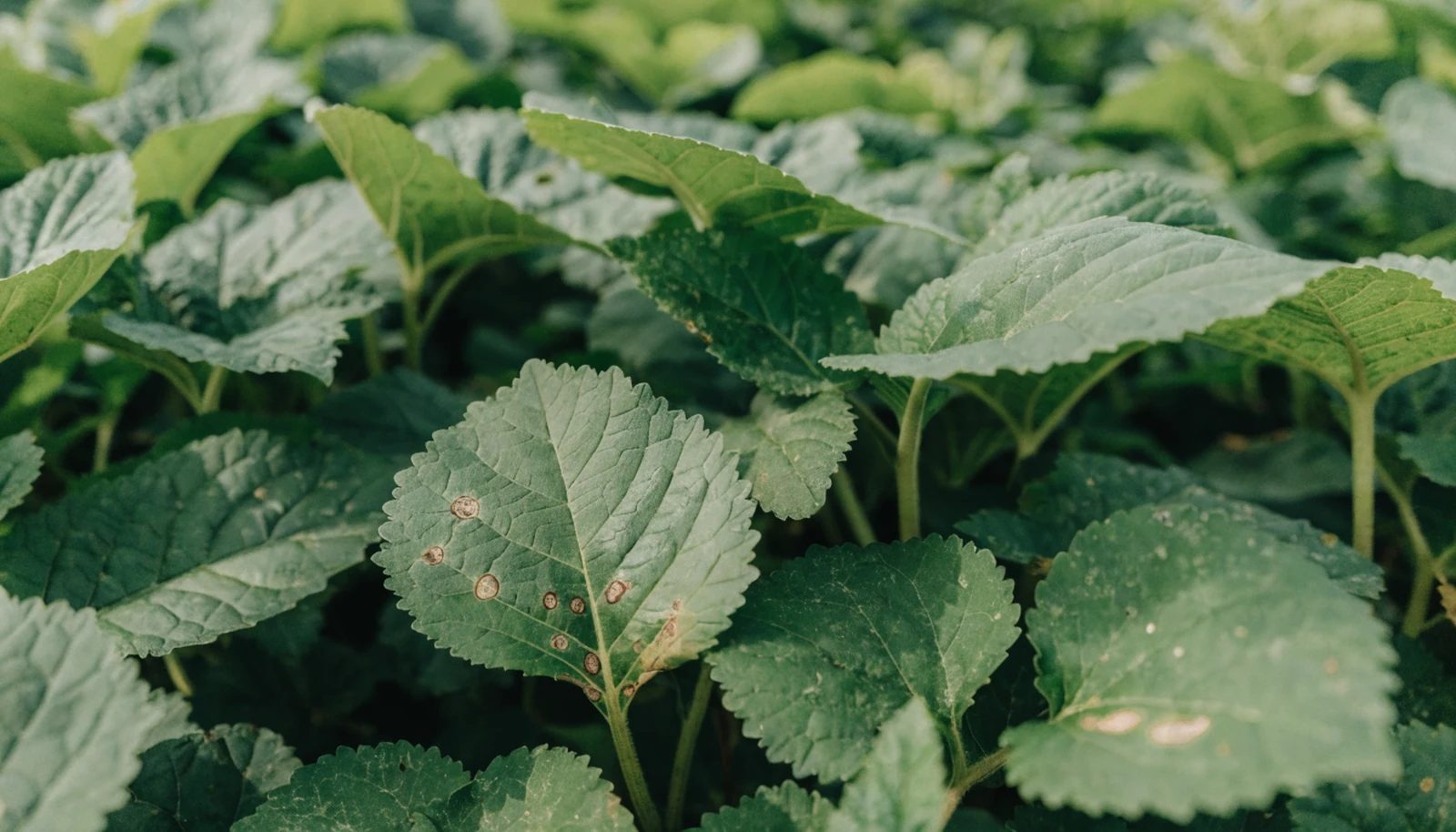
Crops affected
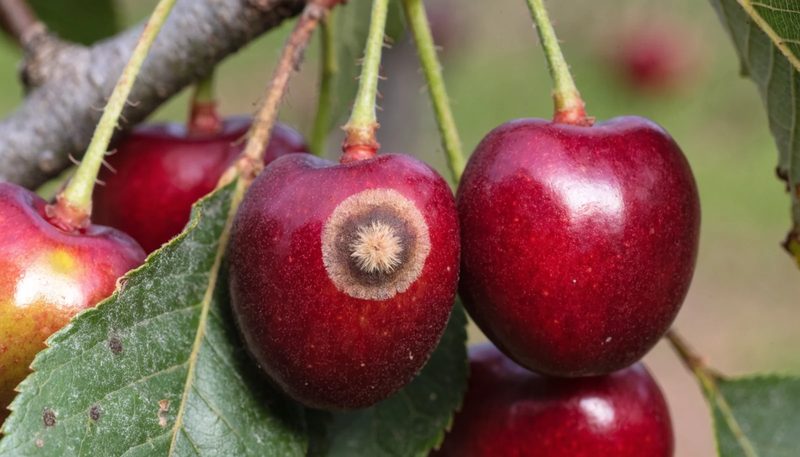
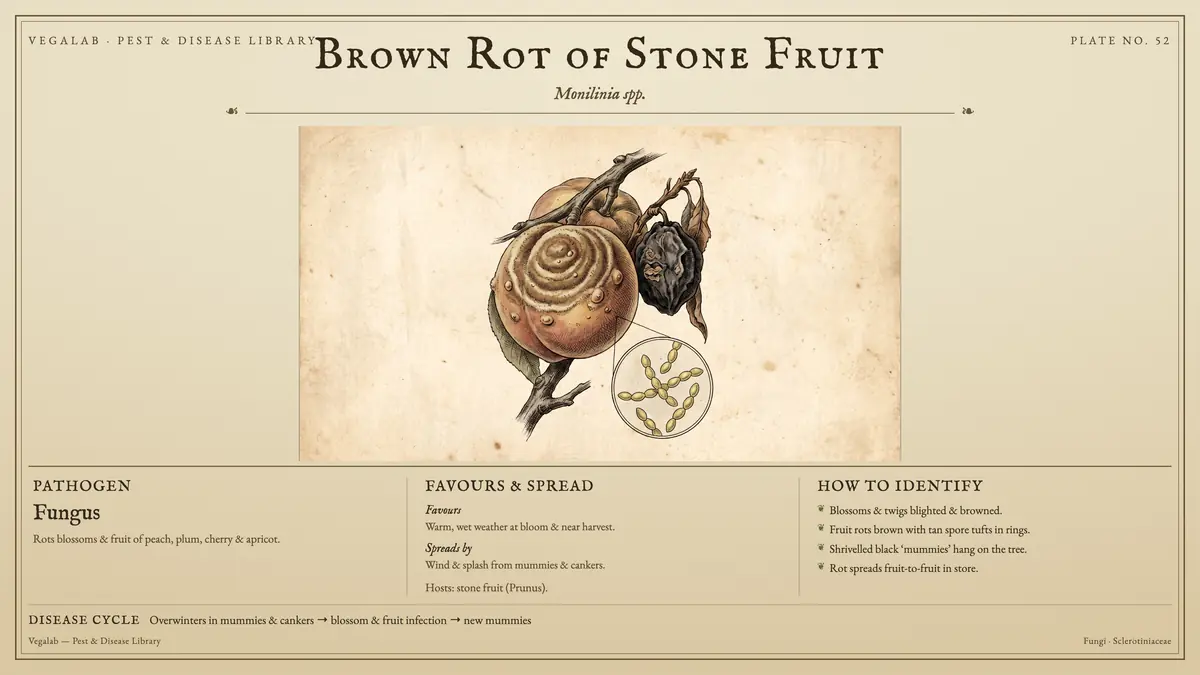
How to identify brown rot of stone fruit
- Shrivelled black ‘mummies’ hang on the tree.
What is it?
Monilinia infects blossoms (blossom blight) and ripening fruit (fruit rot), spreading fast in warm, humid conditions and surviving between seasons in mummified fruit and cankered twigs.
How to identify it
- Blossom blight: browned, collapsed flowers with grey spore masses, sometimes with gummy cankers on adjacent twigs.
- Fruit rot: firm brown spots that expand rapidly, soon covered in tan/grey spore tufts.
- Mummified fruit clinging to the tree or on the ground.
- Rapid post-harvest breakdown of infected fruit in storage and transit.
Life cycle & spread
Overwinters in mummies and twig cankers; spores infect blossoms in spring and ripening fruit later; wounds and warm wet weather accelerate fruit infection and spread.
Conditions that favour it
Warm, wet, humid weather at bloom and near harvest; fruit wounds (insects, hail, cracks); carry-over inoculum in mummies and cankers.
Damage and how it spreads
Blossom blight reduces fruit set; fruit rot destroys fruit on the tree and after harvest, often causing severe pre- and post-harvest losses.
Monitoring & scouting
Two critical windows: bloom (blossom blight) and the weeks before harvest (fruit rot). Scout in warm wet spells and protect both windows.
How to control it
- Sanitation (remove mummies and cankered wood), wound and insect management, and preventive protectant programs at bloom and pre-harvest.
How to manage brown rot
- Remove mummified fruit and infected twigs in dormancy. Mummies on the tree and on the ground are the primary inoculum for blossom blight. This is the highest-return single action and it is done when there is time to do it.
- Protect the blossom period in wet springs, since blossom blight both destroys flowers and establishes the cankers that feed the ripening-fruit phase.
- Protect the pre-harvest window. Susceptibility rises steeply as fruit ripens and sugars increase; the final weeks are when protection matters most.
- Control the insects and cracking that wound fruit. Almost every ripening-fruit infection starts at a wound - insect entry, hail injury, cracking or bird damage. See Oriental Fruit Moth and Fruit Cracking & Splitting.
- Thin fruit so they do not touch. Contact between fruit is a direct infection route and creates the clusters of rotted fruit typical of the disease.
- Prune for airflow and light so the canopy dries quickly, and avoid overhead irrigation near harvest.
- Handle gently and cool fast. Brown rot progresses rapidly at ambient temperature; rapid cooling and cold-chain maintenance are genuine control measures, and rough handling creates the wounds that let it in.
- Rotate modes of action · resistance is documented in Monilinia populations.
Monilinia has two distinct infection periods - blossom and ripening fruit - and a programme that covers only one of them leaves the door open. Most of the fruit lost to brown rot is lost in the last weeks before harvest and in the days after it.
Fruit that looks sound at picking can rot within days in transit, because infections established in the orchard progress once the fruit warms. The cold chain is part of the disease programme, not just logistics.
Blossom blight and fruit rot: one fungus, two phases
- Blossom blight: flowers turn brown, wither and cling to the spur rather than dropping cleanly; in wet weather the infection moves into the spur and shoot, producing a small canker with gum at its base
- Twig canker: the bridge between the two phases - cankers produced from blossom infections sporulate later and supply spores to ripening fruit
- Fruit rot: a small brown spot that expands rapidly, becoming soft, then producing concentric rings of tan-grey powdery spore tufts · the diagnostic sign
- Mummification: infected fruit dries and shrivels on the tree, remaining attached over winter as the primary inoculum for next spring
- Post-harvest rot: the same lesions developing in transit and storage from orchard infections
The concentric grey-tan spore tufts distinguish brown rot from most other fruit rots. See Anthracnose, whose lesions are sunken with salmon-pink sporulation, and Gray Mold (Botrytis), which is dusty grey-brown.
Why mummies matter more than anything else
If there is one action that determines brown rot pressure in a stone fruit orchard, it is what happens to the mummified fruit. Infected fruit that dries on the tree or falls to the ground carries the fungus through winter and produces enormous numbers of spores at exactly the moment blossom opens.
The arithmetic is stark: a single mummy can produce spores sufficient to infect a large number of flowers, and a block with mummies left in the canopy starts the season with inoculum immediately adjacent to the susceptible tissue. A block that has been thoroughly cleaned starts with inoculum that has to arrive from elsewhere.
This is why winter sanitation is emphasised so strongly for this disease and why it is a poor economy to skip it. Removing mummies from the canopy and either removing or burying those on the orchard floor reduces the inoculum load before any spray decision has to be made, and it reduces the number of applications that will subsequently be needed.
It is also work that can be done outside the busy season, which makes it one of the few disease measures with no competition for labour at the critical moment.
Mowing or burying fallen mummies accelerates their decomposition; leaving them on the surface under the canopy is the worst option.
The last three weeks decide the crop
- Concentrate protection in the final weeks, within pre-harvest interval constraints
- Prevent wounds in that window · insects, birds, cracking, rough handling
- Pick dry and handle into rigid trays to limit bruising
- Cool immediately and hold cold, since the fungus advances at ambient temperature
- Cull visibly affected fruit before packing · one rotting fruit infects its neighbours in a box
Brown rot risk is not evenly distributed through the season. Susceptibility of stone fruit to Monilinia rises steeply as the fruit ripens, and the great majority of fruit rot originates in the final two to three weeks before harvest and in the days immediately after it.
The reason is physiological. Ripening fruit accumulates sugars, softens, and loses the natural resistance of immature tissue; its skin also becomes more prone to micro-cracking. At the same time, any wound - insect entry, hail, bird peck, cracking from rain, or handling damage - becomes an open route into a sugar-rich medium. A spore that lands on a green fruit in June may do nothing; the same spore on a ripening fruit in August establishes quickly.
This concentrates the practical programme. Inoculum reduction happens in winter, blossom protection happens in spring, but the protection that saves marketable fruit happens in that final window - and it has to be balanced against pre-harvest intervals, which is the real constraint growers work within.
It also explains why brown rot appears after harvest on fruit that looked clean. Infections established in the orchard in those last weeks are latent at picking and progress once the fruit warms in transit, which is why rapid cooling and an unbroken cold chain function as disease control rather than merely as logistics.
A brown rot problem that shows up in the packhouse or at the customer is nearly always an orchard problem from the last three weeks, not a handling failure.
Recommended Vegalab solution: Spore Control
Spore Control · natural broad-spectrum fungicide (thymol) applied preventively at bloom and in the pre-harvest ripening window, with thorough coverage; combine with mummy/canker sanitation.
| Role | Product | Use |
|---|---|---|
| Primary control | Spore Control |
Preventing it next season
Remove mummies and cankers, manage fruit-wounding pests and cracking, ensure airflow, and apply preventively at the two key windows.
Claims and product availability vary by jurisdiction. Always read and follow the product label.