The Pill That Has to Survive the Trip
An oral vaccine is a delivery problem before it is anything else.



Many respiratory and gut pathogens enter at a mucosal surface: the nose, the throat, the intestine. Most vaccines still arrive through the arm. A vaccine given at the surface where infection starts can engage the immune tissue that guards that surface, and in some formats it also removes the needle, the clinic visit and the refrigerator. This section looks at those routes from a formulator's point of view: what each one asks of a product, and which of those demands a layered capsule can answer.
An injected vaccine reaches lymph nodes and blood well and produces strong circulating antibody, which is why it remains the backbone of immunization. It is generally less effective at raising secretory IgA and resident memory cells on the mucosal surfaces themselves. Mucosal routes aim at those surfaces directly. Several are already licensed: oral polio, rotavirus, cholera and typhoid vaccines, and a nasal spray influenza vaccine that the FDA cleared for self or caregiver administration in 2024.
Oral tablets and capsules travel the longest road, from the stomach to release in the small intestine. Intranasal sprays reach nasal lymphoid tissue quickly but work against mucus that clears within minutes. Sublingual and buccal films sit on thin tissue for a short, controlled contact time. Microneedle patches are the needle-free route through the skin; a measles and rubella patch has shown responses in infants comparable to injection in a phase 1/2 trial. Each route has a different obstacle, which is why one carrier design rarely fits all four.
The antigen or vector inside a mucosal vaccine is often the same payload that works by injection. The difference is the journey. A tablet has to hold up to warehouse heat, then release on schedule in the right segment of the intestine. A nasal dose has to stay in place long enough to be sampled. A patch has to keep its payload stable in a dry state. These are delivery questions before they are immunology questions, and delivery is what our platform was built for. There is also a question of who the product is for. A vaccine that needs no needle and no refrigerator is worth most to health ministries and global procurement programs working in hot climates over long supply routes, and those buyers reach a product through WHO prequalification rather than a pharmacy shelf.
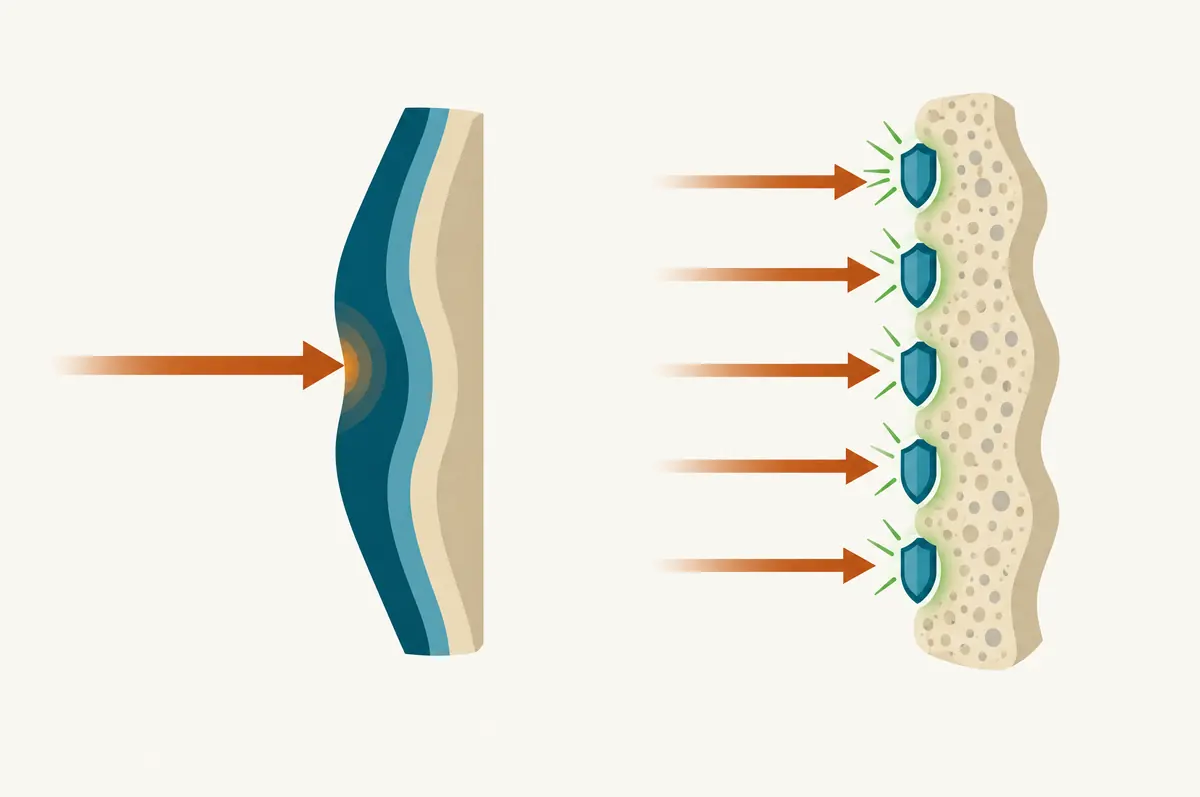
Our encapsulation builds up to 20 biopolymer layers around a core, and each layer can be chosen for a different job. In a vaccine context we think of them as checkpoints: an outer moisture and heat barrier for storage, an enteric layer that stays closed in acid and opens at intestinal pH, a mucoadhesive layer that slows clearance, and an inner sugar glass matrix that holds proteins still while dry. Each stack is designed for a partner's antigen, vector and route, and developed with the vaccine developer under its regulatory pathway.
Oral vaccination is not new in animal health. Wildlife rabies programs in North America and Europe have distributed oral vaccine baits for decades, and fish and poultry vaccines are routinely given in water or feed. The same checkpoints apply: heat in the field, acid and enzymes in the gut, and a dose that has to arrive intact. That is where our Life Sciences and Biosecurity work overlap.
Vegalab brings formulation engineering to vaccine developers: layered shells tuned for heat, acid, enzymes, mucus and release timing, produced under GMP in Korea. Programs start with a feasibility study on stability and targeted release, measured in the developer's own assays, and scale into GMP supply.
Vegalab develops delivery technology for vaccine developers. Our multi-layer encapsulation is built around the antigen or vector, the route and the storage conditions a vaccine needs, from heat and moisture protection on the shelf to timed release in the intestine or residence at a mucosal surface. The vaccine itself is developed and licensed by the vaccine developer.
Oral tablets and capsules, nasal and sublingual formats, and dry formats for thermostable storage. Each uses the same layered architecture with a stack designed for that route.
With a confidential feasibility study on stability and release, on a surrogate payload first and then on the developer's own, measured in the developer's assays.
An oral vaccine is a delivery problem before it is anything else.
The nose and the floor of the mouth are attractive targets: thin tissue, dense immune presence, no needle.
A vaccine that needs two to eight degrees from factory to arm carries a refrigerator with it everywhere it goes.
Last updated: