

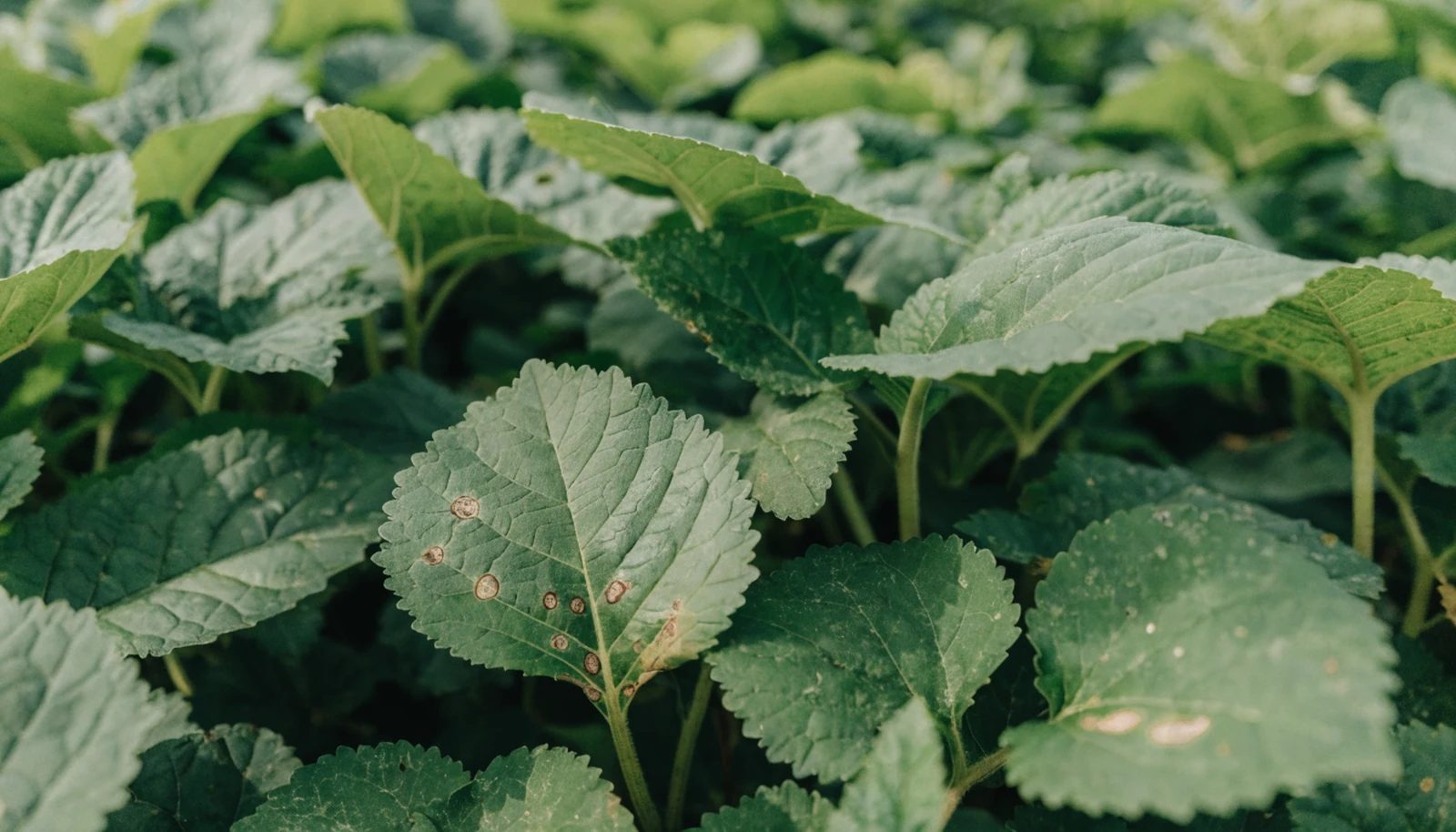
Crops affected
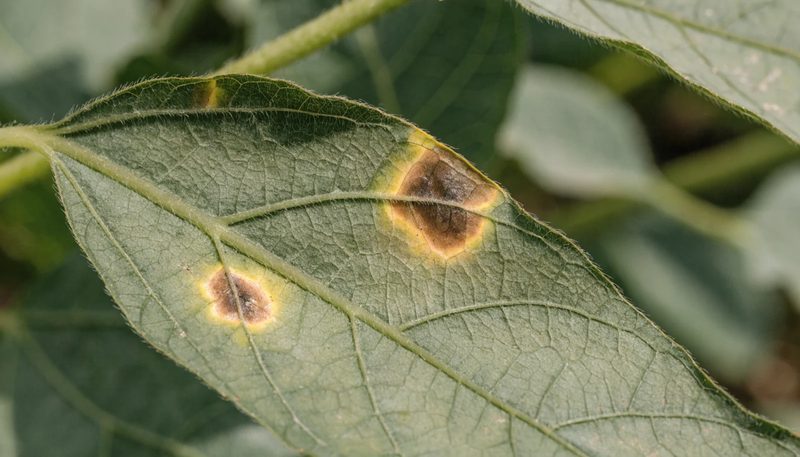
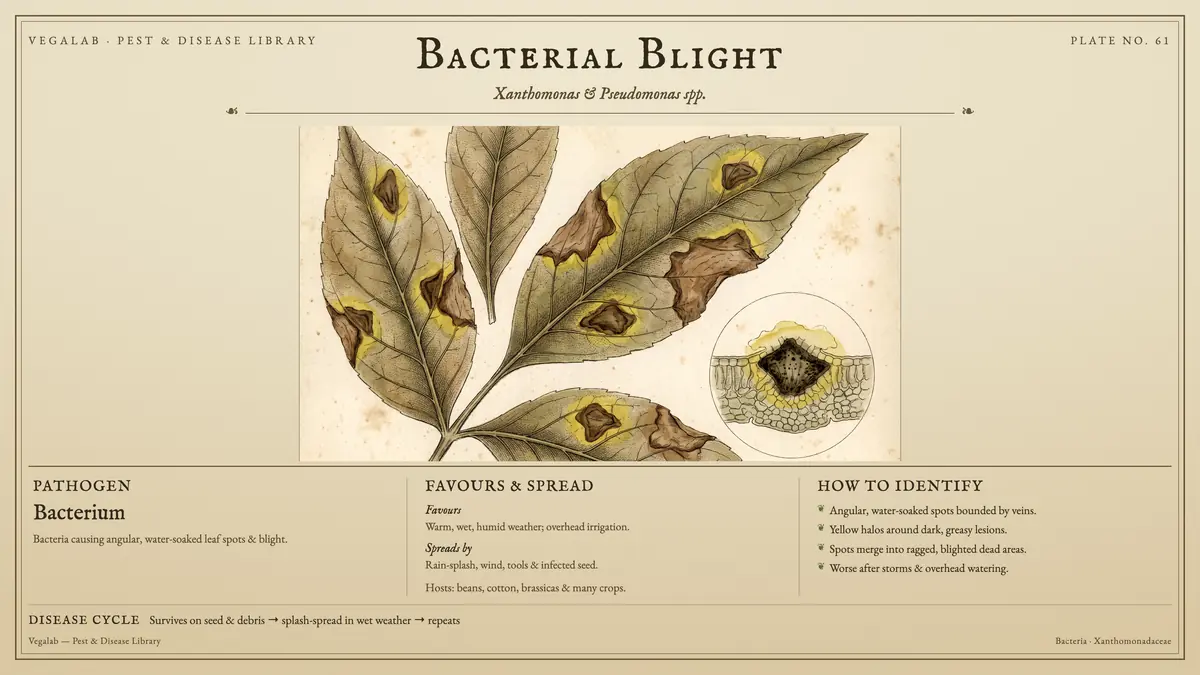
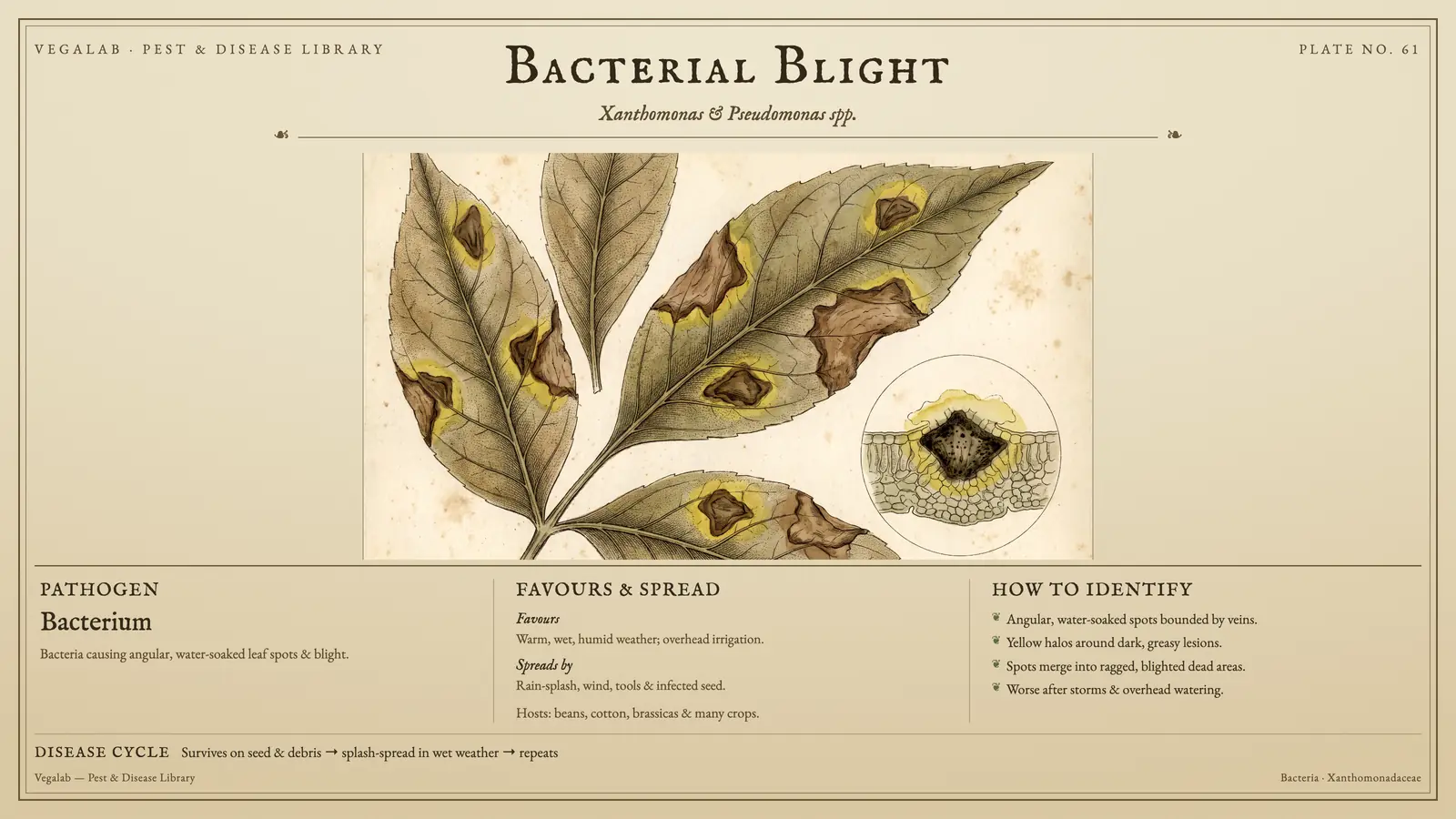
How to identify bacterial blight
- Yellow halos around dark, greasy lesions.
- Spots merge into ragged, blighted dead areas.
- Worse after storms & overhead watering.
What is it?
Bacterial blights are caused by bacteria such as Pseudomonas and Xanthomonas species. They enter leaves through natural openings and wounds and spread in splashing water, on tools, and via infected seed. Warm, wet, windy conditions favor rapid spread, and the bacteria can survive in debris and seed between seasons.
How to identify it
- Small water-soaked spots that turn brown and often become angular (bounded by veins)
- Yellow halos around the spots
- Spots that merge into blighted, dead patches in wet weather
- Streaking on stems and infected, discolored seed in some crops
Life cycle & spread
Bacterial blights are caused by *Pseudomonas* and *Xanthomonas* species, which survive on plant surfaces as epiphytes, in buds and cankers, on crop debris, and on and in seed. Many can live harmlessly on a leaf surface for weeks before conditions allow infection - which is why disease can appear suddenly on a crop that was symptomless.
Entry is through natural openings - stomata, lenticels, leaf scars - and through wounds. Free water is essential: the bacteria swim and are splashed, and they need a water film to enter. Frost injury, hail, wind-driven sand and pruning cuts all dramatically increase infection.
Once inside, they multiply in the intercellular spaces, killing tissue and producing the water-soaked lesions and, in woody hosts, cankers and dieback. Populations then build on the surface again in wet weather, ready for the next infection event.
Conditions that favour it
Cool wet weather is the classic requirement for the *Pseudomonas* blights and cankers, particularly in spring, and warm wet weather for many *Xanthomonas* blights. In both cases the essential element is **free water plus a wound or natural opening**.
Frost events are a major risk factor - frost injury creates entry wounds and *Pseudomonas syringae* can itself promote ice nucleation. Hail, sandblasting in exposed fields, and pruning in wet weather are the other main triggers. High nitrogen and soft growth increase susceptibility.
Damage and how it spreads
Bacterial blight reduces photosynthesis, blights foliage and pods, and downgrades or destroys yield, with seed-borne strains carrying the disease into the next crop. Because it spreads readily in wet, windy weather and survives in debris and seed, prevention and sanitation are essential - there is no cure for infected tissue.
Monitoring & scouting
Inspect after weather events rather than on a calendar: after frost, hail, wind-driven rain or storm damage is when infection has occurred and when the earliest lesions appear.
Look for angular water-soaked lesions with yellow halos on leaves, and on woody hosts for sunken cankers with amber gum or ooze at the margin in wet weather.
Note the association with wounds and with the windward side of a block, which is often the clearest evidence that a problem is bacterial rather than fungal.
How to control it
- Use clean, certified disease-free seed and resistant varieties where available.
- Avoid working plants when wet, and don't overhead-water.
- Rotate crops and remove and destroy infected debris.
- Protect plants during warm, wet, high-risk weather as part of an integrated program.
How to manage bacterial blight
- Use certified clean seed and propagation material. Many bacterial blights are seed-borne, and this is the single most important measure.
- Prune only in dry weather, and disinfect tools between trees or blocks. Every cut made in wet conditions is a potential infection site.
- Protect against frost and reduce frost injury, since frost wounds are a primary entry route for the Pseudomonas blights and cankers.
- Establish windbreaks in exposed fields · wind-driven sand abrades leaves and creates thousands of entry points, and windbreaks measurably reduce bacterial disease.
- Avoid overhead irrigation, and never irrigate into a period when the crop will stay wet overnight.
- Do not work wet foliage. Hands, machinery and clothing spread bacteria efficiently in a water film.
- Remove and destroy cankered wood and infected debris, cutting well beyond the visible margin on woody hosts.
- Moderate nitrogen so growth is not excessively soft, and maintain balanced nutrition.
- Use resistant varieties where available, and expect race specificity.
The measures that work against bacterial diseases are almost entirely about denying entry: clean material, avoided wounds, and no free water at the moment the bacteria are present. Curative options do not exist in any practical sense.
Copper products are protective and their usefulness is limited by widespread copper resistance and by the fact that they cannot reach bacteria already inside tissue. Treat them as one component of prevention, not as a treatment.
Why wounds matter so much more than for fungal disease
Many fungi can penetrate an intact plant surface directly - they produce structures that force entry through the cuticle. Most plant-pathogenic bacteria cannot. They rely on natural openings such as stomata and lenticels, or on wounds, and they need a film of water to move through.
That dependence is the single most useful thing to know about managing bacterial disease, because it converts an apparently uncontrollable problem into a list of avoidable events. Frost cracks, hail bruising, wind-driven sand abrasion, insect feeding punctures, pruning cuts, harvest scars, and machinery damage are not incidental to bacterial disease - they are the mechanism.
It also explains the pattern growers observe: bacterial blight appearing suddenly and severely after a specific weather event, on the windward side of a block, or along a row that was worked while wet. Those are not coincidences; they are the infection events.
The practical consequence is that a great deal of bacterial disease management happens in decisions that are not obviously about disease at all - when to prune, whether to plant a windbreak, how to schedule irrigation, whether to send a crew into a wet block, and how carefully to handle the crop.
See Fire Blight, where trauma infection after hail is a recognised phase of the disease, and Bacterial Shot Hole.
The main bacterial blights by crop
- Bacterial canker of stone fruit (P. syringae): cankers with amber gum, dieback, and blossom and leaf blight; worst after cold wet springs and frost
- Bacterial blight of beans (Xanthomonas, Pseudomonas): water-soaked lesions with yellow margins, seed-borne, worst in warm wet weather
- Halo blight of beans (P. syringae pv. phaseolicola): small lesions with distinctive wide pale-green halos, favoured by cool conditions
- Walnut blight (Xanthomonas arboricola pv. juglandis): black lesions on catkins, leaves and nuts; severe in wet springs
- Bacterial blight of rice (X. oryzae): leaf blight and kraesek wilting; a major constraint in Asian rice
- Bacterial leaf blight of onion and allium: water-soaked streaks progressing to collapse
Where a bacterial disease is regulated or notifiable in your jurisdiction - as several are - reporting obligations apply. Check before treating it as a routine problem.
Recommended Vegalab solution: Spore Control
Vegalab Spore Control (Thymol) forms a protective film on plant surfaces and can support an integrated bacterial blight program, while the foundation of control is clean seed, rotation, sanitation, and avoiding leaf wetness. Bacterial diseases cannot be cured once tissue is infected, so emphasize prevention and protect during wet, high-risk periods.
| Role | Product | Use |
|---|---|---|
| Primary control | Spore Control | Broad-spectrum protective fungicide |
| Companion / broader pressure | Armour Boost | Silica for tissue resilience |
By crop
See crop-specific solutions
Preventing it next season
Start with clean seed and resistant varieties, rotate, avoid working wet plants, don't overhead-water, and remove infected debris. Firm, resilient tissue helps - support it with Armour Boost.
Claims and product availability vary by jurisdiction. Always read and follow the product label.