

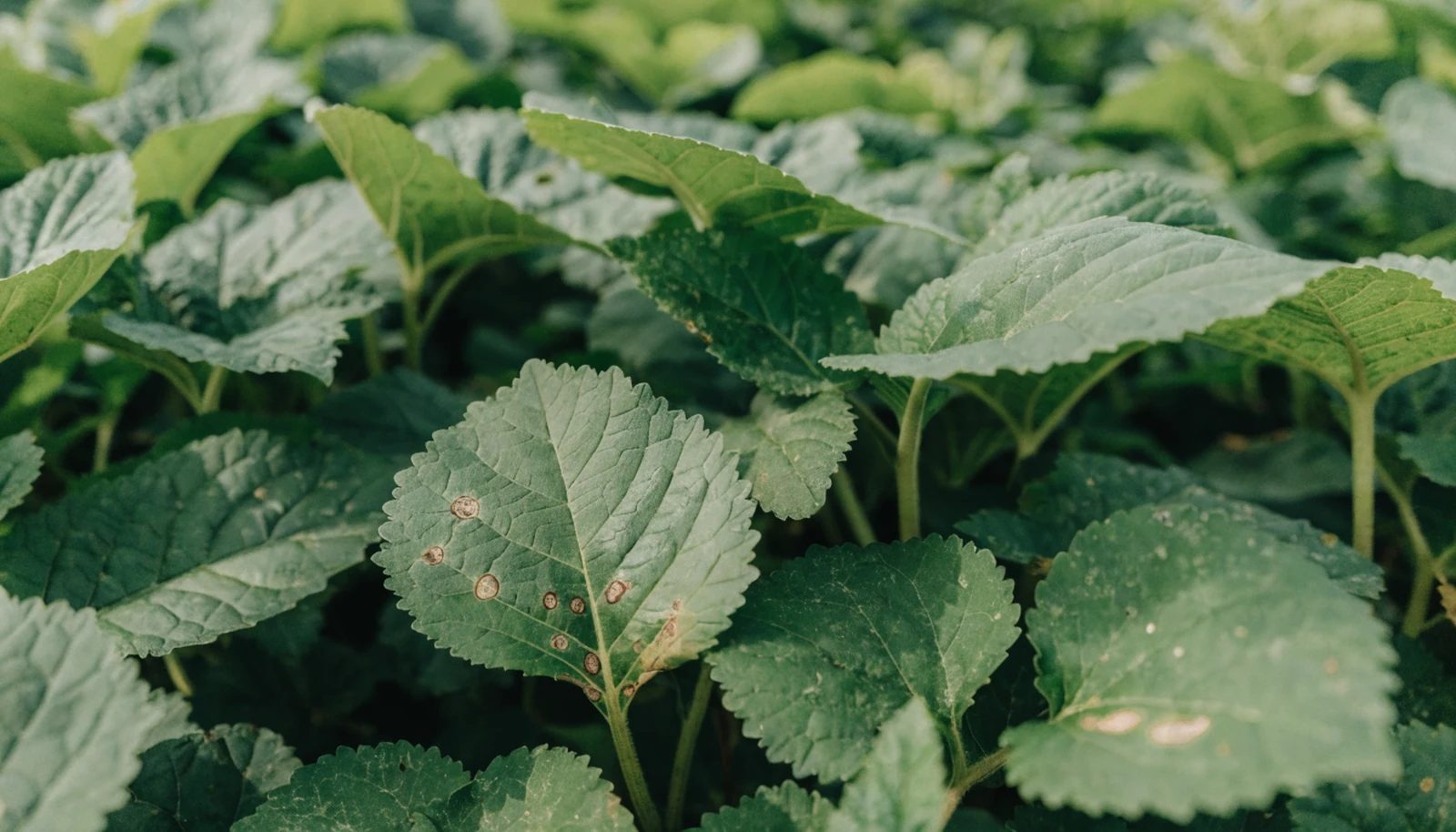
Crops affected
Black Sigatoka at a glance
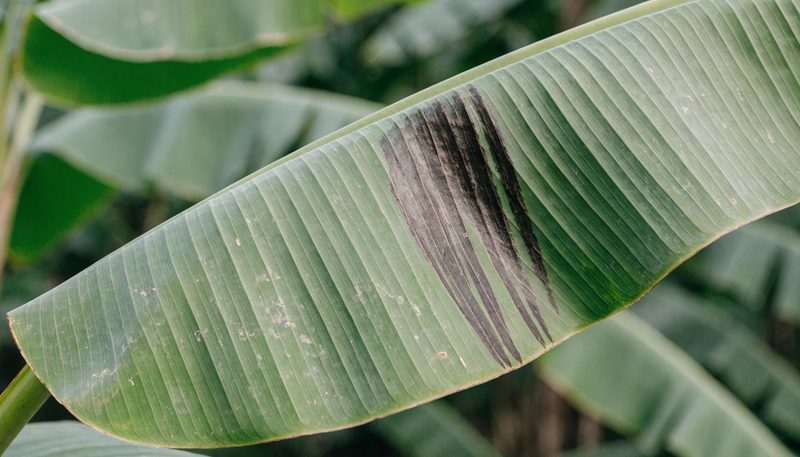
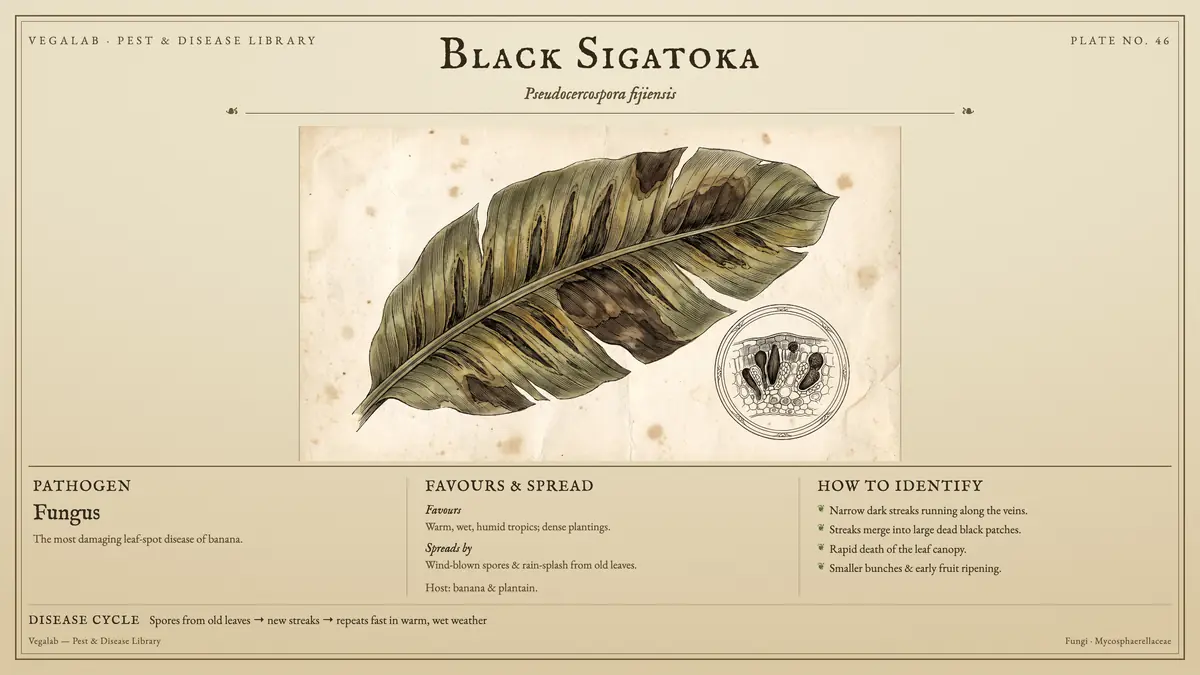
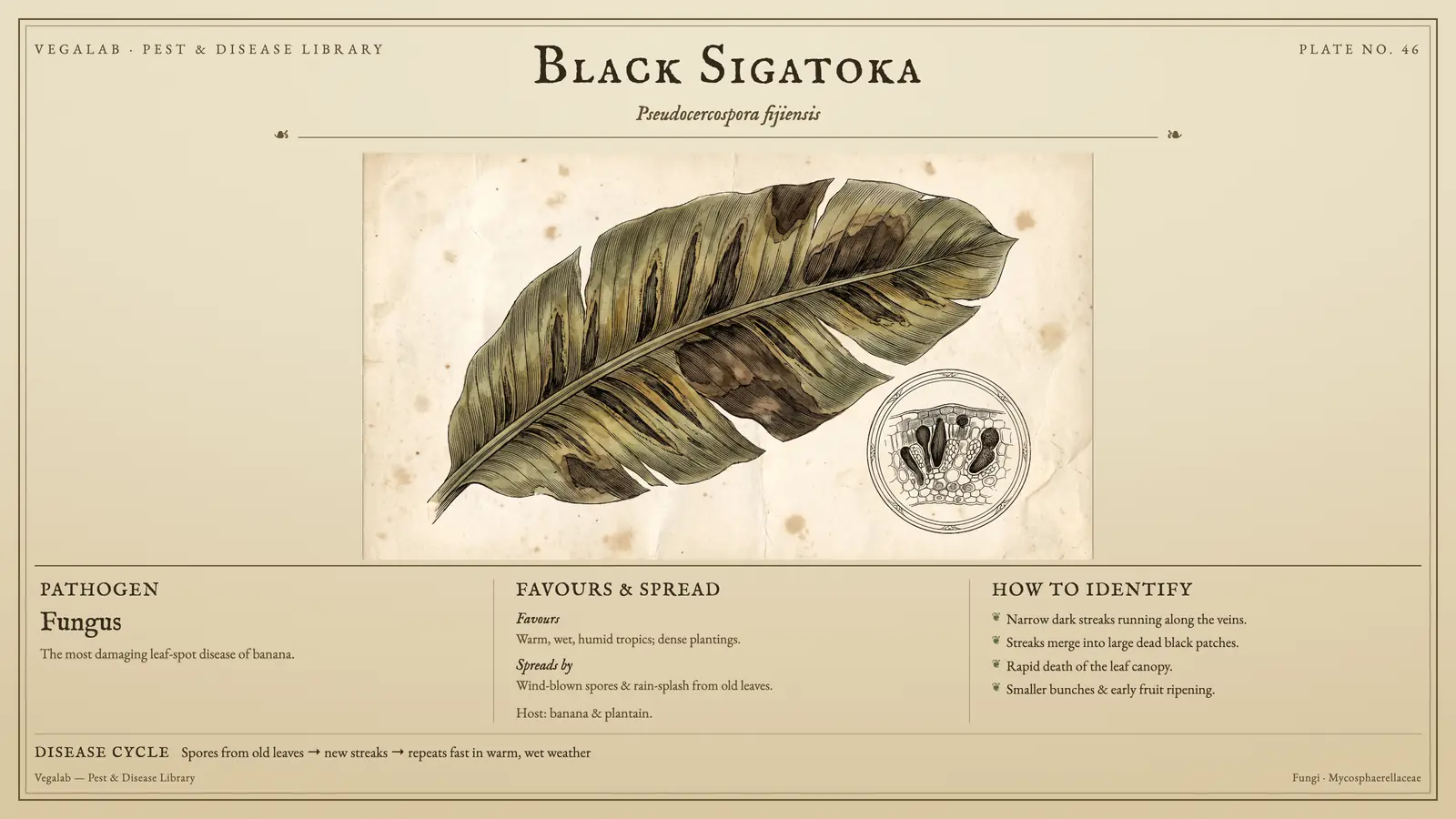
- Narrow dark streaks running along the veins.
- Streaks merge into large dead black patches.
What is Black Sigatoka?
Black Sigatoka is a fungal leaf-spot disease of banana. Spores spread by wind and water, germinate on wet leaves, and infect through the underside. The disease progresses through streaks to spots that merge and kill large areas of leaf, working up from older leaves. Loss of functional leaf area at bunch filling directly reduces yield and fruit quality.
How to identify Black Sigatoka
- Early: tiny reddish-brown specks and streaks on the underside of younger leaves
- Progressing: streaks lengthen into dark brown-to-black spots, often with a yellow halo
- Advanced: spots merge, killing large sections of leaf; heavy infections leave few functional leaves at harvest
Because early symptoms appear on the youngest leaves and undersides, regular scouting of the upper canopy is essential for timing.
Why it is so difficult
Black Sigatoka produces abundant spores, spreads quickly in warm, wet, humid banana-growing regions, and has repeatedly developed resistance to single-site systemic fungicides. Sustainable programs therefore combine cultural practice (deleafing infected tissue, drainage, canopy management) with protectant coverage and strict rotation of modes of action.
Life cycle & spread
*Pseudocercospora fijiensis* (formerly *Mycosphaerella fijiensis*) produces two kinds of spore, and the difference explains why the disease is so hard to contain. **Conidia** are produced in humid conditions and spread short distances by water splash, driving spread within a plantation. **Ascospores** are produced in wet weather from sexual fruiting bodies and are carried by wind over long distances, driving spread between plantations and regions.
Spores germinate on the leaf surface with free water present and enter through the stomata on the underside. The fungus then colonises leaf tissue, producing the progression of streaks and spots that culminates in large necrotic areas with grey centres and yellow halos.
The cycle from infection to sporulation takes several weeks, and infection targets the youngest unfurling leaves - which is why leaf emergence rate relative to disease progress determines whether a plant keeps enough functional canopy to fill a bunch.
Conditions that favour it
Warm, wet and humid: the disease is most severe in tropical lowland banana production with high rainfall, high humidity and temperatures around 25–28 °C. Extended leaf wetness and heavy dew drive infection.
Dense plantings, poor drainage, inadequate deleafing, weedy plantations and low nutrition all worsen it. Because ascospores travel long distances, regional disease pressure matters as much as farm hygiene.
Monitoring & scouting
Assess disease severity systematically using the youngest leaf with symptoms and a standardised severity index - banana disease management is unusually quantitative and forecasting systems depend on consistent scoring.
Inspect the youngest leaves for the earliest stage: tiny pale flecks and thin reddish-brown streaks running parallel to the veins on the **underside** of the leaf.
Track the number of functional leaves per plant at flowering and at harvest. That count, more than lesion counts, predicts bunch weight and fruit quality.
How to manage black sigatoka
- Deleaf systematically. Removing and destroying affected leaves and leaf sections reduces the inoculum load in the plantation and is the foundation of every successful programme. Timing and thoroughness matter more than the total number of leaves removed.
- Maintain drainage and reduce humidity. Adequate spacing, drainage channels, weed control and avoiding over-dense plantings all shorten the wet period the pathogen needs.
- Protect the youngest leaves. New leaves are the susceptible tissue and the ones that will fill the bunch; a programme that protects mature leaves and misses emerging ones fails.
- Use forecasting systems based on rainfall, humidity and disease severity scoring to time applications, rather than fixed calendars.
- Rotate modes of action rigorously. Resistance to several fungicide groups is widespread and well documented in this pathogen, and in some regions has removed whole product classes from use.
- Maintain nutrition, particularly potassium and nitrogen balance, so plants produce leaves fast enough to stay ahead of the disease.
- Consider resistant cultivars where the market allows · resistant hybrids exist, but Cavendish dominates export markets and is highly susceptible, which is the central commercial constraint.
- Coordinate regionally where possible, since ascospores cross farm boundaries.
Black sigatoka is the most economically damaging disease of banana worldwide and the single largest recurring cost in export production. Management is a continuous programme rather than a response, and it combines canopy hygiene with protection of new leaves.
The economic reality of this disease is that it is managed, never eliminated, and in high-pressure regions fungicide programmes can represent a substantial share of production cost. Cultural measures reduce that cost rather than replacing it.
Black sigatoka or yellow sigatoka?
- Black sigatoka (Pseudocercospora fijiensis): streaks and spots visible earliest on the leaf underside; lesions darker; more aggressive, kills leaf tissue faster and at younger leaf stages; has largely displaced yellow sigatoka wherever it has arrived
- Yellow sigatoka (Pseudocercospora musae): symptoms appear first on the upper surface; pale yellow-green streaks; slower and less destructive; more common in cooler and drier banana areas
- Practical consequence: where black sigatoka is present it sets the programme, since it requires more intensive management. Correct identification matters mainly for regions where black sigatoka is not yet established and its arrival would be a reportable event.
- Also distinguish from: cordana leaf spot (large oval lesions with concentric zones), banana freckle (small raised dark specks that feel rough), and sunburn or wind damage (distributed by exposure rather than by leaf age)
The underside-first appearance and the speed of progression separate black from yellow sigatoka in the field.
Why functional leaf count is the number that matters
Banana disease management is unusually focused on a single metric, and it is worth understanding why. A banana plant fills its bunch from the photosynthate produced by its functional leaves, and there is a fairly direct relationship between the number of healthy leaves retained at flowering and through bunch filling and the eventual bunch weight and fruit quality.
Black sigatoka attacks the youngest leaves as they unfurl, so the disease is effectively in a race with the plant's leaf emergence rate. If new leaves emerge faster than the disease destroys them, the plant maintains its canopy and fills the bunch. If the disease wins that race, functional leaf number falls, bunch weight drops, and - commercially just as important - fruit maturation becomes uneven and premature ripening in transit increases, which causes rejection of export consignments.
This is why programmes are evaluated on functional leaf count at flowering and harvest rather than on lesion counts, and why nutrition matters as a disease measure: a well-fed plant produces leaves faster and stays in the race longer.
It also explains why the disease costs money even when the plantation looks acceptable. A plantation with a moderate reduction in functional leaves shows no dramatic symptom but delivers lighter bunches and more transit losses.
See Poor Fruit Color & Low Brix for the quality consequences of reduced canopy, which apply across fruit crops.
Recommended Vegalab solution: Spore Control
Vegalab Spore Control is a natural broad-spectrum fungicide built on the nano-encapsulation platform, targeting spore germination and early infection to prevent establishment. The capsule adheres to the leaf and resists wash-off, then releases its active on contact - providing rainfast, adherent protection suited to wet tropical conditions, with zero pre-harvest and zero re-entry interval. Because its mode of action is physical rather than a single biochemical site, it is a practical rotation partner in resistance-management programs. Results vary by region, pressure and program; registrations, claims and availability vary by jurisdiction - always read and follow the applicable product label.
| Role | Product | Use |
|---|---|---|
| Primary control | Spore Control | Broad-spectrum protective fungicide |
| Companion / broader pressure | Armour Boost | Silica for tissue resilience |
Claims and product availability vary by jurisdiction. Always read and follow the product label.