

Crops affected
What is it?
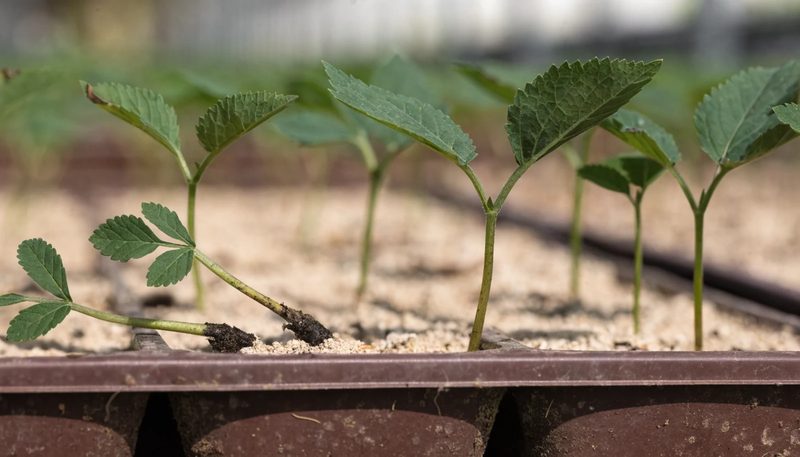
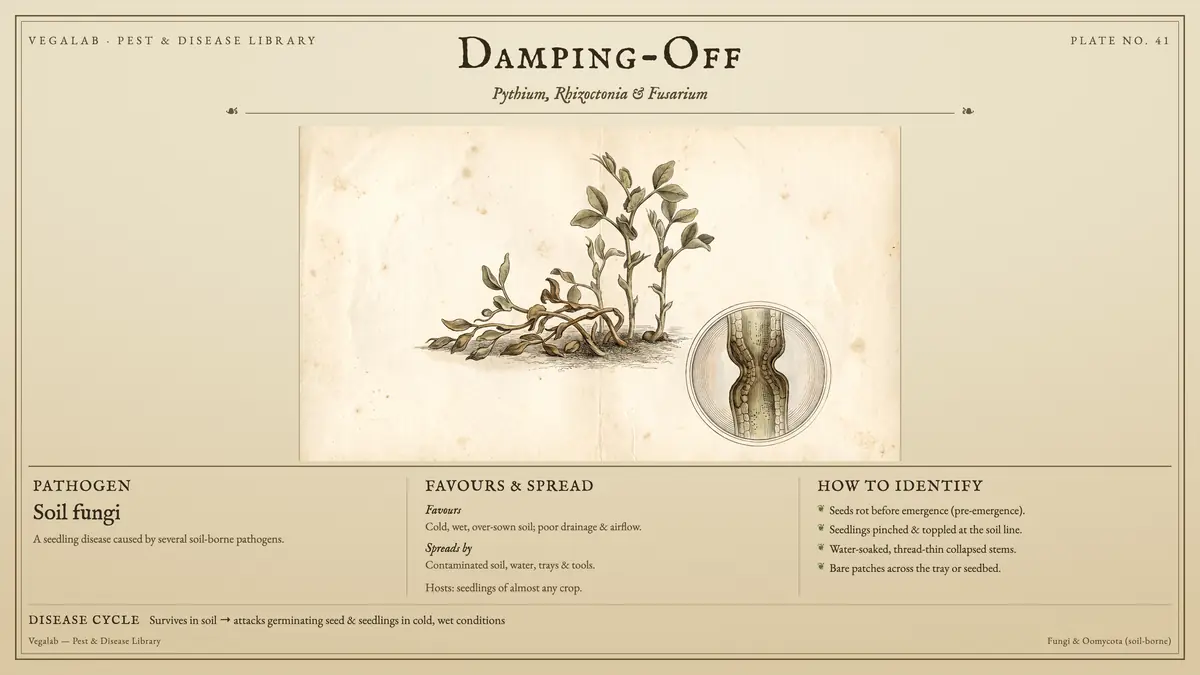
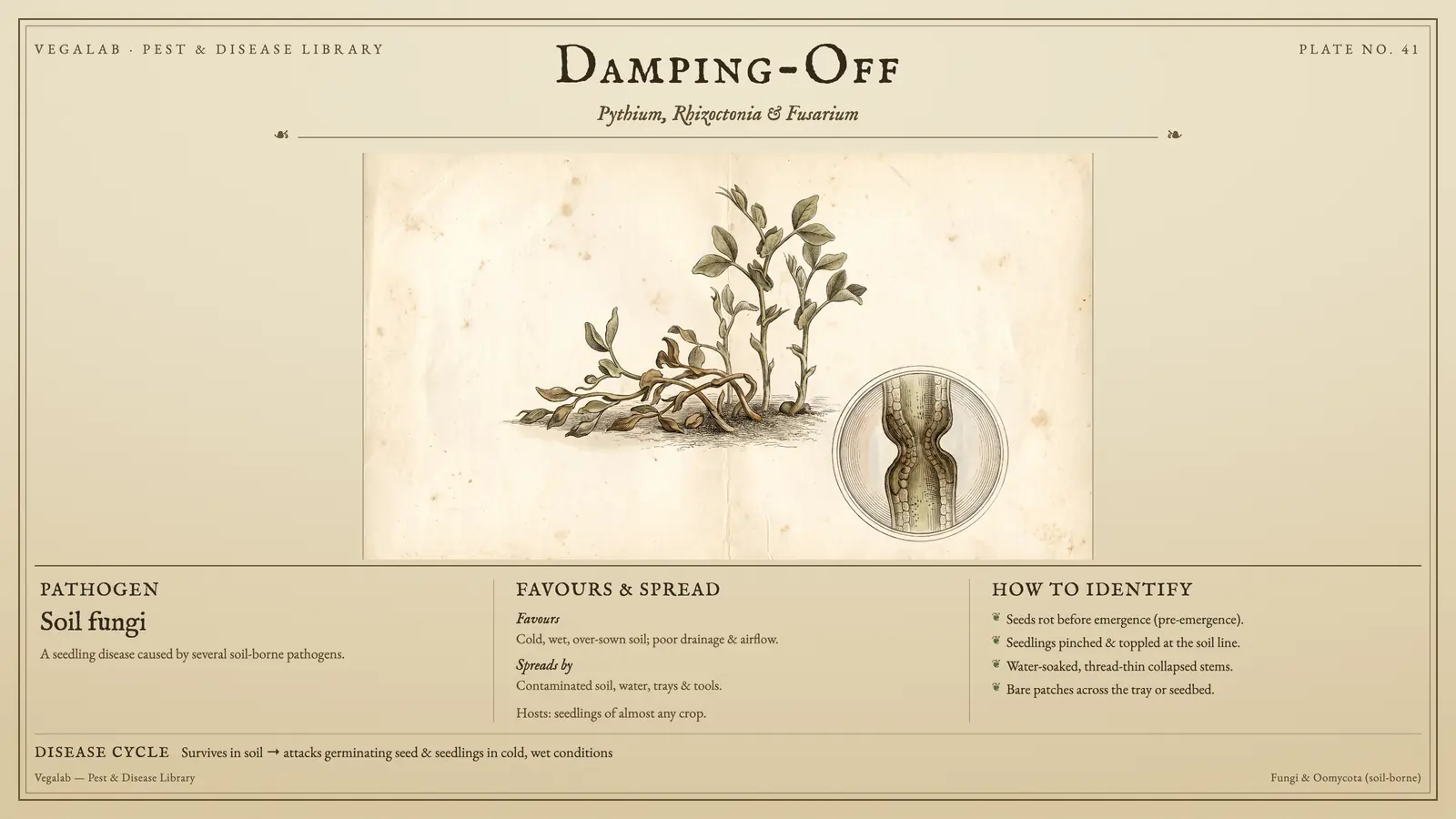
Damping-off is caused by several soil pathogens, most commonly Pythium and Phytophthora, along with Rhizoctonia and Fusarium. They attack germinating seeds and young seedlings, rotting the stem at the soil line. Cool, wet, overcrowded, poorly drained conditions strongly favor the disease.
How to identify it
- Seeds failing to emerge (pre-emergence rot)
- Water-soaked, pinched stems at the soil line
- Toppled seedlings that don’t recover
- Patchy stands, worst in cold wet conditions
Life cycle & spread
Damping-off is not one organism. *Pythium* and *Phytophthora* are oomycetes that swim to roots as motile zoospores in saturated soil; *Rhizoctonia solani* is a true fungus that grows through soil as mycelium; *Fusarium* species colonise vascular tissue. They survive between crops as oospores, sclerotia or chlamydospores in soil, debris and on reused trays.
The window of vulnerability is narrow and specific: from imbibition until the seedling develops secondary thickening in the stem base and a functioning root system. Pre-emergence damping-off kills the seed or sprout before it breaks the surface and simply reads as poor germination - which is why the disease is so often recorded as a seed-quality problem. Post-emergence damping-off produces the classic water-soaked, pinched lesion at the soil line and the seedling topples with its cotyledons still green.
Once the stem base has hardened off, the same pathogens no longer cause collapse - though *Pythium* and *Rhizoctonia* continue as root and crown rots on the mature plant. Speed matters: in a warm, wet, densely sown tray a patch can expand across the flat within two or three days.
Conditions that favour it
Excess water is the primary driver in nearly every case: overwatering, poor drainage, compacted or fine-textured media, and containers standing in water. *Pythium* and *Phytophthora* specifically need saturation, because their zoospores swim.
The secondary drivers are all about slowing the seedling down relative to the pathogen: sowing too deep, low light, cool soil for warm-season crops, poor air movement, high humidity, dense sowing, and excess soluble salts or ammonium nitrogen. *Rhizoctonia* is the exception that also operates in drier, warmer media, so a dry tray is not proof it is not damping-off.
Reused trays, unpasteurised media, dirty benches and hose ends left on the floor are how the inoculum arrives in the first place.
Damage and how it spreads
Damping-off can wipe out an entire tray or seedbed quickly, and surviving seedlings are often stunted. Because the pathogens live in soil, water, and reused containers, the disease recurs wherever conditions are wet and crowded. Prevention is far more effective than rescue once seedlings start collapsing.
Monitoring & scouting
Inspect trays daily during the germination-to-establishment window. This is a disease measured in days, and a delay of 48 hours can be the difference between removing one cell and losing the flat.
Distinguish the pattern: expanding circular patches in a tray indicate a spreading soil-borne pathogen; scattered individual losses point to seed quality, sowing depth or a physical problem.
Check the stem at the soil line and pull gently. A pinched, water-soaked, brown constriction with the top still green and turgid is damping-off. Roots that strip to a bare thread when pulled indicate *Pythium*; a firm dry brown lesion with fine brown mycelium suggests *Rhizoctonia*.
How to control it
- Use clean, well-draining media and sanitized trays and tools.
- Avoid overwatering; provide good airflow and don't sow too densely.
- Bottom-water and let the surface dry between waterings.
- Apply a protective natural fungicide drench to protect germinating seedlings.
How to prevent damping-off
- Water less, and water in the morning. Overwatering is the single most common cause. Let the surface dry between waterings and allow the medium to drain fully - the oomycetes need free water to move at all.
- Use a free-draining medium and clean containers. Pasteurised or fresh media, and trays washed and sanitised between crops. Reused trays are the classic source.
- Sow at the right depth and density. Deep sowing lengthens the vulnerable period before emergence; dense sowing keeps the canopy wet and lets the pathogen move plant to plant.
- Give it light and air movement. A fan over propagation trays does more than most inputs: it dries the surface, strengthens stems and shortens the vulnerable window.
- Match soil temperature to the crop. Warm-season crops sown into cold soil sit still while the pathogen does not. Bottom heat is a disease measure, not just a speed measure.
- Keep the hose end off the floor, use clean water, and avoid splashing between benches.
- Support fast, even establishment. A seedling that gets through the vulnerable stage quickly escapes the disease; root-zone support and balanced nutrition work with that rather than against the pathogen directly.
- Remove affected cells and the medium around them immediately, and do not water the surrounding area from the same can.
Damping-off is almost entirely a prevention disease. There is no treatment that revives a collapsed seedling, and once a flat is running, the practical decision is how much of it to discard. Everything below is about the conditions rather than about a product.
Chamomile tea, cinnamon and similar home remedies circulate widely for this disease. They have little effect on an established infection; the drainage, airflow and watering changes above are what actually work.
Which pathogen is it, and does it matter?
- Pythium · saturated media; roots turn soft and slough off, leaving a bare stele when pulled; the most common cause in over-watered trays
- Phytophthora · also water-driven, but more often crown and root rot on older transplants than tray collapse
- Rhizoctonia · drier and warmer media than the others; a firm brown sunken lesion at the soil line with sparse brown mycelium, often with a wire-stem appearance
- Fusarium · vascular browning up the stem, more often wilt and stunting than clean toppling
- Non-pathogenic causes · salt injury, fertiliser burn, cold injury and physical damage all mimic damping-off and produce scattered rather than expanding losses
Damping-off is a disease complex. Oomycetes such as Pythium and Phytophthora and fungi such as Rhizoctonia and Fusarium often differ in fungicide sensitivity, so diagnosis and label spectrum matter. Some products or mixtures cover more than one group.
See Pythium & Damping-Off, Rhizoctonia (Root Rot & Damping-Off) and Phytophthora.
Where biologicals fit in propagation
Propagation is one of the few settings where microbial products have a genuinely coherent rationale. The mechanism is occupation: beneficial fungi and bacteria applied to a clean medium colonise the root surface and rhizosphere ahead of the pathogens, competing for space and root exudates. That is a preventive, colonisation-first strategy and it is well suited to a sterile starting medium.
It is also a strategy with clear limits worth stating. It has to be in place before the pathogen - applied at sowing or as a medium amendment, not after symptoms appear. It does not overcome a saturated tray: no biological programme survives waterlogging, because the conditions favouring the pathogen still favour it. And it reduces pressure rather than eliminating the organisms. Treat it as one component of a propagation protocol whose foundation is drainage, airflow and hygiene.
Recommended Vegalab solution: Spore Control
Vegalab Spore Control · Clean media and trays, careful moisture and temperature, and a Spore Control application at sowing/early establishment.
Observed results: Spore Control is documented against damping-off (water mold) and fusarium for most fruit and vegetable crops.
| Role | Product | Use |
|---|---|---|
| Primary control | Spore Control | Broad-spectrum protective fungicide |
| Companion / broader pressure | Charge Bioboost | Soil biology / suppressive soil |
| Plant support | Root Boost | Root development / establishment |
By crop
See crop-specific solutions
Preventing it next season
Start with clean media and sanitized trays, water carefully, give airflow, avoid overcrowding, and protect seedlings preventively. Healthy soil biology suppresses these pathogens - support it with Charge Bioboost.
Claims and product availability vary by jurisdiction. Always read and follow the product label.