

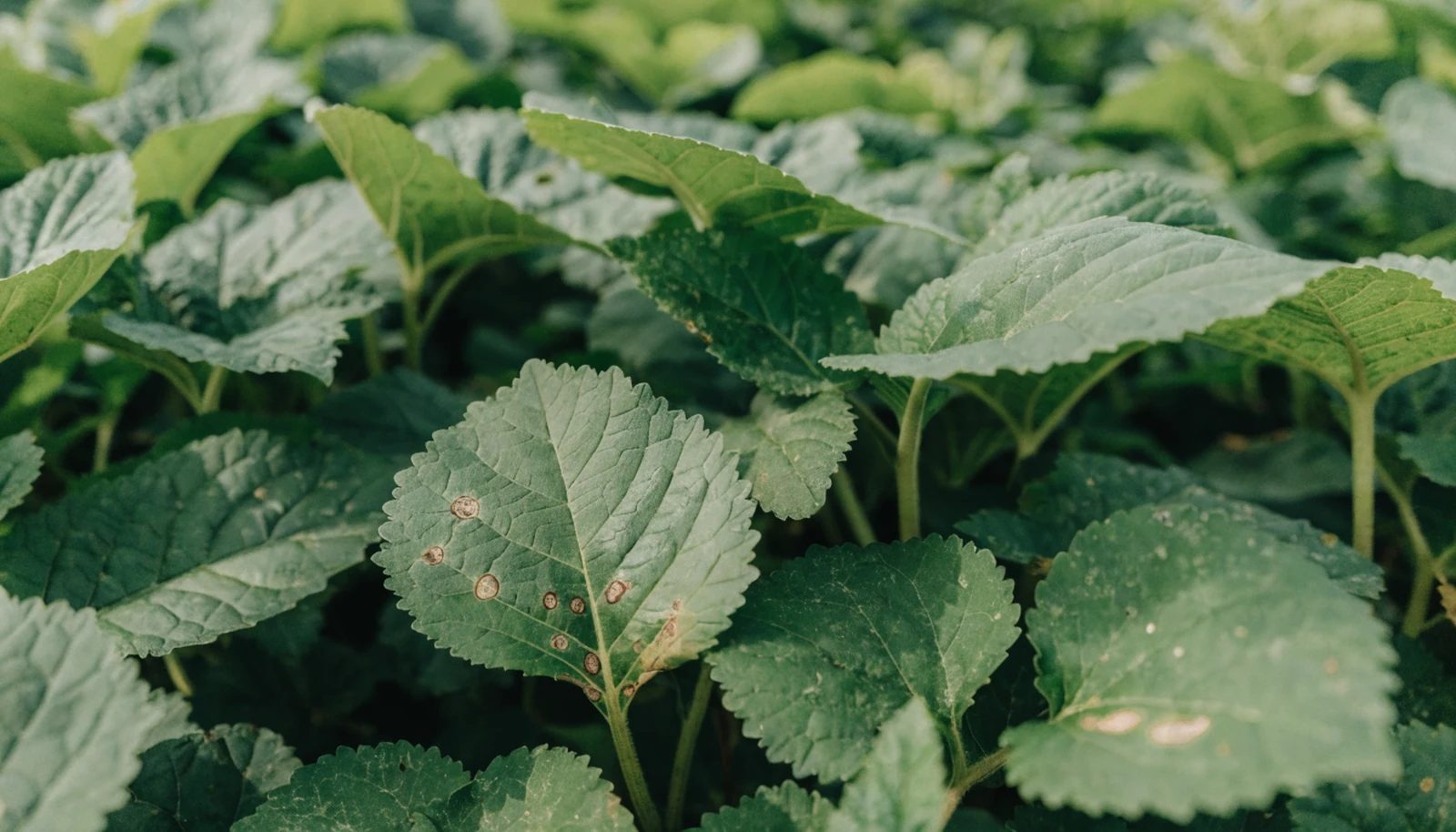
Crops affected
Powdery Mildew at a glance
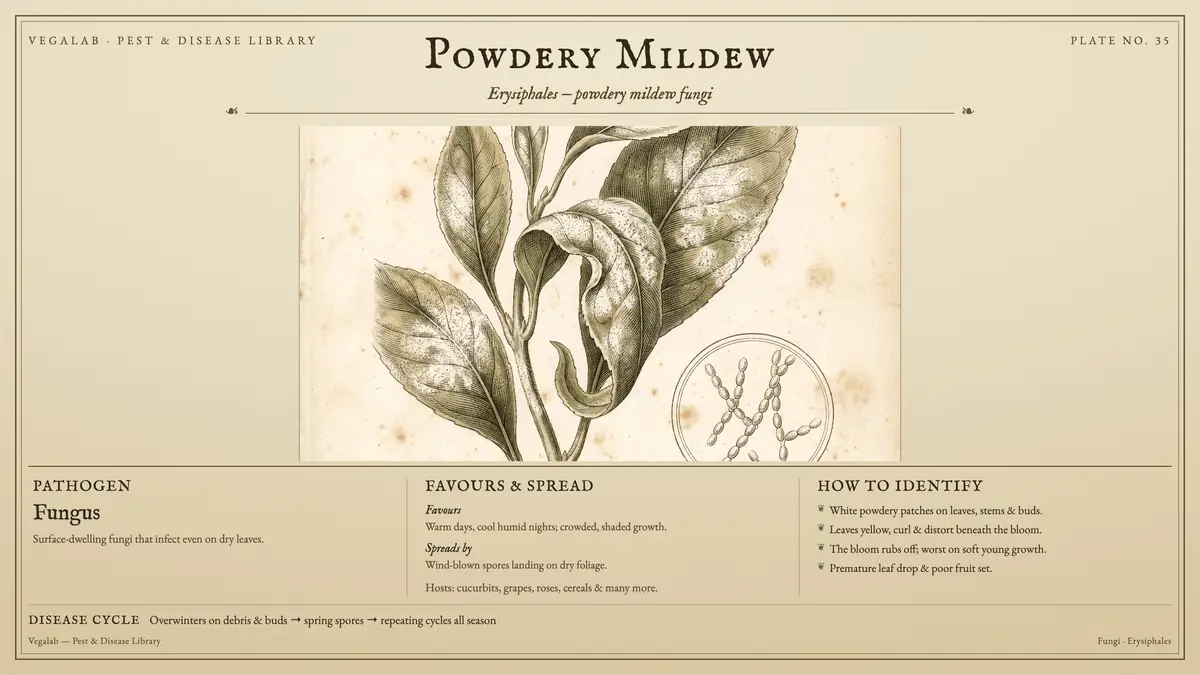
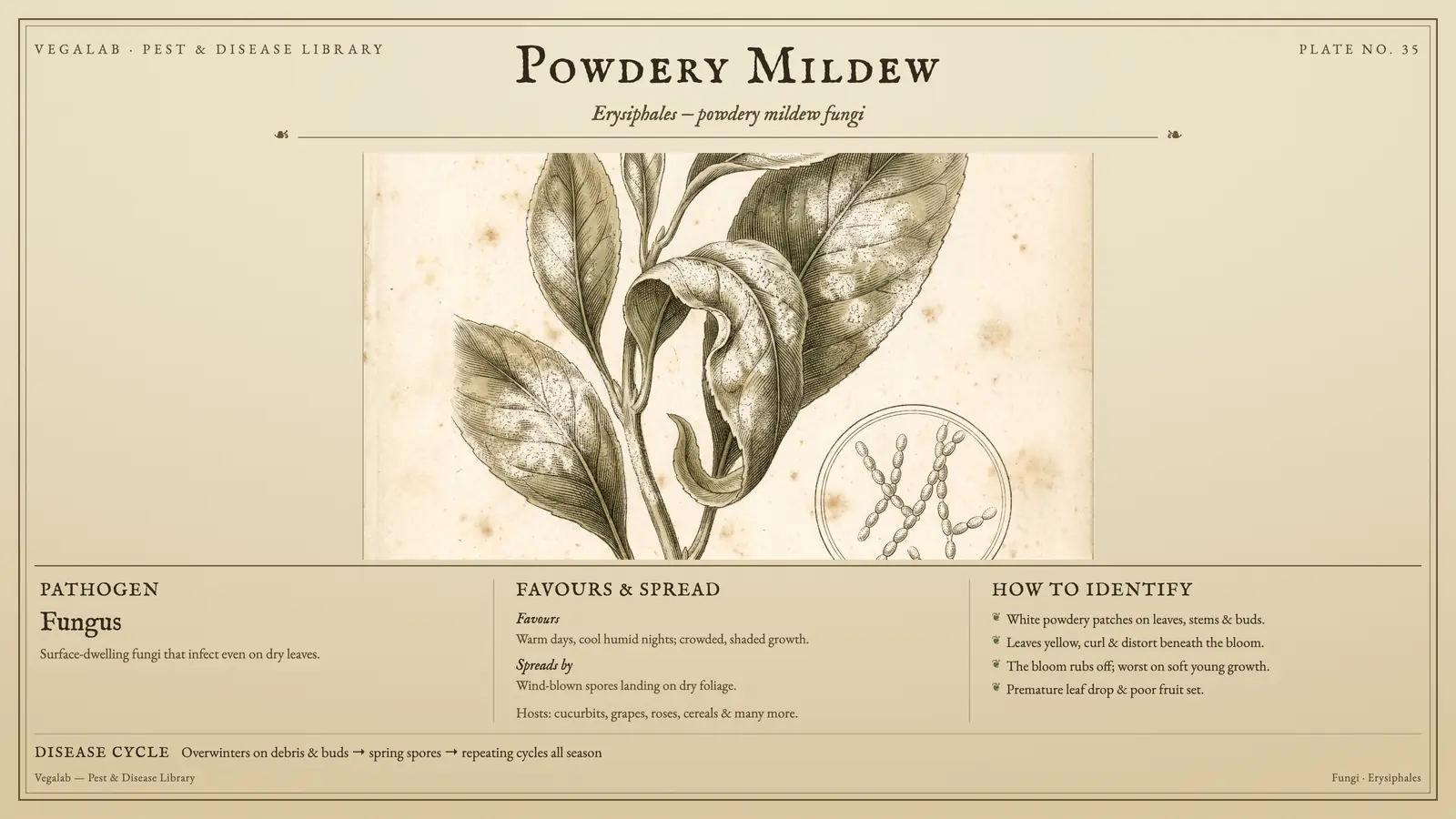
- The bloom rubs off; worst on soft young growth.
What is powdery mildew?
Powdery mildew is caused by fungi in the order Erysiphales. It grows on the surface of leaves, stems and fruit, sending feeding structures into the outer cells. The white "powder" is a mass of fungal threads and spores. Left unchecked it reduces photosynthesis, distorts new growth, and lowers yield and quality.
How to identify powdery mildew
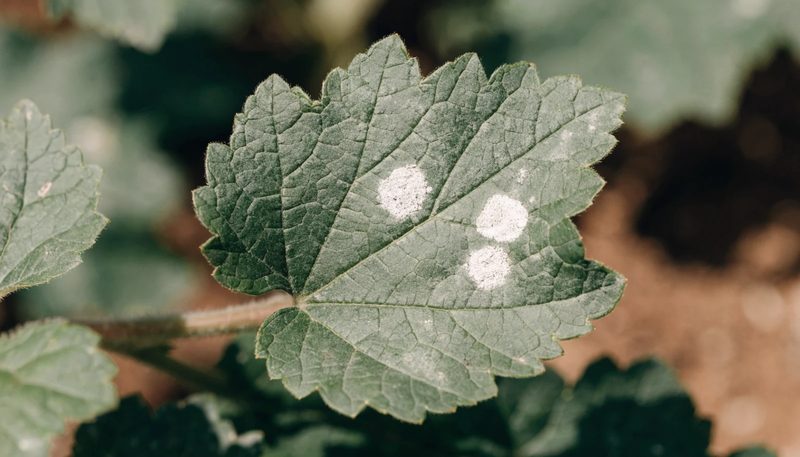
- White powdery patches on the upper surfaces of leaves, spreading to stems, buds and fruit
- Yellowing and distortion of affected leaves; new growth stunted or curled
- Premature leaf drop and, on fruit crops such as grapes, russeting, cracking or reduced quality
Conditions that spread it
Powdery mildew is unusual: it does not need leaf wetness to infect, and heavy rain can wash spores away. It favours warm days, cool nights, high humidity around dense canopies, and shade - which is why it flourishes in greenhouses and crowded plantings. Airflow, canopy management and avoiding excess nitrogen reduce pressure, but once it appears active control is needed.
Controlling powdery mildew naturally
Because powdery mildew grows on the plant surface, it is well suited to control by nature-derived, contact-acting fungicides - provided coverage is thorough and applications are timed to pressure. Rotating away from single-site synthetic chemistry matters, as powdery mildew develops resistance readily.
Life cycle & spread
Powdery mildew generally does not require free water and is favored by humid canopies. Rain may temporarily wash spores or inhibit some species, but overhead irrigation is not a control recommendation because it raises humidity and may favor other diseases.
The fungus grows largely on the surface of the leaf, sending feeding structures called haustoria into the epidermal cells only. That superficial habit is why the white growth can be rubbed off, and why contact and surface-acting treatments work better here than on diseases embedded in tissue.
It overwinters as chasmothecia - small resistant fruiting bodies - on bark, canes and debris, and in mild climates as mycelium in dormant buds, which produces the heavily infected "flag shoots" in spring. Conidia are produced in enormous numbers and carried by wind, and the cycle can repeat in five to seven days in favourable conditions.
Conditions that favour it
Warm and dry with high humidity is the signature combination: roughly 20–27 °C, humid air, and little or no rainfall. Direct rainfall and overhead irrigation actually suppress it by washing spores off - the opposite of most foliar diseases.
Shade and dense canopies raise risk sharply, as does succulent growth driven by high nitrogen. Poor air movement, high plant density and shaded interior canopy are where it starts. Temperatures above roughly 32 °C slow it, which is why it often pauses in high summer and returns in autumn.
Monitoring & scouting
Inspect the shaded interior and lower canopy, and the upper leaf surface, weekly through the warm season. Look for the earliest sign: small circular patches of white talc-like growth, before they merge.
In perennial crops, look for flag shoots in spring - stunted, distorted, white-coated shoots emerging from infected buds. They are the primary inoculum for the season and removing them pays.
Because the pathogen needs no rainfall, do not use rain forecasts as your risk indicator here. Humidity, shade and canopy density are the variables to watch.
How to get rid of powdery mildew
- Open the canopy. Pruning, leaf removal, wider spacing and better air movement reduce humidity in the microclimate where it starts, and increase light exposure, which the fungus dislikes.
- Moderate nitrogen. Soft, fast, succulent growth is the most susceptible tissue; excessive nitrogen reliably worsens powdery mildew.
- Treat early and cover thoroughly. Once colonies merge across a leaf the tissue is already compromised. Coverage of both surfaces matters because the growth is on the surface.
- Use the surface-acting options where the crop allows. Sulphur, potassium bicarbonate, horticultural oils and milk-based sprays all have genuine activity on this disease - more so than on any other in this library. Mind the label restrictions on sulphur with oils and in heat, which can scorch.
- Remove flag shoots and infected debris in perennial crops, and prune out overwintering canes.
- Choose resistant varieties, which have advanced considerably in cucurbits, grapes, cereals and roses.
- Support tissue resilience. Silica and balanced calcium nutrition contribute to firmer epidermal tissue as part of a programme - a supporting input, not a treatment.
Powdery mildew's superficial growth habit is the opening: surface treatments actually reach it. It is also the most likely of the common diseases to respond to simple, low-cost measures if you start early.
Overhead irrigation genuinely does suppress powdery mildew by washing spores from the leaf. It is one of the very few diseases where wetting the foliage helps - and it trades against every other disease in this library, so it is rarely the right lever on its own.
Why powdery mildew appears in dry weather
This is the single most counter-intuitive fact in foliar disease management, and it causes real mistakes. Nearly every other fungal and oomycete disease needs free water on the leaf to infect. Powdery mildew does not - humid air is sufficient, and its spores germinate and infect on a dry surface.
The practical consequences are worth spelling out. A dry spell is not a low-risk period for this disease; a rain event lowers rather than raises risk; and a programme built on rainfall triggers will consistently be late. The variables to watch instead are humidity, shade, canopy density and nitrogen status - and a crop under protection, where humidity is high and rainfall is zero, is the ideal environment for it.
Host specialisation: your cucumber mildew is not your grape mildew
Powdery mildews look identical across crops but are largely host-specific fungi from different genera. That has two practical implications: the disease does not usually spread from an ornamental to a vegetable crop nearby, and product performance and resistance status differ by crop.
The main ones growers encounter are Podosphaera xanthii on cucurbits, Erysiphe necator on grapevine, Blumeria graminis on cereals, Podosphaera leucotricha on apple, Leveillula taurica on peppers and tomatoes · which, unusually, grows partly inside the leaf and shows yellow blotches on the upper surface with sporulation beneath, so it is often mistaken for downy mildew · and Podosphaera pannosa on roses and stone fruit.
Leveillula taurica is the exception to the rub-it-off rule: because it is partly internal, surface treatments work less well against it. If a pepper or tomato shows yellow upper-surface blotches with white growth underneath, expect it to behave differently from cucurbit mildew.
Recommended Vegalab solution: Mildew Control
Vegalab Mildew Control is a geraniol-based fungicide built on the nano-encapsulation platform. The capsule adheres to the canopy and resists wash-off, then releases its active on contact - making it rainfast and friendly to resistance management, with zero pre-harvest and zero re-entry interval. For broader spore-borne disease, Spore Control provides encapsulated adherent cover targeting spore germination and early infection. Results vary by crop, region and disease pressure; claims and availability vary by jurisdiction - always read and follow the applicable product label.
| Role | Product | Use |
|---|---|---|
| Primary control | Mildew Control | Geraniol fungicide for mildews |
| Companion / broader pressure | Spore Control | Broad-spectrum protective fungicide |
| Plant support | Armour Boost | Silica for tissue resilience |
By crop
Claims and product availability vary by jurisdiction. Always read and follow the product label.