

Crops affected
What is it?
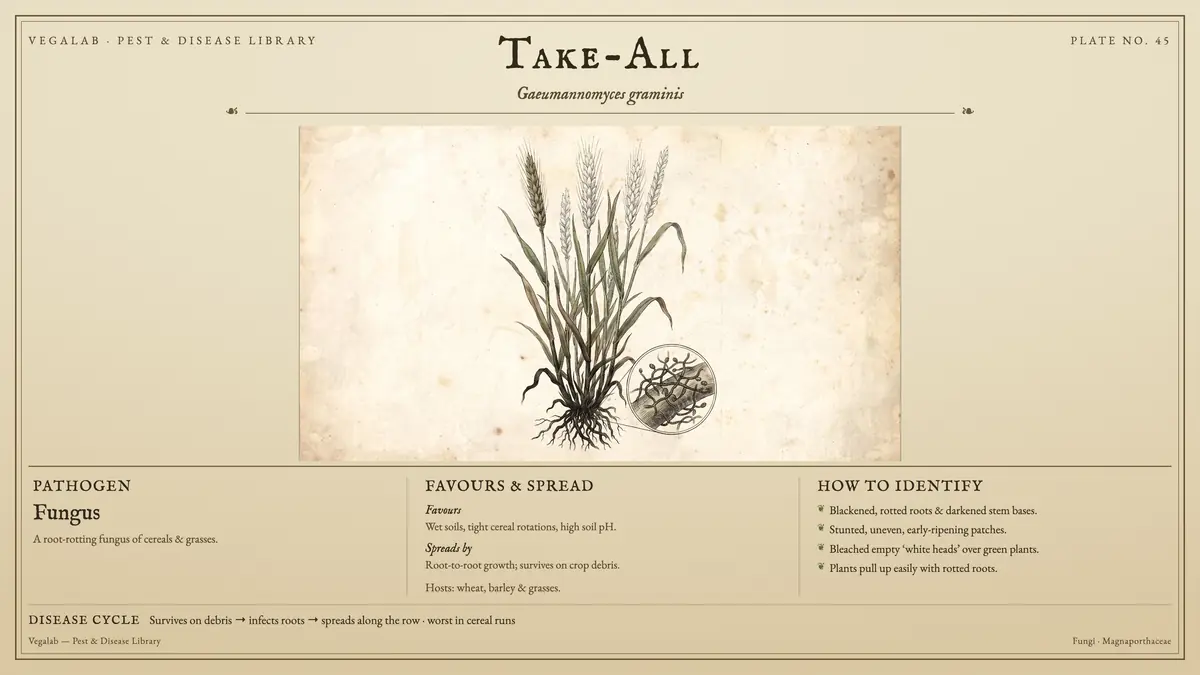
Take-all is caused by the fungus Gaeumannomyces graminis, which infects and blackens the roots and crown of cereals and grasses, choking off water and nutrient uptake. It builds up under continuous cereal cropping and is influenced by soil pH, drainage, and biology. Affected plants cannot move water and nutrients properly, so they stunt and die in patches.
How to identify it
- Patches of stunted, yellowing plants that ripen prematurely (whiteheads in cereals)
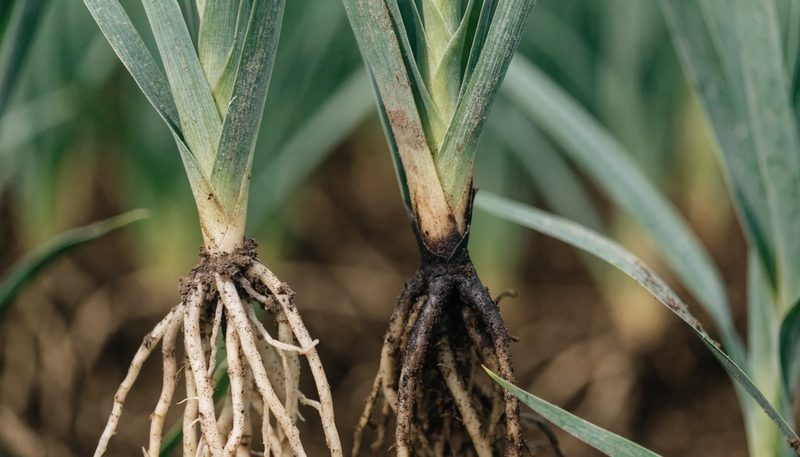
- Blackened, rotted roots and darkened crown tissue
- Plants that pull up easily due to poor root systems
- Worse under continuous cereals and in certain soil/pH conditions
Life cycle & spread
*Gaeumannomyces graminis* var. *tritici* survives between crops as mycelium on infected cereal root and stem-base debris, and on grass weeds and volunteer cereals. It does not produce a durable, long-lived resting spore, which is the key to managing it: the inoculum declines when hosts are absent.
In a growing crop, the fungus grows along the root surface as dark runner hyphae, visible as black threads under a hand lens, and penetrates to destroy the vascular tissue of roots and the stem base. Destroyed roots cannot take up water or nutrients, so the plant starves and dries.
Spread within a crop is root-to-root through the soil, which produces the characteristic patchiness. Because the fungus depends on living cereal roots and declines without them, its population is driven almost entirely by cropping sequence.
Conditions that favour it
Take-all is favoured by **consecutive cereal crops** above all else - this is a rotation disease more than a weather disease. Second and third wheat crops are classically the worst affected.
Other favouring factors: alkaline soils, light and poorly structured soils, high pH, phosphorus deficiency, compaction restricting rooting depth, and cool moist spring conditions. Grass weeds and volunteers carry the fungus between cereal crops and undo an otherwise sound break.
Damage and how it spreads
Take-all reduces tillering, grain fill, and yield in cereals and causes dead patches in turf. Because the fungus builds up in soil under continuous cereal cropping, the disease worsens year on year without rotation and soil management. Once roots are destroyed, individual plants cannot recover - so prevention and break crops are essential.
Monitoring & scouting
Look for uneven, patchy stunting, pale or prematurely ripening plants, and **whiteheads** - bleached empty ears standing above the canopy at grain fill.
Confirm by digging plants and washing the roots. Take-all produces **blackened roots and a shiny black-brown stem base**, and affected plants pull up easily because the root system has been destroyed. The blackening is the diagnostic.
Track it by field and by position in the rotation. Take-all risk is predictable from cropping history, so records are a genuine management tool here rather than an afterthought.
How to control it
- Rotate with non-cereal break crops to reduce inoculum build-up.
- Manage soil pH, drainage, and fertility to favor healthy roots.
- Build suppressive soil biology over time.
- Support root health and use protective inputs as part of an integrated program.
How to manage take-all
- Break the cereal sequence. One or preferably two years of a non-host - oilseed rape, pulses, linseed, potatoes, sugar beet · reduces inoculum markedly. This is the primary control and the reason take-all is largely a second- and third-wheat problem.
- Control grass weeds and volunteer cereals during the break. Couch, blackgrass, ryegrass and volunteers all host the fungus, and a weedy break is not a break.
- Use oats where a cereal is required in the sequence. Oats are resistant to the wheat form of the pathogen and are a useful break within a cereal rotation.
- Correct phosphorus and trace element status and relieve compaction. Take-all damages the root system, so a crop with restricted rooting and marginal nutrition suffers disproportionately.
- Drill later in high-risk situations where local agronomy supports it - early drilling of second wheats extends the autumn period of root infection.
- Do not expect seed treatment to substitute for rotation. Seed treatments reduce early infection and can protect yield in a high-risk crop, but they manage the symptom rather than the inoculum.
- Consider take-all decline in continuous wheat systems · see below.
Take-all is the clearest rotation disease in cereals. Because the fungus has no long-lived resting spore and depends on living cereal roots, a genuine break crop reduces the inoculum substantially - and nothing else available comes close to that effect.
Take-all is often described as untreatable, which is misleading. It is highly manageable, but through rotation rather than through applications.
Take-all decline: the disease that suppresses itself
In some continuous-wheat fields, take-all severity rises during early cereal crops and later declines as suppressive microbial communities develop; 2,4-DAPG-producing fluorescent Pseudomonas are important in well-studied systems. Timing and mechanism are field-dependent, and a nonhost break can reduce or eliminate suppressiveness.
The mechanism is biological. The sustained presence of the pathogen and its host selects for populations of antagonistic soil bacteria - notably fluorescent Pseudomonas species producing antifungal compounds · which build up in the rhizosphere and suppress the fungus. The soil effectively acquires an immune response, and that suppression is transferable: it can be lost by soil sterilisation and restored by adding a small quantity of suppressive soil.
This has two practical implications. In systems committed to continuous wheat, the worst years are the early ones, and pushing through them can lead to a stable lower-disease state. But the suppression is specific to the situation that created it, and it is disrupted by a break in the cereal sequence - so a grower who rotates out and back in restarts the cycle rather than retaining the benefit.
It is also the most-cited natural example of soil microbial communities suppressing a root pathogen, which is the same principle underlying deliberate biological approaches to soil-borne disease.
Take-all decline is real but is not a management recommendation on its own - the yield lost in the peak years usually exceeds the benefit of reaching the declined state.
Whiteheads: take-all or something else?
- Take-all: plant pulls up easily; roots blackened, stem base shiny black-brown; occurs in patches; worst in second and third wheats
- **Fusarium and Microdochium stem base rot:** brown discolouration of the stem base without the black shiny appearance; roots less destroyed
- Sharp eyespot (Rhizoctonia): lens-shaped lesions with dark borders on the stem base, roots largely intact
- Stem borer or wheat stem sawfly: a tunnel inside the stem with frass, and the stem often snaps at the damage point
- Frost or drought at flowering: whiteheads distributed by field topography and exposure rather than in patches, with healthy roots
- Ergot and other head diseases: the head is affected directly, with visible fungal structures, and the roots are fine
Bleached, empty ears standing above a green canopy have several causes, and distinguishing them requires looking at the base of the plant rather than the head.
Dig, wash, and look at the roots. Black roots plus an easy pull is take-all; a tunnel is an insect; healthy roots point to weather or a head disease. See Stem Borers and Rhizoctonia.
Recommended Vegalab solution: Spore Control
Vegalab Spore Control (Thymol) provides broad-spectrum protective fungicidal action and supports an integrated take-all program, while the foundation of control is rotation and soil health. Charge Bioboost supports suppressive soil biology, Balance Boost aids soil balance and remediation, and Root Boost promotes vigorous roots better able to withstand pressure. Combine these with break crops for durable management.
| Role | Product | Use |
|---|---|---|
| Primary control | Spore Control | Broad-spectrum protective fungicide |
| Companion / broader pressure | Charge Bioboost | Soil biology / suppressive soil |
| Plant support | Balance Boost | Soil remediation & balancing |
Preventing it next season
Rotate with break crops, manage pH and drainage, and build soil biology - the long game is the most effective. Charge Bioboost and Balance Boost help create a more suppressive, balanced root zone.
Claims and product availability vary by jurisdiction. Always read and follow the product label.