

Crops affected

How to identify pythium & damping-off
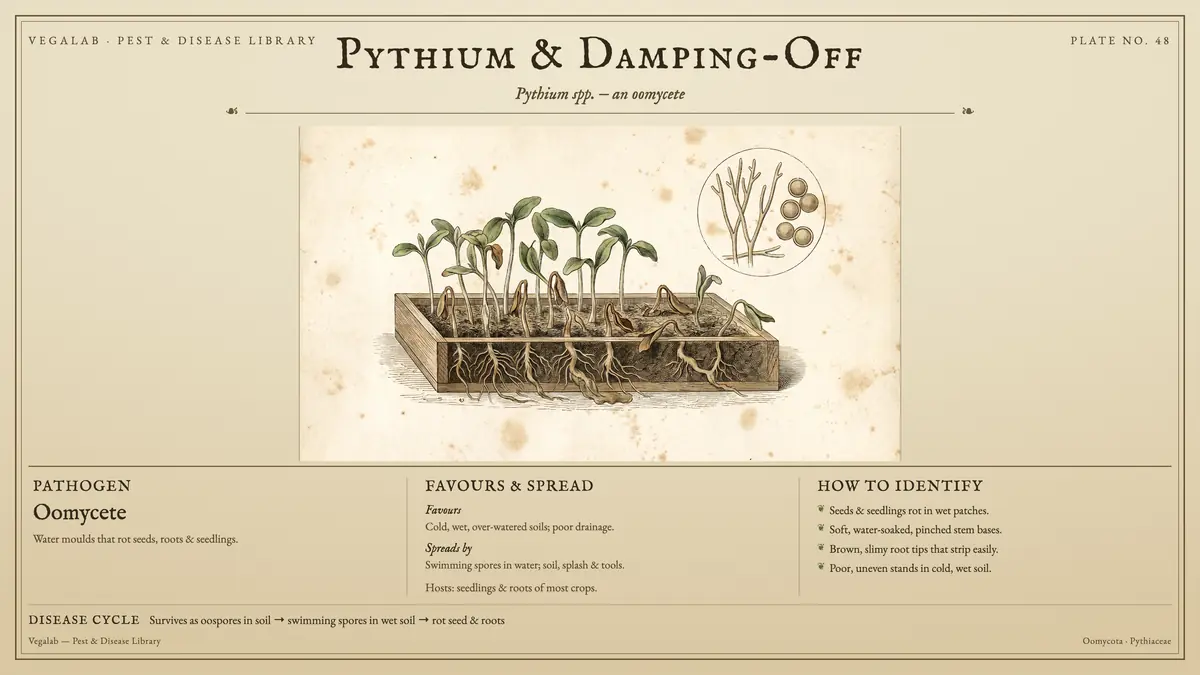
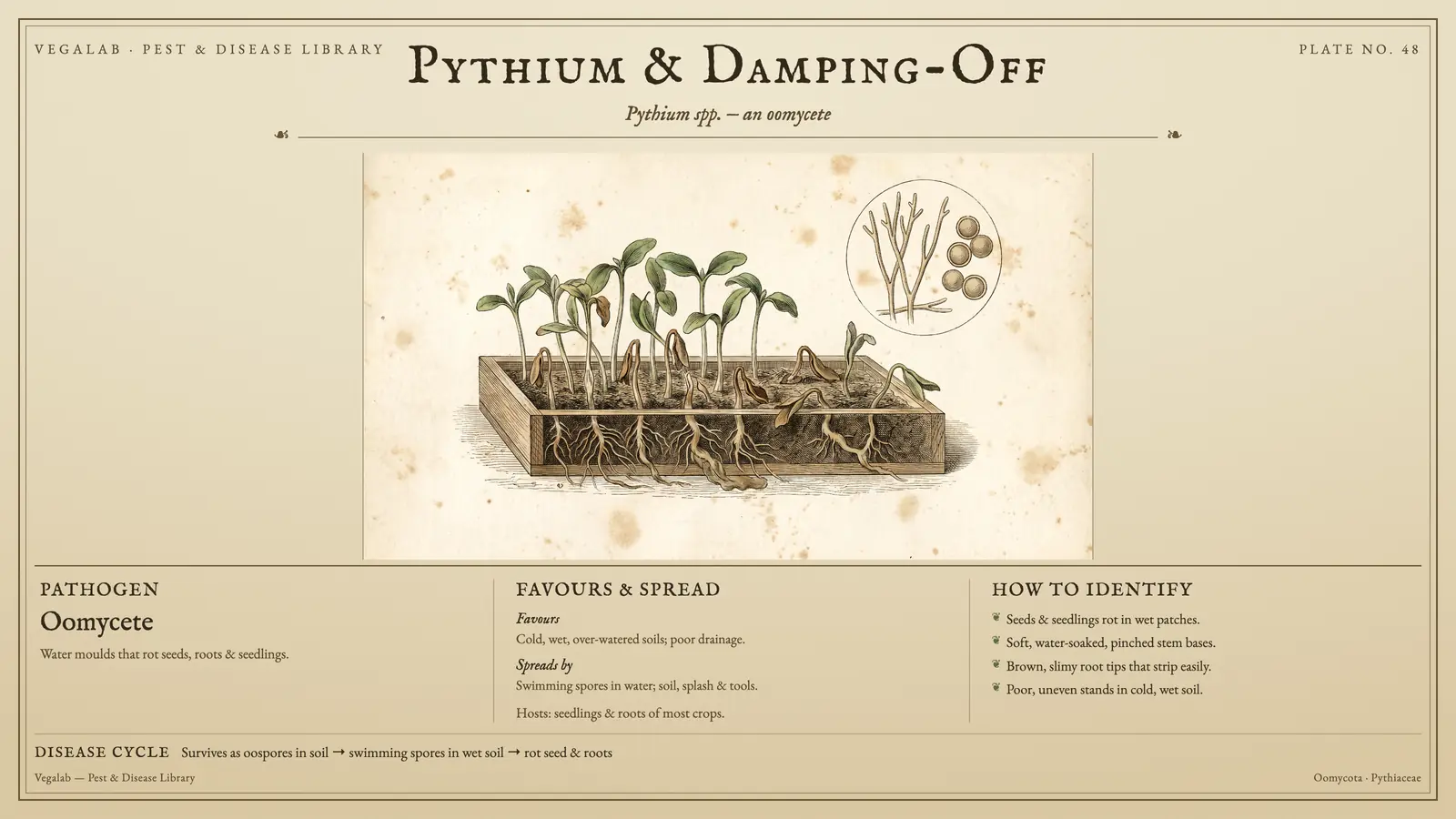
- Seeds & seedlings rot in wet patches.
- Brown, slimy root tips that strip easily.
What is it?
Pythium species live in soil and water and attack germinating seeds, seedling stems at the soil line, and fine feeder roots. They are closely tied to the damping-off complex and thrive wherever soils stay wet and cold.
How to identify it
- Poor, patchy or failed emergence (seed and pre-emergence rot).
- Seedlings collapsing at the soil line with pinched, water-soaked stems (post-emergence damping-off).
- Brown, soft, mushy roots and easily detached root “sleeves.”
- Stunting and uneven stands in wet, cool, compacted or overwatered areas.
Life cycle & spread
Survives in soil and debris as resting spores; produces swimming zoospores in saturated soil that infect roots and seedlings. Spreads in water, splash and contaminated media or tools.
Conditions that favour it
Cool, wet, poorly drained or overwatered soils; heavy or compacted media; sowing into cold, wet ground.
Damage and how it spreads
Kills seeds and seedlings (reducing stands) and rots fine roots (reducing vigour and uptake), with the greatest impact at establishment.
Monitoring & scouting
Watch emergence and seedling vigour; check roots of stunted plants; assess irrigation and drainage in problem areas.
How to control it
- Manage irrigation and drainage, avoid waterlogging, use clean media and good propagation sanitation, and support a healthy, biologically active root zone.
- Focus on prevention and root protection.
How to manage pythium
- Stop over-watering. This is the single dominant cause. Let the medium surface dry between waterings, and never leave trays or pots standing in water.
- Use a free-draining medium and containers with adequate drainage; fine, water-retentive media in deep cells are the classic high-risk combination.
- Water in the morning so the surface dries before night.
- Match soil temperature to the crop. Cool wet media with a warm-season crop gives the pathogen a long head start on a slow-germinating seed.
- Treat the water source. Recycled irrigation water, open tanks and hose ends resting on the floor all carry zoospores; filtration or disinfection matters in propagation.
- Use pasteurised media and sanitised trays and benches. Reused trays are a common introduction route.
- Improve drainage in the field · subsoil compacted layers, use raised beds, and avoid planting susceptible crops in low, wet parts of a block.
- Colonise the rhizosphere first. Beneficial microbial inoculants applied at sowing occupy root surfaces ahead of the pathogen, which is a preventive strategy suited to a clean starting medium and no substitute for drainage.
Pythium is a water mould whose zoospores swim, so free water is not merely a favourable condition - it is the transport mechanism. Remove the saturation and you remove most of the disease, which makes this one of the most preventable problems in the library.
No biological or chemical programme survives a waterlogged tray, because the conditions that favour the pathogen persist regardless of what has been applied. Fix the water first.
Pythium beyond damping-off
- Inspect roots routinely in container and hydroponic production, not only when plants look sick
- Watch for a block that underperforms without a clear cause · root-pruning Pythium looks like a fertility problem
- Treat the solution, not just the plants, in recirculating systems · filtration, UV or slow sand filtration
- Maintain root-zone oxygen, since low dissolved oxygen strongly favours the pathogen
Pythium is best known as a seedling pathogen, but it does not stop when the stem hardens off - it continues as a chronic root pathogen on mature plants, and in that form it is substantially under-diagnosed.
On established plants Pythium prunes the fine feeder roots, the ones doing the water and nutrient uptake. The plant does not wilt dramatically or collapse; it simply underperforms - reduced vigour, poor response to fertiliser, midday wilting on adequate moisture, lower yield, and uneven growth across a block. Because there is no dramatic symptom, this is frequently attributed to nutrition, irrigation scheduling or soil variability.
It is a particular problem in hydroponic and recirculating systems, where the pathogen spreads through the nutrient solution to every plant on the line, and in container production where drainage is marginal. In these systems root inspection should be routine rather than reactive: healthy roots are white and firm with abundant fine laterals, whereas Pythium-affected roots are brown, sparse and strip easily.
See Poor Root Development · the two are closely related and frequently the same underlying situation.
Pythium or Phytophthora?
- Pythium: predominantly a fine-root and seedling pathogen; a general root-pruning and damping-off agent across a very wide host range; rarely kills a mature plant outright
- Phytophthora: more often attacks larger roots, the crown and the trunk; produces defined crown lesions with a sharp margin; capable of killing mature trees and vines
- Site pattern: both follow water, but Phytophthora damage typically shows as declining or dying individual plants in wet spots, while Pythium shows as generally weak growth
- Diagnosis: Pythium roots strip to a bare thread; Phytophthora gives reddish-brown crown discolouration with a clear boundary between healthy and diseased tissue
Both are oomycetes, both are water-driven, and both respond to similar chemistry - so the distinction is less critical for treatment than Pythium versus Rhizoctonia. It still matters for expectations.
See Phytophthora and Rhizoctonia (Root Rot & Damping-Off). All three are covered together at Damping-Off.
Recirculating systems: one plant infected means all of them exposed
- Treat the returning solution · UV, slow sand filtration or heat, sized to the flow
- Keep solution temperature down; warm solution is low-oxygen solution
- Maintain high dissolved oxygen through aeration and adequate flow
- Isolate and remove affected plants promptly, since every hour they are on the line exposes the rest
- Sanitise between crops · channels, tanks, pumps and pipework, not just the growing surfaces
Hydroponic, NFT and any recirculating irrigation system changes the arithmetic of this pathogen completely. In soil, Pythium spreads root to root through a limited volume and an infection stays local for a while. In a recirculating solution, zoospores released by one infected root system are pumped past every other root system on the line within minutes.
That is why Pythium is the defining disease risk of hydroponic production and why the control point is the water rather than the plant. Filtration, UV sterilisation, slow sand filtration and heat treatment of the returning solution are all used to break that transmission, and in a well-run system they are the primary defence rather than an optional refinement.
Dissolved oxygen is the other lever, and it is often the more practical one. Pythium damage is markedly worse in warm, oxygen-poor solution: warm water holds less oxygen, root respiration demands more, and stressed roots are both more susceptible and more attractive. Keeping solution temperature down and aeration up does more in many systems than any treatment applied afterwards.
In a recirculating system, root inspection should be scheduled rather than reactive. By the time a plant looks sick the whole line has been exposed for days.
Recommended Vegalab solution: Spore Control
Spore Control · natural broad-spectrum fungicide (thymol) used preventively where label-supported as part of a soil-health and seedling-protection approach. - Charge Bioboost · soil inoculant that supports a healthy, biologically active root zone, helping seedlings establish under disease pressure.
| Role | Product | Use |
|---|---|---|
| Primary control | Spore Control | |
| Also apply | Charge Bioboost |
Preventing it next season
Right-size irrigation, ensure drainage, use clean media and trays, sanitise tools, and avoid sowing into cold, wet soils.
Claims and product availability vary by jurisdiction. Always read and follow the product label.