

Crops affected
How to identify bacterial shot hole
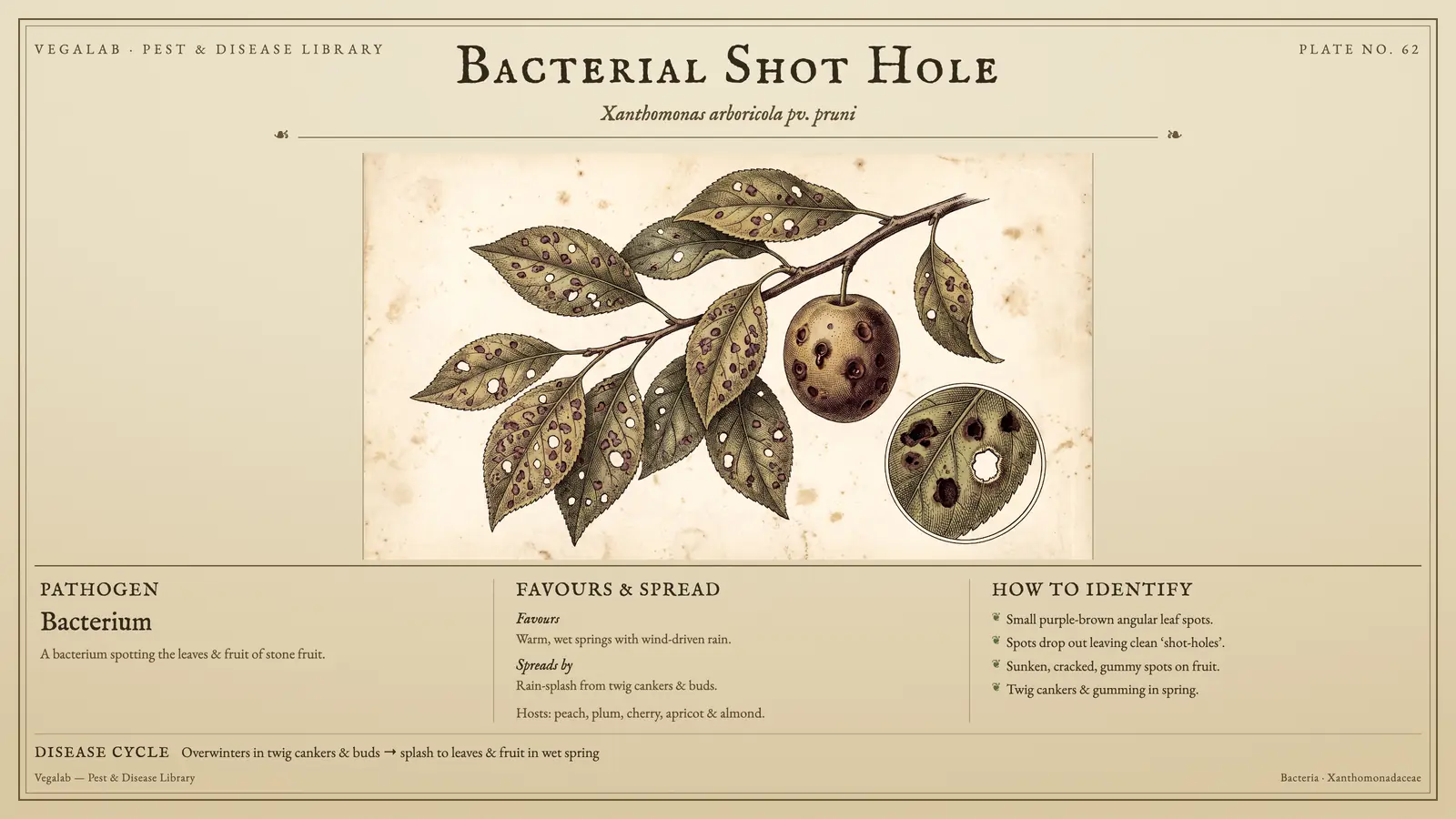
Pathogen. Bacterium A bacterium spotting the leaves & fruit of stone fruit.
What is it?
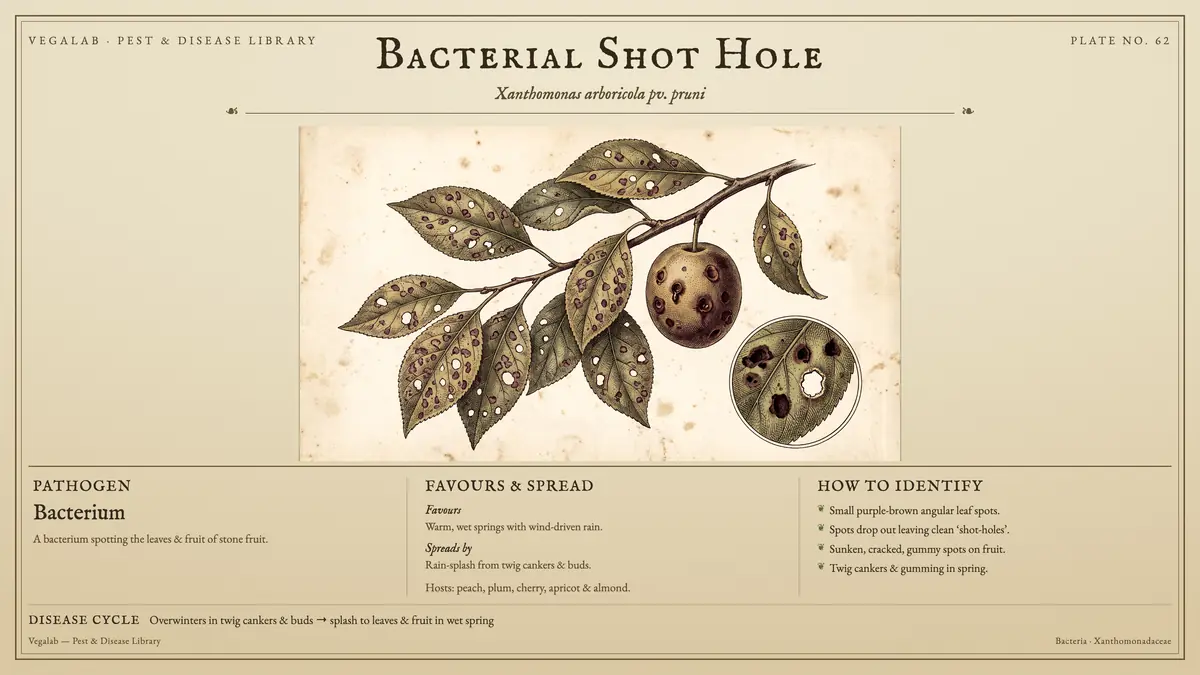
Bacterial shot hole (commonly caused by Xanthomonas arboricola on stone fruit) infects leaves, fruit, and twigs. Lesions on leaves are surrounded by tissue that dies and falls away, creating the characteristic holes. The bacteria overwinter in twig lesions and buds and spread in spring rains and wind into new growth.
How to identify it
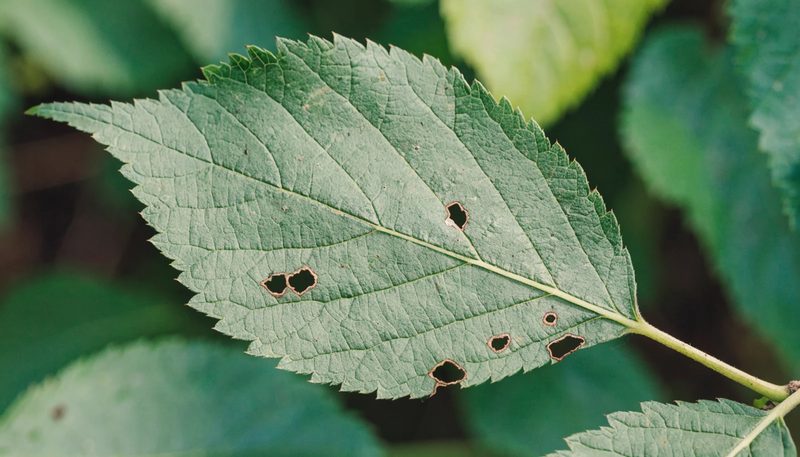
- Small, dark, water-soaked leaf spots that dry and drop out, leaving holes
- Yellowing around spots and premature leaf drop in heavy cases
- Dark, sunken spots or cracking on fruit
- Twig lesions and gumming that overwinter the bacteria
Life cycle & spread
*Xanthomonas arboricola* pv. *pruni* overwinters in twig cankers, in buds and in leaf scars on stone fruit. In spring, bacteria multiply and are released in wet weather, splashed and wind-driven onto new leaves, shoots and developing fruit.
Infection needs free water and warm conditions, and entry is through stomata and wounds. On leaves the bacteria kill small areas of tissue which then dry, become brittle and **drop out**, leaving the characteristic holes that name the disease. On fruit, infection produces sunken, cracked, dark lesions; on twigs it produces cankers that carry the pathogen to the next season.
Because the overwintering sites are on the tree itself, disease pressure in a block reflects last season's infection level more than any external source.
Conditions that favour it
Warm wet weather during shoot and fruit development is the requirement, with wind-driven rain being particularly effective at spreading and inoculating. Sandy, exposed sites are markedly worse because sandblasting wounds the leaves.
Susceptible cultivars, high nitrogen, and blocks with substantial existing twig cankers all raise risk. Frost and hail damage create entry wounds.
Damage and how it spreads
Repeated shot-hole infection weakens trees through leaf loss, blemishes and cracks fruit (reducing marketability), and creates twig cankers that carry the disease forward. Because it overwinters in the tree and spreads in spring rains, it recurs without sanitation and protection. Infected tissue cannot be cured.
Monitoring & scouting
Inspect leaves after warm wet weather for small angular water-soaked spots that will become the shot holes, and check whether the holes have clean or ragged margins.
Inspect fruit from early development onward for small dark sunken spots, and twigs in dormancy for cankers - the dormant canker assessment predicts next season's pressure.
Note the distribution: bacterial shot hole is typically worse on the windward side and in exposed positions, which helps distinguish it from fungal and physiological causes.
How to control it
- Prune out infected twigs and improve airflow within the canopy.
- Manage irrigation to keep foliage drier and avoid prolonged wetness.
- Maintain tree vigor and balanced nutrition.
- Protect new growth during wet spring conditions as part of an integrated program.
How to manage bacterial shot hole
- Remove twig cankers in dormancy. These are the overwintering reservoir and the source of spring inoculum. Pruning them out reduces next season's disease directly.
- Plant windbreaks on exposed and sandy sites. Sandblasting is a major driver of this disease because it creates the wounds the bacteria need; windbreaks are one of the most effective measures available and are often decisive.
- Choose less susceptible cultivars, which vary substantially · this is a major factor on high-risk sites.
- Avoid overhead irrigation and reduce leaf wetness duration.
- Moderate nitrogen to avoid excessively soft, susceptible growth.
- Apply protectants preventively in wet springs where warranted, recognising they are suppressive rather than curative, and observing local copper resistance status.
- Maintain tree vigour, since stressed and defoliated trees are less able to carry a crop and more susceptible the following year.
- Do not prune in wet weather, and disinfect tools between trees.
On a sandy, windy site this disease is often site-limited rather than management-limited. Windbreak establishment can achieve more than several seasons of spray programme.
Shot holes: bacterial, fungal, or insect?
- Bacterial shot hole: holes with angular margins, often surrounded by a narrow yellow or purple-brown border; associated water-soaked spots elsewhere on the leaf; worse on the windward side; fruit lesions sunken and cracked
- **Shot hole disease (Wilsonomyces/Stigmina): holes are more circular with a reddish-brown border**, and lesions carry tiny dark fungal fruiting bodies visible with a lens
- Cherry leaf spot: small purple spots that may drop out, with the leaf turning yellow and dropping soon after - heavy defoliation is the main symptom
- Insect feeding: holes with irregular, chewed margins and often frass present; no water-soaked halo, no fruiting bodies
- Spray or nutrient injury: holes and necrosis distributed by spray coverage pattern or leaf position, appearing after a datable event
Holes in stone fruit leaves have several causes and the distinction is straightforward once you know what to look at - the margin of the hole and the surrounding tissue.
Angular margins with a coloured border and no fungal fruiting bodies point to bacterial. A lens showing dark fruiting structures in the border points to a fungal shot hole. Chewed margins with frass mean insects.
Why fruit lesions cost more than leaf holes
The leaf symptom names the disease but the fruit symptom is where the money is. Leaf shot holing has to be very heavy before it causes economically significant defoliation, and stone fruit tolerates moderate leaf loss with little effect on the current crop.
Fruit lesions are a direct loss. Infection on developing fruit produces small water-soaked spots that become sunken, dark and often cracked, and on a fresh-market crop that is an immediate downgrade or a cull. Worse, the cracks provide entry for brown rot and other secondary rots, so a bacterial spot lesion frequently becomes a fungal rot in transit - meaning the loss shows up after the fruit has been packed and shipped.
The timing of that risk is early: fruit is most susceptible while it is small and expanding, well before it looks like a crop worth protecting. Protection decisions made at that stage are what determine fruit finish at harvest, which is a difficult thing to justify at the time and easy to regret later.
It also means an assessment based on leaf symptoms understates the problem. A block with modest shot holing on leaves can still carry substantial fruit infection, and inspecting fruit rather than foliage is what gives the true picture.
See Brown Rot of Stone Fruit · bacterial fruit lesions are a common entry point for it, so the two problems compound.
Recommended Vegalab solution: Spore Control
Vegalab Spore Control (Thymol) forms a protective film on plant surfaces and can support an integrated shot-hole program during wet, high-risk periods, alongside the essential cultural controls. As a bacterial disease it cannot be cured once tissue is infected, so prioritize pruning out twig lesions, airflow, and protecting new growth in spring.
| Role | Product | Use |
|---|---|---|
| Primary control | Spore Control | Broad-spectrum protective fungicide |
| Companion / broader pressure | Armour Boost | Silica for tissue resilience |
Preventing it next season
Prune infected twigs, open the canopy for airflow, keep foliage drier, and protect new growth in wet spring weather. Vigorous, well-nourished trees resist pressure better - support firm tissue with Armour Boost.
Claims and product availability vary by jurisdiction. Always read and follow the product label.