

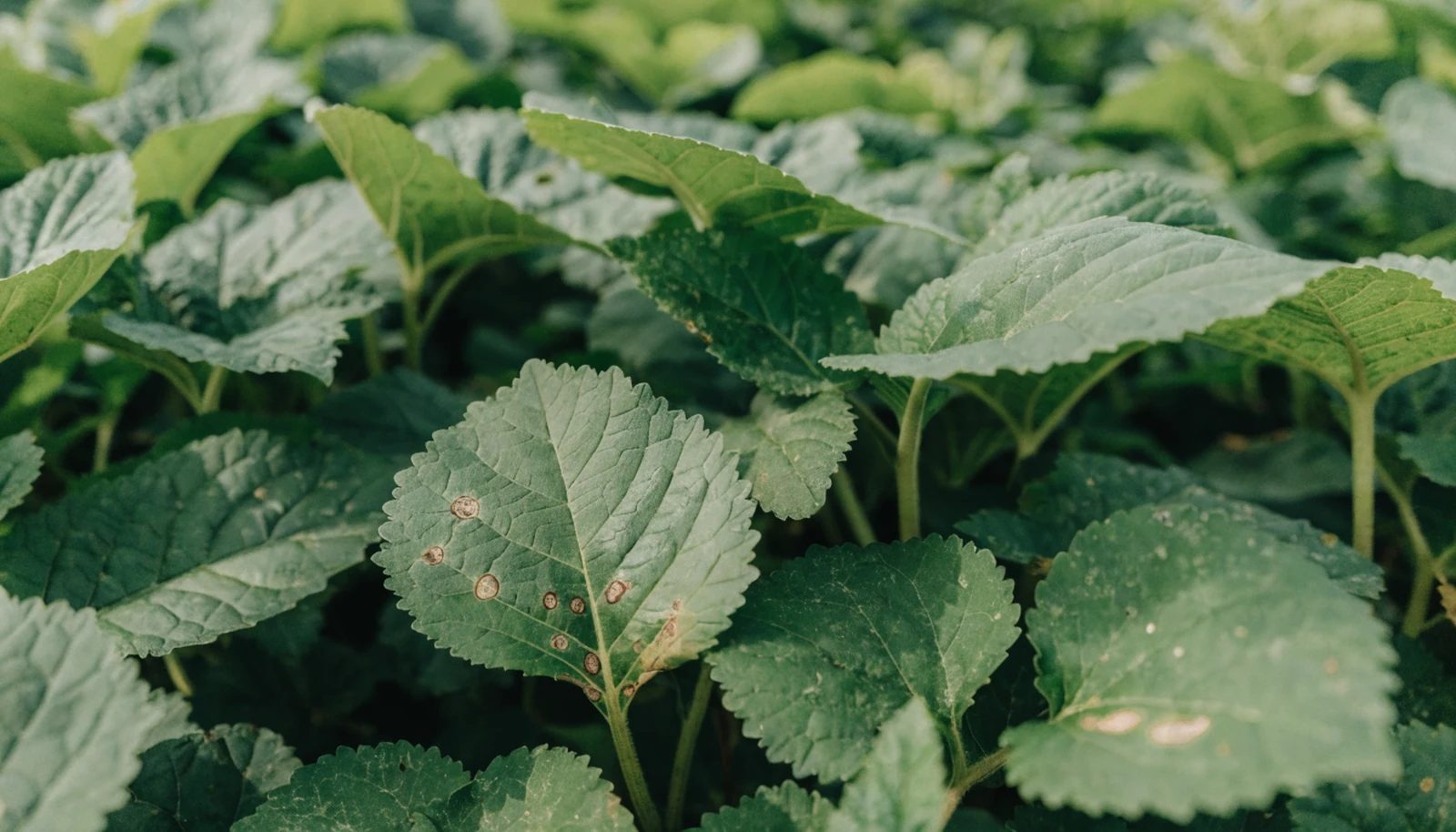
Crops affected
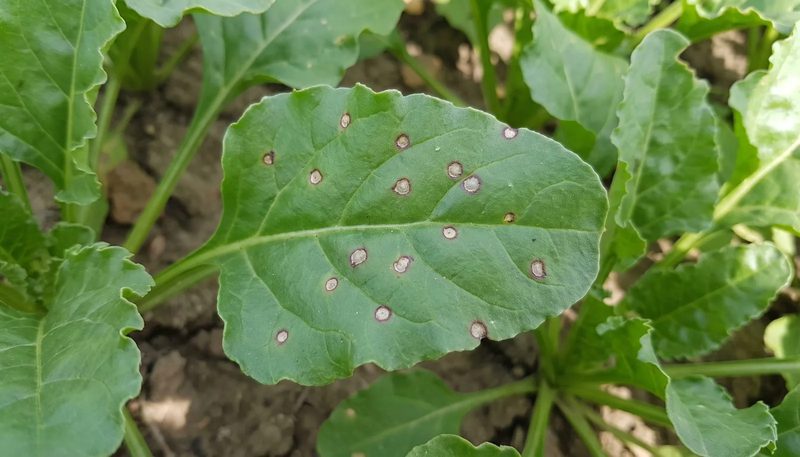
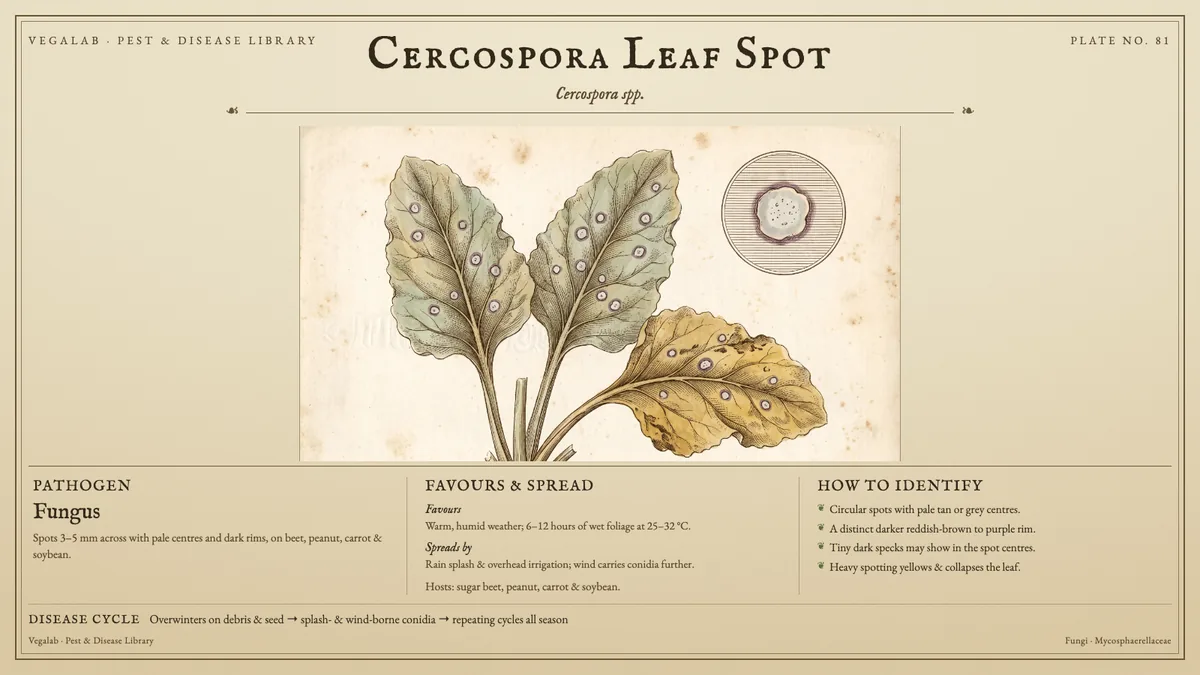
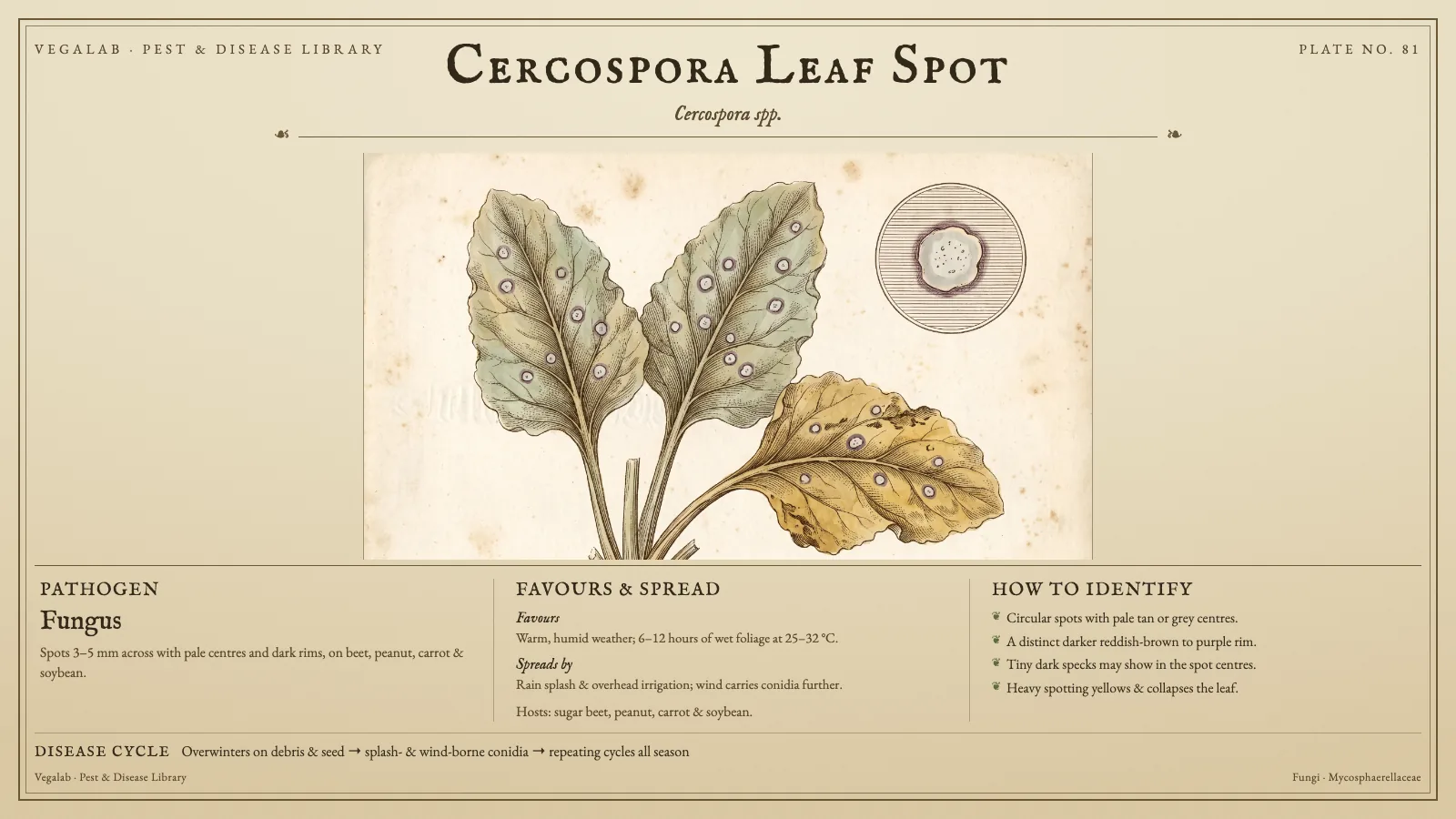
Cercospora Leaf Spot at a glance
- Heavy spotting yellows & collapses the leaf.
How to Identify Cercospora Leaf Spot
- Sugar beet and table beet: circular spots 3 to 5 mm across, tan or grey centres with a reddish-brown to purple border. Heavily infected leaves yellow and collapse, exposing the crown to sunscald and secondary rots. Tiny dark specks (pseudostromata) may be visible in the lesion centres.
- Peanut: early leaf spot (C. arachidicola) produces tan lesions with yellow halos, mainly on the upper leaf surface. Late leaf spot (C. personatum) produces darker, nearly black lesions primarily on the lower surface. Both cause premature defoliation under high pressure.
- Carrot: oval to elongated water-soaked spots on older leaves, turning tan to brown with age. Severe infections defoliate the crop before harvest, reducing yield and storage quality.
- Soybean (frogeye): circular spots with a grey-brown centre and a reddish-purple border, 1 to 5 mm across. Favoured by warm nights and overhead irrigation; QoI-resistant strains are widespread in major soybean-producing states.
Symptoms vary by host but share a common pattern: circular spots with a pale or tan centre and a distinct darker border. Key characteristics by crop:
Disease Cycle and Spread
Cercospora is polycyclic: a single infected plant can generate multiple infection cycles in one season. Primary inoculum comes from infected crop debris in the field and, in some host-pathogen combinations, from infected seed. Rain splash and overhead irrigation spread conidia over short distances; wind disperses them further. Infection requires 6 to 12 hours of wet foliage at 25 to 32 degrees C. Because the latent period before visible lesions is 7 to 14 days, symptoms on the plant always lag real infection pressure. Begin protective applications before conditions favor infection, not after lesions appear.
Vegalab Spore Control for Cercospora Leaf Spot
Spore Control contains 1% thymol, a naturally occurring phenol with membrane-disruptive activity against a broad range of fungal pathogens. Its mode of action is independent of DMI (FRAC 3) and QoI (FRAC 11) fungicides. Published research shows thymol activity against Cercospora beticola remains consistent across isolates regardless of DMI or QoI resistance profile, supporting its use in a resistance-management rotation alongside conventional programs.
Spore Control applications are preventive. The product protects clean, uninfected tissue at the time of application. Applications cannot cure established lesions or reverse tissue damage already visible. For best results, begin applications before or at the very first sign of disease, and maintain a regular program through the period of peak disease risk.
| Use | Dilution | Product per 1,000 L water | Repeat interval |
|---|---|---|---|
| Preventive, early season or clean crop | 1:1,000 | 1 L | Every 7 to 10 days |
| High disease pressure, active outbreak | 1:500 | 2 L | Every 5 to 7 days |
Resistance Management
QoI and DMI resistance in Cercospora beticola has spread widely across beet-producing regions of North America and Europe. Rotating Spore Control with conventional fungicide FRAC groups preserves the efficacy of the full program. Because thymol acts through a different mechanism, it contributes to rotation diversity without duplicating the mode of action of the products it alternates with.
Always check the current product label for the maximum registered rate before application. Rates shown are for guidance; label directions govern. Product claims, registrations, and availability vary by jurisdiction.
Important information
Product claims, registrations, and availability vary by jurisdiction. Always consult the current product label for approved uses, rates, and safety instructions before use. This page does not constitute a registered label or a guarantee of efficacy.
Recommended Vegalab solution: Spore Control
Spore Control · natural broad-spectrum fungicide (1% thymol) applied preventively before and during periods of disease risk, on a 7 to 10 day interval and tightened to 5 to 7 days under high pressure; rotate with conventional FRAC groups.
| Role | Product | Use |
|---|---|---|
| Primary control | Spore Control |
Claims and product availability vary by jurisdiction. Always read and follow the product label.