

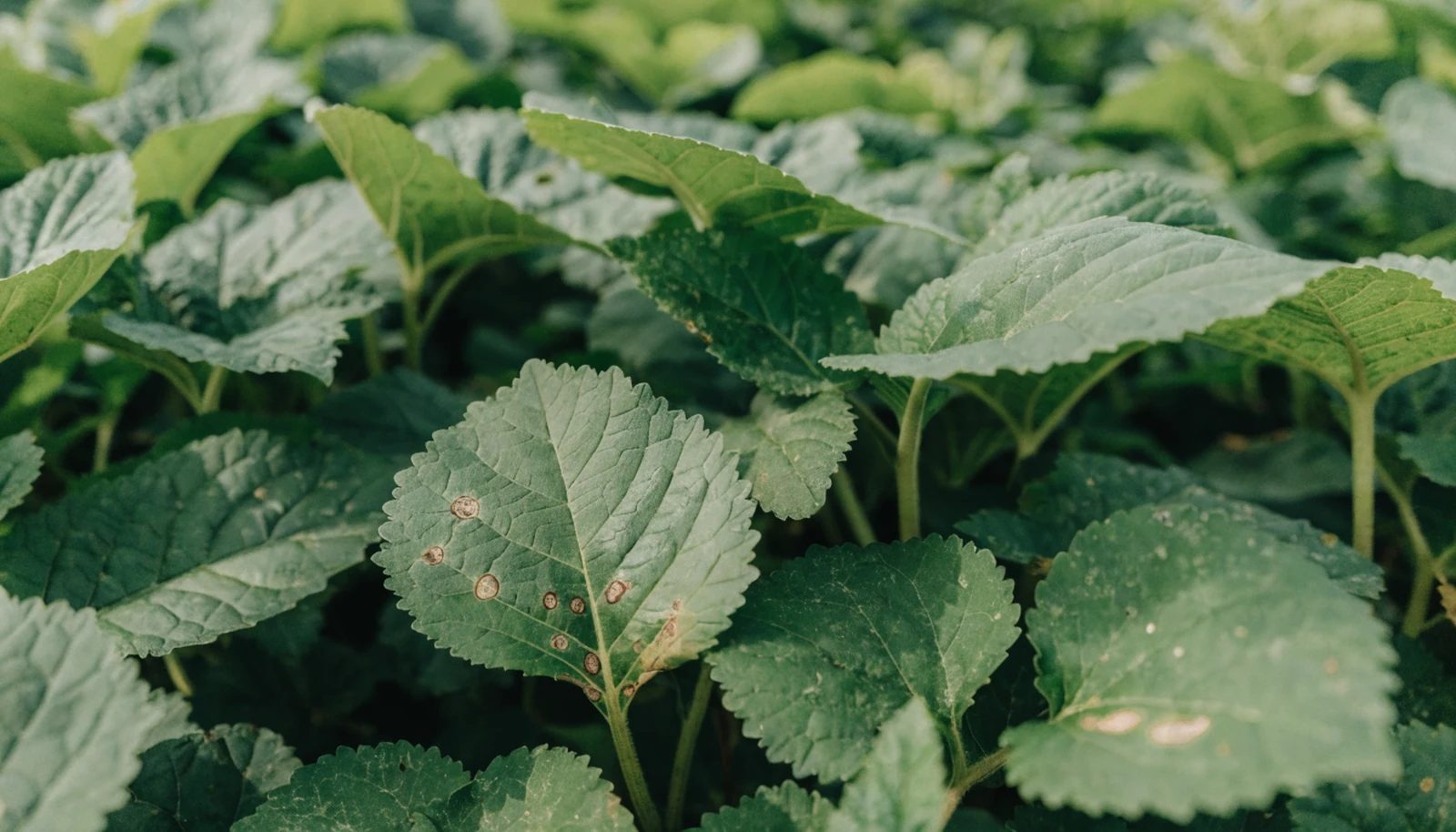
Crops affected
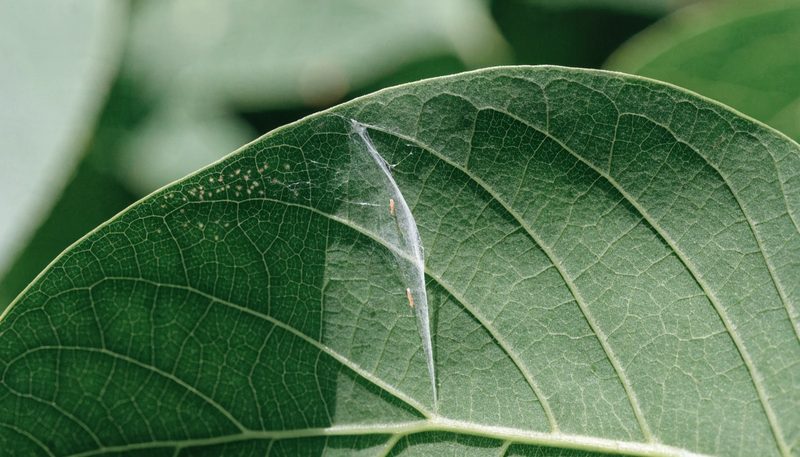
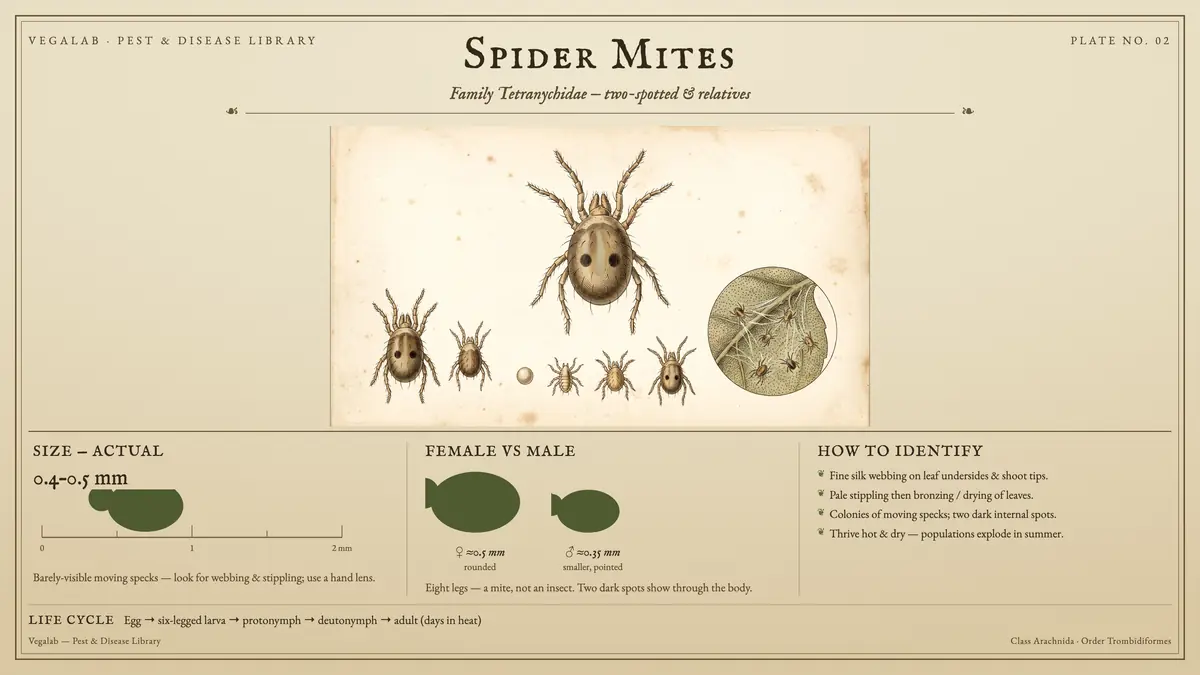
How to identify spider mites
Female and Male. ♀ ≈0.5 mm, rounded; ♂ ≈0.35 mm, smaller, pointed. Eight legs - a mite, not an insect. Two dark spots show through the body.
- Colonies of moving specks; two dark internal spots.
- Thrive hot & dry - populations explode in summer.
What are spider mites?
Spider mites (family Tetranychidae, most commonly the two-spotted spider mite, Tetranychus urticae) are sap-feeding arachnids 0.4–0.5 mm long. They cluster on leaf undersides, feeding through hundreds of punctures. Because they reproduce quickly - a generation in as little as a week in the heat - they are among the most damaging pests in greenhouses, high tunnels and warm-climate crops.
How to identify spider mite damage
- Stippling: fine pale or yellow speckling on the upper leaf surface
- Bronzing: leaves turn bronze or grey and dry out as feeding intensifies
- Webbing: fine silk on leaf undersides and between stems - a sign the infestation is advanced
- Tiny moving dots: mites visible on the leaf underside, easiest to see tapped onto white paper
Damage appears first in hot, dusty, drought-stressed spots. Scout leaf undersides weekly in warm weather.
Why spider mites are hard to control
Spider mites are notorious for resistance. Their short life cycle and huge populations mean survivors of a single-site spray pass on resistance rapidly, and many populations now resist multiple conventional miticide classes. Sprays also miss eggs and sheltered leaf undersides. Effective programs rotate modes of action, achieve thorough coverage, and target all mobile stages.
Managing spider mites naturally
- Cultural steps: avoid drought and dust stress, maintain humidity where practical, remove heavily infested material
- Coverage: direct spray to leaf undersides where mites and eggs concentrate
- Rotate modes of action: a physically-acting, nature-derived acaricide is a valuable rotation partner - no single biochemical site for mites to adapt around
Life cycle & spread
A female lays 100 or more eggs over her life, laying them on leaf undersides beside the feeding site. Eggs hatch into six-legged larvae, pass through two nymphal stages, and reach adulthood without any resting stage that a spray can be timed against.
Speed is the whole problem. At 30 °C a generation can close in about a week; at 20 °C it takes nearer three. A population that looks trivial at the start of a hot fortnight can be doing visible damage by the end of it, and overlapping generations mean eggs, nymphs and adults are all present at once - which is why a single knock-down application so often appears to work and then fails.
In temperate crops the mated females overwinter off-crop, in bark crevices, trellis structure and greenhouse framework, changing colour to a dull orange. They walk back onto the crop in spring. Sanitation of structures between crops matters more than growers expect for this reason.
Spider mites on plants: field, tunnel and houseplants
- Field: worst in hot, dry, dusty conditions, and along dusty headlands and track edges first
- Tunnel and greenhouse: continuous generations, no rainfall, and structures that harbour overwintering females
- Houseplants and nursery stock: low humidity and no natural enemies; infestations travel in on new plants
The pest is the same organism across every setting, but the pressure is not. In the open field, rain, wind and a full complement of predatory mites keep numbers down until a hot dry run removes all three brakes at once. Under glass or plastic there is no rain, less air movement and a stable warm temperature, so the generation time shortens and nothing interrupts it - which is why greenhouse crops and high tunnels see the worst outbreaks.
Houseplants sit at the extreme end of that gradient: warm, still, dry air, no predators, and often a plant that is already water-stressed. The management logic is the same in all three - raise humidity, remove the dustiest and most stressed plants from the middle of the block, and treat the leaf underside rather than the canopy top.
How to get rid of spider mites
- Confirm it is mites. Tap a suspect leaf over white paper and look for moving dots. Stippling alone is also caused by dust, spray scorch and early nutrient disorders.
- Raise humidity and wash the canopy where the crop allows it. Mites do badly in moving, humid air, and a hard water spray to leaf undersides removes a large share of a light population outright.
- Treat leaf undersides, not the canopy top. Coverage is the single most common reason a mite spray underperforms. Increase water volume and get the nozzles under the leaf.
- Repeat on the hatch interval. One application kills what it touches; the eggs behind it hatch within days. Plan the follow-up before you make the first pass.
- Rotate the mode of action across the season, and protect any predatory mites you have - a broad-spectrum insecticide that removes them usually makes the mite problem permanently worse.
There is no single-pass answer, because no product reaches every life stage and the eggs keep hatching. What works is a sequence, and the sequence matters more than the choice of any one input.
Populations flare after a broad-spectrum insecticide because the predators die faster than the mites recover. If an outbreak followed a spray for something else, that is usually the reason.
Treatment options compared
- Water and humidity management · free, no residue, no resistance risk. Reduces a light population and slows a heavy one; will not rescue a crop on its own.
- Insecticidal soaps and horticultural oils · contact only, no residual activity, cheap and low-residue. Effective on what they wet, which means coverage of the leaf underside decides the result.
- Botanical and essential-oil products · contact activity through the cuticle or the breathing pores. Low residue and short pre-harvest intervals; again coverage-dependent, and repeat applications are expected.
- Predatory mites · genuinely effective and self-sustaining in protected crops if introduced before the population runs away. Slow, and incompatible with most broad-spectrum chemistry.
- Conventional acaricides · fast and residual, but Tetranychus urticae is one of the most resistance-prone pests in agriculture, with documented resistance to most acaricide groups. Rotation is not optional.
Every option below has a place. The honest differences are in what they reach, how fast resistance builds against them, and what they cost in beneficials.
Neem oil for spider mites: what it does and what it misses
Neem oil is the most searched home and small-farm answer to spider mites, and it is not a bad one. It works two ways: the oil itself smothers what it coats, and azadirachtin acts as a growth regulator and antifeedant on the stages that survive.
The limits are worth stating plainly. Azadirachtin degrades quickly in sunlight, so residual activity is short. It is far weaker on eggs than on mobile stages, so the hatch behind an application is largely untouched. And oils can scorch a crop applied in heat or bright sun, or tank-mixed with sulphur - which is exactly when mite pressure peaks. Applied in the evening, to leaf undersides, on a 5–7 day interval, it does useful work. Applied once at midday over the top of the canopy, it will disappoint.
Insecticidal soap: where it works
Insecticidal soap disrupts the mite's cuticle and kills by desiccation. It has essentially no residual activity - once it dries, it is done - which is both its weakness and the reason resistance to it is not a practical concern.
That makes it a genuinely good fit for two situations: a light, early population you can wet thoroughly, and a pre-harvest window where residue matters and you need a short interval. It is a poor fit for a heavy infestation in a dense canopy, because you cannot wet enough of the leaf underside to matter. Water quality affects it too - hard water reduces activity, and soft water plus good coverage is most of the result.
Red spider mite and other species
"Red spider mite" usually means the same animal. Tetranychus urticae is called the two-spotted spider mite when it is pale green with two dark patches, and the red spider mite when overwintering females turn orange-red - one species, two names, depending on the season and who is talking.
Other species do behave differently, and they matter for product choice: the carmine spider mite (Tetranychus cinnabarinus) is a warm-climate pest of cotton and ornamentals; the citrus red mite (Panonychus citri) and European red mite (Panonychus ulmi) are perennial-crop pests that overwinter as eggs on wood rather than as adults in shelter, which changes the timing of a dormant application entirely. If you are treating a tree or vine crop, identify to species before you set a spray timing.
The eriophyid mites - rust, russet and blister mites - are a different family, far smaller, and cause bronzing and distortion rather than webbing. See Broad & Russet Mites, Apple Mite and Citrus Rust Mite.
Recommended Vegalab solution: Spider Mite Control
Vegalab Spider Mite Control is a natural terpenoid acaricide built on the nano-encapsulation platform, formulated to act on all mobile mite stages with residual activity. Because its mode of action is physical rather than a single biochemical target, it fits resistance-management rotations. For mixed mite pressure (spider, broad and russet mites), MultiMite Control provides broad-spectrum cover. Both are designed for standard foliar application with zero pre-harvest and zero re-entry interval. Results vary by crop, region and pressure; claims and availability vary by jurisdiction - always read and follow the applicable product label.
| Role | Product | Use |
|---|---|---|
| Primary control | Spider Mite Control | Contact miticide / insecticide |
| Companion / broader pressure | MultiMite Control | Broader mixed mite & insect pressure |
| Plant support | Armour Boost | Silica for tissue resilience |
By crop
Claims and product availability vary by jurisdiction. Always read and follow the product label.