

Crops affected
How to identify leaf miners
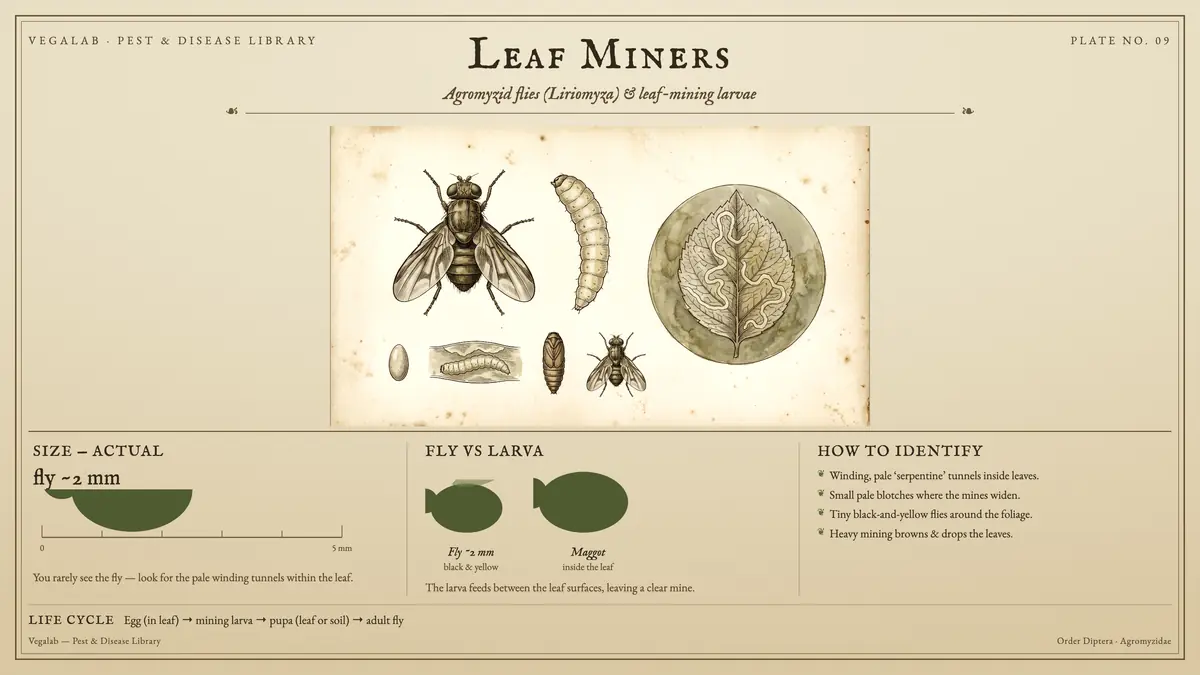
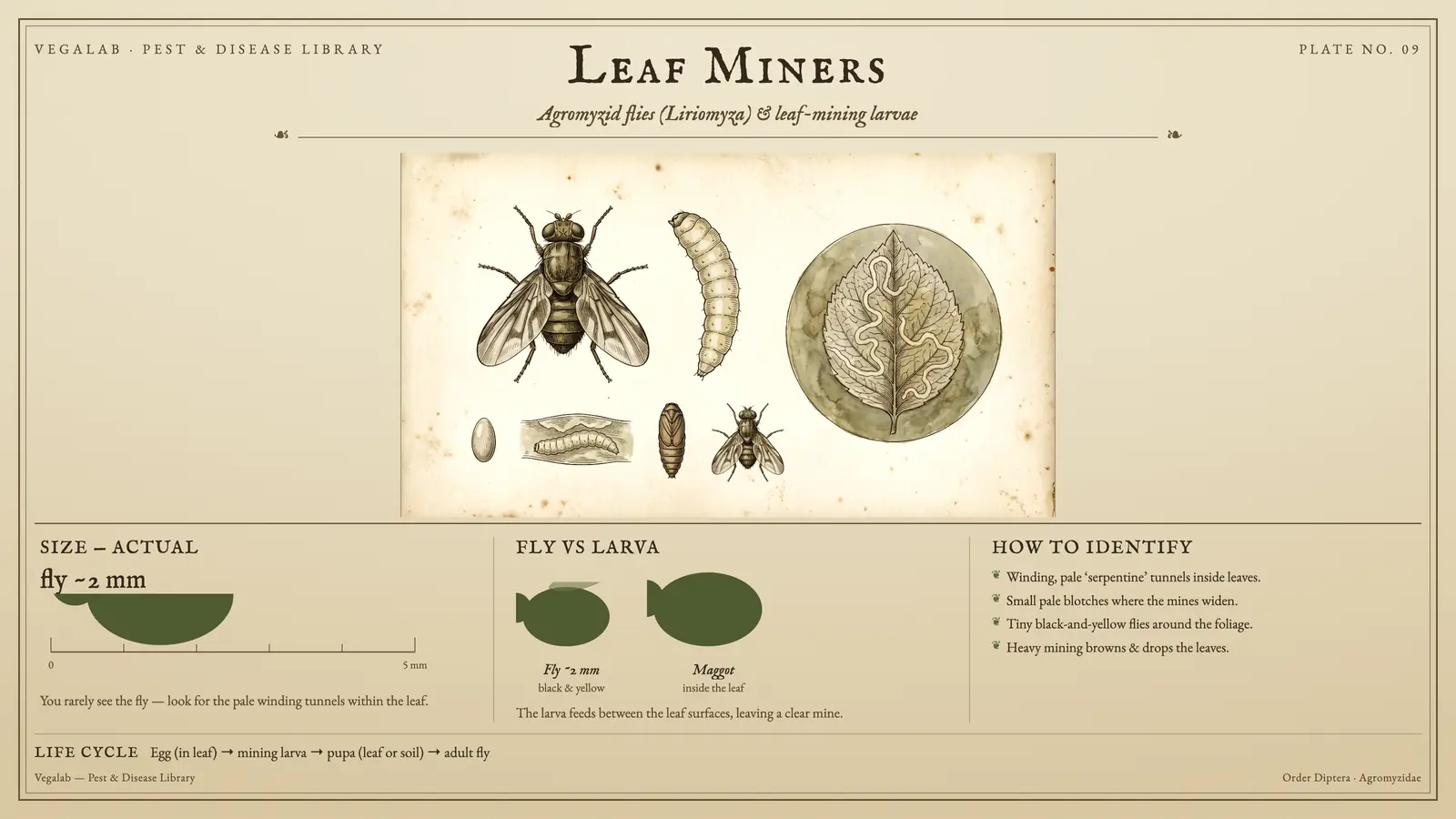
Size. fly ~2 mm You rarely see the fly - look for the pale winding tunnels within the leaf.
Fly and larva. Fly ~2 mm, black & yellow; Maggot, inside the leaf.
- Tiny black-and-yellow flies around the foliage.
- Heavy mining browns & drops the leaves.
What is it?
Leaf miners are the larvae of various flies, moths, and beetles that feed inside leaf tissue. Adults lay eggs in or on the leaf; the hatching larvae tunnel between the leaf surfaces, creating the characteristic mines. Several generations can occur in a season, especially in warm conditions and greenhouses.
How to identify it
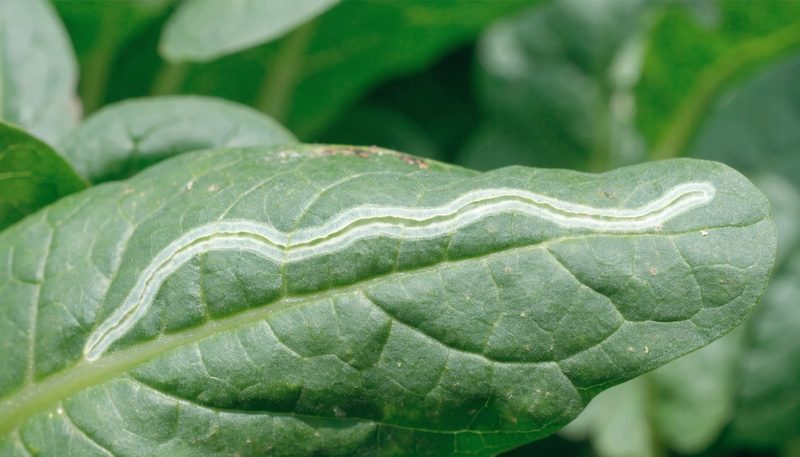
- Winding, whitish or translucent tunnels (mines) within the leaf
- Blotchy pale patches where mines widen
- Tiny larvae visible inside the mines when held to the light
- Reduced vigor and unsightly damage on leafy crops and ornamentals
Life cycle & spread
The adult is a small fly, moth or beetle depending on the group. Females puncture the leaf to feed and to lay, and those feeding punctures - small pale stipples on the upper surface - are often the earliest sign, visible before any mine.
The larva hatches inside the leaf and feeds between the upper and lower surfaces, so it is physically enclosed in plant tissue for its entire feeding life. The mine widens as the larva grows, which is why a mine tapers: the narrow end is where it started. Most species then exit to pupate in the soil or leaf litter; some pupate inside the mine.
A generation can complete in two to three weeks in warm weather, and populations build through overlapping generations across a season. Because the feeding stage is inside the leaf and the pupal stage is usually in the soil, only the adult and the egg-laying female are exposed at all.
Damage and how it spreads
By destroying leaf tissue, leaf miners cut photosynthesis and stunt plants, and on leafy vegetables and ornamentals the cosmetic damage alone makes the crop unsellable. Heavy mining on young plants is especially damaging. Because larvae are sheltered inside the leaf, control is most effective against eggs, emerging larvae, and adults.
How to control it
- Remove and destroy mined leaves to reduce the next generation.
- Use sticky traps to monitor and reduce egg-laying adults.
- Protect parasitic wasps, which are important natural enemies of leaf miners.
- Apply a natural larvicide when adults and young larvae are active, repeating for successive generations.
How to control leaf miners
- Remove and destroy mined leaves early, while infestation is light. This physically removes the larvae, and on a small block it is often sufficient on its own.
- Target the adults, and time it. Yellow sticky traps indicate when flights begin; applications aimed at adults before egg-laying prevent mines that no later spray can reach.
- Choose products with translaminar movement if a spray is warranted - a purely surface-active product will not reach a larva inside the leaf.
- Protect the parasitoids. Leaf miners are heavily parasitised by Diglyphus and Dacnusa wasps, and in protected crops these often hold the population on their own. Broad-spectrum insecticides remove them and reliably make leaf miner worse - this pest is a classic secondary outbreak after spraying for something else.
- Use floating row cover on susceptible vegetable crops to keep the egg-laying adults off entirely.
- Cultivate and manage litter after harvest to disrupt pupae in the soil.
- Tolerate cosmetic damage where you can. On a mature crop the yield effect of moderate mining is small; the cost is appearance. On seedlings and leafy salad it matters much more.
The larva is protected inside the leaf, which rules out most contact products for the stage doing the damage. Effective programmes target the adult, exploit translaminar movement, or remove mined tissue.
Insecticide resistance is well documented in Liriomyza leaf miners, and outbreaks are frequently created by removing their natural enemies. Rotation and restraint both matter.
Which leaf miner do you have?
- Serpentine leaf miners (Liriomyza spp., flies) · winding, snaking mines in vegetables, beans and ornamentals; the main protected-crop group
- Vegetable leaf miner and tomato pinworm · mines that later become surface blotches or move into fruit; see Leafminers & Tomato Pinworm
- Citrus leaf miner (Phyllocnistis citrella, moth) · silvery serpentine mines with a central frass line and curled young leaves; damage also opens the door to citrus canker
- Blotch leaf miners on apple and pear (moths) · irregular patches rather than lines
- Beet and spinach leaf miner (Pegomya spp.) · large blotch mines in beet, chard and spinach, where the leaf is the product
Mine shape is the quickest field diagnostic: a narrow line that widens is a fly miner; an irregular patch is usually a moth or a later-stage blotch miner.
Neem and spinosad: what reaches a larva inside a leaf
This is the honest answer growers searching for a leaf miner spray need. A contact product - insecticidal soap, horticultural oil, a simple pyrethrin - cannot reach a larva sealed inside leaf tissue. Against mines already present, those products do nothing useful, and applying them anyway is where most disappointment with "organic leaf miner control" comes from.
Neem is different in degree: azadirachtin has some translaminar movement into the leaf and also deters egg-laying, so it has a real if partial effect on early mines and a better one used preventively. Spinosad likewise has translaminar activity and is effective against Liriomyza larvae, but it is also toxic to the parasitoid wasps doing much of the work - a trade worth making deliberately rather than by default. Where the crop is not the leaf itself, the cheapest effective tool remains picking off mined leaves and protecting the parasitoids.
Recommended Vegalab solution: Larva Control
Vegalab Larva Control (oxymatrine) targets leaf-mining larvae as part of its broad larvicidal spectrum, killing on contact or ingestion and acting as an anti-feedant, with a 0-hour REI. Larva BioControl offers a biological alternative for rotation. Time applications to adult activity and young larvae, and reapply for successive generations; remove badly mined leaves alongside spraying.
| Role | Product | Use |
|---|---|---|
| Primary control | Larva Control | Natural larvicide (foliar) |
| Companion / broader pressure | Larva BioControl | Biological larvicide / rotation partner |
By crop
See crop-specific solutions
Preventing it next season
Monitor with traps, remove mined leaves promptly, conserve parasitic wasps, and keep plants vigorous. Rotating Larva Control and Larva BioControl supports resistance management.
Claims and product availability vary by jurisdiction. Always read and follow the product label.