


What does neem oil do for plants?
Last updated:
Neem oil is a plant-derived pesticide from neem tree seeds, used for centuries to control plant pests and diseases1. Sprayed on leaves, it smothers soft-bodied pests such as aphids and spider mites on contact, its azadirachtin deters feeding and disrupts insect growth, and it controls mild to moderate powdery mildew1,3,5,7. It acts only where the spray lands, and its azadirachtin breaks down on leaves within days1,4.
What is neem oil made of?
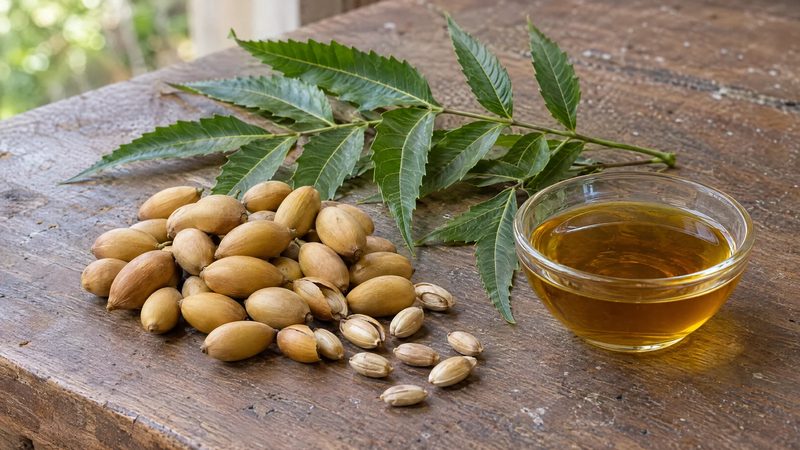
Neem oil comes from the seeds of the neem tree (Azadirachta indica). It is yellow to brown, tastes bitter and smells of garlic or sulfur, and it has been used for hundreds of years against pests and diseases1. Neem oil and its purified components appear in over 100 pesticide products, applied to many crops and ornamental plants1.
It is a mixture, not a single compound. Azadirachtin, a limonoid concentrated in the seed kernels at roughly 4 to 6 grams per kilogram of seed, is the most active component against insects1,2. When azadirachtin is extracted, the portion left over is called clarified hydrophobic neem oil, made mostly of fatty acids and glycerides1. That oil fraction is largely free of azadirachtin but still has fungicide and insecticide effects, and many over-the-counter neem products sold in garden centers contain it3. The active ingredient line on the label tells you which form a product contains.
| Component | What it is | How it acts on pests |
|---|---|---|
| Azadirachtin | Limonoid concentrated in neem seed kernels2 | Deters feeding, disrupts growth and molting, reduces egg laying1,2 |
| Clarified hydrophobic neem oil | Oil left after azadirachtin is extracted; fatty acids and glycerides1 | Insecticide and fungicide effects of the oil fraction3 |
| Other neem triterpenoids | Related compounds such as nimbin and salannin found in seed extracts2 | Antifeedant activity, especially against caterpillars2 |
In North America, interest in neem oil peaks in June, at the start of the main garden pest season, and on hot days oil sprays should not go on above 90°F. In the Southern Hemisphere, the same window falls around December and January.
How does neem oil kill or stop pests?
Neem works in two ways at once. As an oil, it blocks the breathing pores (spiracles) of insects it coats, so they die from lack of air, and oils can also disrupt feeding3. As a source of azadirachtin, it reduces feeding, repels insects and interferes with their hormone systems, which makes it harder for them to grow and lay eggs1.
Azadirachtin suppresses the insect hormones that control molting and development, which shows up as reduced pupation, malformed insects and adults that fail to emerge4. Its feeding-deterrent effect varies widely between insect groups: caterpillars respond to very low concentrations, while most beetles, true bugs and aphids are less sensitive to it as a deterrent2. The growth-disrupting effects are more consistent across species, and they, rather than feeding deterrence, are the main reason neem controls pests2.
The azadirachtin route works only on insects that eat treated plant tissue1. In a laboratory study, green peach aphids developed resistance to pure azadirachtin over 40 generations but not to whole neem seed extract4.
Does neem oil work on spider mites and aphids?
Yes, as a contact spray. For spider mites, University of California guidance lists insecticidal soaps and oils, including plant-based oils such as neem, as the preferred selective treatments5. Oils must contact the mites to kill them, so thorough coverage, especially of leaf undersides, is essential, and repeat applications may be needed5.
For aphids, the same guidance names soaps and oils, including neem, as the best insecticide choices for most situations6. They kill mainly by smothering, so infested foliage needs complete coverage, top and underside6. Neem oil kills only the aphids present on the day it is sprayed, so applications may need repeating6. Sprays can kill natural enemies that are hit directly, but they leave no toxic residue, so beneficial insects that arrive later are not affected6.
Azadirachtin also cuts aphid reproduction: in laboratory diet studies, female aphids fed low concentrations showed a sharp drop in fecundity within 48 hours2. Oils applied during the growing season also control whiteflies and young scale insects3.
Does neem oil work on powdery mildew?
Neem oil controls mild to moderate powdery mildew infections7. Oils work best as eradicants, clearing existing growth, with some protective activity, whereas most other low-toxicity fungicides, such as sulfur, are mainly preventive7. Neem oil products have been effective against several types of powdery mildew and rust3.
Timing and compatibility matter. Never apply an oil spray within 2 weeks of a sulfur spray, because the combination can injure plants, and never spray oils when temperatures are above 90°F or on drought-stressed plants7. Follow the product label for intervals and any plant-specific precautions.
Does neem oil get rid of fungus gnats?
Not on its own. Fungus gnats (Bradysia species) breed in moist potting mix, and their larvae live in the top 2 to 3 inches of the growing medium8. Short-lived contact sprays, including neem, do not give lasting control of adult gnats and need repeating every couple of days to have an effect8. Larvae in the growing medium are not directly affected by sprays aimed at the adults8.
The most important step is letting the top 1 to 2 inches of growing medium dry between waterings, which reduces egg and larval survival and makes the pot less attractive to egg-laying females8. For the larvae, Colorado State University Extension points to a drench of the insect-parasitic nematode Steinernema feltiae or of Bacillus thuringiensis subsp. israelensis (Bti), and yellow sticky cards trap adults8.
What are neem oil's risks to people, pets, bees and fish?
For people, neem oil can be slightly irritating to the eyes and skin, and azadirachtin can be very irritating to the skin and stomach1. Most of the remaining oil is fatty acids and other substances common in the diet1. Follow the product label for protective clothing and handling.
Cats are a specific concern. In other countries, neem oil applied to cats for flea control has caused adverse reactions including drooling, trembling and convulsions, and some cats died1. Keep neem products off pets and follow the label for re-entry once plants are sprayed.
Neem oil is rated practically non-toxic to birds, mammals and bees, partly because insects must eat treated plant tissue to be affected1. Researchers have questioned that view for natural enemies and pollinators, and long-term laboratory exposure to azadirachtin affected bumblebee reproduction4. Neem oil is slightly toxic to fish and aquatic organisms, and azadirachtin is moderately toxic to them, so keep spray and runoff away from ponds and streams1.
| Who is exposed | What the sources report |
|---|---|
| People handling it | Neem oil slightly irritating to eyes and skin; azadirachtin can be very irritating to skin and stomach1 |
| Cats | Adverse reactions, some fatal, after neem oil was applied for flea control1 |
| Bees and other pollinators | Practically non-toxic in fact sheet ratings; chronic laboratory exposure affected bumblebee reproduction1,4 |
| Fish and aquatic life | Neem oil slightly toxic; azadirachtin moderately toxic1 |
| Plants | Precautions on impatiens, fuchsia, hibiscus, some roses, ornamental olive and some carnations3 |
Key takeaways
- Neem oil is a seed-derived pesticide: the oil smothers soft-bodied pests and its azadirachtin disrupts insect feeding and growth.
- It works on spider mites and aphids only where the spray makes contact, so leaf undersides and repeat applications matter.
- It controls mild to moderate powdery mildew, but never within 2 weeks of sulfur or above 90°F.
- For fungus gnats, drying the top of the potting mix does more than neem sprays.
- Keep it off cats and out of water, where azadirachtin is moderately toxic to fish, and follow the product label.
References
- Neem Oil General Fact Sheet
- Azadirachtin from the neem tree Azadirachta indica: its action against insects
- Insect Control: Horticultural Oils (Fact Sheet 5.569)
- Azadirachtin-Based Insecticide: Overview, Risk Assessments, and Future Directions
- Pest Notes: Spider Mites (UC ANR Publication 7405)
- Pest Notes: Aphids (UC ANR Publication 7404)
- Pest Notes: Powdery Mildew on Vegetables (UC ANR Publication 7406)
- Fungus Gnats as Houseplant and Indoor Pests (Fact Sheet 5.584)
Frequently asked questions
How do you use a neem oil spray on plants?
How long does neem oil last on leaves?
Can neem oil damage plants?
Does neem oil kill caterpillars?
Caterpillars are the insects most sensitive to azadirachtin's feeding-deterrent effect, responding at under 1 to 50 parts per million depending on the species2. Many neem oil products are clarified oil that is largely free of azadirachtin, so check the active ingredient on the label before relying on it for caterpillars3.