

Crops affected
How to identify caterpillars
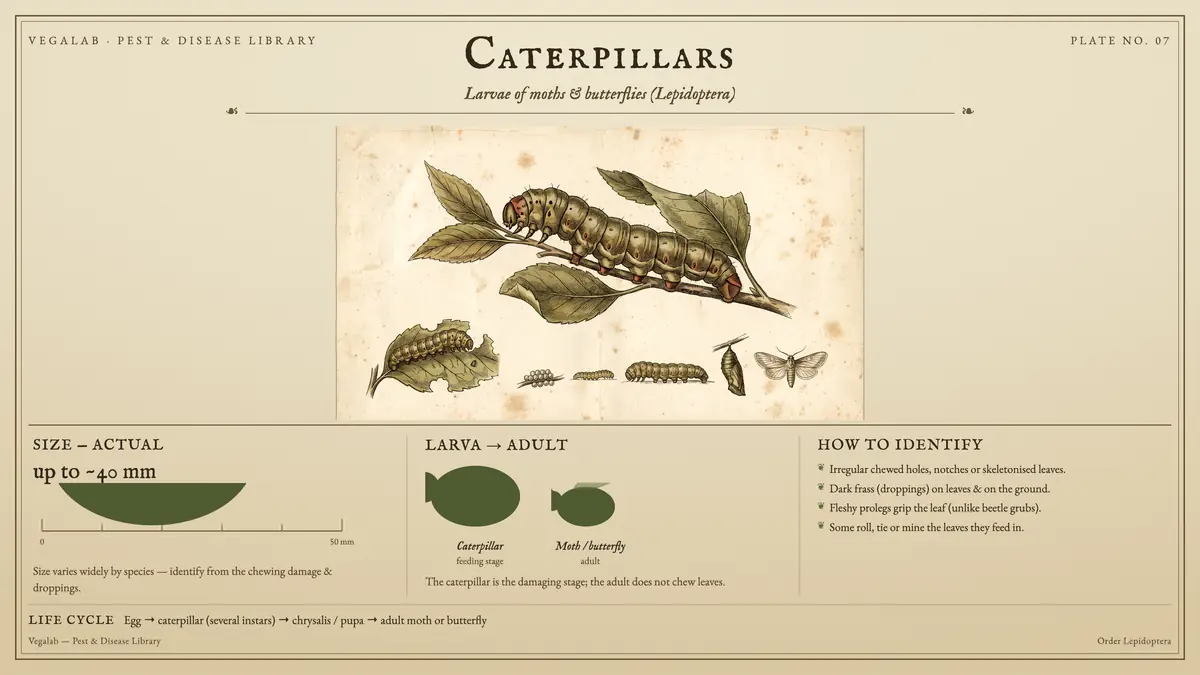
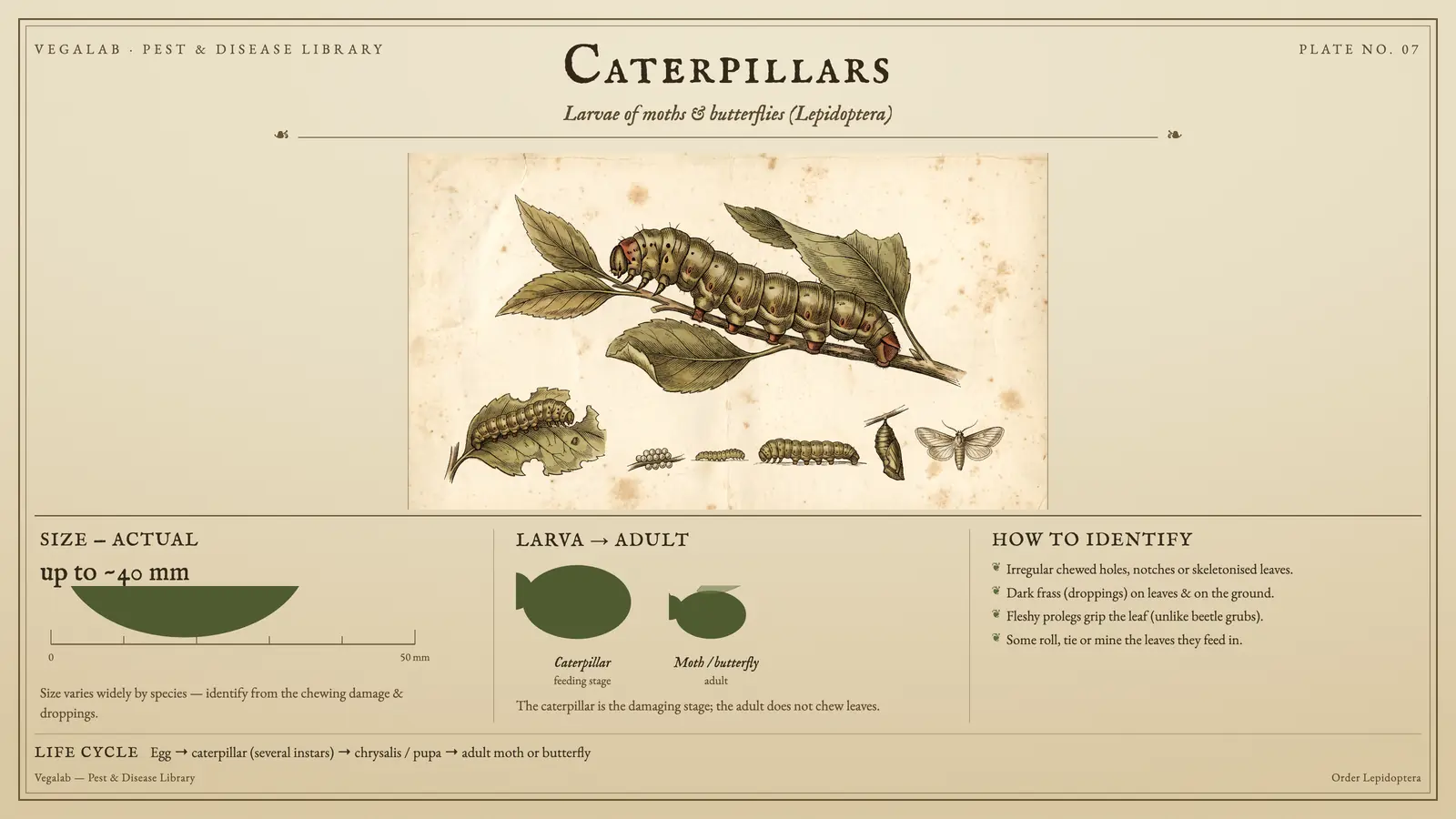
Size. up to ~40 mm Size varies widely by species - identify from the chewing damage & droppings.
What are crop-damaging larvae?
"Larvae" covers the immature, feeding stage of many insect pests - caterpillars (the larvae of moths and butterflies such as armyworms, loopers, budworms and hornworms) and the grubs of some beetles. It is this stage, not the adult, that consumes plant tissue. Larvae are most vulnerable to control when small, before they burrow into protected sites or reach later, tougher instars.
How to identify larval damage
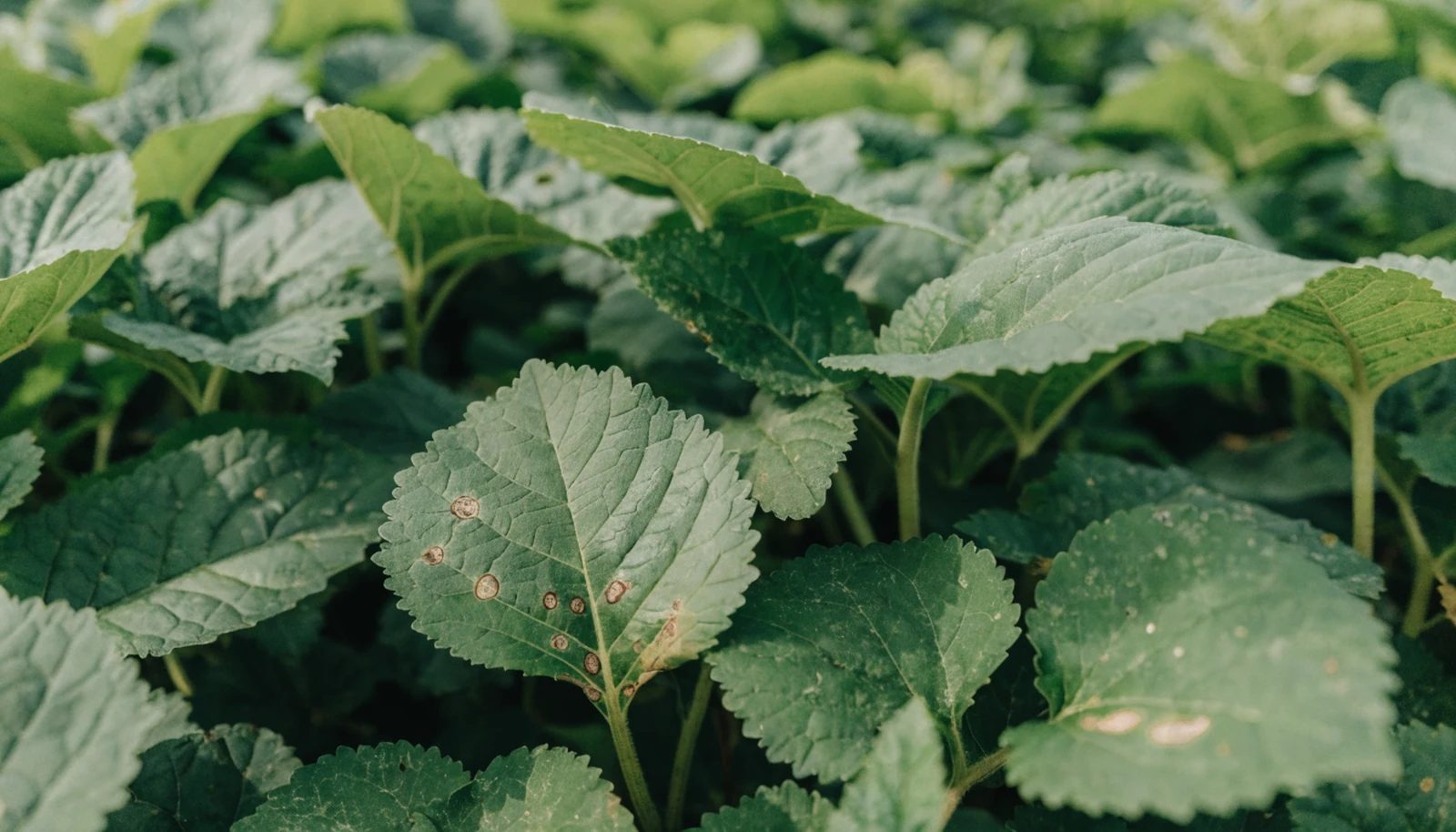
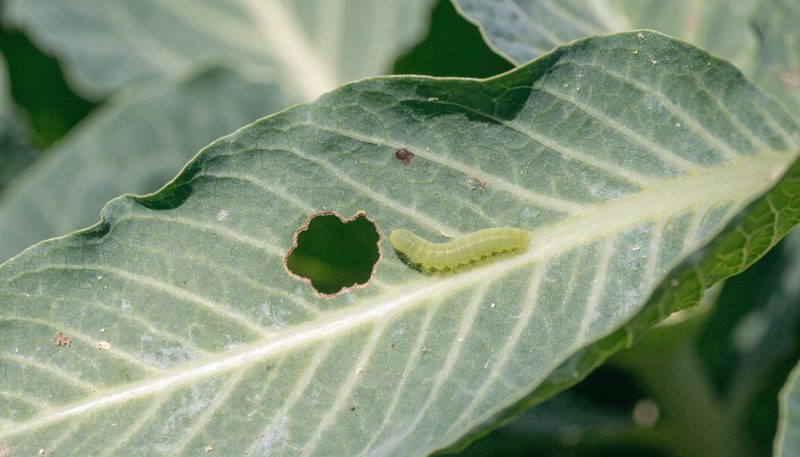
- Ragged holes, chewed leaf margins, and skeletonised leaves
- Frass (dark droppings) on leaves and in leaf whorls
- Boring holes in fruit, pods or stems, sometimes with entry wounds and rot
- The larvae themselves · on leaf undersides, in growing points, or at the soil line
Scout for eggs and small larvae early; controlling young stages is far more effective than fighting large larvae after damage is done.
Why timing matters
Larval populations build quickly and later instars are harder to control and cause the most damage. Monitoring - including for adult flights where relevant - lets you target the vulnerable early larval window. Rotating modes of action protects the tools you have from resistance.
Life cycle & spread
This entry covers the caterpillar stage of many moth and butterfly species, so the details vary - but the shape is consistent and it is the shape that matters for management. Adults lay eggs on or near the host; the larva passes through four to six instars; and it then pupates, either in the soil, in a cocoon on the plant, or in debris.
Two generalisations hold across almost all of them and drive every decision. First, **the last two instars eat the great majority of the total**, so control applied to small larvae prevents most of the damage. Second, the pupal stage is a non-feeding refuge that no foliar application reaches, which is why cultivation, residue management and trapping of adults carry so much of the load.
Generation number varies from one a year in cool climates to continuous under protection and in the tropics. Where generations overlap, all instars are present at once and there is no clean spray window.
Conditions that favour it
Warmth accelerates development for essentially all species. Populations build where hosts are available continuously, where flowering weeds feed the adults, and where residue and volunteers bridge between crops.
The most consistent risk multiplier is broad-spectrum insecticide use, because caterpillars are among the most heavily parasitised pest groups. Removing the parasitoid and predator complex reliably produces worse caterpillar problems than leaving it alone.
Monitoring & scouting
Use pheromone traps to detect adult flights before larvae exist - this is the warning that lets you act on small larvae rather than large ones.
Scout at dawn or dusk, and inspect growing points, leaf undersides and the harvested part of the crop. Record instar as well as number, because the treatable window is defined by size.
Look for frass, which is often visible before the larvae are, and distinguish it from slug damage by the absence of slime.
How to control caterpillars
- Identify the species, or at least the group. Whether it feeds openly on leaves, bores into fruit, cuts stems at ground level or hides in a whorl decides where and when to treat - and those four behaviours need four different placements.
- Treat small larvae. This is the single most repeated lesson in caterpillar management: early instars are far easier to kill and have eaten almost nothing yet.
- Use Bt where it fits. Bacillus thuringiensis is effective, highly selective and leaves the natural enemies alive. It must be ingested, works on small larvae, and degrades in sunlight - so evening application, good coverage and repeat intervals.
- Protect the parasitoids and predators. Braconid and ichneumonid wasps, Trichogramma, predatory bugs and birds take a large share. Broad-spectrum sprays are the main cause of caterpillar outbreaks.
- Hand-pick on small plantings. Genuinely effective for large conspicuous species, and free.
- Use exclusion netting on high-value vegetable and salad crops.
- Cultivate and manage residue to disrupt pupae in the soil - one of the few measures that reaches that stage.
- Set the threshold on the harvested part. Leaf feeding on a mature plant is usually cosmetic; a larva in a head, pod or fruit is the loss.
Caterpillars are the pest group where biological and cultural control performs best. Reaching for a broad-spectrum insecticide is often what turns a minor problem into a recurring one.
Caterpillar, sawfly larva, or slug?
- Caterpillar (moth/butterfly larva): up to five pairs of fleshy prolegs on the abdomen, each tipped with tiny hooks; leaves dark frass pellets
- Sawfly larva: looks like a caterpillar but has six or more pairs of prolegs without hooks, and typically rears its tail end when disturbed; often feeds in groups
- Beetle larva: three pairs of true legs and no abdominal prolegs at all; many are soil-dwelling grubs
- Slug or snail: no legs, no frass, silvery slime trails, irregular smooth-edged holes
Proleg count separates caterpillars from sawflies, which matters because Bt does nothing to sawfly larvae · they are not Lepidoptera. See Slugs & Snails.
Where to look, by feeding habit
- Open leaf feeders (loopers, cabbageworms, armyworms): scout the canopy and leaf undersides; contact and Bt applications work if timed to small larvae
- Fruit and pod borers (bollworm, codling moth, fruit moths): scout the fruiting structures; the larva is exposed for hours only, so timing to egg hatch is everything
- Stem and whorl borers (stem borers, fall armyworm in maize): the larva sits in a protected funnel or tunnel; high water volume directed into the whorl, or systemic activity, is required
- Cutworms: feed at night at the soil line and hide in soil by day; treat the soil surface and stem base, not the canopy
- Leaf miners and rollers: larva inside leaf tissue or a rolled leaf; contact products largely fail, and removal of affected tissue often beats spraying
Deeper entries: Armyworm & Cutworm, Cabbage Looper, Diamondback Moth & Cabbage Caterpillars, Stem Borers, Leaf Miners.
Recommended Vegalab solution: Larva Control
Vegalab Larva Control is a natural broad-spectrum larvicide built on the nano-encapsulation platform, targeting caterpillars and larvae across a wide range of field and greenhouse crops. Its botanical actives are delivered for effective contact and coverage, and it is formulated to fit integrated programs and spare beneficial insects and pollinators when used as directed. It carries zero pre-harvest and zero re-entry interval. Results vary by crop, pest species, region and pressure; claims and availability vary by jurisdiction - always read and follow the applicable product label.
| Role | Product | Use |
|---|---|---|
| Primary control | Larva Control | Natural larvicide (foliar) |
| Companion / broader pressure | Larva BioControl | Biological larvicide / rotation partner |
Claims and product availability vary by jurisdiction. Always read and follow the product label.