

Last updated:
Navel orangeworm (Amyelois transitella) is a small gray moth whose larvae develop inside almonds, pistachios and walnuts. It overwinters as larvae in mummy nuts, flies three to four times a year, and lays eggs on split or damaged nuts. Control rests on removing mummies by February 1, mating disruption, and covering nuts from almond hull split or pistachio hull slip through harvest.
Crops affected
How to identify navel orangeworm
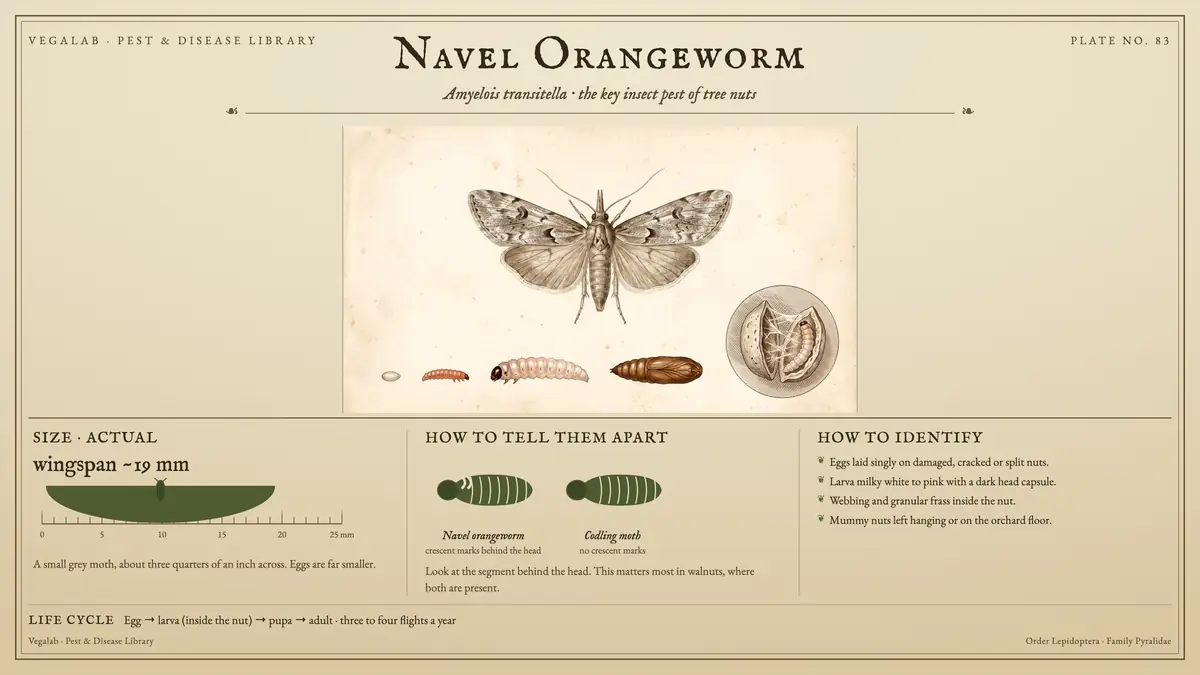
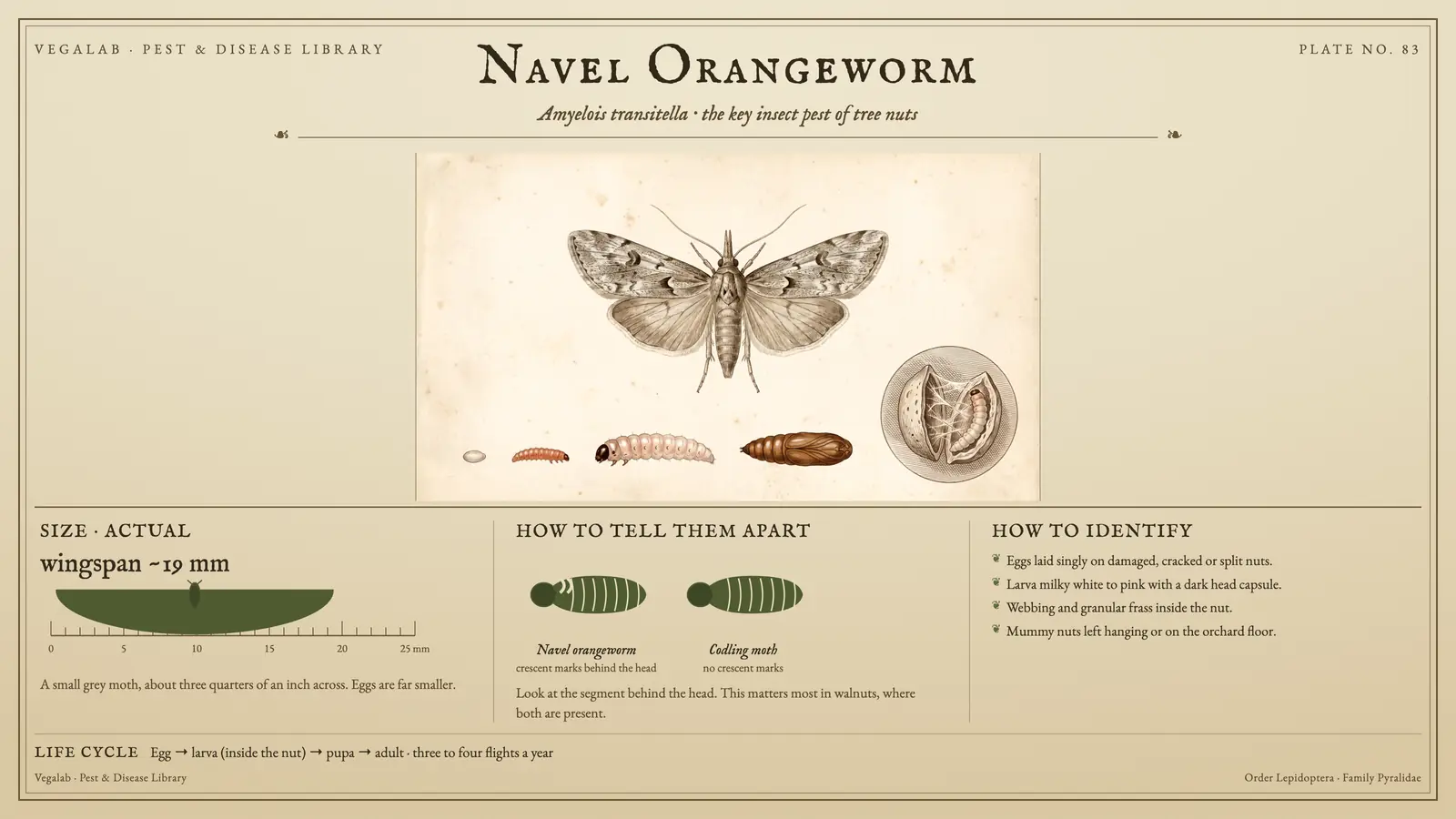
Size. wingspan ~19 mm A small gray moth, about three quarters of an inch across. Eggs are far smaller.
When should you treat navel orangeworm in each crop?
Timings follow the UC IPM Pest Management Guidelines for each crop. The windows differ, and the difference matters more than the product does:
| Crop | Key window | What is happening |
|---|---|---|
| Almond | Hull split, no later than 1 percent split | Nuts become susceptible the moment the hull opens |
| Almond | 14 to 21 days after hull split begins | Second window under moderate to high pressure |
| Almond | Hull split through shake | The pre-harvest window, where conventional intervals close |
| Pistachio | Late June to early July | Second flight; treated under severe pressure |
| Pistachio | August, at hull slip | About 2,100 degree-days from first egg lay, roughly a month before harvest |
| Pistachio | September, pre-shake | Fourth flight and delayed-harvest cover |
| Walnut | Hull split through harvest | Timed to the local flight; often overlaps codling moth |
What is it?
Amyelois transitella is a pyralid moth whose larvae develop inside the nut. It completes three to four flights a year and overwinters as larvae inside unharvested “mummy” nuts, either still hanging in the tree or lying on the orchard floor. It is never in the soil at any stage.
Females lay 100 to 200 eggs, placed directly onto nuts that are already damaged, cracked, split or mummified. Eggs hatch in 4 to 23 days depending on temperature, so within a single flight the egg population is a continuous smear across several weeks rather than one pulse. Larvae enter the nut shortly after hatching and remain inside until they emerge as adults.
That last point governs everything about managing it. The insect is reachable by a spray only while the egg sits on the hull surface and while the newly hatched larva crosses to the split. Before that it is a flying moth. After that it is behind a shell. Coverage of the nut and hull surface, and holding that surface treated across the egg-laying window, is what separates a program that works from one that does not.
What are the signs of navel orangeworm?
- Eggs · flattened and oval, laid singly on the hull surface, white at first and turning reddish-orange shortly before hatch.
- Larvae · reddish-orange when newly hatched, later milky white to pink, with a dark head capsule and a pair of crescent-shaped marks on the segment behind the head. Those crescents separate it from codling moth and peach twig borer.
- Inside the nut · webbing and granular frass, usually the first thing a grower notices.
- Mummy nuts · nuts still hanging after harvest, or on the orchard floor, are the overwintering site and the best single predictor of next season's pressure.
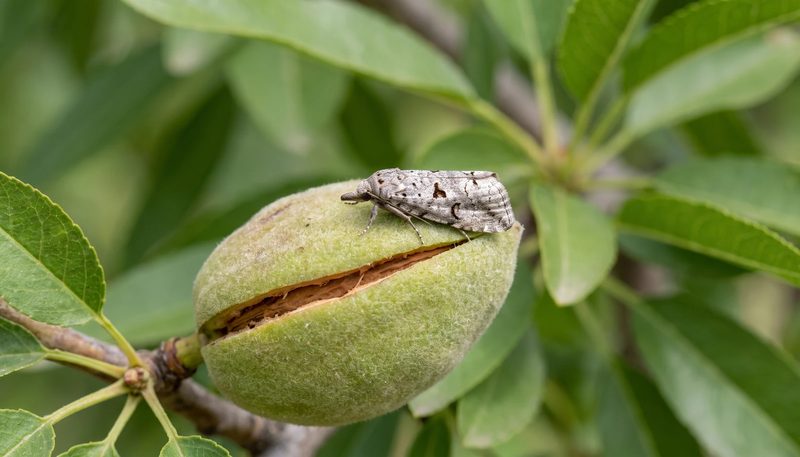
- Adults · gray mottled moths roughly three quarters of an inch across, active at dusk, caught in pheromone traps.
- At harvest · tunneled kernels with webbing and frass, counted as reject percentage on the grade sheet.
What is the navel orangeworm life cycle?
Larvae overwinter inside mummy nuts, in the tree or on the orchard floor, never in the soil. Three to four flights follow through spring and summer; females mate and lay within nights, onto damaged and split nuts. Nuts become susceptible only when the hull splits, and the eggs land on the hull with the neonates walking to the split. Once inside the nut, nothing sprayed can reach them.
What damage does navel orangeworm cause?
The direct loss is the tunneled kernel. The larger loss is what follows it. Female navel orangeworm carries Aspergillus flavus and introduces it while laying, and the damaged kernel is the substrate the fungus grows on. Aflatoxin is a regulated carcinogen policed tightly in EU and Asian markets, so navel orangeworm damage is a market-access problem as much as a yield problem.
On a well-run program reject rates run around 1.9 to 2.1 percent. With mating disruption in place they can approach 1 percent. Closing that gap is worth roughly 131 to 201 dollars per acre depending on nut price, which is why the program below is worth running properly.
How do you control navel orangeworm?
- Winter sanitation. Remove mummy nuts before bud swell. In the central and southern San Joaquin the standard is no more than 0.2 mummies per tree in the tree and 8 per tree on the ground by 1 February; in the northern San Joaquin and Sacramento valleys, under 2 per tree. Blow or sweep to row centers and destroy by discing or flail mowing by 1 March. Nothing else moves damage as far.
- Mating disruption. Hang dispensers midway up the tree in late March or early April. Published kernel damage reductions run 35 to 53 percent.
- Monitor. Pheromone traps at one per 50 acres, minimum two per orchard, at 6 to 8 feet in early March. Egg traps baited with almond presscake at one per 10 acres in almond and one per 5 acres in pistachio, checked once or twice weekly. Biofix is set when egg numbers rise across two consecutive samplings or when half the traps carry eggs. First-brood hatch follows about 100 degree-days after biofix.
- Treat the susceptible window. In almond, the beginning of hull split, no later than 1 percent, determined by sound fruit in the top south-western quadrant just beginning to split. In pistachio, hull slip in August. Add further applications through the window where pressure warrants.
- Hold the window to harvest. The pest keeps laying up to shake. This is the part of the season most programs leave uncovered, and it is where the Vegalab pass is designed to sit.
- Harvest promptly. As soon as good removal can be achieved. Delayed harvest is the most common reason a program that looked right on paper failed in the field.
Where the Vegalab pass fits
Vegalab sits inside an integrated program rather than replacing one. Sanitation and mating disruption do the heavy lifting; the hull-split program carries the rest. What Vegalab adds is the part of the season the rest of the program cannot reach.
Every conventional hull-split material carries a pre-harvest interval, commonly 7 to 14 days. Navel orangeworm keeps laying through that interval and up to shake. Spider Mite Control is a geraniol nanoemulsion with a zero pre-harvest interval and a zero re-entry interval, and its active carries a residue tolerance exemption under 40 CFR 180.1251. That is what makes an application right up to harvest possible at all.
Both products act on contact at the treated nut and hull surface, which is where the egg sits and where the newly hatched larva must cross. Neither is a nerve agent and neither carries a known cross-resistance to insect growth regulator or diamide chemistry, so both rotate cleanly into an existing program.
Recommended program
Fix the dilution first and let the water volume set the per-acre rate: it is the concentration on the nut surface that does the work. The figures below are stated at the recommended field standard of 200 gallons of water per acre.
| Role | Product | Rate | Timing |
|---|---|---|---|
| Foundation | Orchard sanitation and mating disruption | Not a Vegalab product | Mummies to standard by 1 February, destroyed by 1 March; dispensers from late March |
| Principal application | Spider Mite Control | 1:500 · 51 fl oz/acre at 200 gallons of water per acre | Almond: hull split, no later than 1 percent. Pistachio: hull slip, August |
| Repeat applications | Spider Mite Control | 1:500 · 51 fl oz/acre at 200 gallons of water per acre | Every 7 days through the susceptible window |
| Pre-harvest window | Spider Mite Control | 1:500 · 51 fl oz/acre at 200 gallons of water per acre | Up to shake. Zero PHI and zero REI |
| Coverage aid, optional | Jumping Worm Control | 1:800 · 32 fl oz/acre at 200 gallons of water per acre | In tank with the principal and repeat applications |
Application
Foliar spray into the canopy, targeting the nuts and hulls, at 200 gallons of water per acre. Tractor-mounted sprayer, every row and both sides. Never a soil application and never by air, because this pest is never in the soil. A contact residual is not a fourteen-day growth regulator, so hold the seven-day interval through the window rather than stretching it.
Always read and follow the applicable product label. Registrations, permitted uses and crop clearances vary by jurisdiction, and the label governs where it and this page differ.
How do you prevent navel orangeworm next season?
The whole of navel orangeworm prevention is winter sanitation and timely harvest. Count mummies in January, hit the standard for your region, destroy what you knock down before 1 March, and get the crop off as soon as it will shake cleanly. An orchard that starts the season clean needs less from every other step, including this one.
Important information
Product claims, registrations, and availability vary by jurisdiction. Always consult the current product label for approved uses, rates, and safety instructions before use. This page does not constitute a registered label or a guarantee of efficacy.
Recommended Vegalab solution: Spider Mite Control
Spider Mite Control · geraniol nanoemulsion at 1:500 (51 fl oz/acre at 200 gallons of water per acre), applied as a foliar spray onto the nuts from hull split through shake on a seven-day interval, with zero pre-harvest and zero re-entry interval. Jumping Worm Control may be tank-mixed as a coverage aid.
| Role | Product | Use |
|---|---|---|
| Principal application | Spider Mite Control | |
| Coverage aid, optional | Jumping Worm Control |
By crop
Key takeaways
- Nuts become susceptible only when the hull splits, and once larvae are inside no spray reaches them.
- Larvae overwinter in mummy nuts in the tree or on the orchard floor, never in the soil.
- In almond, treat at the beginning of hull split, no later than 1 percent split.
- In pistachio, the key timing is hull slip in August, about 2,100 degree-days from first egg lay.
- Delayed harvest is the most common reason a program that looked right on paper fails in the field.
Claims and product availability vary by jurisdiction. Always read and follow the product label.