

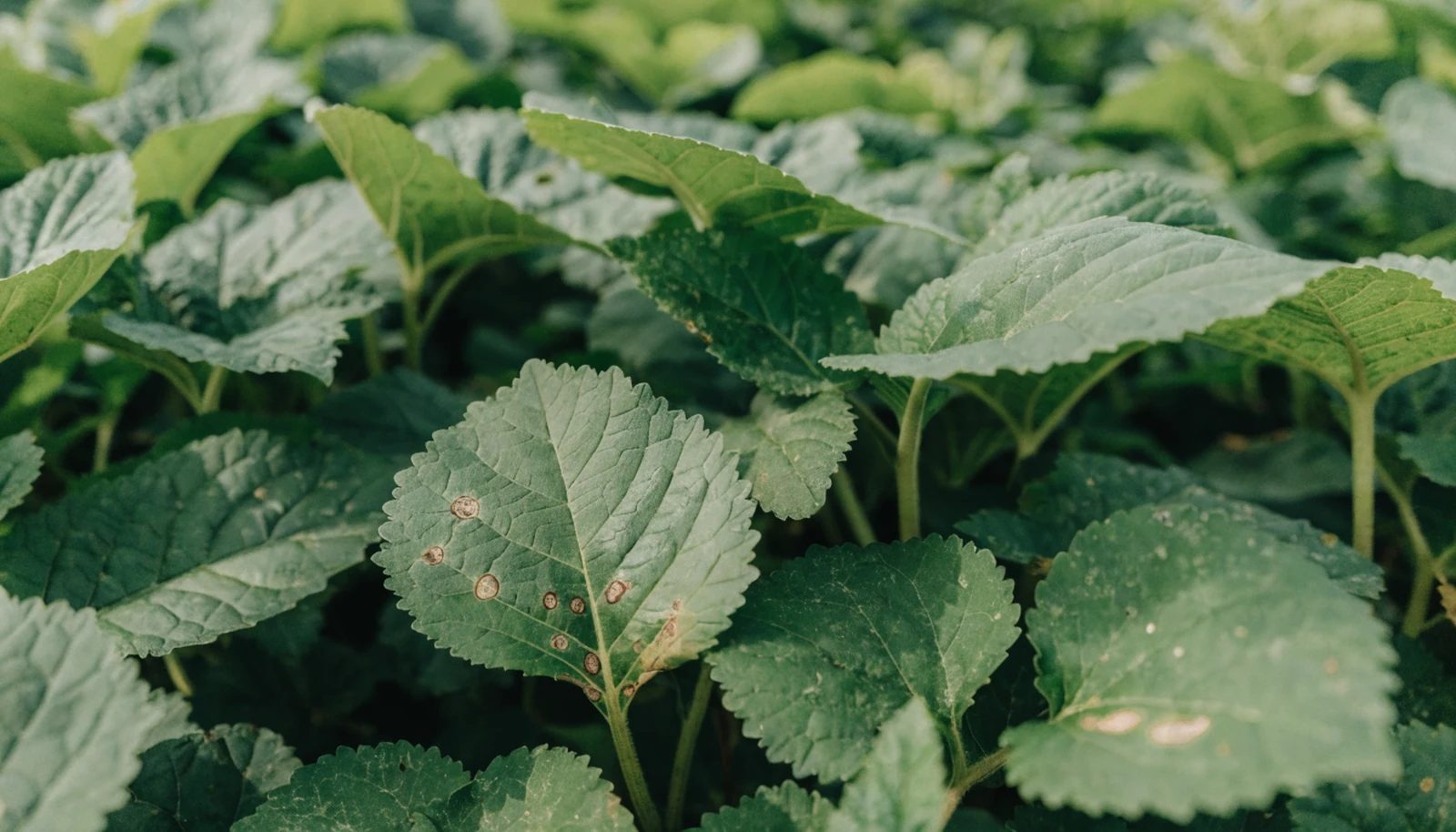
Crops affected
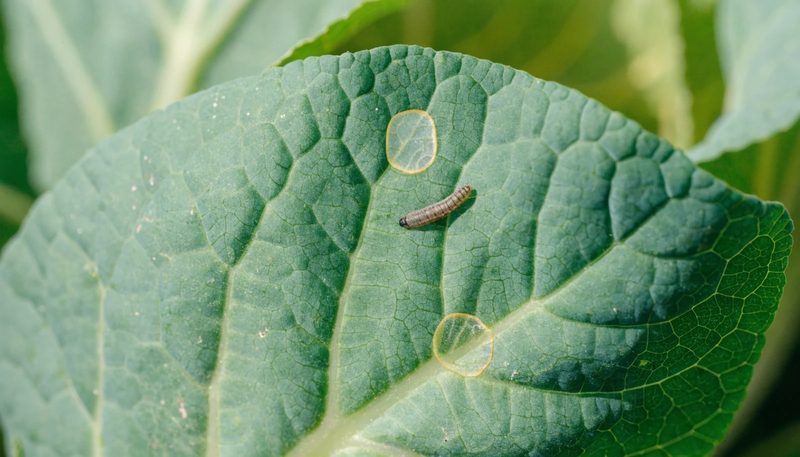
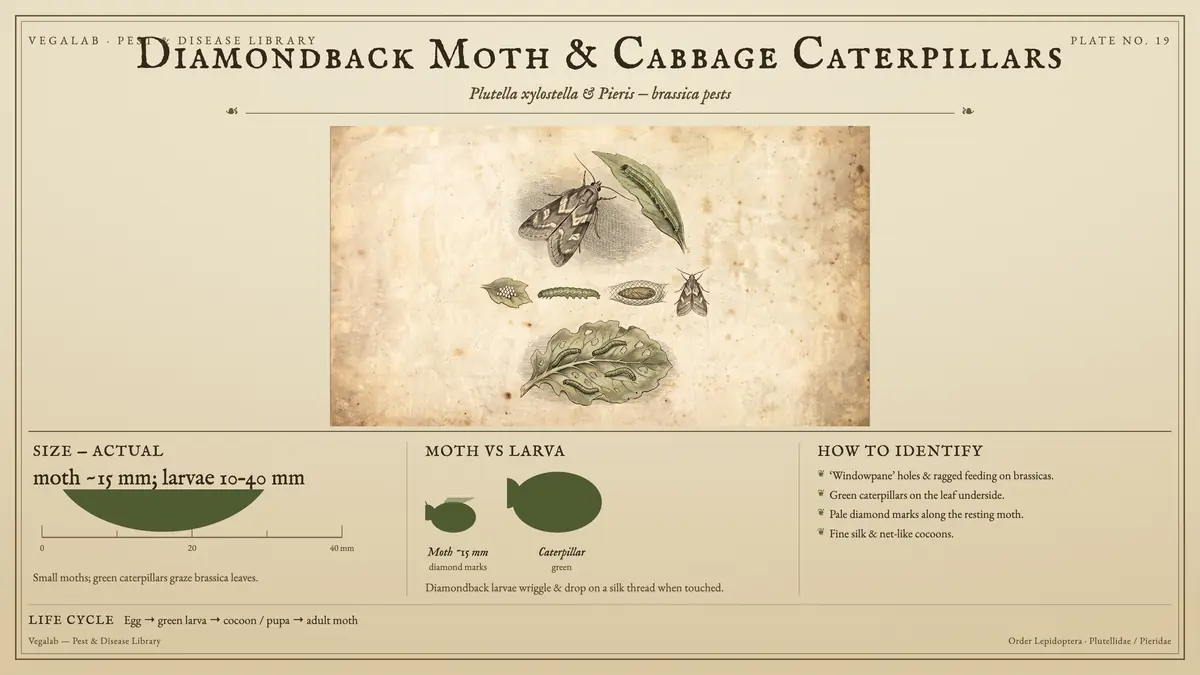
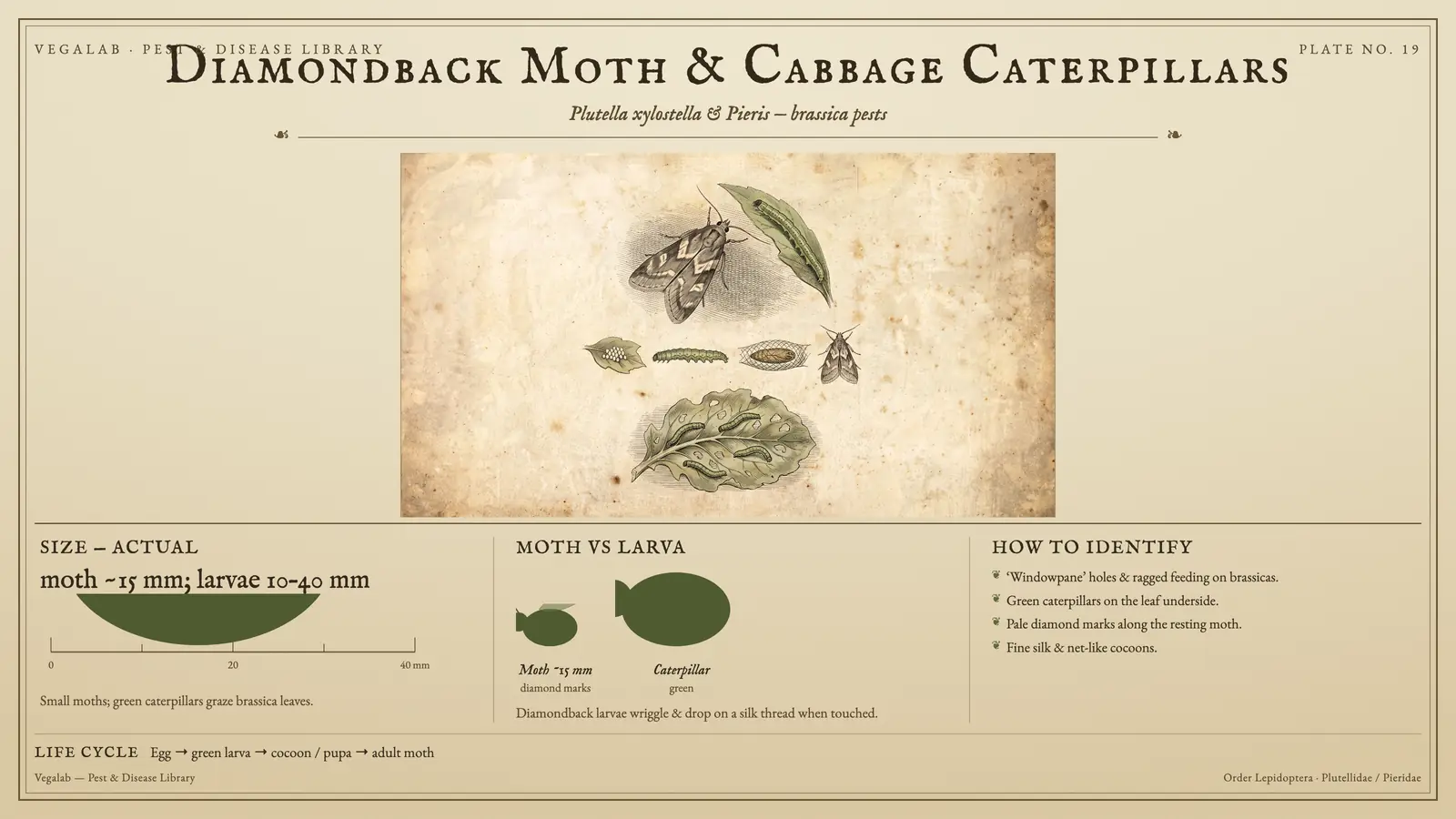
How to identify diamondback moth & cabbage caterpillars
Size. moth ~15 mm; larvae 10 - 40 mm Small moths; green caterpillars graze brassica leaves.
- Pale diamond marks along the resting moth.
What is it?
Diamondback moth is a small moth whose larvae feed on brassica foliage; it is notorious worldwide for evolving resistance to synthetic insecticides. The cabbage caterpillar complex (including loopers and webworms) causes similar leaf and head damage.
How to identify it
- Small green larvae that wriggle and drop on a silk thread when disturbed.
- 'Windowpane' feeding (one leaf surface left intact) progressing to shot-holes.
- Damage and frass in growing points and heads, contaminating produce.
- Tiny diamond-patterned moths fluttering over the crop at dusk.
Life cycle & spread
Rapid life cycle (as little as 2-3 weeks in warm weather) with many overlapping generations, which is why resistance develops so fast under repeated single-chemistry use.
Conditions that favour it
Warm weather, continuous brassica cropping, and heavy reliance on one insecticide class drive both numbers and resistance.
Damage and how it spreads
Defoliation and head contamination cut marketable yield; in seedlings, growing-point damage can kill plants. Resistance can render whole chemical classes ineffective.
Monitoring & scouting
Scout undersides and growing points for young larvae; use pheromone traps for moth flights; act on early instars.
How to control it
- Target early instars, rotate modes of action, and use a natural mode of action to slow resistance;
- conserve parasitoids that help suppress diamondback moth.
How to manage diamondback moth
- Rotate modes of action rigorously, and never apply the same group twice consecutively. This is not best practice for this pest - it is the difference between having options in five years and not.
- Break the host cycle. A genuine brassica-free period between crops, immediate destruction of residue, and control of volunteers and cruciferous weeds. This is the most effective single measure available.
- Protect the parasitoids. Diadegma and Cotesia wasps provide substantial natural control and are far more sensitive to broad-spectrum insecticides than the moth is. Many outbreaks are created by spraying.
- Use trap cropping. Indian mustard planted as a border is markedly more attractive to egg-laying females than the cash crop, concentrating the population where it can be treated or destroyed.
- Exclude with netting in high-value production.
- Time to small larvae, treat leaf undersides, and accept that coverage is difficult in a waxy brassica canopy - a wetter is usually necessary.
- Set thresholds on the harvested part. Windowing on outer wrapper leaves rarely matters; larvae or frass in the head is the loss.
Diamondback moth is one of the world’s most resistance-prone crop pests. Resistance is documented to many major insecticide classes and, in some populations, to Bt products; susceptibility varies by region and mode of action.
Rainfall is a genuine natural control - heavy rain drowns small larvae. Overhead irrigation has been used deliberately for this effect in some systems, though it trades against foliar disease risk.
Recognising the damage
- Windowing: larvae eat the lower leaf tissue and leave the upper epidermis, producing translucent patches that later tear through - the signature of this pest
- Open-mesh pupal cocoons on leaf undersides: loose, white, net-like, and quite unlike the solid cocoons of other brassica caterpillars
- Damage to growing points in seedlings and transplants, which is disproportionately costly because it destroys the head before it forms
- Contamination of heads, florets and hearts at harvest, which is the commercial threshold in most brassica crops
Also see Cabbage Looper. The wriggle-and-drop response plus the net-like cocoon confirm diamondback moth.
Why this pest broke insecticide resistance records
Diamondback moth is worth understanding as a case study, because the same conditions produce resistance in other pests and recognising them early is worth a great deal. Three factors combined here.
Generation speed. A fortnight from egg to adult means dozens of selection events per year, where a pest with two generations gets two. Resistance alleles that would take decades to spread in a slower insect spread in a few seasons.
Continuous host availability. Brassicas are grown in overlapping successions in most production regions, so there is no host-free period during which the population crashes and resistant individuals lose their advantage.
Repeated exposure to the same chemistry. Where a single effective product exists, it gets used every generation, which applies maximum selection pressure at maximum frequency.
The lesson generalises: any pest with fast generations, continuous hosts and repeated same-mode exposure will follow the same path. Where you can break one of the three - usually the host bridge - you slow the other two.
This is also why the cultural measures are the ones that hold. A brassica-free period reduces the population and dilutes resistant genotypes at the same time, which no product can do.
Trap cropping with Indian mustard
- Sow the trap crop before or with the cash crop, and re-sow in succession so young attractive growth is continuously available
- Site it on the windward edge and around block perimeters where moths arrive
- Treat or destroy the trap crop while larvae are still on it · this is the step that removes the generation
- Never let it senesce or be harvested with larvae present
- Scout it, not just the cash crop · it is also your early-warning indicator
Trap cropping is unusually effective against diamondback moth and it is worth describing properly, because it is one of the few tactics that works with the pest's behaviour rather than against its physiology - which means resistance cannot erode it.
Female diamondback moths strongly prefer Indian mustard (Brassica juncea) over cabbage, cauliflower and broccoli for egg-laying. Planted as a border or as interspersed rows, it draws a disproportionate share of the egg load away from the cash crop and concentrates the resulting larvae in a small, known area. That concentration is the point: it can then be treated intensively, mown, or destroyed, removing a large part of the generation in one operation on a fraction of the area.
The failure mode is predictable. If the trap crop is allowed to mature, senesce or be harvested while it is carrying larvae, it stops being a trap and becomes a nursery that releases a generation into the cash crop. Successive sowings, so that attractive young mustard is always present, are what make the technique reliable.
Because it exploits behaviour rather than biochemistry, trap cropping does not select for resistance. For the most resistance-prone pest in agriculture, that is a considerable advantage.
Recommended Vegalab solution: Larva Control
Larva Control · natural broad-spectrum larvicide (oxymatrine, from Sophora flavescens) applied at early-instar stage with good coverage of leaf undersides and growing points; its natural mode of action supports resistance management.
| Role | Product | Use |
|---|---|---|
| Primary control | Larva Control |
By crop
Preventing it next season
Rotation, mode-of-action rotation, conserving natural enemies, and treating young larvae before heads form.
Claims and product availability vary by jurisdiction. Always read and follow the product label.