

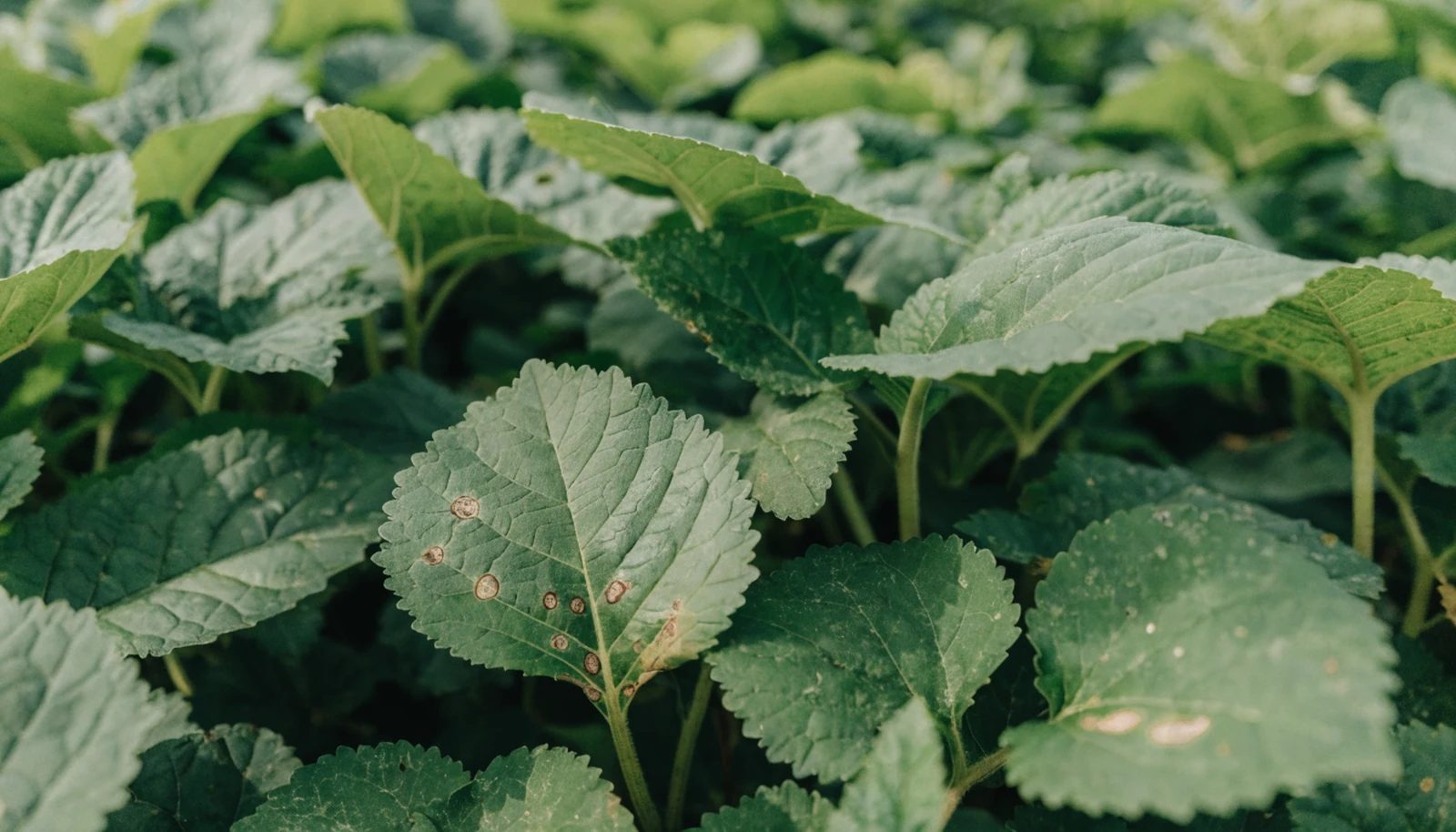
Crops affected
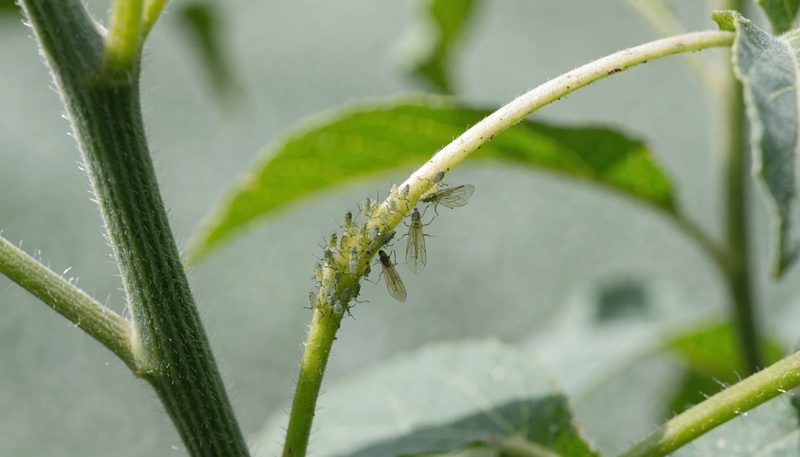
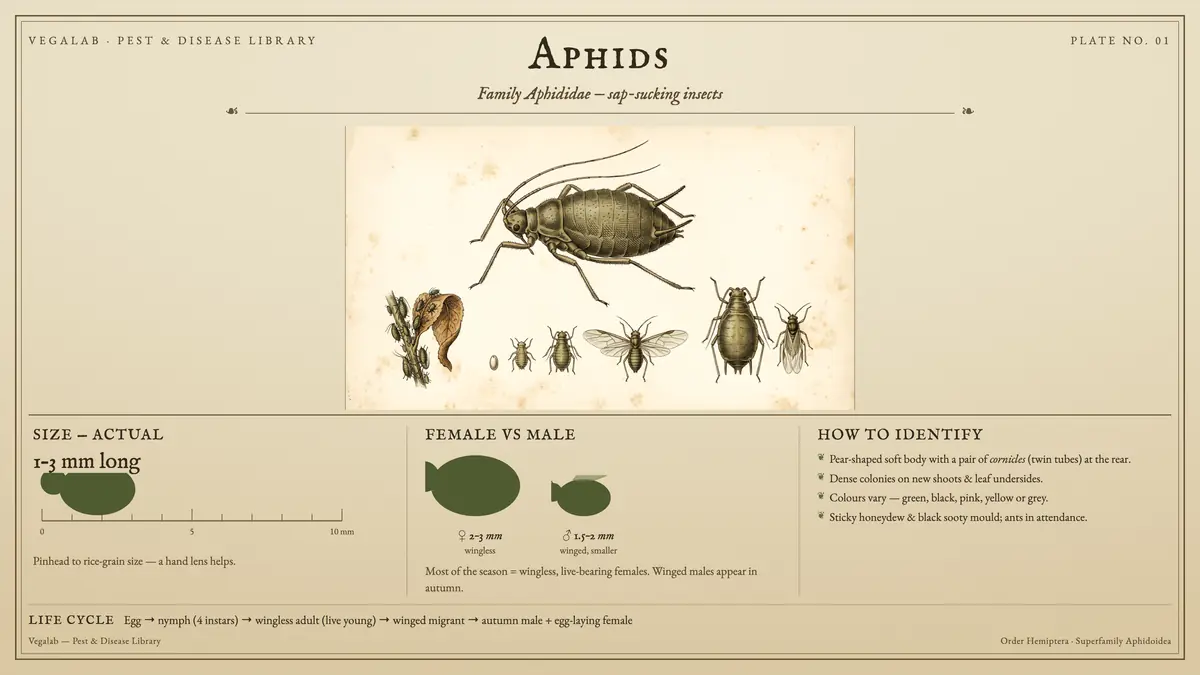
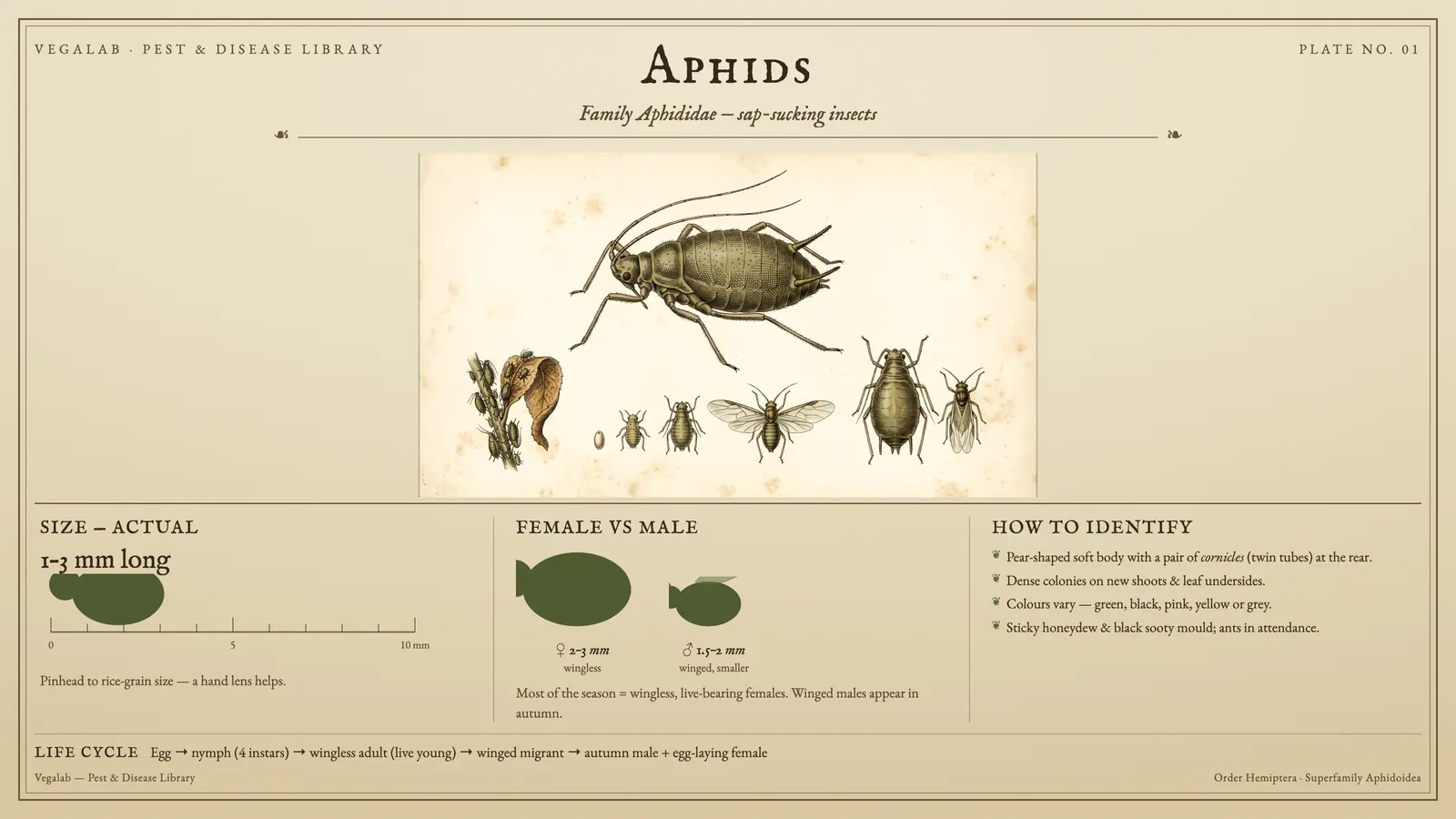
How to identify aphids
- Pear-shaped soft body with a pair of cornicles (twin tubes) at the rear.
What is it?
Aphids are small, soft-bodied insects (1–3 mm) that feed by piercing plant tissue and sucking sap. They cluster on tender new growth, shoot tips, and the undersides of leaves. They come in green, black, yellow, pink, and gray, and reproduce extremely fast - a single female can produce dozens of live young without mating, so colonies explode in days.
How to identify it
- Clusters on shoot tips and leaf undersides
- Curled, distorted new growth
- Sticky honeydew and black sooty mould
- Virus-like symptoms from feeding transmission
Life cycle & spread
Aphids have the most unusual reproductive strategy of any pest in this library, and it explains why they appear so suddenly. Through the growing season, females reproduce parthenogenetically and give birth to live young rather than laying eggs - no males, no eggs, no waiting. A nymph can reach reproductive age in about a week, and it already carries developing embryos when it is born.
The practical effect is a compounding population. One female can found a colony of hundreds within two weeks in warm weather, which is why a crop that looked clean on Monday can carry visible colonies by Friday. Populations are mostly wingless while conditions are good; crowding, declining host quality or day-length change triggers winged forms that disperse to new hosts.
In cold climates the cycle closes with a sexual generation in autumn that lays overwintering eggs on a woody host, with the aphids moving back to herbaceous crops in spring. In mild climates and under protection, the parthenogenetic cycle simply continues year-round with no break to exploit.
Conditions that favour it
Mild and moderate suits them best - roughly 15–25 °C. Very hot dry weather and heavy rain both knock populations back, the latter physically washing colonies off the plant.
The dominant risk factor is soft, nitrogen-rich growth. Excess nitrogen produces exactly the high-amino-acid sap aphids feed on, and over-fertilised crops carry markedly heavier populations. Sheltered sites, protected cropping, and any situation where natural enemies have been removed by a broad-spectrum insecticide all raise pressure sharply.
Damage and how it spreads
Beyond the direct damage from sap feeding, aphids are the most important insect vectors of plant viruses - they can transmit mosaic and leaf-curl viruses as they move between plants, which is often far more damaging than the feeding itself. Honeydew also fuels sooty mold that blocks photosynthesis. Because aphids reproduce so quickly, a small colony can become an infestation within a week.
Monitoring & scouting
Inspect the growing points, flower buds and the undersides of the youngest leaves weekly. Aphids concentrate on the newest, softest tissue, not on mature leaves.
Look for the secondary signs, which are often visible before the insects: sticky honeydew, black sooty mould growing on it, ants farming the colony, and white cast skins that look like dead aphids but are moulted shells.
Count colonies rather than individuals, and note whether winged forms are present - winged aphids mean the population is dispersing and new colonies are being founded elsewhere. Also check for parasitised aphids: bronze, swollen 'mummies' mean parasitic wasps are already working, and spraying will remove them.
How to control it
- Knock back light infestations with a strong spray of water to the undersides of leaves.
- Encourage and protect natural predators - ladybugs, lacewings, and hoverfly larvae.
- Avoid excess nitrogen, which produces the soft new growth aphids love.
- Treat colonies directly with a natural contact insecticide, repeating every 3–5 days until controlled.
How to get rid of aphids
- Wash them off. A firm jet of water to growing points and leaf undersides physically removes a large share of a colony, costs nothing, and leaves the predators alive. Repeat every few days while pressure lasts.
- Cut the nitrogen. Soft, over-fed growth is what builds aphid populations. This is the single most effective preventive lever and the one most often overlooked.
- Protect and encourage the natural enemies. Ladybirds, hoverfly and lacewing larvae, and parasitic wasps will collapse an aphid population on their own. Flowering margins and insectary strips support them; a broad-spectrum spray removes them and guarantees a rebound.
- Pinch out heavily infested tips. Colonies concentrate on the newest growth, so removing a few shoot tips often removes most of the population.
- Use contact products where intervention is warranted, aimed at growing points and leaf undersides, and repeat - coverage decides the result because the products have little residual.
- Exclude under protection. Insect screening, yellow sticky traps for monitoring, and removing weed hosts around the structure.
- Control ants where they are farming the colony. Ants actively defend aphids from predators and move them between plants.
Aphids are one of the few pests where doing less can work better, because their natural enemies are effective and fast when left alone. The most common way growers make an aphid problem worse is spraying broad-spectrum insecticide for something else.
If an aphid outbreak followed a spray for another pest, the spray is very likely the cause. Aphids recover faster than their predators do, so the population comes back to a plant with nothing left to eat it.
Aphids as virus vectors · the real cost
The feeding damage is usually the smaller problem. Aphids are the most important insect vectors of plant viruses in the world, transmitting several hundred, and much of that transmission happens during brief probing rather than sustained feeding.
Aphids can transmit nonpersistent viruses during brief probes, before insecticides kill them, so insecticide programs alone may not prevent primary infection. Use clean or resistant stock, exclude vectors where practical, remove virus reservoirs, use reflective or barrier tactics, and manage aphids where it can reduce colonization or secondary spread.
What does help against non-persistent viruses is stopping the aphids landing in the first place: reflective and coloured mulches, crop covers, barrier and border crops, clean seed and transplants, and roguing infected plants early. Persistent viruses - the luteoviruses like barley yellow dwarf - require sustained feeding, so vector control does work against those.
See Mosaic Virus and Leaf Curl Viruses. If virus is the concern, prioritise exclusion over killing.
Neem, soap and the home remedies
Aphids are soft-bodied and sit on exposed growing points, which is why simple contact products genuinely work on them - more reliably than on most pests in this library.
Insecticidal soap kills by disrupting the cuticle and works well on direct contact, with no residual and no meaningful resistance risk. Horticultural oils smother similarly. Neem adds antifeedant and growth-regulating effects and suppresses reproduction, so it does a little more over a few days. All three depend entirely on hitting the aphids - which, since aphids cluster in the open on shoot tips, is achievable here in a way it is not for scale or leaf miners.
Of the widely circulated home remedies, dilute soap solutions do work by the same mechanism as commercial soaps, though household detergents risk phytotoxicity. Garlic and chilli sprays have modest repellent effect at best. Diatomaceous earth is largely ineffective against aphids on foliage and harms beneficials in the process. The water jet remains the best free option.
Which aphid, and does it change anything?
- Green peach aphid (Myzus persicae) · the most important vector of all; pale green to pink; enormous host range; heavily insecticide-resistant
- Cotton/melon aphid (Aphis gossypii) · small, variable yellow to dark green; cotton, cucurbits, citrus; resistant to multiple groups
- Black bean aphid (Aphis fabae) · matt black, dense colonies on bean tips and beet
- Cabbage aphid (Brevicoryne brassicae) · grey-green with a waxy coating that sheds sprays; deep in brassica hearts where coverage is hard
- Rosy apple aphid (Dysaphis plantaginea) · causes leaf curling and misshapen fruit at low numbers, so thresholds are far lower
- Russian wheat aphid and greenbug · cereal pests injecting toxins, causing damage disproportionate to their numbers
Two practical consequences: the waxy-coated species (cabbage aphid, woolly aphid) resist wetting and need a spreader plus real coverage, and the species that inject toxins or curl leaves justify action at much lower counts than a simple sap-feeder would.
Recommended Vegalab solution: Spider Mite Control
Vegalab Spider Mite Control with MultiMite Control (oxymatrine) for broader pressure, targeting colonies on growing points and leaf undersides at first sign; encapsulated actives reduce off-target exposure - time around pollinators and natural enemies.
Observed results: MultiMite Control (oxymatrine) was evaluated against cotton/melon aphid (Aphis gossypii) in an independent pest-control operator trial in 2013. Spider Mite Control targets aphids alongside spider mites; no aphid percentage is claimed.
| Role | Product | Use |
|---|---|---|
| Primary control | Spider Mite Control | Contact miticide / insecticide |
| Companion / broader pressure | MultiMite Control | Broader mixed mite & insect pressure |
By crop
See crop-specific solutions
Preventing it next season
Scout new growth weekly, keep nitrogen balanced, and support beneficial insects. Vigorous, resilient plants tolerate aphid pressure better - balanced nutrition and adequate silica help build tougher tissue that is harder for aphids to colonize.
Claims and product availability vary by jurisdiction. Always read and follow the product label.