

Crops affected
How to identify lygus & plant bugs
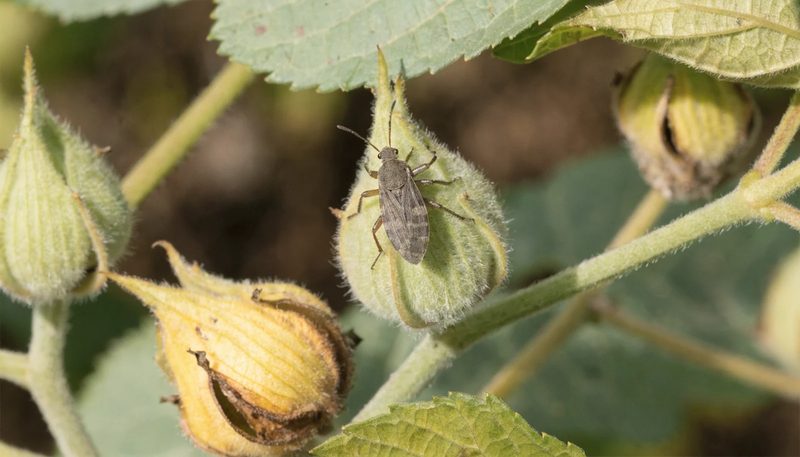
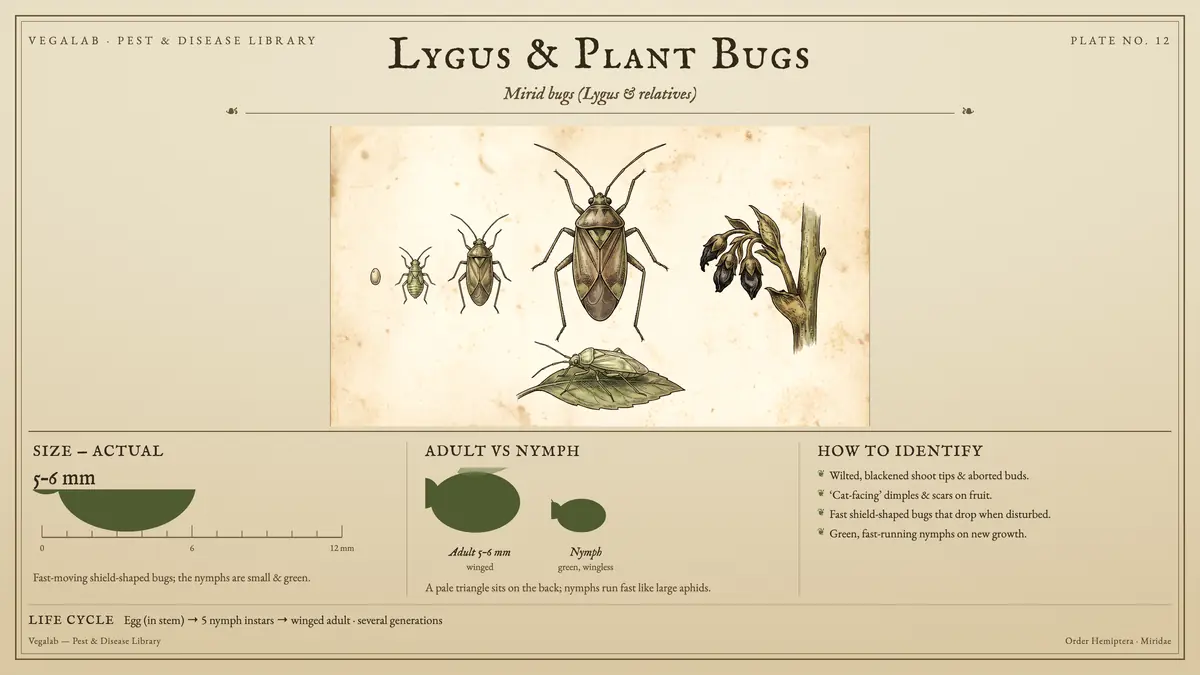
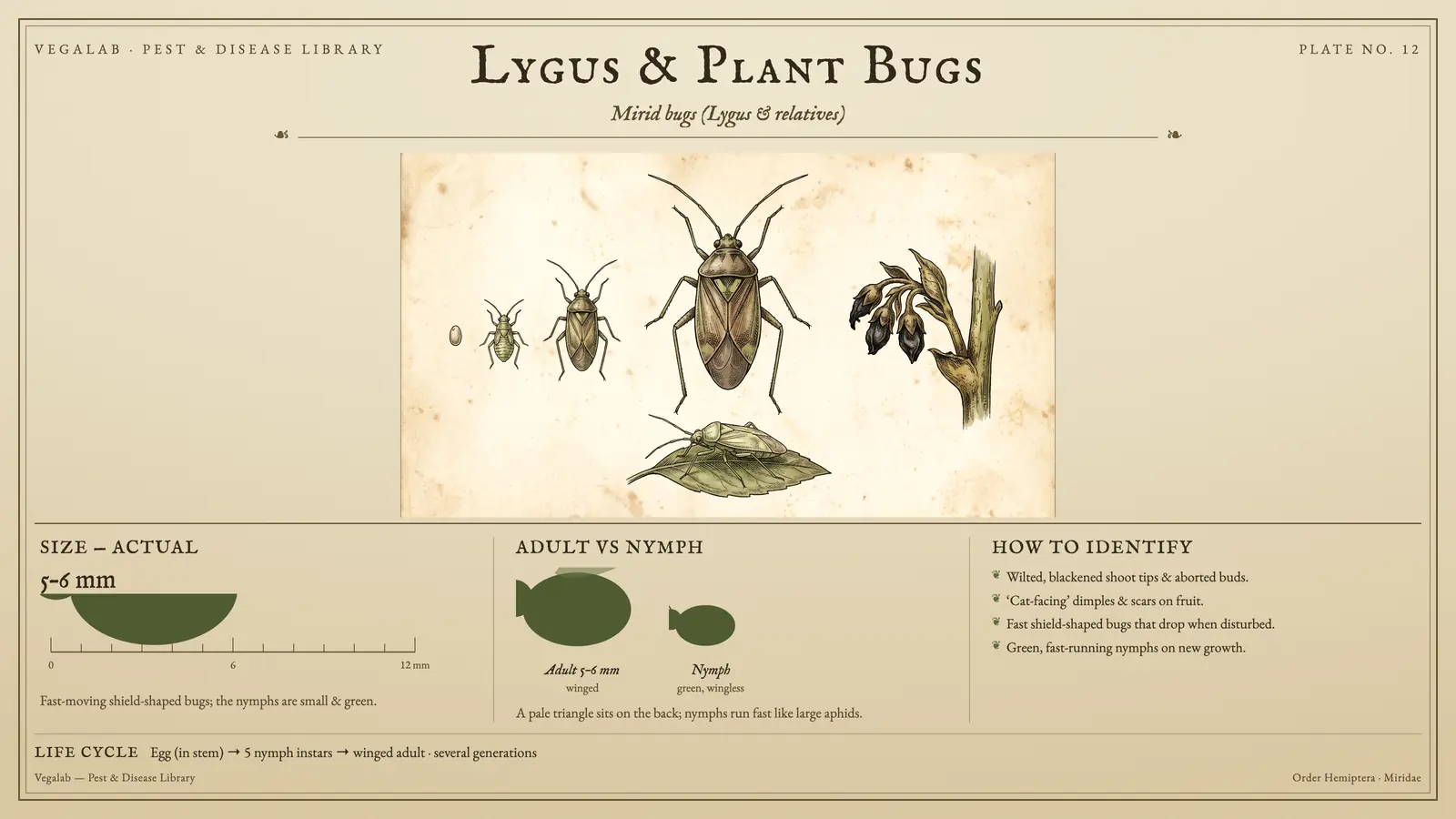
Adult and nymph. Adult 5 - 6 mm, winged; Nymph, green, wingless.
- Wilted, blackened shoot tips & aborted buds.
- ‘Cat-facing’ dimples & scars on fruit.
What is it?
Lygus are mobile true bugs that pierce plant tissue and inject saliva, killing cells around each feeding site. They concentrate on the most valuable tissue - buds, flowers and young fruit - which makes even modest populations costly. Both adults and nymphs feed and cause damage.
How to identify it
- Adults: small (5–6 mm), mottled greenish-brown bugs with a pale triangle on the back.
- Nymphs: pale green, fast-moving, aphid-like but quicker, with developing wing pads.
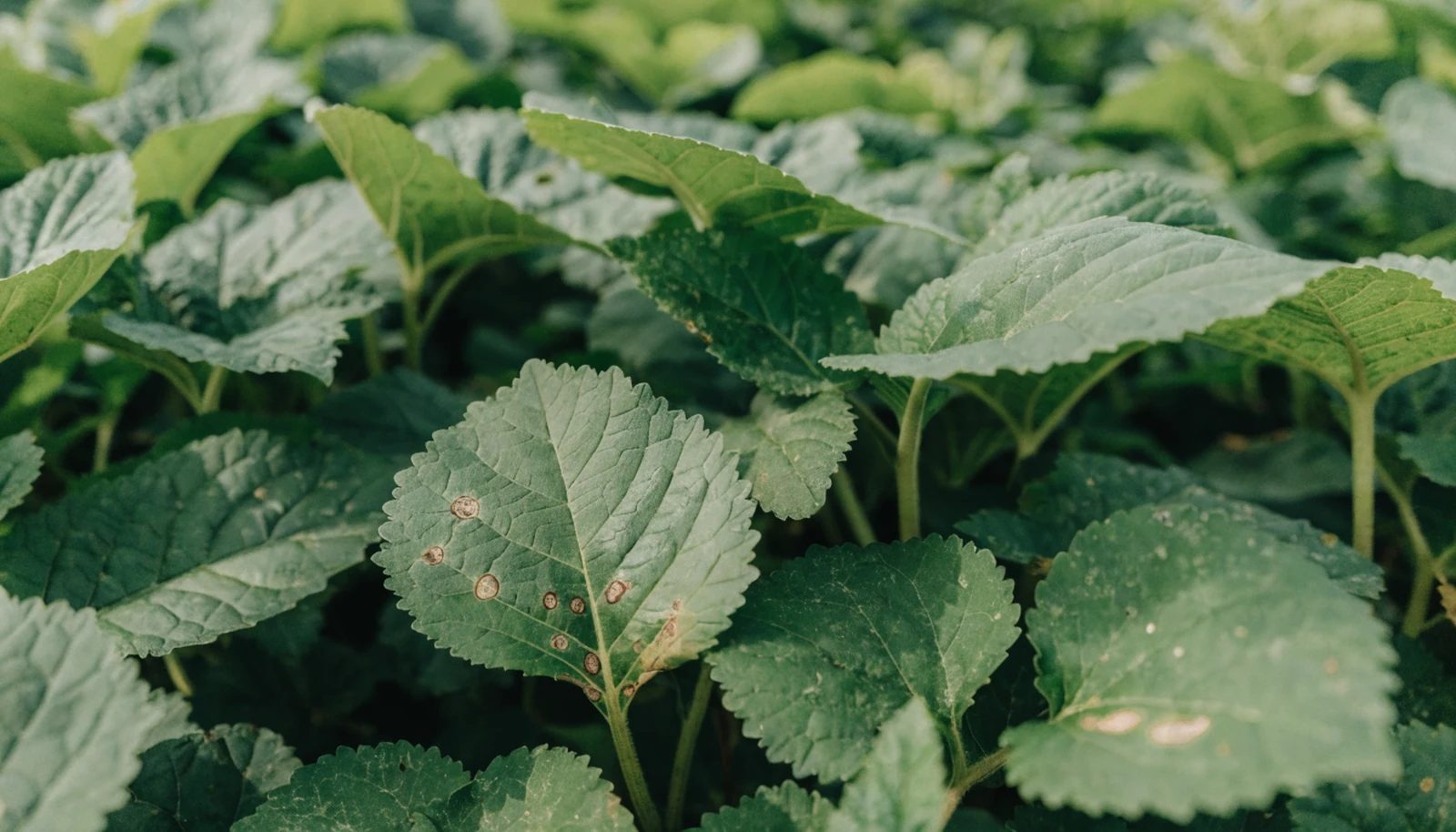
- Damage: aborted buds and flowers, deformed or “cat-faced” fruit, sunken corky spots, and pinprick necrotic feeding marks.
- Sweep-net sampling flushes adults and nymphs from the canopy.
Life cycle & spread
Lygus overwinter as adults in weeds and field margins, move into crops in spring, and complete several generations per season. Nymphs develop through five instars in 3-4 weeks.
Conditions that favour it
Populations build on flowering weeds and field margins, then move into crops as those hosts dry down or are mown - often right at the crop's bloom stage.
Damage and how it spreads
Feeding on reproductive tissue causes flower and fruit abortion, deformity and downgrade, directly cutting marketable yield. In strawberries it produces classic cat-faced, misshapen fruit.
Monitoring & scouting
Monitor field margins and weed hosts; sweep-net the crop to time treatments; act at threshold during bloom and early fruit set.
How to control it
- Manage broadleaf weeds and margins that harbour Lygus;
- treat at threshold in the bloom/early-fruit window with thorough coverage of feeding sites;
- conserve natural enemies.
How to manage lygus and plant bugs
- Sweep-net or beat-sample during the susceptible window. Lygus damage happens during flowering and early fruit or seed set; monitoring at other times tells you little that matters.
- Understand the movement. Lygus populations build on flowering weeds and alfalfa and move into the crop when those hosts are cut or dry down. A cotton or strawberry block next to an alfalfa field that has just been mown is about to receive its population - timing scouting to neighbouring cutting schedules is genuinely predictive.
- Use strip-cutting in alfalfa where it is a neighbouring crop, so the whole field is never cut at once and the bugs are not all displaced simultaneously.
- Manage weed hosts in and around the block ahead of the crop's susceptible stage, but not during it - removing hosts mid-season pushes the bugs onto the crop.
- Use trap crops such as alfalfa strips within strawberry, which concentrate lygus for targeted vacuum or spot treatment.
- Vacuum harvesting is used commercially in strawberry with modest but real effect.
- Time any treatment to nymphs, which are less mobile than adults and do not re-invade immediately.
- Protect natural enemies, notably Peristenus parasitoids and big-eyed bugs and damsel bugs.
Lygus bugs feed by injecting digestive enzymes into developing buds, flowers and seeds, which kills the tissue around the feeding site. The damage is therefore done at very low insect numbers and appears well after the feeding - deformed fruit, aborted buds, blemished seed - which makes prevention and timing far more important than knock-down.
Cutting an adjacent alfalfa field is one of the most reliable predictors of lygus arrival in a neighbouring crop. If you know the cutting date, you know the risk date.
Recognising lygus damage after the fact
- Strawberry: cat-facing · seedy, hardened, misshapen fruit with clustered achenes where feeding killed the developing receptacle tissue
- Cotton: square and small boll shed, blackened anthers, and 'dirty bloom'; damage to terminals causing crazy-top growth
- Alfalfa and clover seed: shrivelled, blackened or aborted seed and reduced seed set
- Beans and peas: pitted, dimpled and discoloured seed; pod distortion
- Peach and other stone fruit: cat-facing and gummy sunken depressions on fruit from early-season feeding
- Canola: pod abortion and blemished seed, and bud drop from pre-flowering feeding
Because the insect injects enzymes and moves on, the damage is diagnosed from the deformity rather than from the pest, often weeks later. The pattern is crop-specific:
See Fruit Cracking & Splitting and Blossom-End Rot for the physiological causes of misshapen fruit, which are frequently blamed on insects and vice versa.
Lygus, stink bug, or something physiological?
- Lygus / mirid plant bug: 5–7 mm, green to brown, oval with a small pale triangle or V on the back; fast-moving and drops or flies readily when approached; nymphs are green, aphid-like but faster, with dark spots on the back
- Stink bug (pentatomid): larger, shield-shaped, slower moving, releases a strong odour when handled; damage is similar in kind - corky spots, dimpling, seed blemish - but usually on larger fruit and later in development
- Physiological cat-facing / poor set: distortion caused by cold at flowering, poor pollination or nutrient imbalance; typically affects a whole flush uniformly rather than scattered individual fruit
- Practical distinction: insect damage is scattered and individual; physiological distortion tends to be uniform across a flush or a block.
Both lygus and stink bug damage is done during flowering and early fruit set, so the diagnostic window for the insects has usually closed by the time the deformity is visible. Records from the flowering period are worth keeping for this reason.
Scouting technique matters more than scouting frequency
- Standardise sweeps or beats · same number, same depth, same time of day
- Count nymphs separately from adults · nymphs mean in-field reproduction
- Sample early morning for higher, more repeatable counts
- Sample edges separately from field centres to detect immigration gradients
- Record neighbouring crop operations, particularly alfalfa cutting dates
Lygus is a pest where the sampling method determines whether you see the population at all, and poor technique is a more common reason for a surprise than infrequent scouting. The insects are fast, they drop or fly when disturbed, and adults leave the plant before a casual inspection registers them.
Sweep netting is the standard method in alfalfa, cotton and seed crops: a fixed number of 180-degree sweeps through the upper canopy while walking, counted per set number of sweeps, at consistent times of day. Consistency is what makes counts comparable between visits - sweeping harder, deeper or later changes the number more than the population does.
Beat sampling suits strawberry and bush crops: a tray or beating sheet held under the canopy while the plant is tapped sharply, so dislodged bugs and nymphs fall where they can be counted. Nymphs matter as much as adults here, because they indicate reproduction in the block rather than transient adults passing through.
Time of day matters: lygus are less mobile in the cool of early morning, so counts taken then are higher and more repeatable than midday counts of the same population.
Where you sample matters too: sample field edges adjacent to alfalfa, weedy margins or recently cut hosts separately from field centres, because immigration produces edge gradients and an average across the field masks a treatable edge.
A block that looked clean at midday and shows cat-facing three weeks later was usually sampled at the wrong time of day, not too rarely.
Recommended Vegalab solution: Spider Mite Control
Spider Mite Control · all-natural acaricide/contact product (geraniol with peppermint, cottonseed and rosemary oils); foliar spray targeting Lygus on buds, flowers and young fruit, repeated per pressure.
| Role | Product | Use |
|---|---|---|
| Primary control | Spider Mite Control |
Preventing it next season
Manage broadleaf weeds and field margins, monitor early, and treat before populations move into bloom.
Claims and product availability vary by jurisdiction. Always read and follow the product label.