

Crops affected
How to identify peach fruit moth
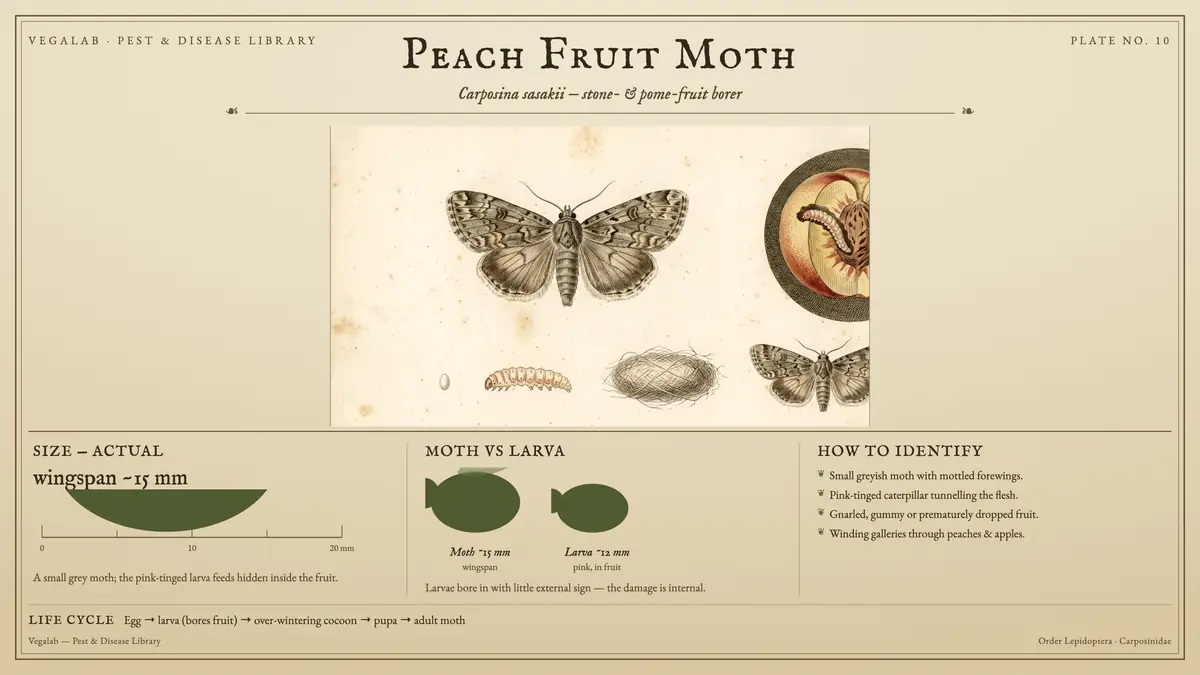
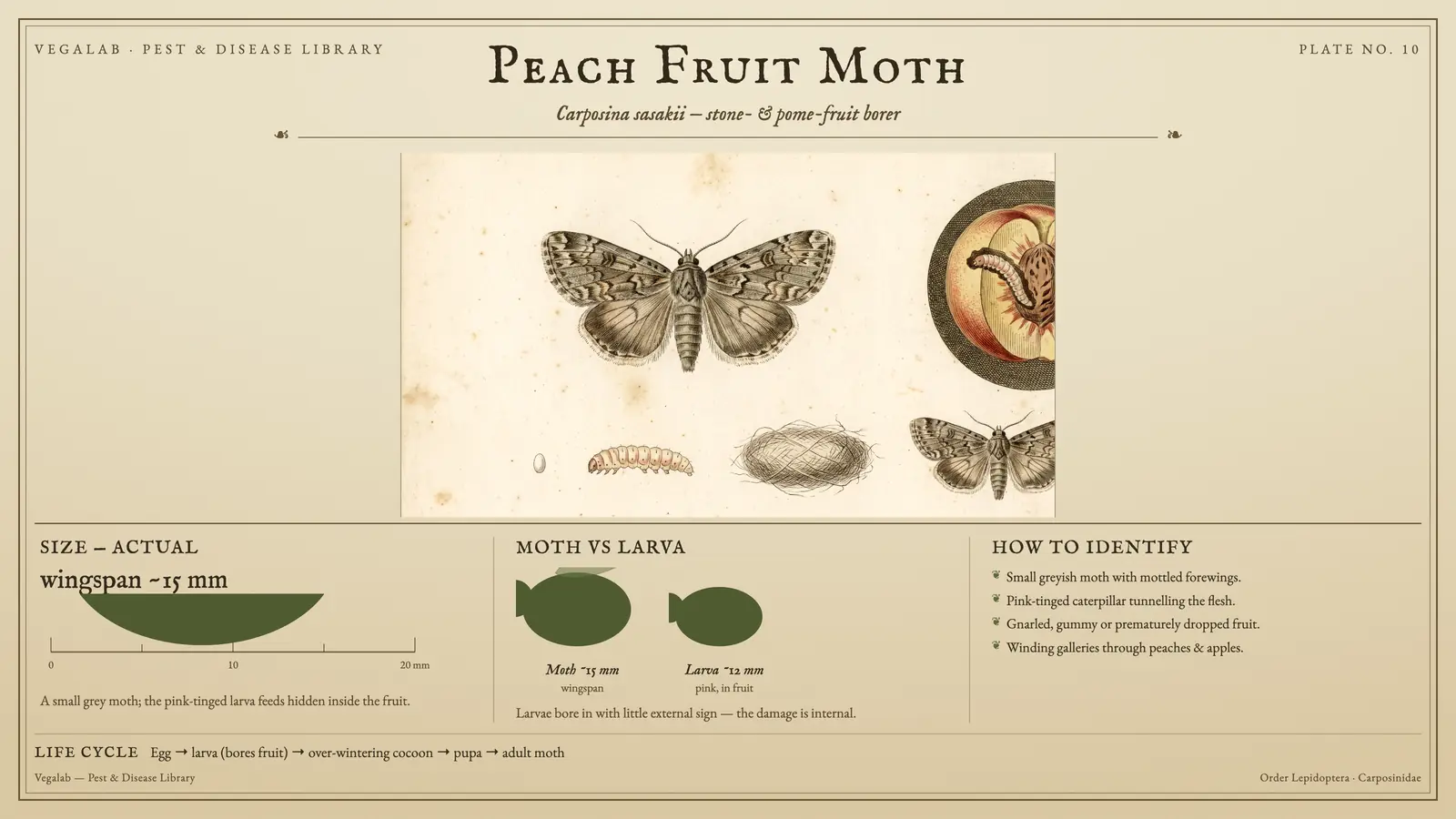
Size. wingspan ~15 mm A small grey moth; the pink-tinged larva feeds hidden inside the fruit.
Moth and larva. Moth ~15 mm, wingspan; Larva ~12 mm, pink, in fruit.
- Small greyish moth with mottled forewings.
- Pink-tinged caterpillar tunnelling the flesh.
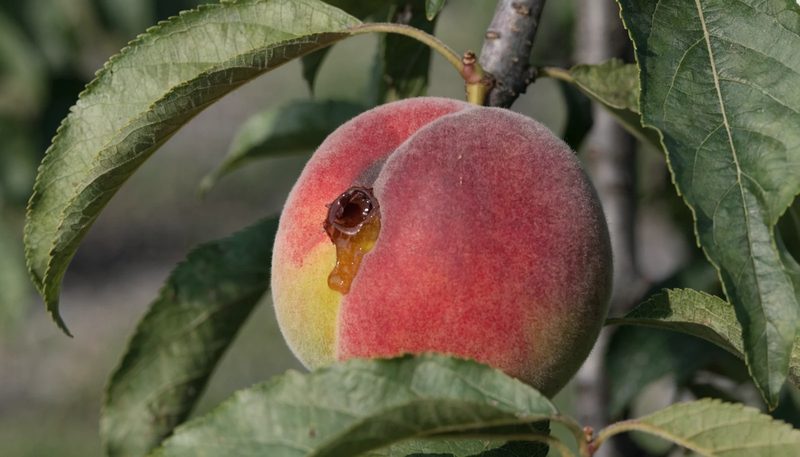
- Gnarled, gummy or prematurely dropped fruit.
- Winding galleries through peaches & apples.
What is it?
Carposina sasakii adults lay eggs on developing fruit; the hatching larvae bore inside to feed, then exit to pupate in the soil or debris. The internal feeding causes gumming, rot, and premature drop. There can be multiple generations per season depending on region and climate.
How to identify it
- Small entry holes in fruit, sometimes with gumming or frass
- Internal tunneling and rot when fruit is cut open
- Premature fruit drop
- Adult moth flights detected with monitoring traps
Life cycle & spread
*Carposina sasakii* overwinters as a mature larva in a dense cocoon in the soil, usually in the top few centimetres beneath the tree canopy. Adults emerge over an extended period through summer, which is what makes the pest hard to time - emergence is not a single clean flight.
Females lay eggs on the fruit surface, often in the calyx or stem cavity. The larva bores in and tunnels through the flesh, feeding around the stone and leaving the flesh filled with gummy frass. Damaged fruit often shows only a small entry point and a gum exudate on the outside, so infestation is easily missed until the fruit is cut.
There are typically one or two generations a year, with the second overlapping the first. Mature larvae exit the fruit - on the tree or after it drops - and return to the soil to spin overwintering cocoons.
Conditions that favour it
A pest of temperate and East Asian stone and pome fruit production: peach, apple, pear, plum, apricot, jujube and hawthorn. Risk concentrates in orchards with a history of the pest, since the overwintering population is in the soil beneath the trees.
Undisturbed soil under the canopy, dropped fruit left in place, and nearby unmanaged or wild hosts such as hawthorn all sustain populations between seasons.
Damage and how it spreads
Peach fruit moth larvae destroy fruit from the inside and cause heavy drop, with the potential for severe losses in unmanaged orchards. Because the larvae are protected once inside the fruit, the window for control is at egg hatch - so monitoring and timing are central to any successful program.
Monitoring & scouting
Pheromone and bait traps track the extended adult emergence; because emergence is protracted, trapping matters more here than for pests with a single sharp flight.
Inspect fruit for small entry points with gum exudate, and cut suspect fruit to confirm - tunnelling around the stone with gummy frass is the signature.
Collect and cut dropped fruit, which is often infested, and record entry counts at harvest.
How to control it
- Monitor adult flights with traps to time control to egg hatch.
- Collect and destroy dropped and infested fruit to break the cycle.
- Cultivate or manage the soil surface to disrupt pupae where appropriate.
- Apply a natural larvicide at egg hatch, before larvae bore into the fruit.
How to manage peach fruit moth
- Target the soil beneath the canopy. The overwintering larvae are there. Cultivation under the trees, and in some systems ground covers or mulches that impede emerging adults, reduce the population that reaches the canopy.
- Collect and destroy dropped and infested fruit through the season and after harvest. Larvae exit dropped fruit into the soil, so leaving drops in place reloads next year's population.
- Bag fruit where labour allows. Fruit bagging is standard practice against this pest in several producing regions and is close to fully effective.
- Time applications to the extended emergence using trap catch, and expect to cover a longer period than for a single-flight pest.
- Remove or manage wild and abandoned hosts nearby, particularly hawthorn and unmanaged jujube and apple.
- Sanitise the orchard floor in autumn, removing debris that shelters cocoons.
Because emergence is protracted rather than concentrated, calendar programmes perform poorly against this pest and trap-led timing performs much better.
Distinguishing the internal fruit feeders of stone fruit
- **Peach fruit moth (Carposina): tunnelling around the stone with gummy frass filling the flesh; small entry point with gum on the surface; overwinters in soil**
- Oriental fruit moth: tunnels to the stone too, but also attacks shoot tips causing flagging; overwinters under bark and in debris
- Plum curculio: a weevil, not a moth - leaves a distinctive crescent-shaped scar on the fruit surface where the female cuts before laying
- Brown rot: not an insect at all - a fungal rot with grey-brown sporulation, often colonising insect entry wounds afterwards
See Oriental Fruit Moth and Brown Rot of Stone Fruit. Insect entry wounds frequently become brown rot infection sites, so the two problems compound.
Fruit bagging and orchard-floor management
- Bag fruit after set where labour allows · near-complete protection and multiple secondary benefits
- Collect and destroy drops weekly · each infested drop is a future overwintering larva
- Cultivate beneath the canopy in late autumn and again before emergence
- Avoid leaving culls or infested fruit in or near the orchard
- Manage wild hosts · hawthorn in particular sustains populations outside the orchard
Two measures dominate practical control of this pest, and both are unusual in a modern programme because neither involves a spray.
Fruit bagging places a paper or non-woven bag over each fruit after set, physically preventing egg-laying on the fruit surface. It is close to fully effective, it also protects against several other fruit pests and against sunburn and bird damage, and it is standard commercial practice in parts of East Asia for exactly this reason. The constraint is labour: it is a per-fruit operation, so it suits high-value fruit and production systems where labour is available, and it does not scale to low-value bulk production.
Orchard-floor management attacks the overwintering stage. Because mature larvae leave the fruit and spin cocoons in the top few centimetres of soil beneath the canopy, that soil is the pest's reservoir. Cultivating under the trees in late autumn and early spring exposes cocoons to desiccation, cold and predation. Collecting dropped fruit through the season removes larvae before they ever reach the soil.
This pest is managed successfully with sanitation and physical exclusion in its main production regions. Spray programmes alone perform poorly against it because adult emergence is protracted rather than concentrated.
Recommended Vegalab solution: Larva Control
Vegalab Larva Control (oxymatrine) is a fast-acting natural larvicide that kills peach fruit moth larvae on contact or ingestion and acts as an anti-feedant, with a 0-hour REI and no toxicity restrictions. Time applications to egg hatch using trap data, and reapply for each generation. Larva BioControl can be rotated in for resistance management.
| Role | Product | Use |
|---|---|---|
| Primary control | Larva Control | Natural larvicide (foliar) |
| Companion / broader pressure | Larva BioControl | Biological larvicide / rotation partner |
Preventing it next season
Trap every season, sanitize dropped fruit, manage pupation sites, and treat each generation at egg hatch. Keep trees vigorous with balanced nutrition to aid recovery.
Claims and product availability vary by jurisdiction. Always read and follow the product label.