

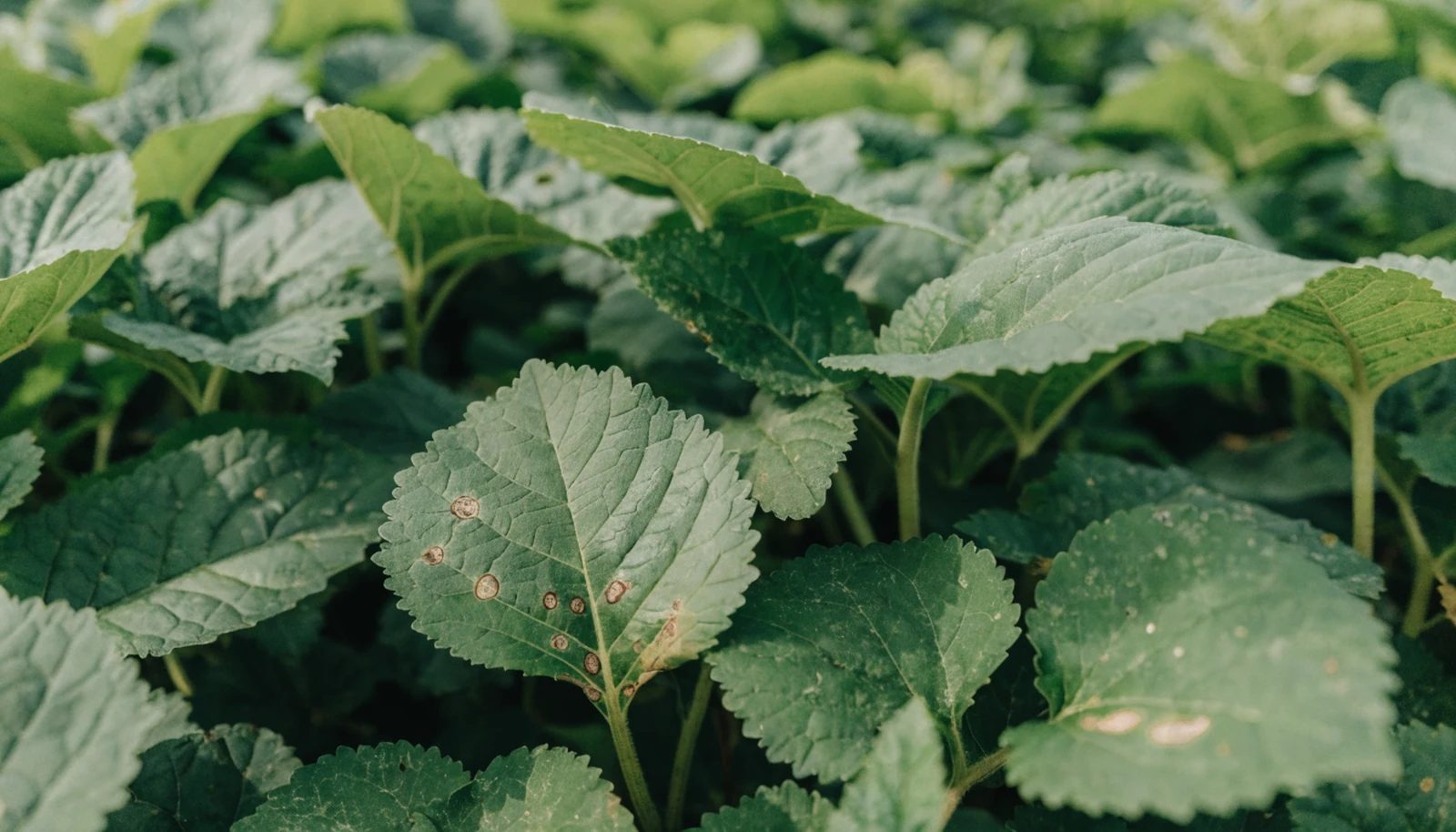
Crops affected
How to identify clearwing & peach tree borers
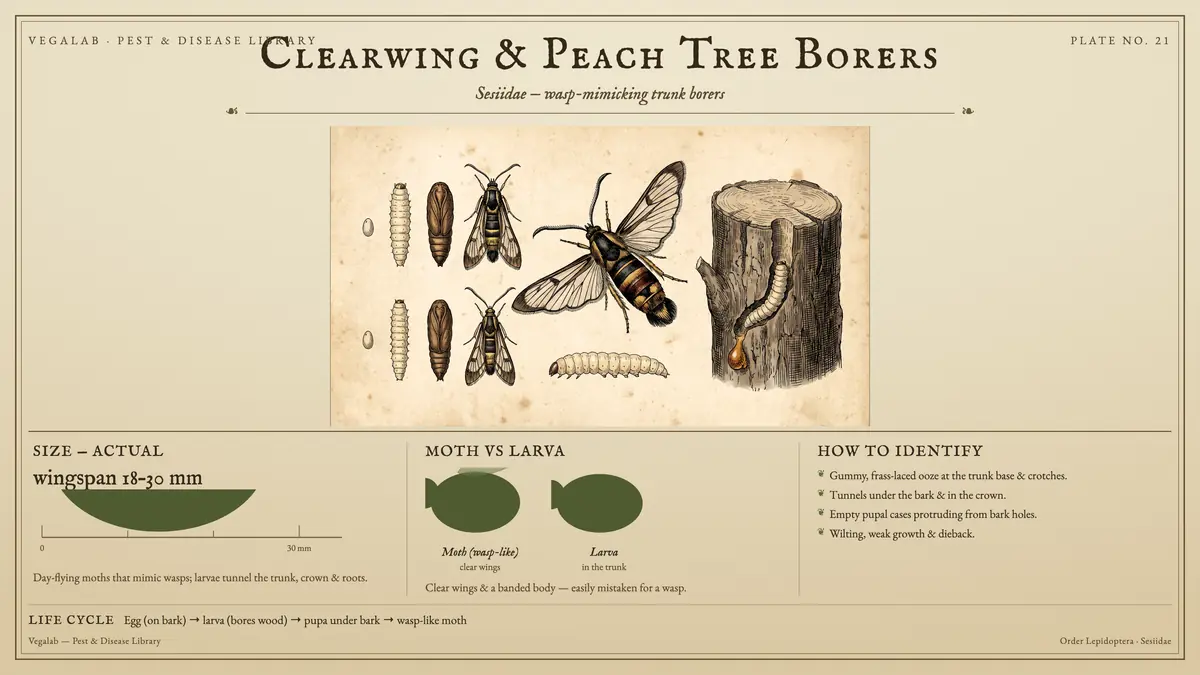
Size. wingspan 18 - 30 mm Day-flying moths that mimic wasps; larvae tunnel the trunk, crown & roots.
- Tunnels under the bark & in the crown.
- Empty pupal cases protruding from bark holes.
- Wilting, weak growth & dieback.
What is it?
Clearwing borer larvae bore beneath the bark at the trunk base, crown and roots, disrupting the tree's vascular flow. The clear-winged, wasp-like adults lay eggs on bark; established borers are hidden under bark, so timing and the soil/crown approach matter.
How to identify it
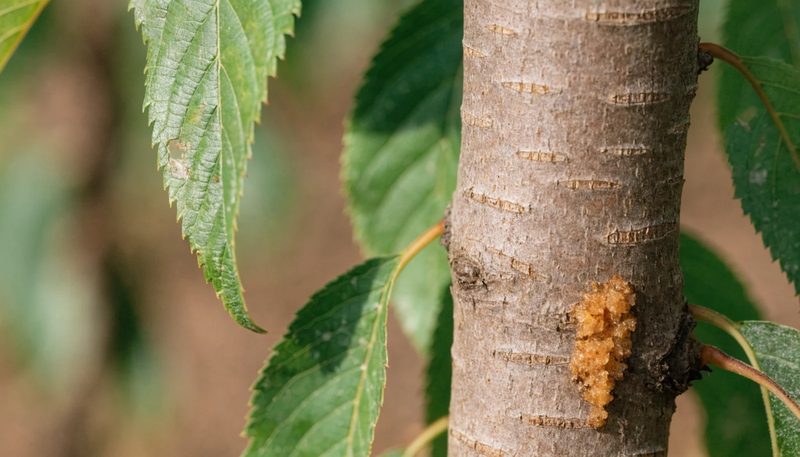
- Gummy ooze (gummosis) mixed with frass at the trunk base and crown.
- Sawdust-like frass at bark cracks and the soil line.
- Loose, dying bark and girdled, declining trees; sudden collapse in young trees.
- Wasp-like clearwing moths near trunks in summer; pheromone traps confirm flights.
Life cycle & spread
Adults lay eggs on lower trunk/bark; larvae bore in and feed under bark for months (often overwintering as larvae); typically one to two generations per year depending on species and region.
Conditions that favour it
Stressed, wounded or sunburned trunks attract egg-laying; mechanical and pruning wounds and poor tree vigour increase risk.
Damage and how it spreads
Tunnelling girdles and weakens trunks and crowns, reducing vigour and yield and, in young trees, killing them outright.
Monitoring & scouting
Use pheromone traps to time adult flights; inspect trunk bases for gummosis and frass; target egg-hatch and the trunk/crown zone.
How to control it
- Treat the trunk/crown at egg-hatch;
- address crown- and root-zone larvae through the soil;
- protect trees from trunk wounds and sunburn;
- keep trees vigorous.
How to manage clearwing borers
- Prevent trunk wounds. Keep mowers and cultivators away from trunks, use trunk guards, and avoid string-trimmer damage at the base. This single practice prevents most infestations in young orchards.
- Keep trees unstressed. Adequate and consistent irrigation, appropriate nutrition and sunscald protection (trunk painting or wraps where relevant) all reduce attractiveness to egg-laying females.
- Time trunk applications to adult flight, guided by pheromone traps. Applications are preventive, directed at the bark where eggs are laid - treating after larvae are in the cambium achieves little.
- Prune correctly and at the right time. Clean cuts that heal quickly, made in dry weather outside the flight period, avoid creating oviposition sites.
- Remove larvae mechanically on small plantings. Probing a tunnel with a wire, or carefully cutting out the larva from the cambium, is laborious but effective and standard practice on individual valuable trees.
- Remove and destroy severely infested trees, which are inoculum sources and will not recover once girdled.
- Consider mating disruption where the block is large enough and the species has a commercial pheromone available.
Clearwing borers attack stressed and wounded trees far more than healthy intact ones, which makes this a pest managed primarily by not creating entry points. Once larvae are in the cambium, options are limited and largely mechanical.
Gum mixed with coarse, sawdust-like frass at the trunk or crown is a strong sign of a clearwing borer. Gum alone is nonspecific and can follow wounds, canker, cold injury, or other stress; inspect for entry holes or larvae before diagnosis.
Which borer, and where it attacks
- Peachtree borer (Synanthedon exitiosa) · attacks the lower trunk and crown at or below soil level; gum and frass at the base; the most damaging to young stone fruit
- Lesser peachtree borer (S. pictipes) · attacks upper trunk, scaffolds and pruning wounds and cankered areas, higher on the tree
- Dogwood, lilac/ash and rhododendron borers · ornamental hosts; similar cambium feeding at wounds and graft unions
- Currant and raspberry crown borers · cane and crown feeding in soft fruit
- Squash vine borer (Melittia) · a related clearwing but attacks herbaceous cucurbit vines, with frass at the stem base and sudden wilting of the whole vine
Position on the tree separates the two peach borers and determines where treatment is directed - base and soil line for peachtree borer, upper trunk and wounds for lesser peachtree borer.
Why young trees die and mature trees survive
The same amount of borer feeding has very different consequences depending on trunk diameter, and this explains the age pattern growers observe. Larvae feed in the cambium, a thin cylinder of living tissue just beneath the bark, and the damage is effectively a partial girdle. On a young tree with a trunk a few centimetres across, a few larvae can interrupt a large proportion of that cylinder and the tree is girdled - nutrient transport fails, the canopy declines and it dies.
On a mature trunk the same larvae remove a small fraction of a much larger circumference. The tree compartmentalises the damage, grows new cambium around it, and often carries a low-level infestation for years with no visible decline. That is why mature orchards tolerate populations that kill nursery stock and first-leaf trees.
The management implication is that scouting and preventive effort should be concentrated on young plantings and replants, where the pest is genuinely lethal, rather than spread evenly across an orchard.
Trunk protection for young plantings
- Trunk guards on all young trees, inspected annually and loosened as the trunk grows
- Vegetation-free trunk line so mowers never approach the stem
- Trunk paint or whitewash against sunscald cracking
- Plant at correct depth, graft union clear of the soil
- Inspect the base of every young tree annually for gum and frass · early detection allows mechanical removal before girdling
Because clearwing borers are lethal to young trees and largely cosmetic on mature ones, the highest-return investment is a deliberate trunk-protection routine for the first few years after planting. The components are simple and mostly mechanical.
Physical guards - spiral wraps, mesh sleeves or rigid guards - prevent both mower and trimmer injury and the egg-laying that follows it. They must be inspected and loosened as the trunk expands, because a guard that girdles the tree causes the damage it was meant to prevent, and they should be removable so the trunk can be checked.
A clean, vegetation-free trunk line removes the reason machinery comes close to the trunk at all. Mulch or herbicide-maintained strips reduce mowing right up to the stem, which is where most wounds originate.
Whitewash or trunk paint on the sunny side prevents sunscald, which cracks bark and creates entry points - particularly relevant on young stone fruit in hot climates and on the south-west aspect in the northern hemisphere.
Correct planting depth and graft union placement, since a buried graft union and soil piled against the trunk both create permanently moist, damage-prone tissue at exactly the height peachtree borer prefers.
Most young-tree borer losses trace back to a mower wound or sunscald crack. The pest is opportunistic; the wound is the actual cause.
Recommended Vegalab solution: Larva Control
Larva Control - natural broad-spectrum larvicide (oxymatrine) applied to the lower trunk/crown at egg-hatch to target young larvae before they bore deep under bark. - Larva BioControl - live Steinernema carpocapsae nematodes applied to the moist crown and soil zone to reach borer larvae in the lower trunk, crown and roots.
| Role | Product | Use |
|---|---|---|
| Primary control | Larva Control | |
| Also apply | Larva BioControl |
Preventing it next season
Avoid trunk wounds, protect against sunburn, keep trees vigorous, monitor flights with pheromone traps, and treat at egg-hatch.
Claims and product availability vary by jurisdiction. Always read and follow the product label.