

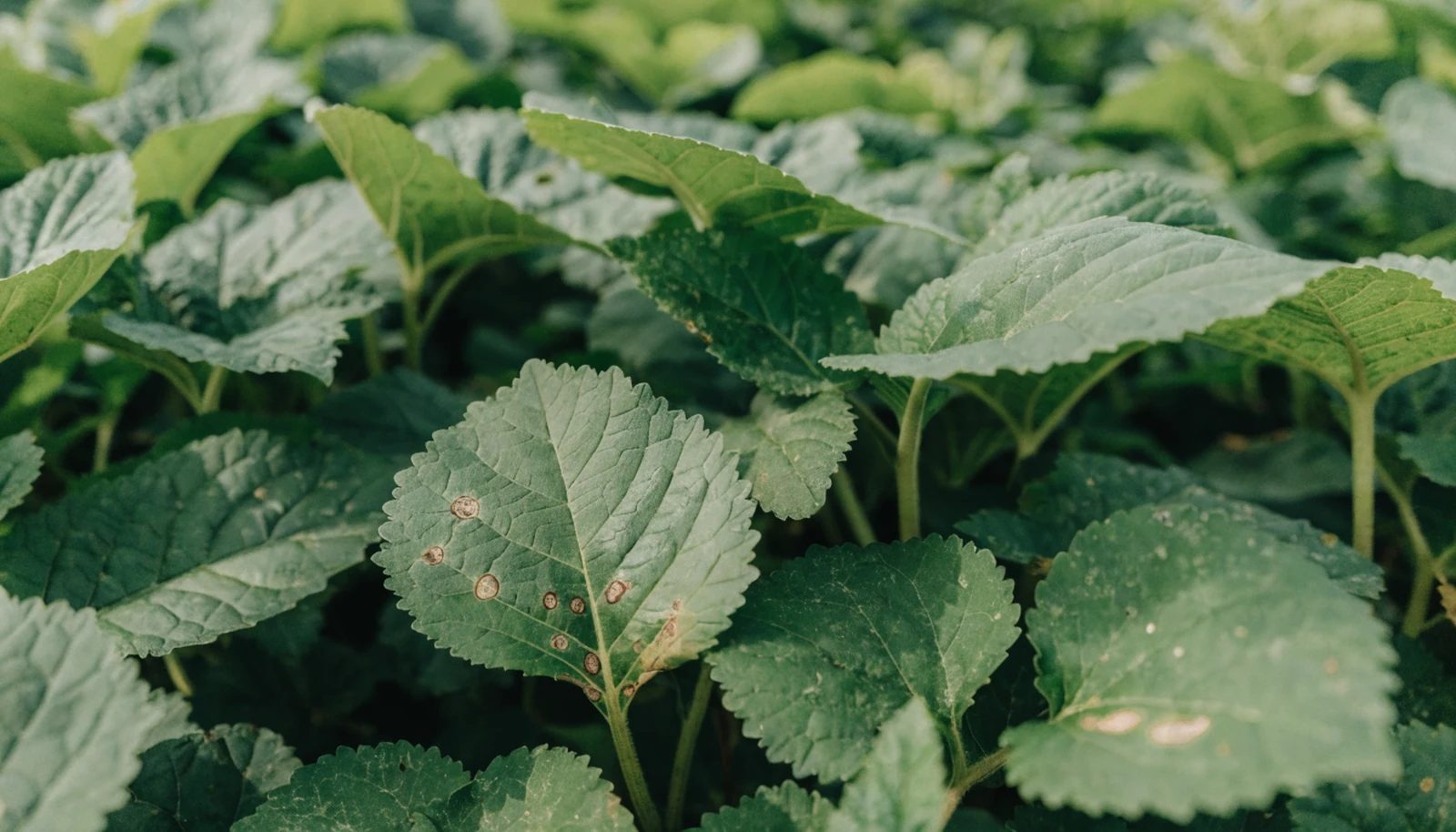
Crops affected
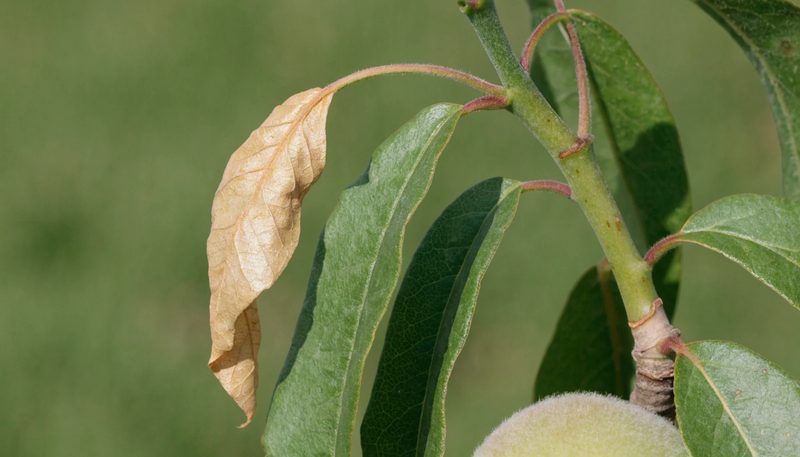
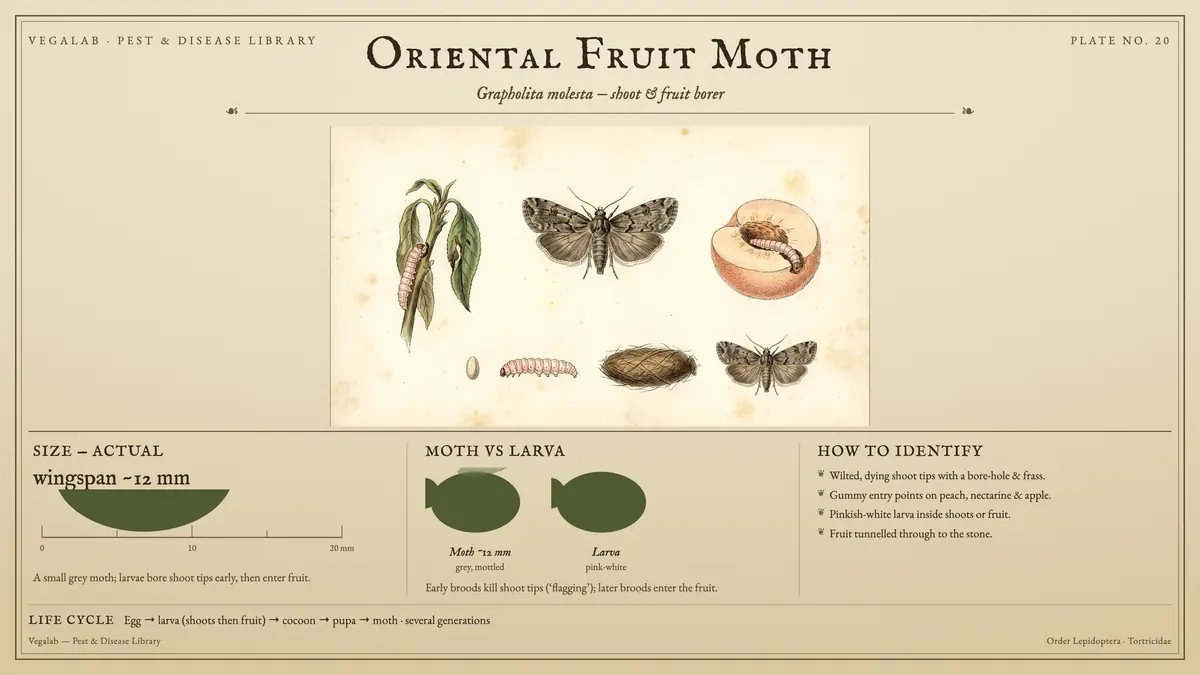
How to identify oriental fruit moth
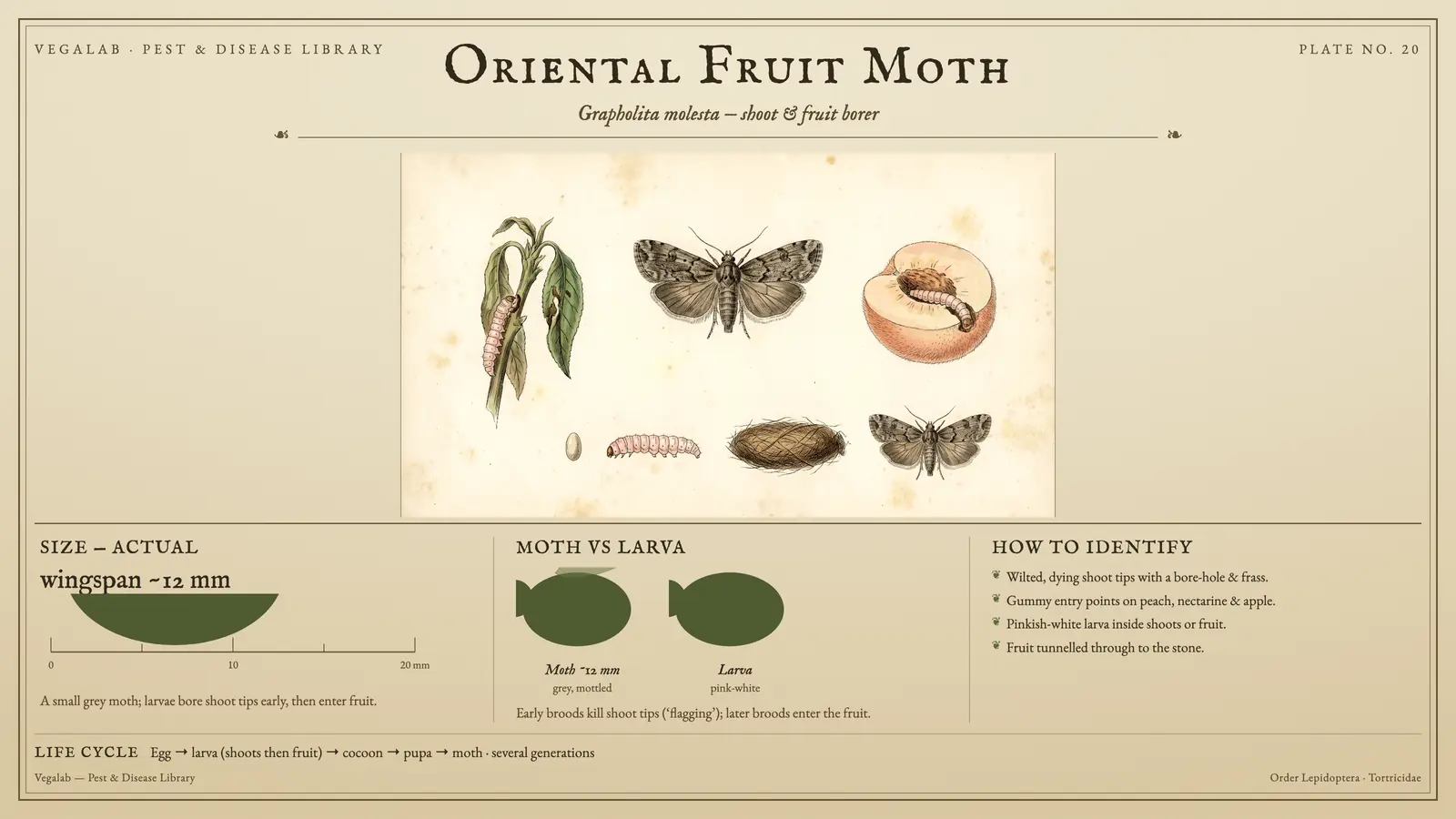
Size. wingspan ~12 mm A small grey moth; larvae bore shoot tips early, then enter fruit.
Moth and larva. Moth ~12 mm, grey, mottled; Larva, pink-white.
- Fruit tunnelled through to the stone.
What is it?
Oriental fruit moth larvae first tunnel into tender shoot tips (causing flagging), then later generations bore into fruit. Because larvae are protected once inside shoots or fruit, timing to egg-hatch is essential.
How to identify it
- Wilting, dying shoot tips ('flagging') with frass at the entry point in early season.
- Small entry holes in fruit, often near the stem, with frass and internal tunnelling.
- Pinkish-white larvae with a brown head inside shoots or fruit.
- Adult flights detected with pheromone traps.
Life cycle & spread
Several generations per season; early generations attack shoots, later ones attack fruit. Larvae overwinter in cocoons in bark and debris.
Conditions that favour it
Warm seasons and overlapping generations sustain pressure; nearby unmanaged hosts and debris increase carry-over.
Damage and how it spreads
Shoot boring reduces growth in young trees; fruit boring causes direct cullage and entry points for rot, with significant pre-harvest loss in stone and pome fruit.
Monitoring & scouting
Use pheromone traps to time flights and set biofix; scout shoots for flagging early and fruit for entries later; treat at egg-hatch.
How to control it
- Time sprays to egg-hatch of each generation;
- sanitation of dropped/infested fruit;
- combine with monitoring for accurate timing.
How to manage oriental fruit moth
- Pheromone-trap biofixes and locally validated degree-day models improve timing against codling moth and Oriental fruit moth by targeting vulnerable stages. Combine them with trap or fruit monitoring and local guidance.
- Use mating disruption. This pest responds well to pheromone dispensers, and in blocks of adequate size it can carry most of the programme.
- Cut out flagged shoots in the early generations. Removing wilted tips physically removes larvae before they become the generation that attacks fruit - cheap and effective.
- Sanitise the orchard. Remove dropped and mummified fruit, clean bins, and scrape loose bark that provides overwintering sites.
- Protect the parasitoids, notably Macrocentrus wasps, which take a meaningful share of larvae.
- Rotate modes of action, and treat the later generations with particular care since that is when fruit damage occurs.
- Watch neighbouring hosts · abandoned peach and plum trees nearby reinfest a managed block.
Shoot flagging in spring is a gift: it is a visible, easily removed indicator of an active generation weeks before any fruit is at risk. Blocks that act on flagging have far less fruit damage later.
Oriental fruit moth or codling moth?
- Oriental fruit moth: primarily stone fruit - peach, nectarine, plum, apricot - and also apple and quince; bores into shoot tips causing flagging, which codling moth never does; fruit entry often at the stem end
- Codling moth: primarily pome fruit · apple and pear · plus walnut; drives a clean tunnel to the core and eats the seeds; no shoot attack
- Peach twig borer: also causes shoot flagging in stone fruit, but the larva is chocolate brown with a dark head, against oriental fruit moth's creamy white to pink
- Practical rule: flagging shoots in a peach orchard means oriental fruit moth or peach twig borer, not codling moth. Seeds eaten in an apple means codling moth.
See Codling Moth and Peach Fruit Moth (Carposina).
Mating disruption: when it works and when it does not
- Deploy before first flight, based on trap catch or historical timing
- Place dispensers in the upper canopy, where the moths fly
- Treat whole blocks, and coordinate with neighbours where blocks are small
- Reduce a high population conventionally first, then maintain with disruption
- Keep monitoring · trap catch under disruption is suppressed, so use fruit inspection to judge whether it is holding
Oriental fruit moth is one of the pests that responds best to mating disruption, and the technique is worth understanding properly because its failures are predictable rather than random. Dispensers release synthetic pheromone across the block at a concentration that prevents males locating the natural pheromone plume of a female. No mating, no fertile eggs.
The conditions for success are specific. Block size matters most · small blocks suffer immigration of already-mated females from outside, and the technique cannot help with those. Population density matters: disruption works well at low to moderate populations and poorly at high ones, so it is a maintenance tool that needs the population brought down first. Timing matters: dispensers must be in place before the first flight, not after it. And uniformity matters · gaps in coverage, particularly at block edges and in tall canopies where dispensers sit too low, become mating refuges.
Where those conditions are met, mating disruption can carry most of the programme for this pest and substantially reduce insecticide use. Where they are not, it disappoints - and the reason is almost always block size or starting population, not the product.
Degree-day timing in practice
- Set the biofix on first sustained catch, not first catch
- Use local temperature data · in-block or nearest station
- Accumulate above the published threshold for the species and region
- Time to predicted egg hatch, which is when the larva is briefly exposed
- Shorten intervals for later generations as hatch becomes continuous
- Verify with fruit inspection, since trap catch alone does not measure damage
Oriental fruit moth is managed on a model rather than on observation, and the mechanics are simple enough to run on a spreadsheet. The pest develops at a rate determined by temperature, so accumulated heat predicts each generation's egg hatch far more reliably than the calendar does.
Start with a biofix: the date of first sustained trap catch in spring, meaning consistent captures rather than a single stray moth. From that date, accumulate degree-days above the species' development threshold using daily maximum and minimum temperatures. Local extension services publish the threshold and the target accumulations for each generation's egg hatch, and applications are timed to those targets - typically a few hundred degree-days after biofix for the first generation, with subsequent generations following at intervals.
Two practical cautions. First, generations overlap increasingly as the season progresses, so the clean single window available for generation one blurs into continuous hatch by generation three - intervals shorten and the model becomes a guide rather than a precise trigger. Second, a model is only as good as its temperature data: use readings from the block or a nearby station, not a regional average, because a few degrees changes the timing by days.
The same method applies to codling moth, and the two are often run together in mixed orchards on separate biofixes. See Codling Moth.
Recommended Vegalab solution: Larva Control
Larva Control · natural broad-spectrum larvicide (oxymatrine) applied at egg-hatch of each generation, targeting young larvae before they bore into shoots or fruit.
| Role | Product | Use |
|---|---|---|
| Primary control | Larva Control |
By crop
Preventing it next season
Pheromone monitoring for accurate timing, sanitation of infested fruit and prunings, and prompt treatment of early instars.
Claims and product availability vary by jurisdiction. Always read and follow the product label.