


How do you get rid of spider mites on indoor plants?
Last updated:
Isolate the plant, cut off and bag the worst leaves, and rinse the whole plant in a shower or sink with lukewarm water, paying attention to leaf undersides, at least weekly.3 Treat every susceptible houseplant at the same time.2 If mites persist, spray insecticidal soap or horticultural oil with full underside coverage, following the product label, and repeat to catch newly hatched mites.1,5
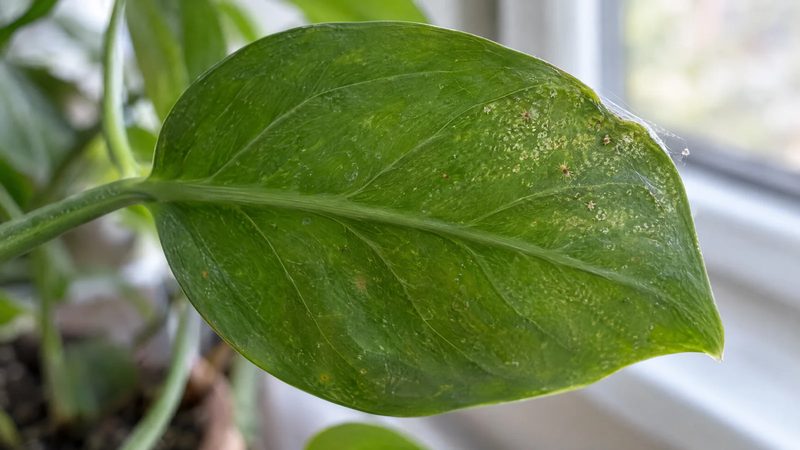
How do you know if a houseplant has spider mites?
The spider mite found on houseplants is almost always the twospotted spider mite (Tetranychus urticae), which Colorado State University Extension names as the most important species indoors.2 Spider mites are arachnids, related to spiders and ticks rather than insects.1 To the naked eye they look like tiny moving dots; adults are less than 1/20 inch long, with eight legs, an oval body and two eyespots, and they live in colonies, mostly on leaf undersides, that can hold hundreds of mites.1 The twospotted spider mite is straw colored, often with two dark blotches on the body.3
Damage is usually noticed before the mites. Feeding on the underside of leaves produces yellowish, bronze or silvery stippling on the upper surface, and middle-aged leaves tend to show it first.3 Fine silk appears on leaf undersides and between leaves and stems, and heavy infestations bring yellowing, wilting and leaf drop.3 Webbing is the easiest way to tell spider mites from aphids and thrips, which also feed on leaf undersides.1
To confirm, tap a leaf over a sheet of white paper; dislodged mites move around rapidly.1 South Dakota State University Extension also suggests tapping over dark paper, or smearing the specks on white paper, where crushed mites leave brownish streaks.5 A hand lens makes the mites and their round, translucent eggs easy to see.1
| Sign | What to look for | Where |
|---|---|---|
| Stippling | Fine yellowish, bronze or silvery speckles | Upper leaf surface, middle-aged leaves first |
| Webbing | Fine silk strands | Leaf undersides and between leaves and stems |
| Mites | Tiny moving dots, two dark blotches | Colonies on leaf undersides |
| Eggs | Spherical, translucent droplets | Leaf undersides |
| Paper test | Moving specks, or brownish streaks when smeared | Paper held under a tapped leaf |
In North America, indoor spider mite problems build in fall and winter, when heated homes run very low humidity5 and plants brought inside to overwinter can carry mites with them3; outdoors, spider mites are most numerous from June through September1. In the Southern Hemisphere the same heated-home risk falls from about May to August.
Why do spider mites infest indoor plants?
Spider mites thrive in the warm, dry conditions found in most homes.3 Checking plants matters most in winter, when heated homes run very low humidity, which is just what the mites like.5 Dry air helps them in several ways: they feed more when low humidity lets them evaporate the excess water they excrete, most of their natural enemies need more humid conditions, and drought-stressed plants change their chemistry in ways that make them more nutritious to mites.2
Mites arrive on new plants, on plants brought indoors to overwinter, and through open screens in summer.3 Once inside they move from plant to plant by leaf contact, by walking, and by drifting on strands of webbing.3 They can also ride household air currents or travel on a person moving between plants.5 Few houseplants are out of reach: the twospotted spider mite feeds on more than 1,100 plant species in more than 140 plant families.6
How fast do spider mites multiply indoors?
Fast enough that a few mites become a visible problem in weeks.5 Spider mites can reproduce in just a few days in a warm location, so populations can explode within a few weeks.5 Each female lays 2 to 6 eggs a day and up to 100 in her lifetime, eggs hatch in 2 to 6 days, and a full generation takes 7 to 20 days depending on conditions.4 Under favorable temperatures a generation can be completed in less than a week.1
That speed is why one treatment rarely finishes the job. Newly hatched larvae have six legs, and the later stages have eight.1 Most miticides do not affect eggs, so repeat treatments are needed to reach mites that hatch after the first one.2
| Stage | Description | Timing |
|---|---|---|
| Egg | Spherical, translucent, cream colored before hatching | Hatches in 2 to 6 days |
| Larva | Six legs, smaller than adults | First stage after hatching |
| Two nymphal stages | Eight legs, resemble small adults | Shed skin between stages |
| Adult female | Eight legs, 0.4 to 0.6 mm, two dark spots | Lays 2 to 6 eggs a day, up to 100 in a lifetime |
| Full generation | Egg to egg-laying adult | 7 to 20 days; under a week when warm |
How do you get rid of spider mites on houseplants step by step?
Start with the steps extension services rank first, which use no pesticide at all. Light to moderate infestations can often be controlled by rinsing alone.3
- Isolate infested and newly bought plants, and keep plants brought in from outdoors apart for about a month, until they have stayed clean.3
- Treat all susceptible houseplants at the same time, not just the one showing damage.2
- Trim, bag and remove heavily infested leaves, and discard severely infested plants.2
- Rinse plants in the shower or sink with lukewarm water, concentrating on leaf undersides, at least weekly; wrap the pot in a plastic bag to keep soil in place.3
- Wipe the leaves of larger plants with a soft, damp cloth, and repeat at one to two week intervals while mites persist.2
- Raise humidity by setting pots on, not in, trays of pebbles and water, or by daily misting, without overwatering.3
- Water plants enough that they are not drought stressed, which increases mites and mite damage.1
What natural sprays kill spider mites on indoor plants?
When rinsing is not enough, the options on houseplants are mainly insecticidal soaps and horticultural oils.2 UC IPM lists both petroleum-based horticultural oils and plant-based oils such as neem, canola and cottonseed oils as acceptable, along with plant extracts formulated as acaricides, including garlic extract, clove oil, mint oils, rosemary oil and cinnamon oil.1 Rosemary oil, clove oil and peppermint oil are among the active ingredients permitted in minimum risk pesticide products exempted from federal registration.7
Soaps and oils kill only the mites they touch, so coverage of leaf undersides is essential and repeat applications may be needed.1 Colorado State rates horticultural oil as perhaps the most effective miticide for home use, and insecticidal soap as marginally effective against twospotted spider mites, especially where webbing blocks penetration.2 Do not apply soaps or oils to water-stressed plants or above 90°F, and test them on part of the foliage several days before a full treatment, because some plants are injured.1 Retreatment every five to seven days or so catches mites that hatched after the previous spray.5 Follow the product label for any spray, including its houseplant use directions and interval.4,5
When practical, spray houseplants outdoors in a shaded spot and let them dry before bringing them back in.3 Predatory mites such as Phytoseiulus persimilis, sold by mail order, have controlled spider mites on interior plants, but they need fairly high humidity.2 Predators do not feed on plants, so without pest mites to eat they starve or leave, and UC IPM uses a guideline of one predator for every 10 spider mites.1
| Option | How it works | What the sources say |
|---|---|---|
| Rinsing in shower or sink | Washes mites and webbing off leaves | Can control light to moderate infestations; repeat at least weekly |
| Wiping leaves | Removes mites from large leaves | Repeat at one to two week intervals |
| Pebble trays and misting | Raises humidity | Counters the dry conditions mites favor |
| Horticultural oil | Contact kill | Perhaps the most effective home-use miticide; full coverage needed |
| Insecticidal soap | Contact kill | Marginal against twospotted mites where webbing blocks coverage |
| Predatory mites | Eat spider mites | Have worked on interior plants; need fairly high humidity |
Why do spider mites keep coming back?
Eggs that survive a treatment, untreated neighboring plants and dry air restart the cycle, which is why the steps above are repeated rather than done once.2,3 Broad-spectrum insecticides make matters worse. Spider mites frequently become a problem after insecticide sprays, because these kill the mites' natural enemies, and some products such as carbaryl have been shown to make spider mites reproduce faster.1 Colorado State also reports outbreaks after soil applications of the systemic insecticide imidacloprid.2
Resistance is the other reason. The twospotted spider mite has the highest incidence of pesticide resistance among arthropods, and chemical control often produces resistance to new pesticides within 2 to 4 years.6 Penn State Extension advises switching to a different chemical class of miticide after every third application.4
Key takeaways
- Houseplant spider mites are usually twospotted spider mites (Tetranychus urticae); look for stippled leaves and fine webbing on leaf undersides.
- Warm, dry indoor air, especially in heated homes in winter, lets them multiply in weeks.
- Isolate the plant, remove the worst leaves, and rinse undersides with lukewarm water at least weekly.
- Horticultural oil and insecticidal soap work only on contact; cover leaf undersides, follow the product label and repeat for new hatchlings.
- Broad-spectrum insecticides can trigger outbreaks, and this mite resists pesticides faster than almost any other arthropod.
References
- Pest Notes: Spider Mites (UC ANR Publication 7405)
- Spider Mites (Fact Sheet 5.507)
- Spider mites (Houseplant Pests fact sheet)
- Twospotted Spider Mite
- Check Your Houseplants for Pests
- The genome of Tetranychus urticae reveals herbivorous pest adaptations
- 40 CFR 152.25: Exemptions for pesticides of a character not requiring FIFRA regulation (Table 1 to paragraph (f)(1), active ingredients permitted in exempted minimum risk pesticide products)
Frequently asked questions
Can a houseplant recover from spider mites?
Should I throw away a plant covered in spider mite webbing?
If most of the plant is encased in webs and crawling with mites, South Dakota State University Extension advises bagging it carefully and removing it from the house.5 Afterward, change your shirt, wash your hands, and check the remaining plants, starting with those closest to the one you discarded.5
How do you tell spider mite webbing from spider webs?
Spider mite silk is very fine and sits mostly on leaf undersides and between leaves and stems, with the mites visible on it.3 Webbing made by spiders, and fluff from cottonwood trees, is often confused with spider mite webbing.2 Tapping the leaf over white paper settles it: spider mites show up as tiny moving specks.1