

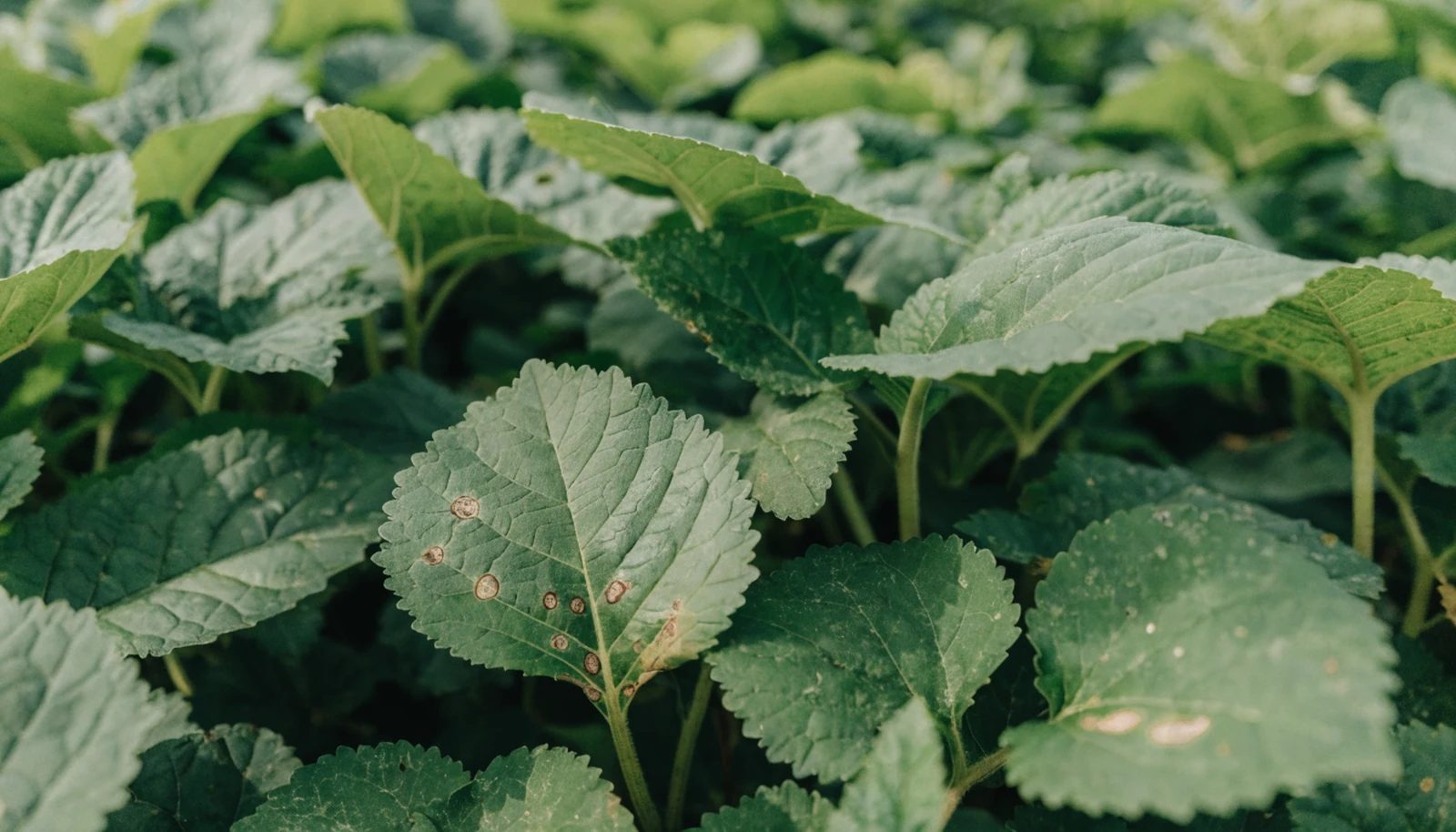
Crops affected
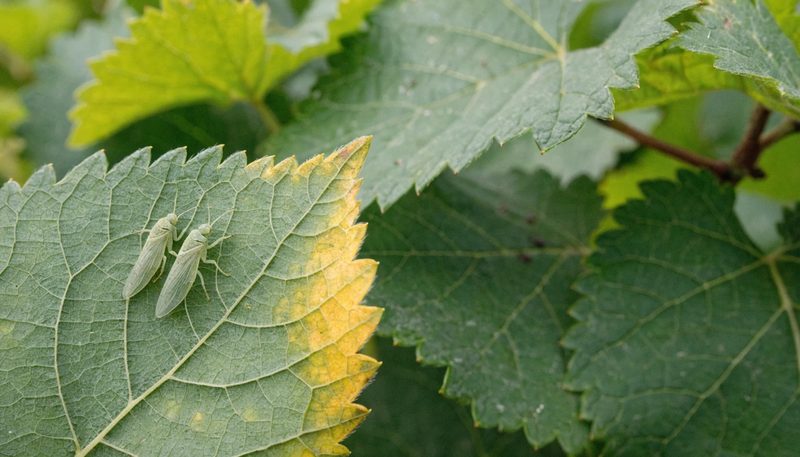
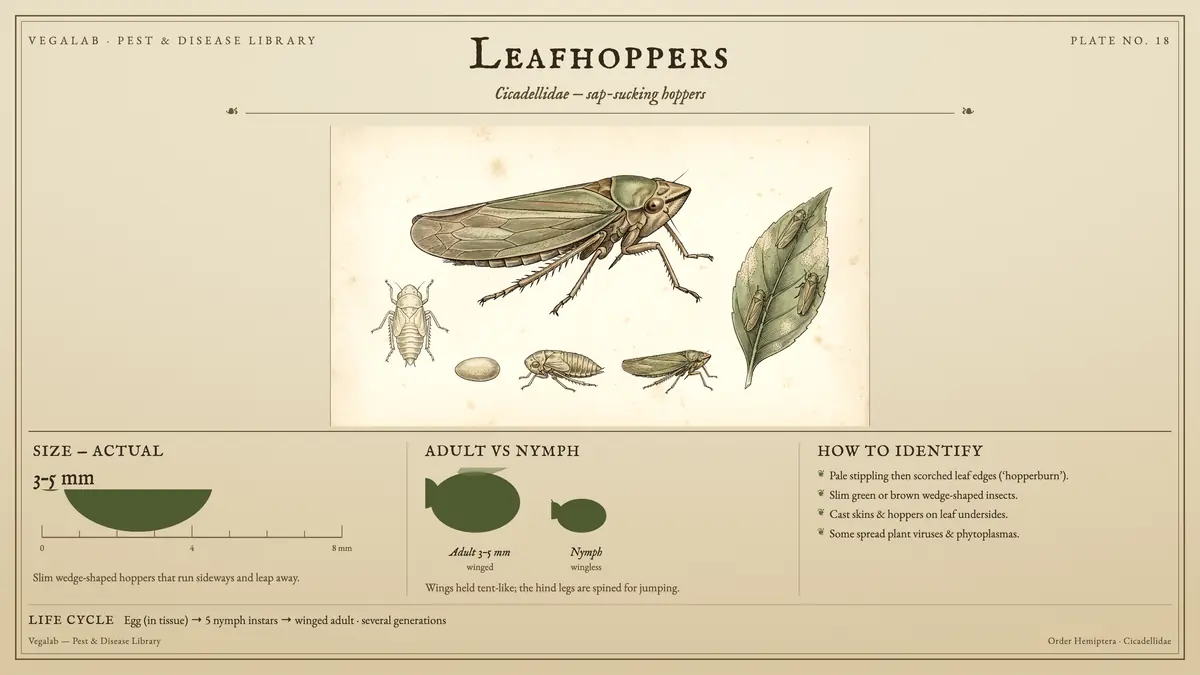
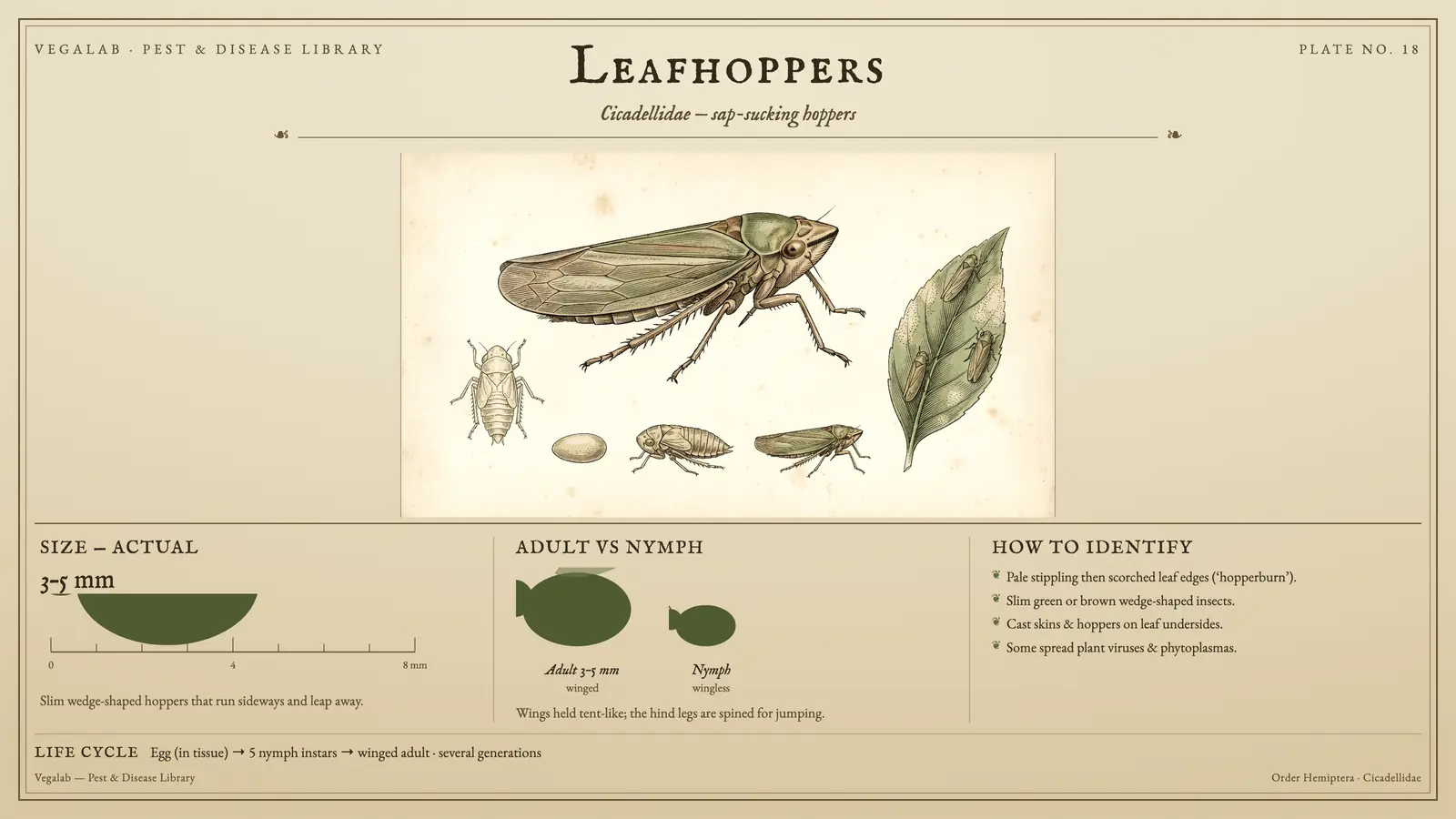
How to identify leafhoppers
Size. 3 - 5 mm Slim wedge-shaped hoppers that run sideways and leap away.
What is it?
Leafhoppers are wedge-shaped insects that feed on sap and inject saliva, disrupting the plant's vascular tissue. Some species also vector phytoplasmas and viruses, adding disease risk to direct feeding damage.
How to identify it
- Small (a few mm), green to brown wedge-shaped insects that run sideways and hop/fly when disturbed.
- Leaf yellowing, marginal browning and upward curling - 'hopperburn' - starting at leaf tips/edges.
- Stippling and pale speckling from feeding; stunted, distorted growth in heavy infestations.
- Cast skins and rapid nymphs on leaf undersides.
Life cycle & spread
Eggs are inserted into leaf/stem tissue; nymphs develop through several instars on leaf undersides; multiple generations per season, with rapid build-up in warm weather.
Conditions that favour it
Warm, dry weather and lush growth favour build-up; migratory species can arrive in waves.
Damage and how it spreads
Direct feeding causes hopperburn and yield loss; pathogen transmission (phytoplasmas, viruses) can add disease losses well beyond the feeding damage.
Monitoring & scouting
Scout leaf undersides for nymphs; watch for early tip/edge yellowing; sweep-net to gauge populations and time treatment to nymphs.
How to control it
- Target nymphs with thorough underside coverage;
- manage early before hopperburn develops;
- conserve natural enemies.
How to manage leafhoppers
- Identify what you are dealing with. Some leafhoppers cause only cosmetic stippling; others inject toxins causing hopperburn, and others vector phytoplasmas and bacteria. The threshold differs by an order of magnitude between those cases.
- Use yellow sticky traps for monitoring and early detection - adults are highly mobile and traps detect arrival before damage.
- Treat nymphs where treatment is warranted. Nymphs are wingless, sit on leaf undersides and cannot escape; adults fly off and re-invade, so applications aimed at adults give short-lived results.
- Manage the weed and margin hosts that carry both the insects and the pathogens they transmit - this is often more effective than treating the crop.
- Use reflective mulches and barrier crops to reduce landing in high-value vegetable crops.
- Protect natural enemies, including Anagrus egg parasitoids and spiders, which provide substantial control in unsprayed systems.
- Screen protected crops and manage the host-free period between plantings.
- Where a phytoplasma disease is the risk, prioritise removing infected plants and reservoir hosts over reducing vector numbers, since transmission needs very few insects.
Leafhoppers matter more as disease vectors and toxin injectors than as sap feeders, and that reframes the thresholds. A population too small to cause visible feeding damage can still transmit a phytoplasma or cause hopperburn.
Hopperburn - marginal yellowing then browning and curling of leaves - is caused by the insect's saliva, not by tissue removal. It appears at low populations and is not reversible, so prevention matters more than knock-down.
Leafhopper, planthopper or psyllid?
- Leafhopper (Cicadellidae): wedge-shaped, holds wings roof-like over the body, moves sideways across a leaf when disturbed then jumps; nymphs also run sideways - a distinctive and reliable behavioural clue
- Planthopper (Delphacidae, Fulgoridae): stouter, with the antennae set below the eyes; includes the rice brown planthopper, a major hopperburn and virus vector
- Psyllid (jumping plant lice): smaller, aphid-like at rest but jumps strongly; nymphs are flat and often produce waxy filaments and honeydew; vectors of citrus greening and zebra chip
- Aphid: does not jump at all, moves slowly, has cornicles at the rear, and forms dense stationary colonies
The sideways scuttle is the fastest field identification for a leafhopper. See Aphids.
The diseases leafhoppers carry
- Aster yellows phytoplasma · carried by the aster leafhopper into carrot, lettuce, celery and many ornamentals; causes yellowing, distortion, witches' broom and hairy roots in carrot
- Grapevine flavescence dorée and other grapevine phytoplasmas · quarantine diseases in several regions with mandated vector control
- Pierce's disease (Xylella fastidiosa) · transmitted by sharpshooter leafhoppers; lethal to grapevine and a regulated concern across several crops
- Maize bushy stunt and corn stunt · phytoplasma and spiroplasma diseases of maize transmitted by corn leafhoppers
- Rice tungro and rice dwarf viruses · transmitted by green leafhoppers
- Potato purple top and beet leafhopper-transmitted virescence · in potato, beet and tomato
The vector role is where most of the economic damage sits, and it varies by system:
Where a regulated pathogen is involved, vector management may be legally mandated and reporting obligations may apply. Check local plant health requirements rather than treating it as an ordinary pest decision.
Hopperburn: a toxin problem, not a feeding problem
- Set low thresholds in hopperburn-susceptible crops; visible symptoms already mean loss
- Scout leaf margins on the youngest fully expanded leaves, where symptoms appear first
- Treat nymphs early · protecting healthy tissue is all that is achievable
- Consider early cutting in alfalfa as an alternative to treatment
- Do not judge success by symptom reversal · existing hopperburn will not recover
Several leafhopper and planthopper species cause hopperburn, and understanding it as a toxic reaction rather than as tissue removal changes both the threshold and the expectation of what treatment achieves.
The insects inject saliva while feeding, and in susceptible crops that saliva disrupts phloem function and triggers a physiological response: leaf margins yellow, then redden or brown, then curl and die, progressing inward. Potato leafhopper on potato, beans and alfalfa is the classic example, and rice brown planthopper produces a whole-field version in which patches of crop collapse and dry out.
Two consequences follow. First, the damage appears at low populations - far below any level at which sap removal would matter - so thresholds are set very low in susceptible crops and scouting has to be sensitive rather than casual. Second, the damage is not reversible: the affected tissue does not recover after the insects are removed. That means treatment prevents further damage but does not repair what is done, so timing is everything and a late application protects only the tissue still healthy.
In alfalfa this drives a specific tactic - early cutting when populations rise, which removes both the insects and the crop in one operation and lets the regrowth start clean.
See Weak Stems & Lodging and Magnesium Deficiency, both of which produce marginal leaf discolouration that is confused with hopperburn.
Recommended Vegalab solution: Spider Mite Control
Spider Mite Control · all-natural contact product (geraniol with peppermint, cottonseed and rosemary oils) that controls leafhoppers and other soft-bodied pests on contact; spray with thorough leaf-underside coverage, repeated per pressure.
| Role | Product | Use |
|---|---|---|
| Primary control | Spider Mite Control |
By crop
Preventing it next season
Early scouting, prompt treatment of nymphs, weed management, and avoiding excess nitrogen that fuels lush, attractive growth.
Claims and product availability vary by jurisdiction. Always read and follow the product label.