

Crops affected
How to identify leaffolder
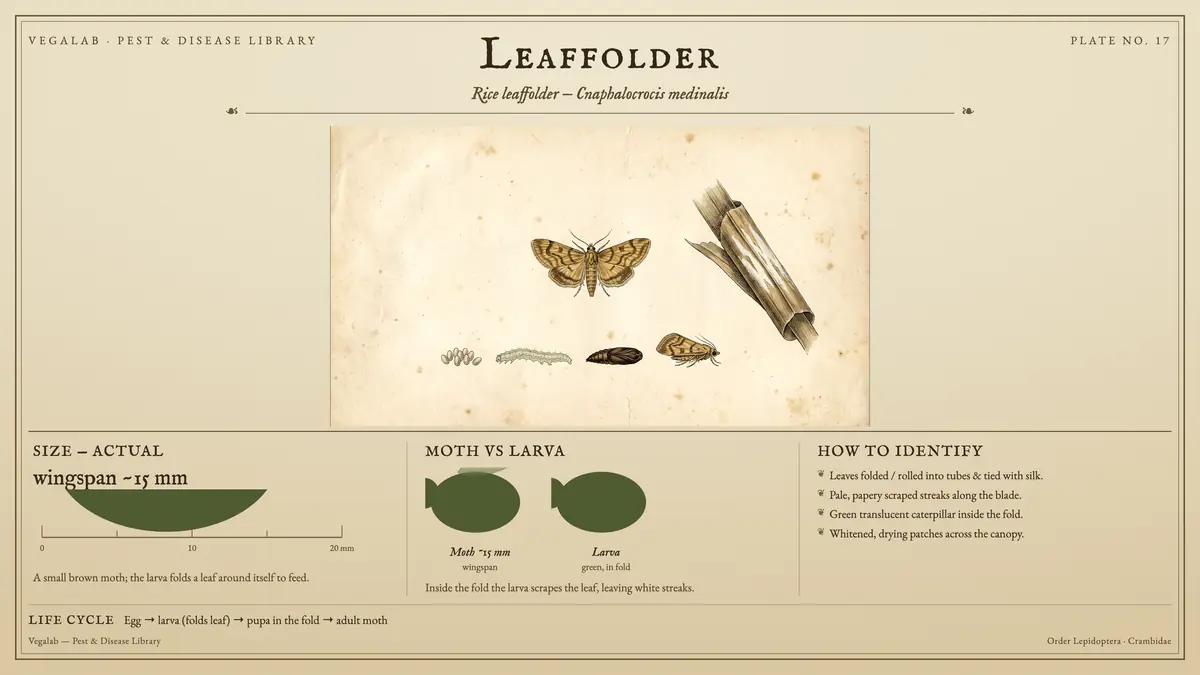
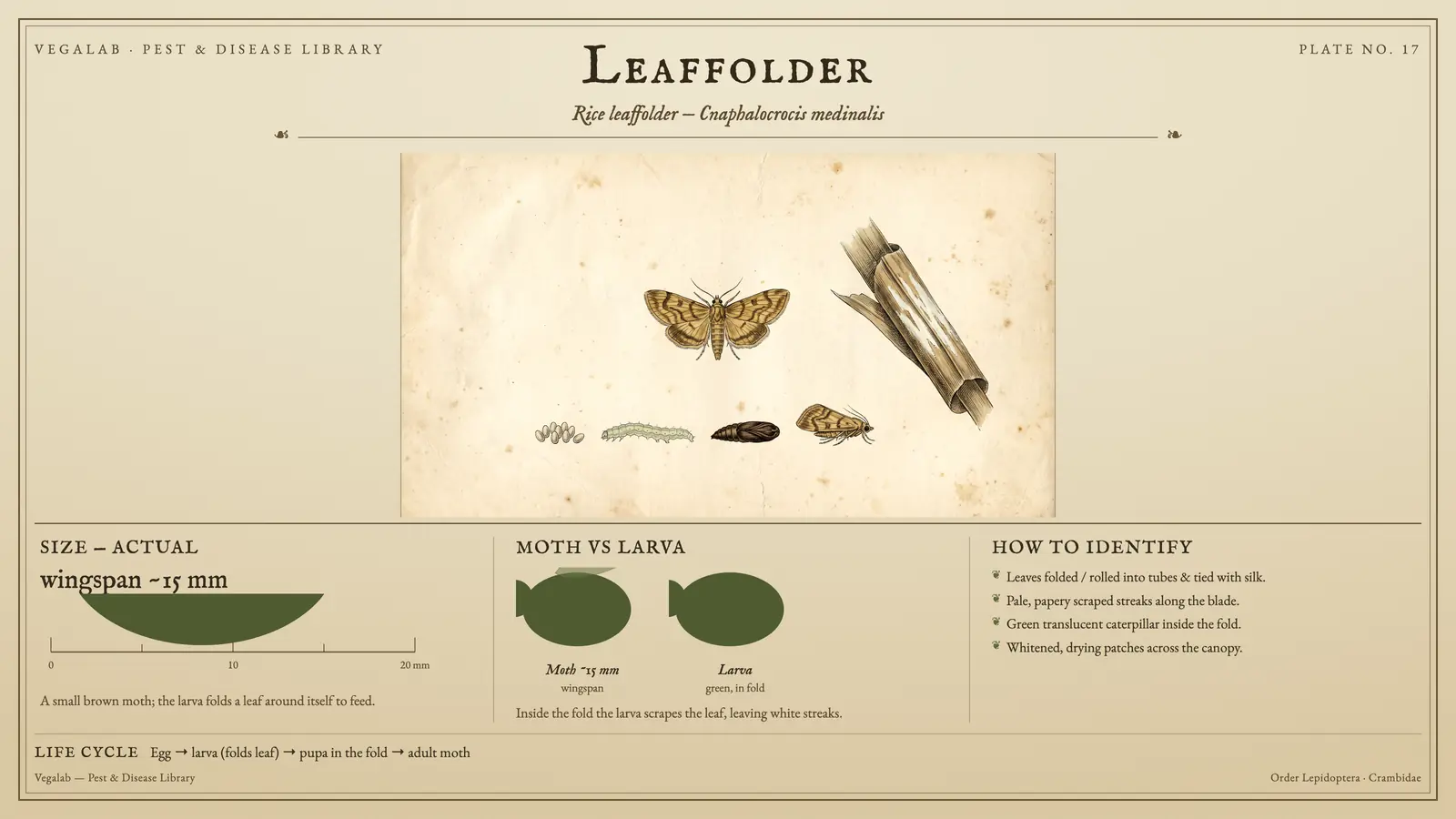
Size. wingspan ~15 mm A small brown moth; the larva folds a leaf around itself to feed.
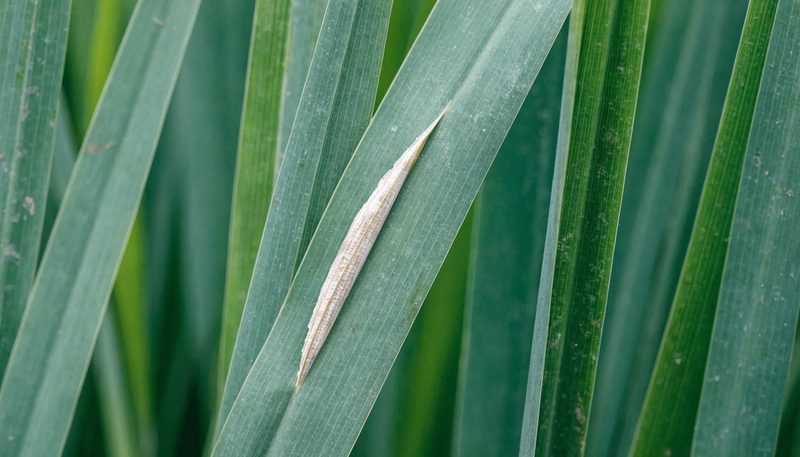
- Pale, papery scraped streaks along the blade.
- Whitened, drying patches across the canopy.
What is it?
Leaffolder larvae fasten a leaf into a tube with silk and feed inside on the green tissue, leaving white, papery streaks. The folded leaf shelters the larva, so early timing matters.
How to identify it
- Leaves folded longitudinally into tubes, fastened with silk.
- White or transparent streaks where larvae have scraped the leaf surface.
- Larvae and frass inside the folds.
- Scorched, papery appearance across the canopy in heavy infestations.
Life cycle & spread
Moths lay eggs on leaves; larvae fold leaves and feed inside through several instars before pupating; multiple generations occur over a rice season.
Conditions that favour it
Lush, high-nitrogen canopies, dense planting and humid conditions favour leaffolder build-up.
Damage and how it spreads
Loss of green leaf area reduces photosynthesis and grain fill; severe infestations at flag-leaf stage are most damaging to yield.
Monitoring & scouting
Scout for fresh folds and feeding streaks, especially on upper and flag leaves; act on young larvae before folds are extensive.
How to control it
- Avoid excess nitrogen, target young larvae early, and ensure coverage of the upper canopy where damage matters most.
How to manage rice leaffolder
- Cut the nitrogen back to requirement. Excess nitrogen produces the soft, dense, shaded canopy the pest thrives in. Split applications matched to crop demand reduce leaffolder pressure directly and are usually the cheapest intervention available.
- Judge by growth stage. Damage during tillering is largely compensated for; damage to the flag leaf and the leaf below during booting and grain fill is what costs yield. Treat the second, tolerate the first.
- Unnecessary early broad-spectrum insecticides can trigger rice leaffolder resurgence by disrupting spiders and parasitoids. Rice often compensates for moderate early defoliation during tillering; use local thresholds, crop stage, and natural-enemy activity before treating.
- Avoid prophylactic early-season sprays entirely. This is the specific practice that creates the problem.
- Manage the canopy. Appropriate spacing and avoiding over-dense transplanting improve airflow and light penetration.
- Where treatment is justified, direct it at the upper canopy and time it to small larvae before folds are fully formed and sealed.
Leaffolder is a pest where the economic reality is often that no treatment is warranted - rice compensates well for leaf area lost during tillering, and much of the visible damage does not translate into yield loss. Deciding whether to act matters more than deciding what to use.
Rice leaffolder is the textbook example of a pest made worse by spraying. Early-season insecticide use removes the spider and parasitoid complex that otherwise keeps it below economic levels.
Leaffolder damage or something else?
- Leaffolder: leaves folded and stitched with silk into a tube; inside, white papery scraped streaks where chlorophyll has been removed; frass in the fold
- Caseworm: cuts leaf pieces and makes a floating tubular case; damage is at the water surface, not in a fold on the plant
- Whorl maggot: feeds in the whorl of young rice producing ragged, chewed emerging leaves without silk folding
- Stem borer: no leaf folding; deadheart and whitehead symptoms with entry holes and frass on the stem
- Rice hispa: scrapes long white parallel streaks between veins on an unfolded leaf, easily confused with leaffolder scraping
The silk-stitched fold is conclusive. See Stem Borers.
Why compensation matters here
Rice has a substantial capacity to compensate for leaf area lost early in the season. During tillering the crop is producing more leaf area than it needs for the yield it will ultimately set, and losing some of it triggers compensatory growth rather than a yield penalty. Field trials repeatedly show no measurable yield response to leaffolder control at this stage even at fairly high folding percentages.
That changes at booting. From flag leaf emergence onward, the upper two leaves supply the majority of the carbohydrate that fills the grain, and there is no longer time or resource to replace them. The same percentage of folded leaves that was economically irrelevant during tillering becomes worth treating once it is the flag leaf being scraped.
The practical consequence is that a percentage threshold applied without reference to growth stage will lead to unnecessary applications early and possibly insufficient attention late. Stage first, then count.
Insecticide-induced resurgence in rice
- Do not spray prophylactically during tillering · this is the specific practice that triggers resurgence
- Rice compensates for early leaf loss, so early damage rarely justifies treatment anyway
- Preserve the spider and parasitoid complex · it is doing most of the work
- Reserve treatment for the booting-to-grain-fill window and for the upper leaves, where damage actually costs yield
Rice leaffolder and the planthoppers are the classic documented case of a pest problem created by its own treatment, and the mechanism is worth stating because it changes what a rational programme looks like.
Irrigated rice supports an unusually rich complex of natural enemies - spiders in particular, plus parasitoid wasps, mirid bugs and predatory beetles - and in an unsprayed crop these hold leaffolder and planthopper populations well below economic levels through the season. Broad-spectrum insecticide applied early, typically as a prophylactic treatment during tillering, removes that complex. The pests then recover faster than their enemies, because they reproduce faster and recolonise from outside, and the population that returns faces no biological resistance at all.
The result is a worse infestation later in the season than the untreated field would have had, and a crop now dependent on repeated spraying for the rest of the season. Large-scale programmes across Asia have demonstrated that simply stopping early-season insecticide use reduces both pest problems and costs, with no yield penalty.
This is the single most important insight in rice pest management and it is counter-intuitive: doing nothing early is usually the higher-yielding decision.
Recommended Vegalab solution: Larva Control
Larva Control · natural broad-spectrum larvicide (oxymatrine) applied at early-instar stage before extensive leaf folding, with good upper-canopy coverage.
| Role | Product | Use |
|---|---|---|
| Primary control | Larva Control |
Preventing it next season
Balanced nitrogen, appropriate plant spacing, and early treatment of young larvae before flag-leaf damage.
Claims and product availability vary by jurisdiction. Always read and follow the product label.