

Last updated:
Box tree moth (Cydalima perspectalis) is an invasive moth from eastern Asia whose green, yellow and black striped caterpillars feed on boxwood, leaving peeled leaves, webbing and green-black droppings.1,4 Control small infestations by hand-picking caterpillars into soapy water and pruning out webbed shoots; for larger ones, apply a Bacillus thuringiensis subsp. kurstaki product while caterpillars are small, following the product label.1,2,5
How do you identify box tree moth?
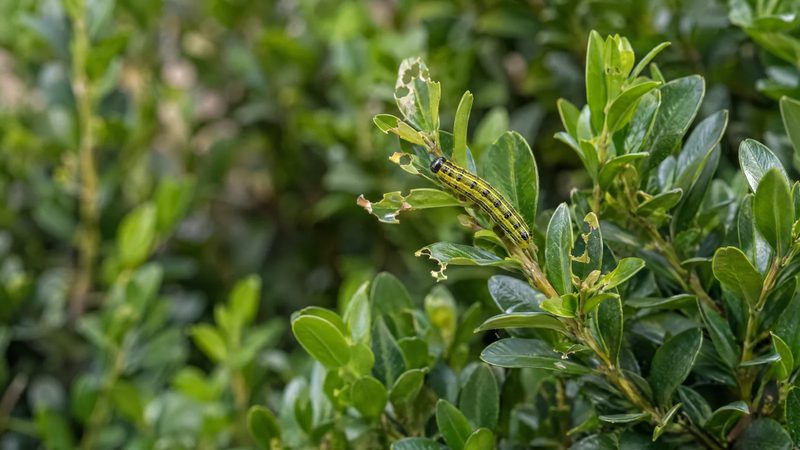
Box tree moth (Cydalima perspectalis) is native to eastern Asia, including Japan, China, the Russian Far East, Korea and India, and its caterpillars feed on boxwood (Buxus spp.).1 The caterpillars are green and yellow with white, yellow and black stripes and black spots, and in Pennsylvania and nearby states they are the only caterpillars that feed on boxwood, so finding one on the plant is a strong sign.1 Newly hatched larvae are greenish yellow with a shiny black head, and mature larvae reach about 4 cm (1.6 inches).3
Adults usually have white wings with a broad dark brown border and a wingspan of about 4 cm, while a less common melanic form is brown with a small white streak on the forewing.3 That brown form makes up about 5 to 10 percent of moths.1 The white form looks superficially like the melonworm moth, which is common in the southeastern United States, but box tree moth has white comma marks on the forewings and a white prothorax that interrupts the brown border.1
| Stage | What it looks like | Duration |
|---|---|---|
| Egg | Pale yellow, in overlapping groups of about 5 to 20 on the underside of leaves | About 3 days |
| Caterpillar | Green and yellow with black, white and yellow stripes and black spots; up to about 4 cm | About 14 days to mature |
| Pupa | Green with brown stripes, hidden in white webbing among leaves and twigs | About 14 days |
| Adult moth | White wings with a dark brown border, or the less common all-brown form; wingspan about 4 cm | Strong fliers that disperse several miles |
| Overwintering larva | Second to fifth stage caterpillar in a silken cocoon between leaves | Through winter, then resumes feeding in spring |
In North America, inspect boxwood from May to September2: overwintered caterpillars resume feeding in spring, generations overlap from May to October in New York4, and in western New York a second wave of caterpillars appeared in September before overwintering5. Because diapause is triggered by day length3, the same stages would fall in the opposite months in the Southern Hemisphere.
What are the signs of box tree moth damage on boxwood?
Young caterpillars feed on the undersides of leaves, which gives leaves a peeled look from above, and older caterpillars eat the whole leaf except the midrib.1 They also web leaves together and build silken retreats.1 Webbing is often easiest to see by spreading the branches and looking into the interior of the shrub, and green-black balls of droppings are another sign.4 Molted black head capsules can also be found in and around infested plants.3
In heavy infestations caterpillars strip bark once the leaves are gone.4,5 Box tree moth can completely defoliate a boxwood within one growing season, and in western New York heavy larval feeding caused visible injury within two weeks.5 In Europe, where there are few natural enemies to hold populations back, extensive feeding has killed individual plants and entire plantings.1
- Leaves that look peeled or skeletonized, or only midribs left.1,3
- White silk webbing inside the canopy and at shoot tips.4,5
- Round, green-black or greenish-brown droppings on and under leaves.4,5
- Green and yellow striped caterpillars with black spots.1
- Bare twigs or stripped bark after heavy feeding.4,5
Where is box tree moth found in Ontario and the United States?
In North America, box tree moth was first reported in Toronto, Ontario, by a citizen scientist in August 2018, and the Canadian Food Inspection Agency (CFIA) confirmed it there in November 2018.3 Ontario, Quebec, New Brunswick, Nova Scotia, Newfoundland and Labrador and Prince Edward Island are now the regulated areas for box tree moth in Canada, and boxwood plants for planting may move freely within and between those provinces.2 Anyone who suspects box tree moth in Manitoba, Saskatchewan, Alberta or British Columbia should report it to the CFIA.2
In the United States, box tree moth was confirmed in New York in 2021, Michigan in 2022, Ohio and Massachusetts in 2023, and Pennsylvania in 2024.1 Its arrival in New York was likely on a storm from the nearby infestation in Ontario, and a federal quarantine restricts the export of boxwood nursery stock from counties with known infestations.4 The moth flies an estimated 5 to 10 km a year on its own and also spreads on infested boxwood shrubs.2
There are no native boxwood species in continental North America and boxwood does not grow wild here, so only planted ornamentals can be infested.1 That is a major difference from Europe, where box tree moth was detected around 2006 and has spread to up to 30 countries, helped by two native wild boxwood species.3 A 2024 climate model found most of North America climatically suitable for the moth, except Alaska and the northern territories of Canada, higher elevations in the Rocky Mountains, and hot, dry southern areas.6
What is the box tree moth life cycle?
Box tree moth completes 1 to 5 generations a year depending on location, and it overwinters as a second to fifth stage caterpillar in a silken cocoon spun between boxwood leaves.3 Overwintering caterpillars survive temperatures of at least -22°F (-30°C).1,4 They also need an obligatory diapause of 6 to 8 weeks triggered by a day length of about 13.5 hours.3
Penn State Extension expects two generations across most of Pennsylvania and three around Philadelphia, with overwintered caterpillars resuming feeding in early to mid-spring and, after diapause, again in late May to early June.1 In western New York in 2022, monitoring recorded two complete generations: caterpillars throughout July, adults from early August peaking at the end of the month, and a second wave of caterpillars in September that went into winter as young larvae.5 Across New York, generations can overlap from May to October.4
How do you control box tree moth caterpillars?
From May to September, inspect boxwoods regularly.2 Adults, pupae, mature caterpillars and leaves carrying eggs can be removed by hand and destroyed in soapy water, in alcohol or in a sealed airtight container, because those stages are not easily controlled with treatments.2 While caterpillars are small, a strong jet of water knocks many off the plant, and most cannot climb back before starving.1 Pruning out damaged shoots and bagging them for dumpster disposal also removes caterpillars.5
For feeding caterpillars, the CFIA advises a biological pesticide containing Bacillus thuringiensis subsp. kurstaki, and more than one treatment may be needed.2 Penn State Extension adds that horticultural oil and insecticidal soap will likely control young caterpillars, and that Bacillus thuringiensis and spinosad have been used against box tree moth in Europe.1 Sprays work best while caterpillars are small, because older caterpillars hide behind webbing that blocks the spray.5 Thorough coverage into the interior of the shrub is necessary, and hiring a professional applicator is an option.4 Use only a product registered for boxwood in your state or province and follow the product label.4,3
A sex pheromone is commercially available, and pheromone-baited traps are used to monitor plantings for male moths.1,5 Natural enemies are not a fix yet: parasitism by native wasps and flies in Europe has stayed too low to control the moth, and the lack of natural mortality factors in newly invaded regions is one of the main reasons the moth has spread so widely.1,7 Where infested clippings or whole shrubs must be removed, bag them and keep them on site, and in New York contact the State Department of Agriculture and Markets before moving them.4
| Option | Stage it targets | Notes |
|---|---|---|
| Hand-picking into soapy water or alcohol | Caterpillars, pupae, adults, egg-bearing leaves | Effective for small infestations |
| Strong water jet | Small caterpillars | Many cannot climb back before starving |
| Pruning and bagging webbed shoots | Caterpillars and pupae in webbing | Bag for dumpster disposal |
| Bacillus thuringiensis subsp. kurstaki | Feeding caterpillars | Multiple treatments may be needed; follow the product label |
| Horticultural oil or insecticidal soap | Young caterpillars | Needs thorough coverage under leaves |
| Pheromone traps | Adult males | Monitoring only |
Key takeaways
- Box tree moth (Cydalima perspectalis) caterpillars feed on boxwood and leave peeled leaves, webbing and green-black droppings.
- It was first found in North America in Toronto in 2018 and is regulated across Ontario, Quebec and the Atlantic provinces.
- Overwintering caterpillars tolerate at least -22°F (-30°C), and two generations a year are expected across most of Pennsylvania and were recorded in western New York.
- Hand-pick small infestations; for larger ones use a Bacillus thuringiensis subsp. kurstaki product while caterpillars are small, following the product label.
- Bag infested clippings and keep them on site rather than moving them to a new area.
References
- Box Tree Moth
- Box tree moth
- Cydalima perspectalis (Walker) (Box tree moth): Fact sheet
- Box Tree Moth
- Box Tree Moth in the United States (ENTO-525)
- Modelling potential distribution of the invasive box tree moth across Asia, Europe, and North America
- Survey of Natural Enemies of the Invasive Boxwood Moth Cydalima perspectalis in Southwestern Mediterranean Europe and Biocontrol Potential of a Native Beauveria bassiana (Bals.-Criv.) Vuill. Strain