

Spider Mite Control
All-natural acaricide · No resistance build-up, Kills on contact.
- Zero REINo re-entry wait
- Zero PHIHarvest the same day
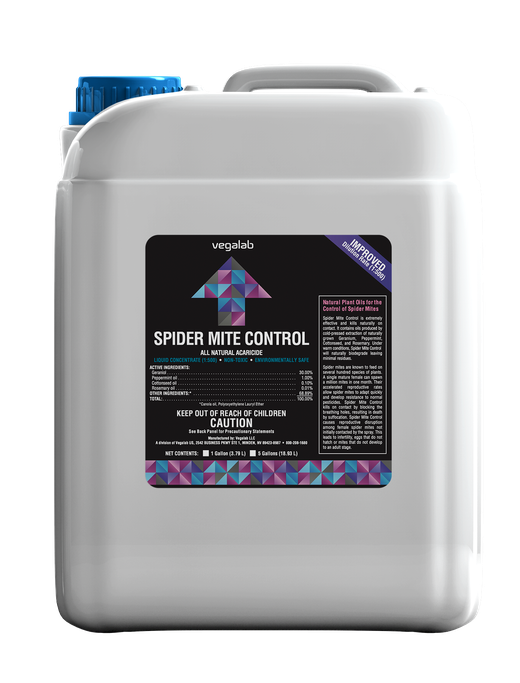
All-natural acaricide from Vegalab Crop Science, powered by Geraniol 30% · peppermint, cottonseed, rosemary oils. Spider Mite Control targets Tetranychus urticae and related Tetranychidae spider mites.
Shipping $20 + $5 per gallon, calculated at checkout. Online orders up to 50 gallons; contact us for larger loads. Not available for delivery to Canada.
Secure checkout on Shopify. Each store keeps its own bag.
Geraniol with peppermint, cottonseed and rosemary oils blocks the breathing holes of spider mites, suffocating adults and deactivating laid eggs. Reproductive disruption in adult females arrests development. No resistance development reported after continued use.
| Active | Geraniol 30% · peppermint, cottonseed, rosemary oils |
|---|---|
| Targets | Tetranychus urticae and related Tetranychidae spider mites |
| Dilution rate | 1:500 · 2 mL/L (7.6 mL/gal) · 2.4 L/ha (33.3 fl oz/acre) |
| Application | Foliar spray, top and underside; repeat every 3–5 days |
| Line · Category | Control · All-natural acaricide |
- Two-spotted spider mite (Tetranychus urticae)
- European red mite (Panonychus ulmi)
- Carmine spider mite (Tetranychus cinnabarinus)
- Other Tetranychidae spider mites
- Spider Mite Control has shown 95% control of spider mites on heavily infested crops (almond, grape, cucurbit, citrus, melon, strawberry).
- 94% control of aphids, scale, thrips, worms and other soft-bodied insects.
How do I know if I have a spider mite infestation?
Spider mites are tiny and easy to miss until populations explode. The clearest early signs are fine stippling or speckling on leaves (pale dots where mites have fed), bronzing or yellowing of foliage, and fine webbing on the undersides of leaves and between stems in heavy infestations. Two-spotted spider mite (Tetranychus urticae) is the most common culprit, thriving in hot, dry conditions where colonies can double in days.
Because mites and their eggs concentrate on leaf undersides, inspect there first - and treat there too, since coverage of the underside is what determines control.
How does Vegalab Spider Mite Control work?
Spider Mite Control is an all-natural acaricide powered by geraniol (30%) blended with peppermint, cottonseed and rosemary oils. The blend works physically and physiologically: it blocks the breathing holes of spider mites, suffocating adults on contact, while deactivating laid eggs and arresting development in adult females. Because the mode of action is contact suffocation rather than a single biochemical target, no resistance development has been reported after continued use - a key advantage over conventional miticides.
Why do spider mites develop resistance - and how does this help?
Spider mites reproduce quickly and are notorious for evolving resistance to single-target chemical miticides, which is why growers are often told to rotate products. Vegalab Spider Mite Control’s contact-suffocation mode of action does not rely on a single biochemical pathway, so there is no reported resistance build-up with continued use. It can anchor a rotation or serve as a resistance-management tool alongside other inputs.
How and when should it be applied?
- Apply when
- First sighting of mites or eggs on leaf undersides
- Repeat
- Repeat on the interval the label sets, because it acts on contact
- Tree nuts
- Almond hull split (no later than 1 percent) and pistachio hull slip, then every 7 days through to shake. Same 1:500 dilution, which is 51 fl oz/acre at the 200 gallons of water per acre orchard standard
- Method
- Foliar spray, both leaf surfaces
- Rate
- 1:500 · 2 mL/L · 2.4 L/ha1:500 · 7.6 mL/gal · 33.3 fl oz/acre · Work out your rate
- Pack sizes
- 3.8 L, 237 mL, 9.5 L1 gal, 8 fl oz, 2.5 gal
- Area treated
- 3.8 L treats ~1.6 ha; 9.5 L treats ~3.9 ha1 gal treats ~3.9 acres; 2.5 gal treats ~9.7 acres
- Pre-harvest interval
- Zero - harvest the same day
- Re-entry interval
- Zero - no re-entry wait
Not timed to a growth stage. Coverage of the leaf underside is the constraint.
Always read and follow the applicable product label.
Apply as a foliar spray to both the top and underside of leaves, where mites and eggs live. The typical rate is 1:500 - 2 mL/L (7.6 mL/gal), or 2.4 L/ha (33.3 fl oz/acre). Because the product hits adults and eggs on contact, repeat every 3–5 days to catch newly hatched mites and break the population cycle. Thorough underside coverage matters more than volume.
Which mites and crops is it for?
It controls two-spotted spider mite (Tetranychus urticae), European red mite (Panonychus ulmi), carmine spider mite (Tetranychus cinnabarinus) and other Tetranychidae. It has been tested on vines, berries, cucurbits, tomatoes and ornamentals. It is biodegradable and minimum toxicity when used as directed.
Need a recommendation for your crop or pest?
Contact usCrop-specific solutions using this product
Frequently asked questions
What is the application rate for Spider Mite Control?
1:500 · 2 mL/L (7.6 mL/gal) · 2.4 L/ha (33.3 fl oz/acre) Application: Foliar spray, top and underside; repeat every 3–5 days.
Is Spider Mite Control suitable for natural or organic programs?
Spider Mite Control is a naturally derived input (Geraniol 30% · peppermint, cottonseed, rosemary oils) designed to fit low-residue and IPM programs.
Which crops is Spider Mite Control used on?
Vines · Berries · Cucurbits · Tomatoes · Ornamentals
Does it kill spider mite eggs as well as adults?
Yes. The geraniol-and-oil blend suffocates adult mites on contact and deactivates laid eggs, while disrupting reproduction in adult females - which is why a repeat spray every 3–5 days is recommended to catch any newly hatched mites.
How often should I spray for spider mites?
Every 3–5 days until the infestation is under control, ensuring thorough coverage of leaf undersides each time. The repeat interval targets mites that hatch after the first application.
Will spider mites become resistant to it?
No resistance development has been reported after continued use. The product works by contact suffocation rather than a single biochemical target, which makes resistance far less likely than with conventional miticides.
Is it safe to use on a range of crops?
It has been tested on vines, berries, cucurbits, tomatoes and ornamentals, and is biodegradable and minimum toxicity when used at label rates. Check the label for your specific crop and region.
Can it be used close to harvest?
Because the active is nature-derived and low-residue, it suits late-season use - there is no pre-harvest interval, so the crop can be picked the same day. Always read and follow the applicable product label.
The evidence behind these actives
Reference pages on the actives this product declares - mode of action, limits and the published sources, written independently of the product listing.
Problems addressed
Pest & disease library
See all plant pests & diseases →
Reference links to identification and management guides. Claims and product availability vary by jurisdiction - always read and follow the product label.
Last updated: