

Crops affected
How to identify codling moth
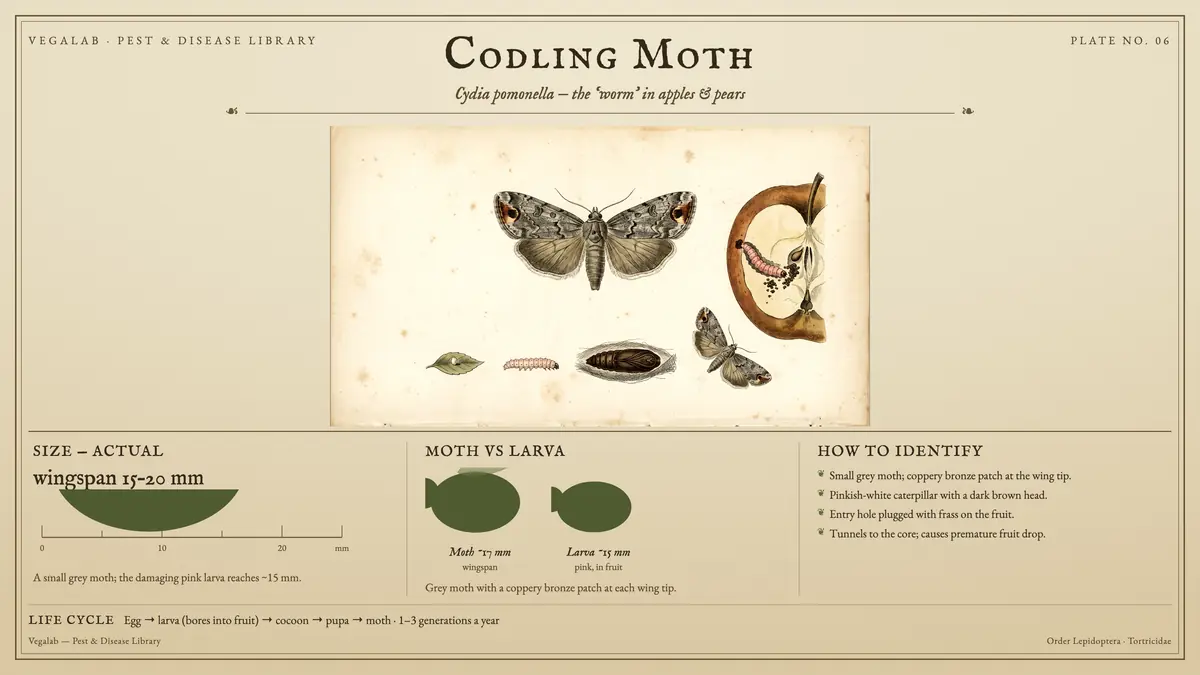
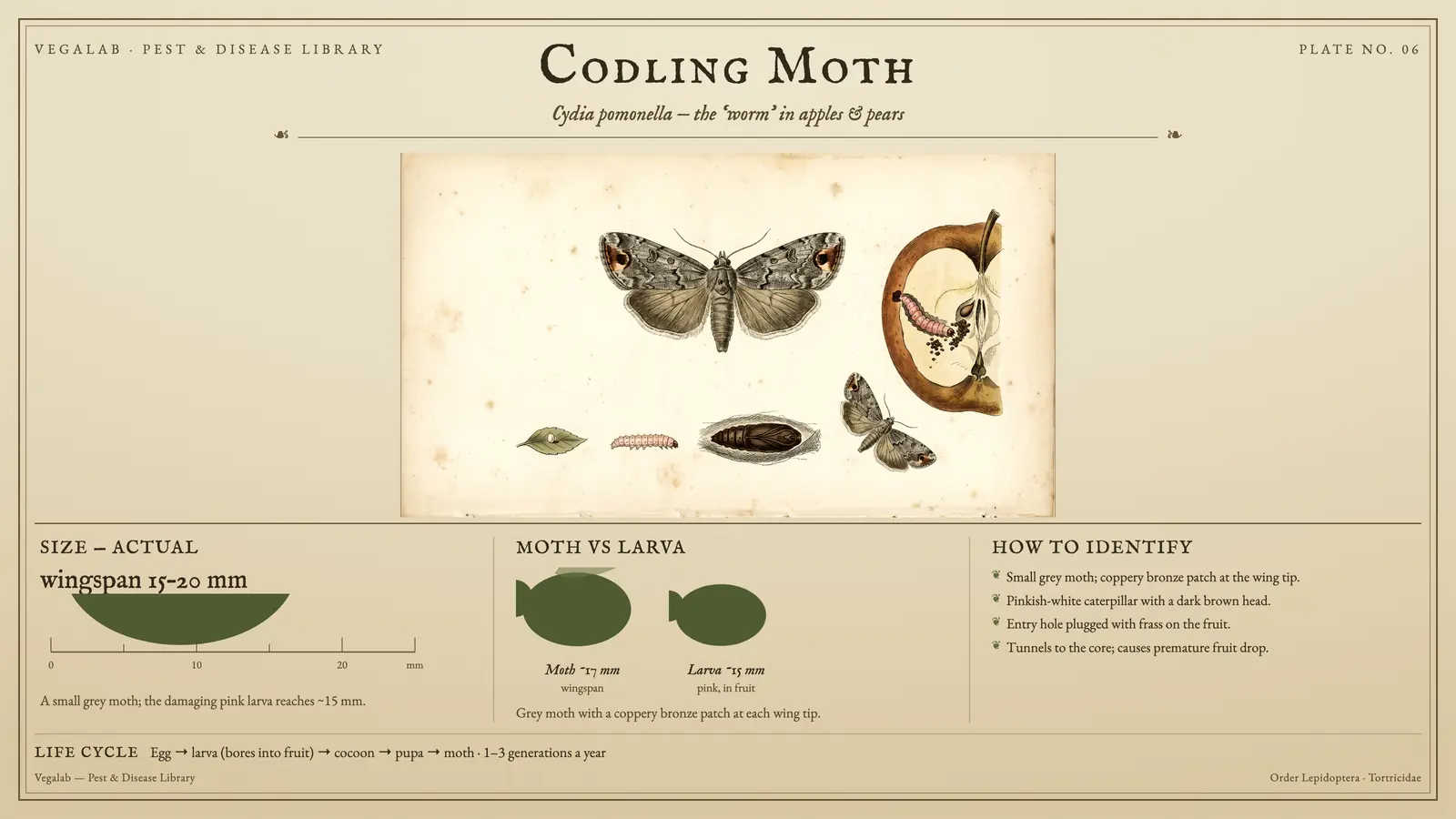
Size. wingspan 15 - 20 mm A small grey moth; the damaging pink larva reaches ~15 mm.
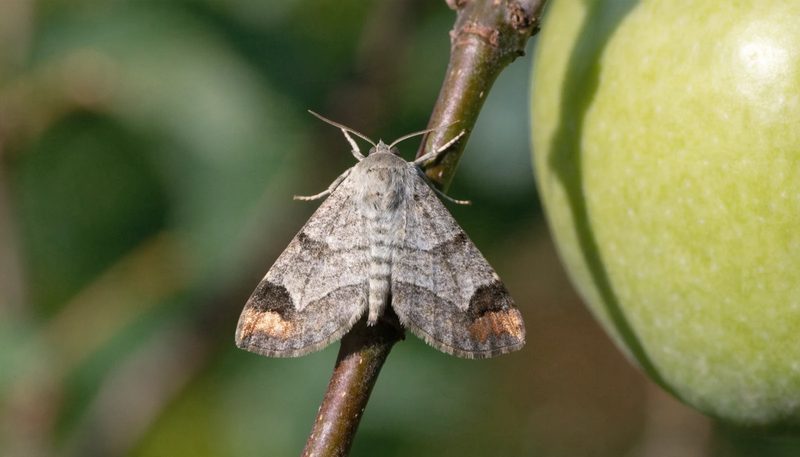
- Small grey moth; coppery bronze patch at the wing tip.
What is it?
Codling moth (Cydia pomonella) lays eggs on or near developing fruit. When the eggs hatch, the young larvae tunnel into the fruit to feed on the seeds and core, then exit to pupate. There are typically multiple generations per season, so pressure builds from spring through harvest.
How to identify it
- Small entry holes in fruit, often surrounded by frass (brown crumbly droppings)
- Tunneling to the core when fruit is cut open
- Premature fruit drop
- Adult moths caught in pheromone traps signaling egg-laying flights
Life cycle & spread
Adults emerge in spring around bloom to petal fall, and flight begins when evening temperatures reach roughly 15 °C - moths will not mate below that, which is why cool evenings delay a generation. Females lay flat, translucent eggs singly on fruit, leaves and spurs.
The larva is the damaging stage and it is exposed for only a matter of hours. On hatching it walks across the fruit surface and bores in, usually at the calyx or where two fruit touch, then tunnels to the core to feed on seeds. Once inside, it is beyond the reach of any contact product - which is why timing to the egg-hatch window, not to the sight of damage, decides the outcome.
The mature larva exits, spins a cocoon under bark scales, in soil or in bin and shed crevices, and either pupates for a second and sometimes third generation or overwinters as a diapausing larva. Degree-day models from first sustained flight are the standard way to predict each hatch.
Damage and how it spreads
Codling moth larvae make fruit unmarketable and cause early drop, and with several overlapping generations a single season can cause heavy losses if egg hatch is not intercepted. Because larvae are protected inside the fruit once they enter, control must target eggs and newly hatched larvae before they tunnel in - which makes timing critical.
Monitoring & scouting
Pheromone traps are essential rather than optional for this pest. Hang them at head height in the upper third of the canopy before bloom, and use the first sustained catch - the biofix - to start a degree-day accumulation.
Time applications to predicted egg hatch from that biofix, not to trap catch numbers and not to visible damage. By the time you see frass at an entry hole the larva is in the core and the fruit is already downgraded.
At harvest, cut a sample of fruit and record the percentage with entries. That figure, more than any in-season count, tells you whether the programme worked and what next season needs.
How to control it
- Hang pheromone traps to monitor flights and time treatments to egg hatch.
- Remove and destroy dropped and infested fruit to reduce the next generation.
- Use tree banding and sanitation to capture and remove larvae and pupae.
- Apply control at egg hatch for each generation, before larvae enter the fruit.
How to control codling moth
- Pheromone-trap biofixes and locally validated degree-day models improve timing against codling moth and Oriental fruit moth by targeting vulnerable stages. Combine them with trap or fruit monitoring and local guidance.
- Target egg hatch. Cover fruit ahead of each predicted hatch, and remember that overlapping generations later in the season mean the windows blur and intervals shorten.
- Use mating disruption on blocks of scale. Pheromone dispensers that saturate the block prevent males finding females. Effective in orchards of roughly four hectares and up, and area-wide programmes work better than isolated ones - a small block surrounded by untreated trees keeps receiving mated females.
- Remove the overwintering sites. Scrape loose bark, clean fruit bins and shed crevices, and remove abandoned or feral host trees nearby. Neglected backyard apple trees are a common reinfestation source.
- Pick up and destroy dropped fruit weekly through the season · each infested drop carries a larva that will complete its cycle on the ground.
- Bag or band where scale allows. Fruit bagging on small plantings is near-total; cardboard trunk bands intercept larvae looking for a pupation site and are removed and destroyed.
- Rotate modes of action. Resistance is documented in long-established orchards, and this pest gets treated repeatedly every season.
Codling moth is a timing problem before it is a product problem. The larva is vulnerable for the few hours between hatching and boring into the fruit, so a well-chosen product applied a week late does almost nothing, and a modest one applied on the hatch does a great deal.
Granulosis virus (CpGV) is a genuinely effective, highly specific biological option for this pest, but it degrades in sunlight and must be applied to coincide with hatch and reapplied often. It is a precision tool, not a rescue.
Codling moth or apple maggot - or oriental fruit moth?
- Codling moth: a single clean tunnel driving to the core, with the seeds eaten and coarse brown frass packed in the tunnel and often extruded at the entry hole. The larva is white to pink with a dark brown head.
- Apple maggot: no clean tunnel · winding brown trails threading through the flesh, with dimpled pitting on the skin outside. The larva is a legless white fly maggot with no distinct head capsule.
- Oriental fruit moth: very similar tunnelling but prefers stone fruit and also bores into shoot tips, causing flagging of new growth - a symptom codling moth does not produce.
- Lesser appleworm and other tortricids: shallower feeding just under the skin rather than a drive to the core.
Cut the fruit open. The internal evidence is unambiguous and it determines the whole programme.
See Oriental Fruit Moth and Peach Fruit Moth (Carposina). Frass at the entry and seeds eaten means codling moth.
Hosts, generations and why the second one hurts most
Codling moth is primarily a pest of apple and pear, and also attacks quince and walnut. Warmer regions get two to three generations a season; cooler regions get one, sometimes a partial second.
The later generations do the commercial damage, for two reasons. The fruit is larger and closer to harvest, so an entry is a direct downgrade rather than something the tree might shed. And generations overlap as the season progresses, so eggs are hatching more or less continuously and there is no longer a single clean window to hit. Programmes that relax after the first generation is controlled are the ones that lose fruit in August.
Walnut growers see the same pest with different economics: entry at the husk stage causes drop and kernel damage. See the "By crop" links above where a crop-specific programme exists.
Recommended Vegalab solution: Larva BioControl
Vegalab Larva BioControl provides a biological mode of action well suited to codling moth programs, and Larva Control (oxymatrine) adds a fast-acting natural larvicide that kills on contact or ingestion. Time applications to egg hatch using trap data, and reapply for each generation. Rotating the two products supports resistance management across the season.
| Role | Product | Use |
|---|---|---|
| Primary control | Larva BioControl | Biological larvicide / rotation partner |
| Companion / broader pressure | Larva Control | Natural larvicide (foliar) |
By crop
See crop-specific solutions
Preventing it next season
Trap-monitor every season, keep up sanitation of dropped fruit, and treat each generation at egg hatch. Healthy, vigorous trees recover better from pest pressure - support them with balanced nutrition.
Claims and product availability vary by jurisdiction. Always read and follow the product label.