

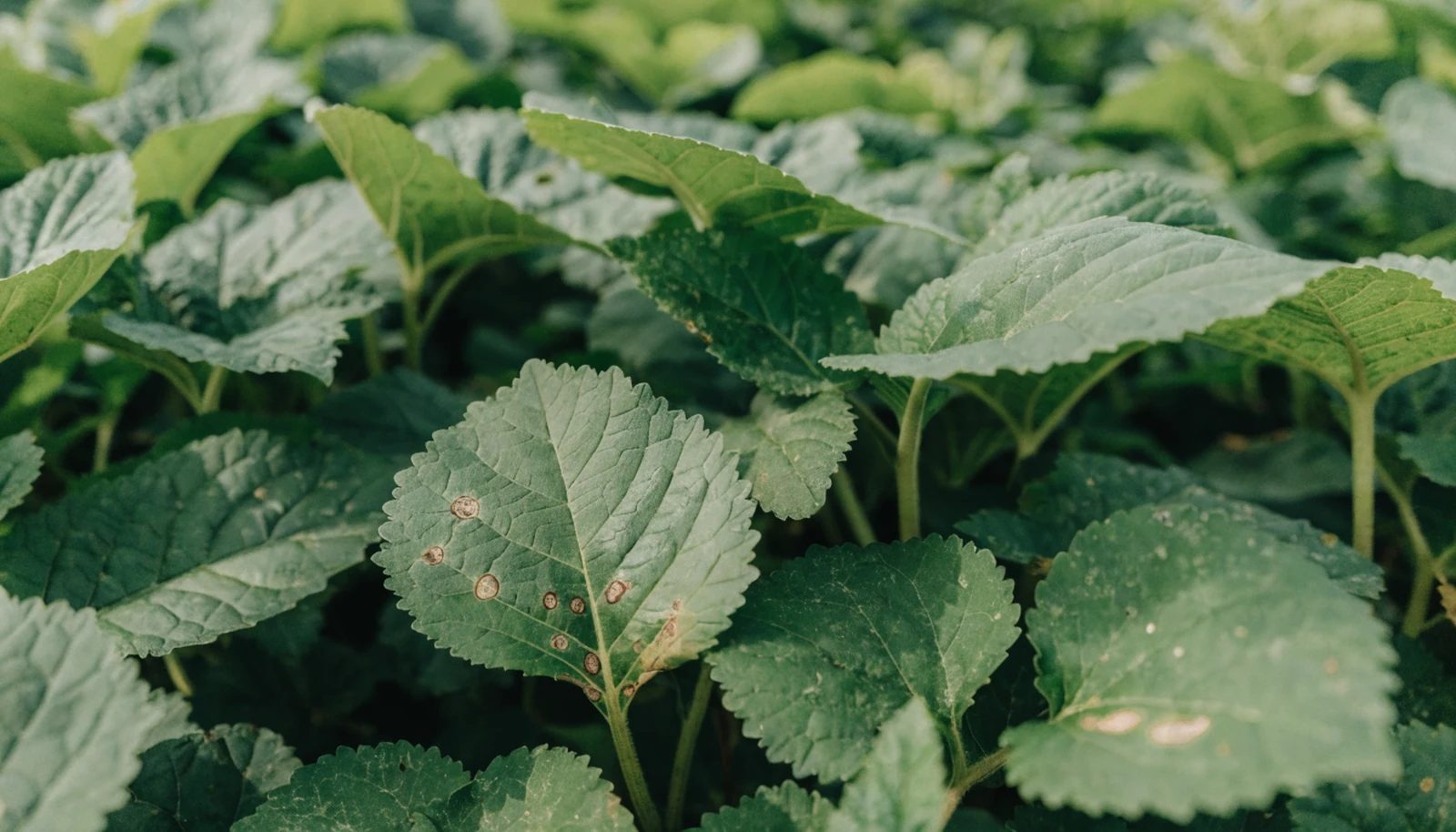
Crops affected
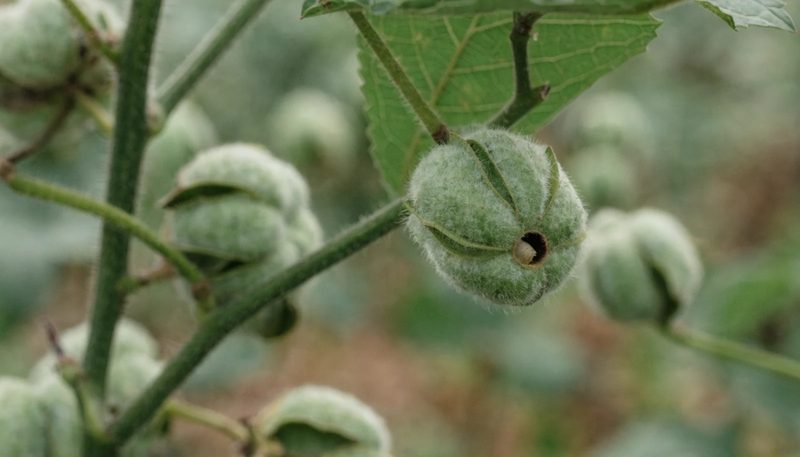
How to identify cotton bollworm
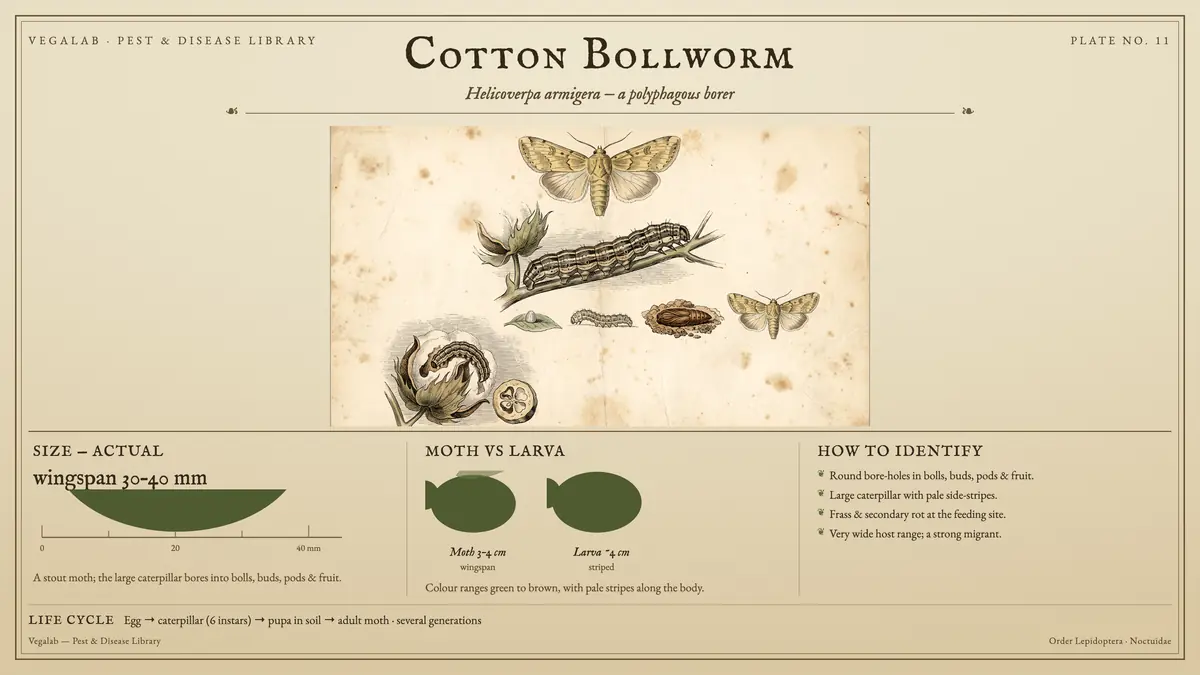
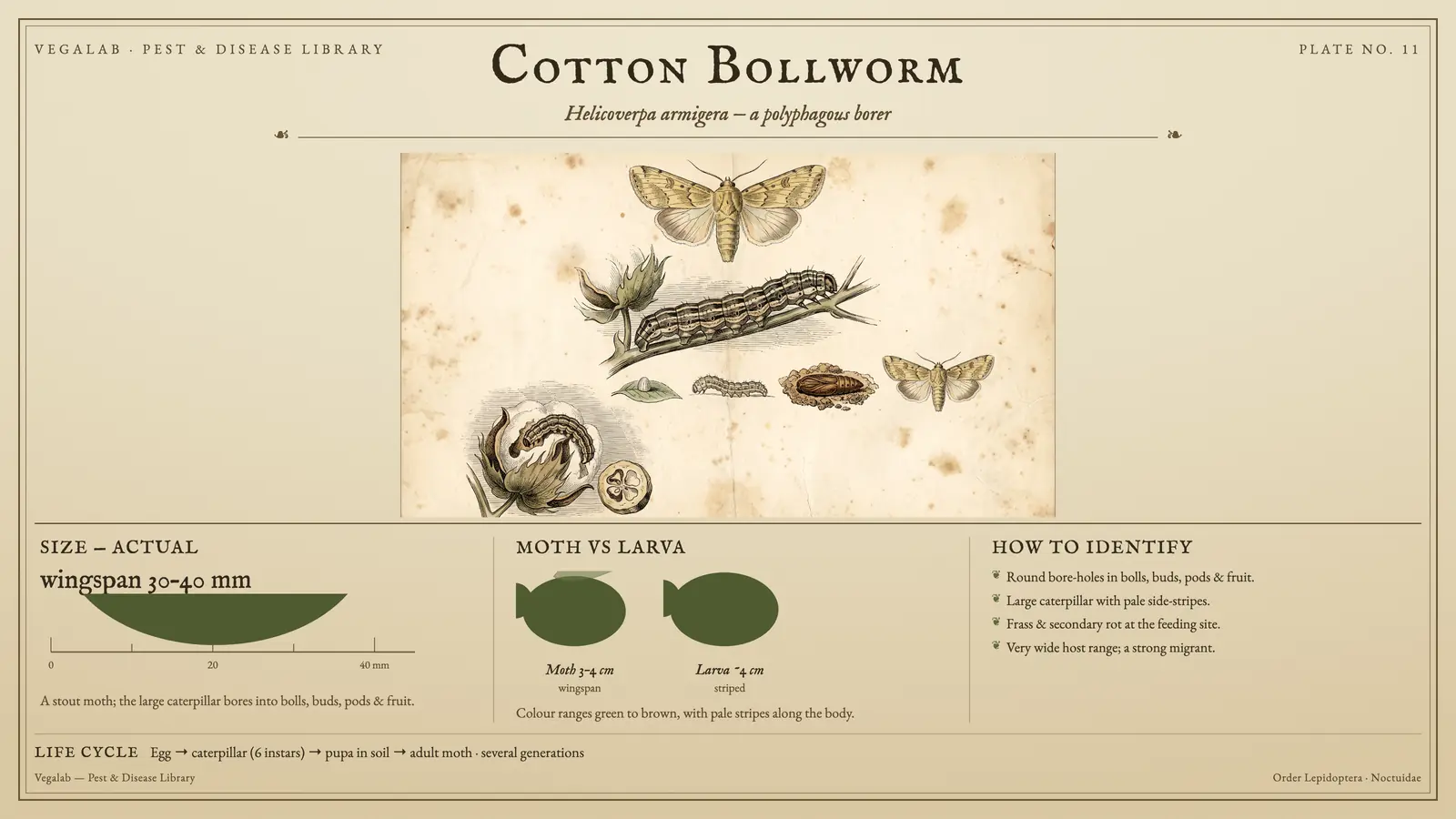
Size. wingspan 30 - 40 mm A stout moth; the large caterpillar bores into bolls, buds, pods & fruit.
Moth and larva. Moth 3 - 4 cm, wingspan; Larva ~4 cm, striped.
What is it?
Cotton bollworm is the larval stage of Helicoverpa moths - among the most damaging and widely distributed caterpillar pests in the world. The same insect is called corn earworm in maize and tomato fruitworm in tomatoes. Females lay eggs singly on tender new growth and flowers, and the emerging larvae move quickly to feeding on reproductive structures.
How to identify it
- Pearl-white, dome-shaped eggs laid singly on new growth, silks and flower buds.
- Young larvae feeding on leaves, buds and flowers before boring inward.
- Larger larvae (up to ~40 mm) boring into bolls, ears or fruit, with colour ranging from green to brown with pale stripes.
- Frass (droppings) at entry holes and hollowed or rotting reproductive structures.
Life cycle & spread
Multiple overlapping generations occur in warm conditions. Moths are strong fliers that migrate into crops, lay eggs on reproductive tissue, and larvae complete development in 2-4 weeks before pupating in the soil. Continuous cropping sustains year-round pressure in warm regions.
Conditions that favour it
Warm temperatures and flowering/fruiting crop stages drive population build-up. Pressure peaks when susceptible reproductive tissue coincides with moth flights.
Damage and how it spreads
Larvae destroy the highest-value tissue - bolls, ears and fruit - causing direct, often severe yield and quality loss. Entry wounds also open the door to secondary rots.
Monitoring & scouting
Use pheromone traps to time moth flights; scout new growth and flowers for eggs and early instars. The control window is egg-hatch to early instar, before larvae bore in and become protected.
How to control it
- Act before larvae enter bolls/fruit - once inside they are shielded from contact products.
- Conserve natural enemies, rotate modes of action for resistance management, and time the first application to early instars.
How to manage cotton bollworm
- Scout the fruiting structures, and act on eggs and small larvae. The larva is exposed for hours. Timing to egg-hatch, not to visible damage, is the whole programme.
- Cultivate after harvest to expose and destroy diapausing pupae in the soil. This is one of the few measures that reaches a life stage nothing else touches.
- Manage the host sequence. Avoid planting susceptible crops in continuous overlap, and use area-wide coordination where it exists - this pest moves between farms.
- Use trap crops. Marigold and pigeon pea are more attractive for egg-laying than several cash crops and concentrate the population.
- Protect natural enemies, particularly Trichogramma egg parasitoids, predatory bugs and lacewings, which take a significant share of eggs and small larvae.
- Rotate modes of action. H. armigera has documented resistance to pyrethroids, organophosphates and carbamates across much of its range, and resistance management is the reason any chemistry still works.
- Use Bt crops within a resistance strategy where they are grown, including the refuge requirements - they exist to slow exactly the resistance this pest excels at developing.
Nuclear polyhedrosis virus (HaNPV) is a highly specific biological option for Helicoverpa, and like Bt it needs to be eaten by small larvae and degrades in sunlight. It is a precise tool for a narrow window, not a rescue for an established infestation.
One pest, many names
The same insect is called cotton bollworm, corn earworm, tomato fruitworm, gram pod borer, African bollworm and Old World bollworm depending on the crop and the region, and closely related Helicoverpa and Heliothis species are often lumped in with it. The naming confusion has a practical cost: growers searching for advice under one crop's name miss guidance published under another's, even though the biology and the timing logic are identical.
What changes between crops is only which structure is attacked and therefore where to scout: squares and bolls in cotton, silks and ears in maize, fruit in tomato, pods in chickpea and pigeon pea. The egg-hatch timing, the hours-long exposure window, the soil pupation and the resistance profile are the same everywhere.
See Pink Bollworm for the other major cotton borer, which behaves quite differently.
Where to scout, crop by crop
- Cotton: squares, white and pink flowers, and small bolls. Check the terminal and the upper third of the plant where egg-laying concentrates.
- Maize: silks first, then the ear tip. Larvae enter through the silk channel, which is also why silk-stage timing matters so much.
- Tomato and pepper: flowers and small green fruit, particularly at the stem end and where fruit touch.
- Chickpea and pigeon pea: flowers and developing pods; pod-boring is the loss.
- Sorghum: the panicle during grain fill.
- Sunflower: the head and developing seed.
Because Helicoverpa larvae move into a fruiting structure within hours of hatching, scouting the wrong part of the plant wastes the only window you have. The pest is not a foliage feeder and inspecting leaves will tell you very little.
In every crop the rule is the same: scout the reproductive structure, count eggs and small larvae, and treat before entry. Once frass is visible at an entry hole, that structure is already lost and the larva inside is beyond reach.
Honest limits of the biological options
Helicoverpa nuclear polyhedrosis virus (HaNPV) and Bt are both genuinely useful against this pest and both are commonly misapplied, so their limits are worth stating plainly. Both must be eaten to work, which means they only reach larvae still feeding on the outside of the plant - a larva already inside a boll or fruit will not be affected. Both are most effective on first- and second-instar larvae and progressively less so as larvae grow. Both degrade under ultraviolet light, giving a residual measured in a day or two rather than a week.
Used as intended - applied in the evening, at good coverage, timed to egg hatch, and repeated across the hatch period - they do useful work and they leave the parasitoid complex intact, which matters for the rest of the season. Used as a rescue treatment on an established infestation of large larvae, they will appear to fail, and that failure is a timing error rather than a product one.
Recommended Vegalab solution: Larva Control
Larva Control · natural broad-spectrum larvicide (oxymatrine, from Sophora flavescens); foliar spray at the start of larval occurrence, targeting eggs and early instars with thorough coverage of foliage and reproductive structures.
| Role | Product | Use |
|---|---|---|
| Primary control | Larva Control |
Preventing it next season
Pheromone trap monitoring, early scouting of reproductive tissue, and a timely first spray before larvae bore in. Destroy crop residues that harbour pupae.
Claims and product availability vary by jurisdiction. Always read and follow the product label.