

Crops affected
How to identify apple mite
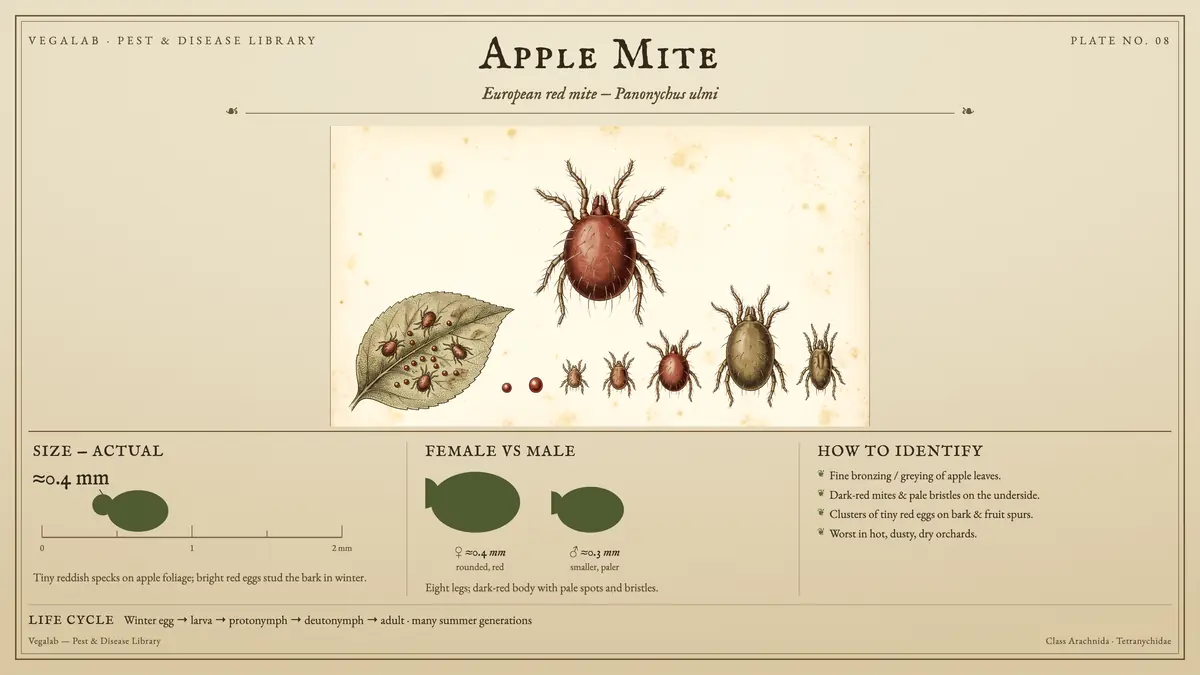
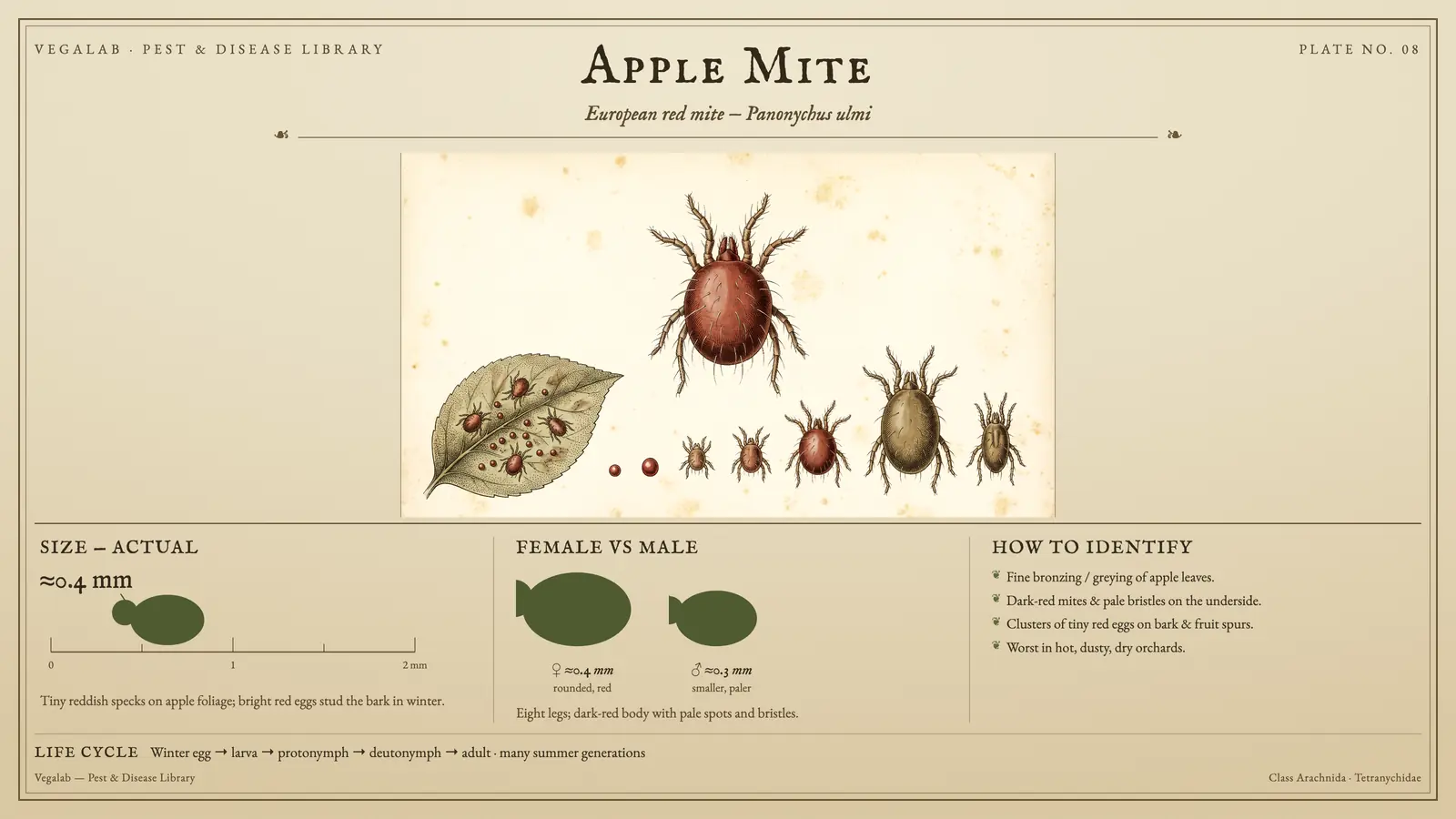
Size. ≈0.4 mm Tiny reddish specks on apple foliage; bright red eggs stud the bark in winter.
Female and Male. ♀ ≈0.4 mm, rounded, red; ♂ ≈0.3 mm, smaller, paler. Eight legs; dark-red body with pale spots and bristles.
- Dark-red mites & pale bristles on the underside.
- Clusters of tiny red eggs on bark & fruit spurs.
- Worst in hot, dusty, dry orchards.
Life cycle. Winter egg → larva → protonymph → deutonymph → adult · many summer generations
What is it?
Apple mite refers to spider-mite-complex pests (such as European red mite and two-spotted mite) that feed on apple and other pome fruit foliage. They puncture leaf cells to feed, reducing the leaf's ability to photosynthesize. Populations surge in hot, dry weather and after sprays that remove beneficial predatory mites.
How to identify it
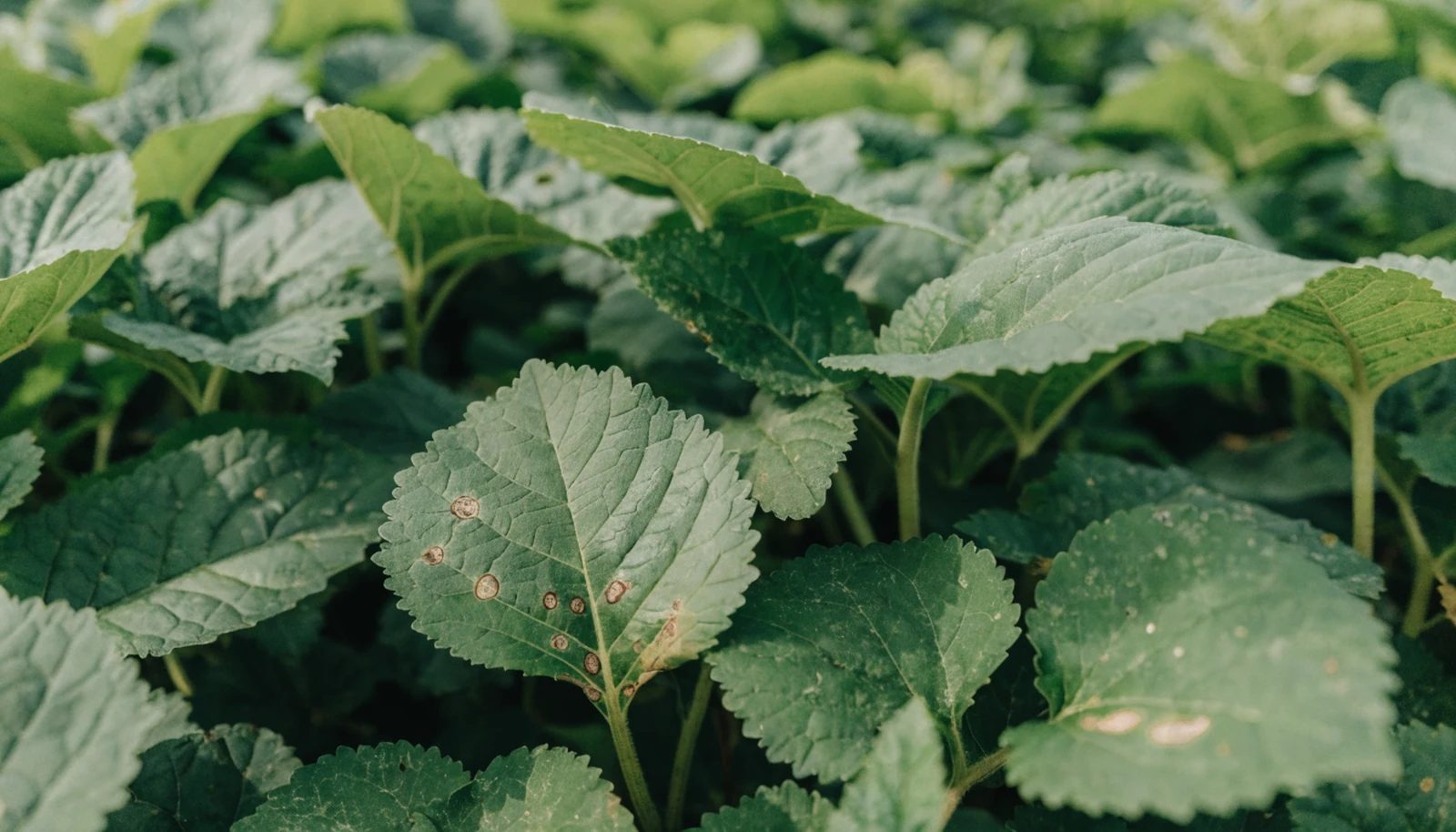
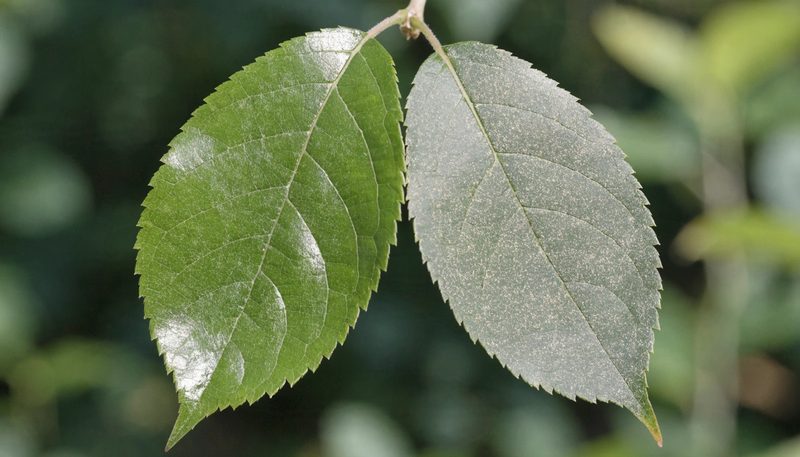
- Bronzed, dull, or stippled leaves, often across whole limbs
- Fine speckling visible on close inspection, sometimes light webbing
- Tiny mites and eggs on leaves and bark (use a hand lens)
- Reduced fruit size and weaker return bloom in heavily affected trees
- Worse in hot, dry summers and dusty orchard edges
Life cycle & spread
*Aculus schlechtendali*, the apple rust mite, is an eriophyid - a family of mites so small (around 0.15 mm) that they are invisible without magnification, and wedge- or carrot-shaped rather than rounded like a spider mite. They have four legs rather than eight.
Overwintering is as adult females under bud scales and in bark crevices. They emerge at bud break and move onto expanding leaves, feeding on the leaf surface cells. Reproduction is rapid and populations can build to very high numbers by early summer.
Because they are wind-dispersed and reproduce quickly, populations move between blocks readily. Numbers typically peak in early to mid summer and decline as leaves harden.
Conditions that favour it
Hot, dry conditions favour build-up, as does dusty foliage. Populations are higher on vigorous young growth and in blocks where predatory mites have been removed by broad-spectrum sprays.
The most important risk factor is loss of the predatory mite complex. Apple rust mite is normally held below damaging levels by *Typhlodromus* and *Amblyseius* predators, and it is also an important **food source** for them early in the season.
Damage and how it spreads
Sustained mite feeding reduces photosynthesis, which lowers fruit size, sugar accumulation, and the following season's bloom. Mite outbreaks are frequently triggered by the loss of predatory mites after broad-spectrum sprays. Because populations rebound fast in heat, timely, predator-friendly control protects both this crop and next year's.
Monitoring & scouting
Inspect leaves with a hand lens of at least 10× - this pest cannot be seen with the naked eye. Look on both surfaces of expanding leaves.
The symptom to watch for is a bronze or silvery cast on the leaf surface, and in heavy infestations a downward leaf curl and a russeted appearance on fruit.
Assess the predatory mite population at the same time. A moderate rust mite population with healthy predator numbers usually needs no action at all.
How to control it
- Monitor leaves through the season and act before populations explode.
- Protect predatory mites by avoiding harsh broad-spectrum chemistry.
- Manage dust on orchard edges and keep trees well-watered.
- Apply a natural miticide that controls mites without driving resistance, covering both leaf surfaces.
Why apple rust mite is often best left alone
- Tolerate low to moderate populations, particularly early in the season
- Assess predators before treating · healthy Typhlodromus numbers usually mean no action is needed
- Treat only for genuine russeting risk on susceptible cultivars, or very high populations causing leaf bronzing and curl
- Avoid broad-spectrum insecticides and some fungicides that are toxic to predatory mites - this is the main cause of mite problems in apple
- Manage dust on headlands and tracks, which favours mite build-up
This is one of the few pests in the library where the standard advice is restraint, and the reasoning is worth following because it applies to several eriophyid mites.
Low apple rust-mite populations can provide alternate prey for predatory mites, but tolerance depends on cultivar, fruit-russet risk, predator abundance, and mite density. Monitor both pest and predator populations and follow local thresholds.
Eliminating rust mite therefore removes the predators' food supply early in the season, the predator population fails to establish, and the outcome is frequently a worse spider mite problem later. Integrated programmes in apple deliberately tolerate rust mite for this reason.
Treating rust mite hard in spring is a well-documented route to a two-spotted or European red mite outbreak in summer. See Spider Mites.
Eriophyid mites are not spider mites
- Size and shape: eriophyids are ~0.15 mm and elongate, wedge- or carrot-shaped; spider mites are ~0.5 mm and rounded. A 10× lens shows spider mites; eriophyids need 20× or more.
- Legs: eriophyids have four; spider mites have eight.
- Webbing: spider mites produce silk webbing; eriophyids never do. This is the quickest field distinction.
- Damage: eriophyids cause bronzing, silvering, russeting, blistering, distortion and galls; spider mites cause stippling then bronzing with webbing.
- Products: several materials effective on eriophyids are weak on spider mites and vice versa, so identification changes the choice.
No webbing plus a bronzed or russeted surface plus nothing visible at 10× means an eriophyid. See Broad & Russet Mites and Citrus Rust Mite.
Russeting: the damage that actually costs money
On most cultivars and in most seasons apple rust mite is a foliage issue with little economic weight. The exception is fruit russeting, and that is where the threshold sits.
Feeding on the fruit surface early in the season, while the skin is still expanding, damages epidermal cells and produces a rough, brownish, netted or corky finish that downgrades fruit cosmetically. Susceptibility varies substantially by cultivar - some are prone, others show almost none - and the window is early, during and shortly after petal fall, when the cuticle is still developing.
The practical approach is therefore cultivar-specific and calendar-limited: on russet-prone cultivars, monitor and act during the early post-bloom window if populations are high; on tolerant cultivars, and after the skin has hardened, the same populations can be ignored. Blanket treatment across a mixed-cultivar orchard is usually spending money on blocks that do not need it - while removing the predator food supply everywhere.
See Fruit Cracking & Splitting and Brown Spot & Cork Spot for the non-mite causes of poor fruit finish, which are frequently confused with russeting.
Recommended Vegalab solution: MultiMite Control
Vegalab MultiMite Control is a natural broad-spectrum mite control suited to the orchard mite complex, and Spider Mite Control adds amplified terpenoid action that suffocates mites and deactivates eggs without causing resistance. Cover both leaf surfaces thoroughly, repeat to break the life cycle, and avoid spraying oil-based products in peak sun to prevent phytotoxicity.
| Role | Product | Use |
|---|---|---|
| Primary control | MultiMite Control | Broader mixed mite & insect pressure |
| Companion / broader pressure | Spider Mite Control | Contact miticide / insecticide |
By crop
See crop-specific solutions
Preventing it next season
Conserve predatory mites, monitor through summer, and keep trees vigorous and well-watered. Strong foliage withstands mite stress better - support tree health with balanced nutrition and Armour Boost.
Claims and product availability vary by jurisdiction. Always read and follow the product label.