

Last updated:
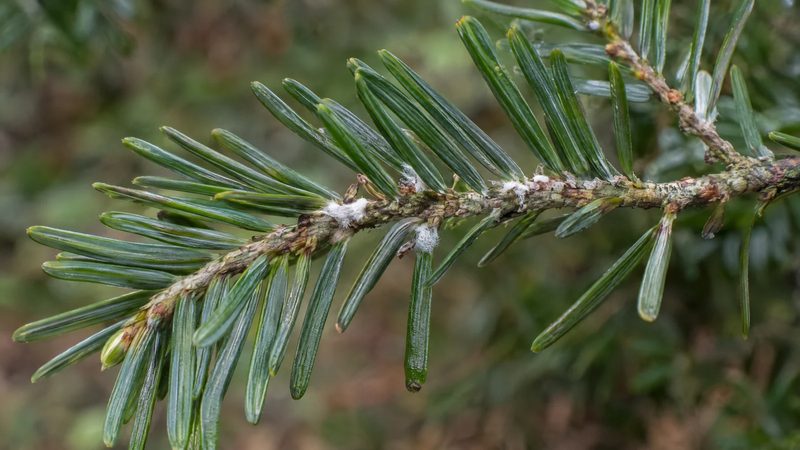
Adelgids are tiny aphid relatives that feed only on conifers.1 Hemlock woolly adelgid (Adelges tsugae) shows as white wool at the base of hemlock needles and can kill trees in 4 to 15 years, while spruce gall adelgids cause cone-like galls that rarely harm the tree.1,5 Treat in late September to October or in spring, following the product label.1,3,5
What are adelgids?
Adelgids (family Adelgidae) are small sap-feeding insects closely related to aphids and phylloxerans, with complex life cycles that can include sexual and asexual generations.1 Unlike true aphids, they lay eggs in every generation and use only certain conifer genera as hosts.1 In the complex life cycle typical of the family, spruce is the primary host, where sexual reproduction and gall formation take place, and a second conifer such as hemlock supports only asexual generations.1
In North America the most damaging species is the hemlock woolly adelgid (Adelges tsugae), a non-native pest of forest and ornamental hemlocks in the East.1 Other invasive members of the family include the balsam woolly adelgid on true firs and pine adelgids in pine plantations.1 On spruce, the Cooley spruce gall adelgid (Adelges cooleyi) and the eastern spruce gall adelgid (Adelges abietis) are the familiar species, known for the galls they cause.7
| Adelgid | Main hosts | Sign | Typical impact |
|---|---|---|---|
| Hemlock woolly adelgid (Adelges tsugae) | Eastern and Carolina hemlock | White woolly tufts on twigs at the needle bases | Decline and death of trees of all ages |
| Cooley spruce gall adelgid (Adelges cooleyi) | Colorado blue spruce; Douglas-fir as alternate host | Cone-like galls at shoot tips; cottony specks on Douglas-fir needles | Usually little or no harm |
| Eastern spruce gall adelgid (Adelges abietis) | Mainly Norway spruce | Pineapple-shaped galls under 1 inch at the base of new shoots | Trees seldom killed; appearance reduced |
In North America the overwintering hemlock woolly adelgid generation resumes development in October and lays eggs from February in Virginia to March in New England, with development of the adelgid running from October to June; Penn State names late September through October as the best treatment window, and spruce gall adelgids are treated from mid-September to early October or in April before bud break1,3,4,6. Where these conifers are grown in the Southern Hemisphere, the same windows fall about six months later, with autumn treatment in about March and April.
How do you identify hemlock woolly adelgid?
The most obvious sign is the white, cottony wax that females produce, seen as small tufts on the twigs at the base of the needles.3,4 Each mass is about 3 mm or more across.4 Under the wax, overwintering females are black, oval and about 2 mm long.3 The wool can stay on the twig long after the adelgids are dead, so look for live insects before deciding a tree needs treatment.3,4
Newly hatched crawlers are reddish brown; once they settle at the base of a needle they stay attached for the rest of their lives.1,3 They spread within and between trees by crawling, on the wind, and on birds, deer and other animals.1 The insect was first recorded in the eastern United States from specimens collected in 1951 in Richmond, Virginia, and now occupies about half of eastern hemlock's natural range.1
Elongate hemlock scale (Fiorinia externa) is the common lookalike. Its waxy covers sit on the lower surface of the needles rather than at the needle base, infested needles develop yellow banding on top, and heavy wax buildup can be misdiagnosed as hemlock woolly adelgid.3,8 The two pests often occur on the same tree, and soil-injected systemic insecticides used for the adelgid do not control the scale.8
Why does hemlock woolly adelgid kill hemlocks?
Hemlock woolly adelgid inserts long stylets into the base of the needles and feeds on stored nutrients in the xylem ray cells, and its feeding is thought to trigger a hypersensitive response that restricts water transport.1 Infested trees show needle discoloration and loss and branch dieback, and as crown vigor falls, trees die.1,3 Death can come in 4 to 15 years depending on moisture and other stresses, and in some areas hemlock mortality has reached 95%.1 In northern areas, where cold winters limit adelgid survival, trees can persist in a weakened state for more than 15 years.1
In eastern North America the adelgid reproduces without mating, completing two asexual generations a year on hemlock.1 The sistens generation hatches in late spring to early summer, rests as dormant first-stage nymphs through the heat, resumes development in fall and lays eggs in late winter.1,4 The progrediens generation hatches in spring and develops quickly.1 Egg-laying usually starts in March in New England and in February in Virginia, and egg hatch runs from early April to late June in Pennsylvania.1,3
What do spruce gall adelgids do to spruce trees?
Spruce gall adelgids cause the new growth to swell into galls that house the developing insects.7 Cooley spruce gall adelgid forms cucumber- or cone-shaped galls about 1 to 4 inches long at the tips of shoots on blue spruce; they turn from green to brown from mid-July and are often mistaken for seed cones.5,7 On Douglas-fir, its alternate host, it causes yellow spots and bent needles but no galls.5 Galls rarely cause serious harm, and old galls are usually hidden by new growth within a few years.5
Eastern spruce gall adelgid is a key pest of Norway spruce in the northeastern United States and also infests white, red and Colorado blue spruce.6 Its galls are pineapple-shaped, usually less than 25 mm long, and form at the base of the current year's shoots.6 The galls open from late July through October as winged adults leave.6 Infested trees are seldom killed, but their appearance can be greatly reduced.6
How do you control adelgids?
Timing matters more than product choice. For hemlock woolly adelgid, Penn State Extension names late September through October as the best window, when registered insecticides target the overwintering females.3 On small trees, horticultural oil smothers the insects, and complete coverage of the tree is needed to kill most of them.4 Insecticidal soap also works but can burn foliage, so test it on a few branches first.4 Follow the product label for any spray.
Large hemlocks are usually treated with systemic insecticides applied as a soil drench, soil injection or trunk injection, and soil injection around large trees is a job for commercial applicators.1,3 Systemics need healthy sap flow to reach the canopy, can take weeks to several months to work, and are best applied in spring or fall before trees are badly damaged.1 Soil applications have shown residual activity of up to three years, but they can affect other arthropods, and leaching is a concern near streams.1 Avoid extra nitrogen fertilizer, which produces tender growth that supports more adelgids.4
For spruce gall adelgids, control must happen before galls form: treat in spring before bud break or in fall after the overwintering females have settled.5,6 Pruning off green galls in June or July, before the adults emerge, is practical for light infestations on a few small trees, while removing brown galls does nothing because the insects have already left.5,6,7 Horticultural oil removes the blue bloom from blue spruce needles.6 Avoid planting Douglas-fir and spruce close together.5,7
Are there biological controls for hemlock woolly adelgid?
Yes, but they are a long-term, forest-scale program rather than a garden product. Since the early 1990s, predators from Asia and western North America, where the adelgid is native, have been released in the East.2 The lady beetle Sasajiscymnus tsugae established but has rarely been recovered in the field.2 The predatory beetles Laricobius nigrinus and Laricobius osakensis have spread widely and feed heavily on the winter generation, but they have not held populations below damaging levels.2
Current work adds silver flies, Leucotaraxis argenticollis and Leucotaraxis piniperda, which are active during the spring generation that the beetles miss.2,4 No biological control agents are available for purchase, and releases are made on public lands, often combined with insecticide treatment of some trees.4
Key takeaways
- Adelgids are aphid relatives that feed only on conifers; hemlock woolly adelgid is the most destructive in North America.
- Look for white wool on hemlock twigs at the needle bases, and confirm live insects before treating.
- Hemlock woolly adelgid can kill hemlocks in 4 to 15 years, while spruce galls rarely harm the tree.
- Treat in late September to October or in spring with full coverage or a systemic, and follow the product label.
- Predatory beetles and silver flies are released on public lands but are not sold for home use.
References
- Biology and Control of Hemlock Woolly Adelgid (FHTET-2014-05, revised June 2016)
- Biological control of hemlock woolly adelgid in North America: History, status, and outlook
- Hemlock Woolly Adelgid
- Hemlock Woolly Adelgid (ENTO-511NP, 3006-1451)
- Cooley Spruce Galls (Fact Sheet 5.534)
- Eastern Spruce Gall Adelgid
- Spruce Gall Adelgids [fact sheet]
- Elongate Hemlock Scale