

Crops affected
How to identify citrus rust mite
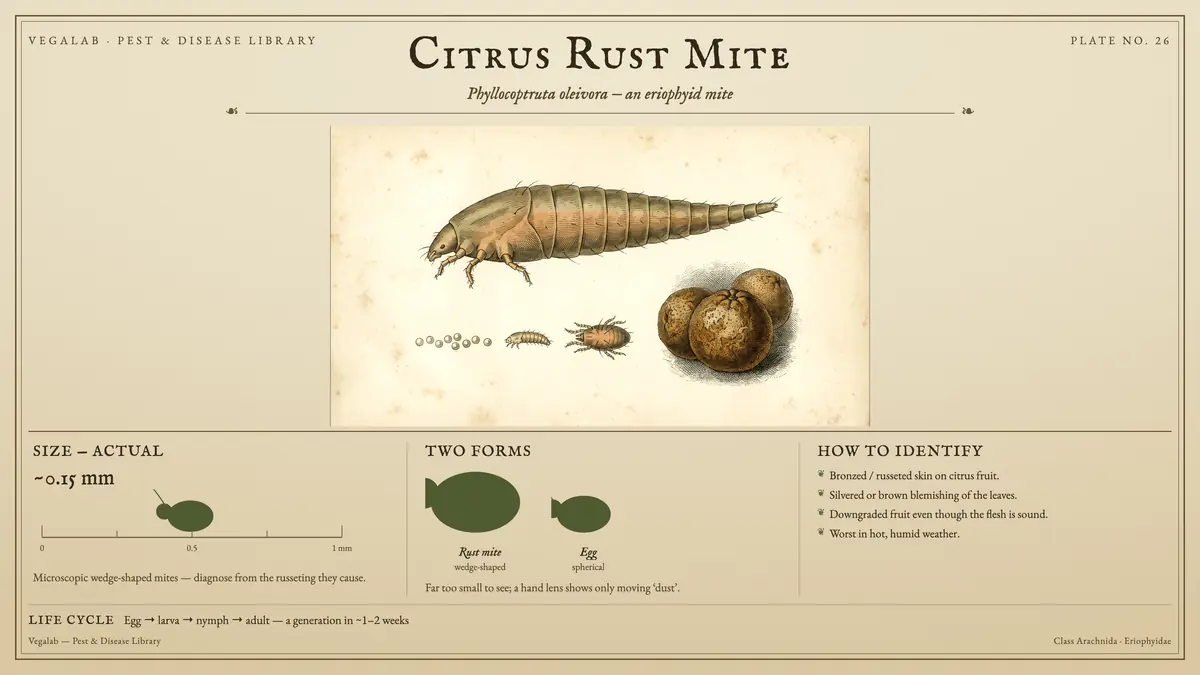
Size. ~0.15 mm Microscopic wedge-shaped mites - diagnose from the russeting they cause.
Two forms. Rust mite, wedge-shaped; Egg, spherical. Far too small to see; a hand lens shows only moving ‘dust’.
- Silvered or brown blemishing of the leaves.
- Downgraded fruit even though the flesh is sound.
- Worst in hot, humid weather.
Life cycle. Egg → larva → nymph → adult - a generation in ~1 - 2 weeks
What is it?
Citrus rust mite is a tiny eriophyid mite that feeds on the surface of fruit and leaves, destroying surface cells. On fruit this produces the characteristic bronzing/russeting that cuts fresh-market value even when internal quality is fine.
How to identify it
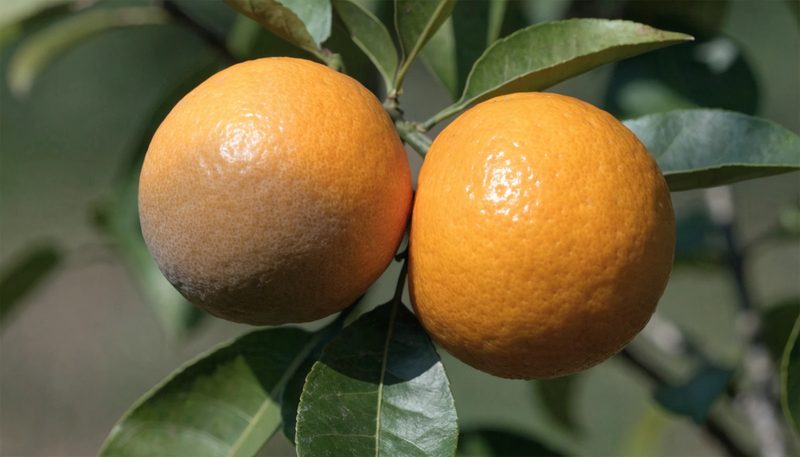
- Bronzing, russeting or a dark, leathery 'sharkskin' finish on fruit (especially the sun-exposed side).
- Silvering or bronzing on leaves; reduced fruit size in heavy infestations.
- Mites invisible to the naked eye - confirm with a hand lens (10-15x) on fruit and leaf surface.
- Fruit downgrade at packout despite sound internal quality.
Life cycle & spread
Very rapid generations build through the warm season; populations on fruit can explode in weeks, so monitoring and timing are critical.
Conditions that favour it
Warm, humid weather and dense canopies favour build-up; fruit becomes susceptible from fruit-set onward.
Damage and how it spreads
Surface feeding bronzes/russets fruit, lowering fresh-market grade and price; severe infestations also reduce fruit size and cause leaf damage.
Monitoring & scouting
Hand-lens count mites on fruit and leaves through the season; treat before visible bronzing develops, since damage is permanent once it appears.
How to control it
- Target mites early with thorough fruit and canopy coverage;
- repeat per pressure;
- manage before cosmetic damage sets in.
How to manage citrus rust mite
- Concentrate on the young-fruit window. From petal fall through early fruit expansion, the surface is susceptible and mite feeding causes permanent russeting. After the cuticle matures, the same population costs little. Monitoring effort and any treatment belong in that window.
- Set the threshold by market. Fresh-market fruit is downgraded by russeting and justifies a low threshold; juice fruit is not affected in value and rarely justifies treatment at all. Applying a fresh-market threshold to a juice block is wasted spend.
- Sample the shaded side and interior canopy, where the mites actually are - sampling only sun-exposed outer fruit understates the population substantially.
- Protect the natural enemies, including predatory mites and the entomopathogenic fungus Hirsutella thompsonii, which can cause dramatic natural collapses of rust mite populations in humid conditions.
- Rotate modes of action. This mite has a short generation time and a documented history of developing resistance quickly.
- Maintain tree vigour and adequate irrigation, since stressed trees show damage more readily.
Because juice and fresh-market fruit have completely different economics for the same damage, the first management question is not how many mites there are but what the fruit is for.
Russeting, sharkskin and the damage patterns
- Early-season feeding on very young fruit produces sharkskin · a silvery-grey, finely cracked appearance over large areas of the surface
- Mid-season feeding produces classic russeting: brown, corky, roughened patches, usually worse on the shaded side of the fruit
- Late feeding, after the cuticle matures, causes little visible change - the fruit has become resistant
- Leaf and twig feeding causes a dull bronze cast, generally of minor economic consequence relative to fruit damage
- Fruit size can be reduced under heavy sustained infestation, which is an additional loss beyond appearance
The gradient from sharkskin through russeting to negligible damage tracks fruit age, which is why the same mite count means different things at different times of year.
Distinguishing rust mite damage from lookalikes
- Rust mite russeting: diffuse brown corky roughening, typically worse on the shaded side, with no defined lesion margin and no raised pustules
- Wind scar: smooth-edged scarring where fruit rubbed against a twig or leaf, often with a matching mark on the adjacent tissue
- Citrus canker: raised, corky, erupting lesions with a water-soaked or oily margin and often a yellow halo - a regulated bacterial disease, not cosmetic
- Melanose: small, dark, raised, sandpapery spots often in tear-stain patterns from rainfall runoff
- Scab: irregular wart-like corky outgrowths that are more raised and defined than rust mite russeting
- Sunburn: on the sun-exposed side, the opposite distribution to rust mite
Rough, discoloured citrus fruit surfaces have several causes and they are routinely conflated, which leads to programmes aimed at the wrong problem.
Distribution is the fastest clue: rust mite damage favours the shaded side, sunburn the exposed side. Anything with a water-soaked erupting margin should be investigated as canker and reported if canker is regulated locally.
Predatory mites and the fungus that collapses populations
- Inspect for fungus-killed mites before treating in humid conditions - discoloured, shrivelled mites suggest an epizootic underway
- Choose fungicides with the mite pathogen in mind where rust mite pressure is a recurring problem
- Protect phytoseiid predators by avoiding unnecessary broad-spectrum applications
- Re-sample a few days after a high count in humid weather rather than treating immediately
Citrus rust mite has two natural enemies worth managing for, and one of them can produce population collapses more dramatic than any product.
The entomopathogenic fungus Hirsutella thompsonii can contribute natural mortality of citrus rust mites under favorable humid conditions.
Predatory mites, chiefly phytoseiids, also feed on rust mite and contribute steady background suppression. As with apple rust mite, they are more sensitive to broad-spectrum materials than the pest is.
The practical consequence is to look before treating: a rust mite population that appears high may already be collapsing from fungal infection, and inspecting for dead, discoloured, fungus-covered mites before making an application avoids spending money on a population that was about to disappear.
This is one of the clearest cases in citrus where a fungicide decision and a mite outcome are linked. A programme that repeatedly suppresses Hirsutella tends to create the rust mite problem it then has to treat.
Recommended Vegalab solution: Spider Mite Control
Spider Mite Control · all-natural acaricide (geraniol with peppermint, cottonseed and rosemary oils) applied on contact with thorough fruit and canopy coverage, before bronzing develops; repeat per pressure.
| Role | Product | Use |
|---|---|---|
| Primary control | Spider Mite Control |
By crop
Preventing it next season
Regular hand-lens monitoring, timely treatment before bronzing, and good coverage of fruit and canopy.
Claims and product availability vary by jurisdiction. Always read and follow the product label.