

Crops affected
How to identify cabbage looper
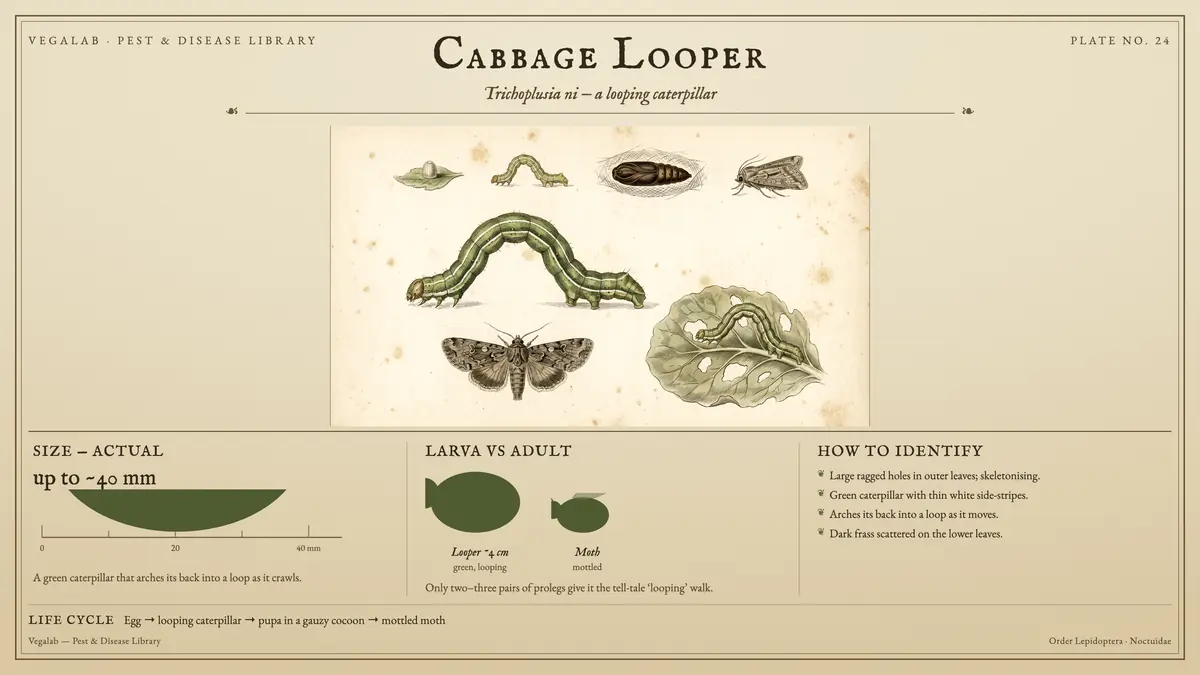
Size. up to ~40 mm A green caterpillar that arches its back into a loop as it crawls.
What is it?
The cabbage looper is the larva of a night-flying moth. It moves in a characteristic looping motion and feeds voraciously on foliage, then on heads and growing points, fouling produce with frass.
How to identify it
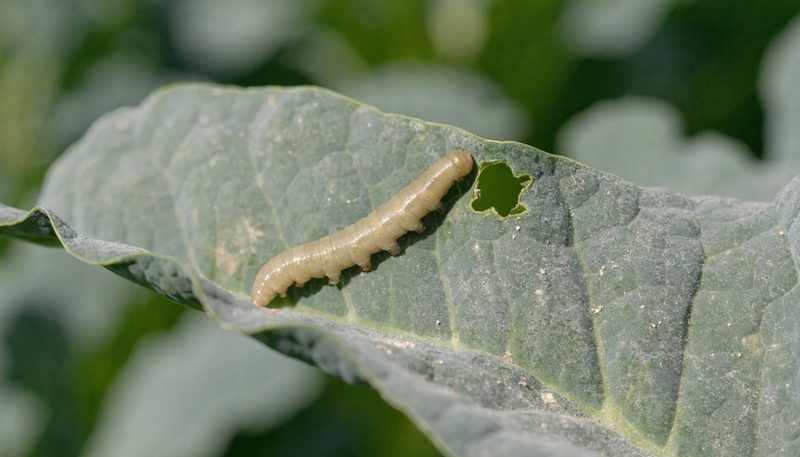
- Green caterpillars with thin white side stripes that loop (arch) as they crawl.
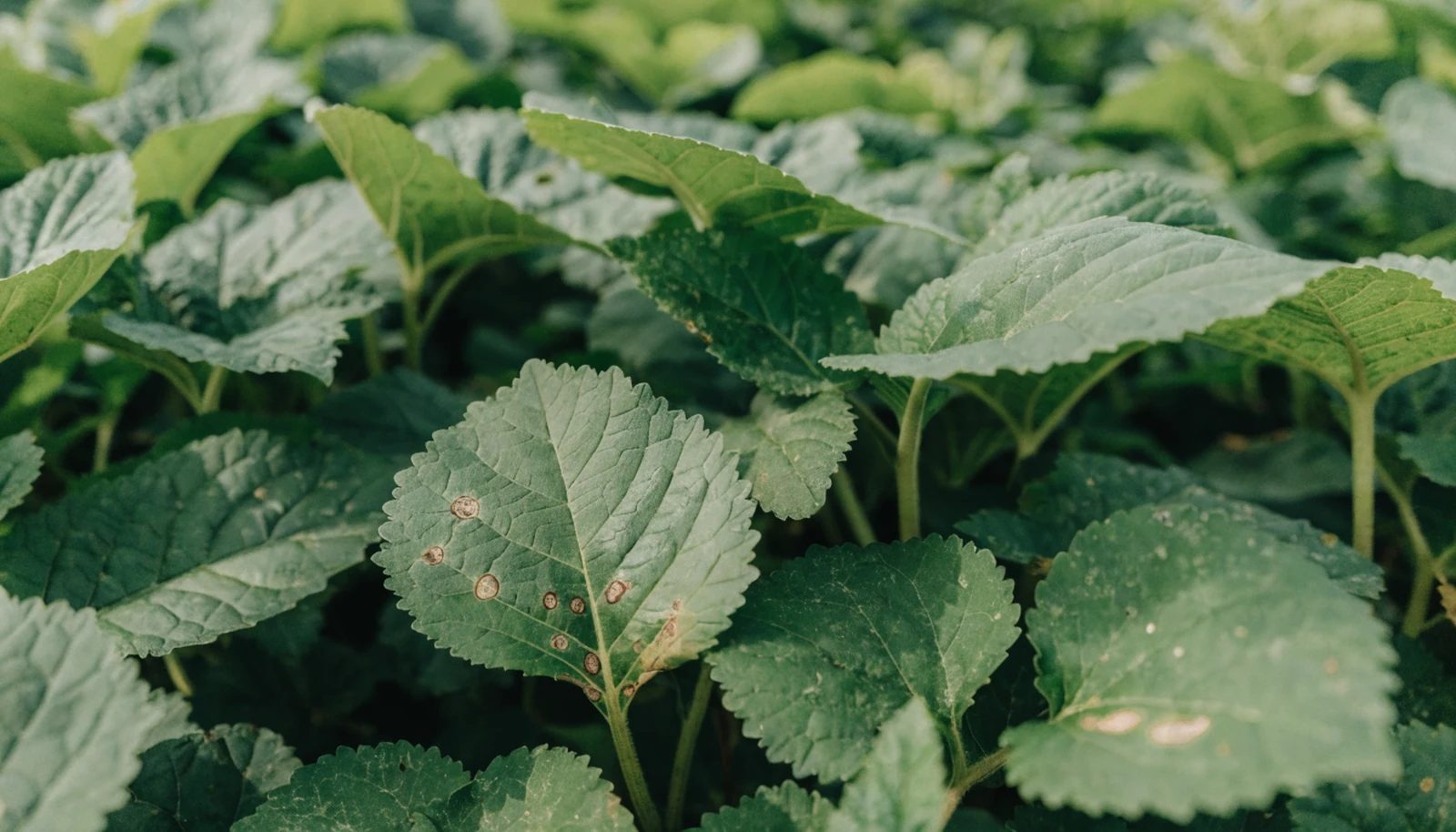
- Large, irregular holes in leaves, progressing into heads and growing points.
- Dark green frass pellets in the canopy and heads.
- Pale, mottled night-flying moths and ragged feeding patches in the crop.
Life cycle & spread
Multiple overlapping generations per season; moths lay single eggs on leaf undersides, and larvae develop over 2-4 weeks before pupating in the canopy.
Conditions that favour it
Warm weather and lush, well-watered crops favour rapid build-up; continuous vegetable cropping sustains populations.
Damage and how it spreads
Defoliation reduces yield; head and growing-point feeding plus frass contamination directly downgrade marketable produce - a major issue in leafy and heading crops.
Monitoring & scouting
Scout leaf undersides and growing points for eggs and young larvae; use pheromone traps for moth flights; act on early instars.
How to control it
- Target early instars before they enter heads;
- ensure coverage of undersides and growing points;
- rotate modes of action;
- conserve natural enemies.
How to control cabbage looper
- Target small larvae. The last two instars do most of the feeding, so control applied to first- and second-instar larvae prevents most of the damage for a fraction of the effort.
- Treat leaf undersides. Eggs and small larvae sit there, and a canopy-top application misses them.
- **Use Bacillus thuringiensis well.** Bt is genuinely effective against loopers and is highly selective, which protects the parasitoids. It must be eaten, so coverage matters; it degrades in sunlight within a day or two; and it only works on small larvae. Apply in the evening and repeat.
- Protect the natural enemies. Trichogramma egg parasitoids and braconid wasps suppress loopers substantially. Broad-spectrum sprays reliably create looper outbreaks by removing them.
- Use row covers on high-value brassica and salad crops to exclude the egg-laying moths entirely.
- Remove crop residue promptly and control volunteer brassicas and flowering weeds that host the adults.
- Set a contamination threshold, not a defoliation one. In head and leaf crops the larva in the harvested part is the loss; in a mature plant moderate leaf feeding costs little.
Bt is the standout option for this pest because loopers are so susceptible to it and because it leaves the parasitoids alive. It is a small-larva, short-residual tool - plan the interval, do not expect one pass to hold.
Looper or another caterpillar?
- Cabbage looper: pale green, no middle prolegs, so it loops as it walks; a thin white stripe along each side; single eggs on leaf undersides
- Imported cabbageworm / cabbage white: velvety green with a faint yellow line, walks normally with a full set of prolegs; adults are the familiar white butterflies flying by day
- Diamondback moth larva: much smaller, pale green, spindle-shaped, wriggles violently and drops on a silk thread when disturbed · a distinctive behaviour no other brassica caterpillar shows
- Armyworm and cutworm: larger, darker, with stripes; feed at night; cutworms cut seedlings at the base
- Slug damage: irregular holes with slime trails and no frass
See Diamondback Moth & Cabbage Caterpillars, Armyworm & Cutworm and Slugs & Snails. The looping gait is conclusive.
Thresholds and the cost of getting them wrong
- Seedlings and transplants: near-zero tolerance · growing point damage is structural
- Leafy and salad crops: near-zero · the leaf is the product
- Heading brassicas before head initiation: high tolerance · outer leaf feeding rarely costs yield
- Heading brassicas after initiation: low tolerance · contamination risk
- Processing crops: effectively zero at delivery regardless of field damage
Cabbage looper is a pest where over-treating is as common a mistake as under-treating, because the visible damage is alarming and the yield consequence often is not. A mature cabbage or broccoli plant tolerates a surprising amount of outer-leaf feeding with no measurable effect on the marketable head - the wrapper leaves are not the product.
What does matter is different in each crop, and setting the threshold on the right thing is most of the skill. In heading brassicas the loss is contamination of the head, so the critical window is from head initiation onward and the threshold is low. In leafy salad and spinach the leaf is the product, so tolerance is near zero throughout. In seedlings and transplants any feeding on the growing point is disproportionately costly because it destroys the plant's structure rather than reducing its area. And in processing crops a single larva in a consignment can trigger rejection of a whole load, which is an economic threshold with nothing to do with agronomy.
Scouting effort is best concentrated in the windows where the threshold is low. Spraying a pre-heading brassica crop for outer-leaf damage usually costs more than the damage does - and removes the parasitoids that would have handled the next generation.
Bt: getting the most out of it
- Apply in the evening · avoids the worst of the UV degradation and coincides with larval feeding
- Add a spreader on waxy brassica foliage, where plain aqueous sprays bead and run off
- Target first and second instars, guided by trap catch or scouting
- Repeat every 5–7 days while hatch continues, rather than expecting one pass to hold
- Do not expect knock-down · feeding stops fast, death takes days
Cabbage looper is one of the most Bt-susceptible pests in agriculture, so it is worth spending a paragraph on how to not waste it. Bacillus thuringiensis subsp. kurstaki produces crystal proteins that dissolve in the alkaline gut of a feeding caterpillar, paralyse the gut wall and stop feeding within hours. Death follows over one to three days - the crop stops being eaten well before the insects disappear, which is often mistaken for failure.
Four practical points determine whether it works. It has to be eaten, so coverage of the surfaces larvae are actually feeding on decides the result - leaf undersides, not canopy tops. It works on small larvae; fifth-instar loopers will often survive a label rate. It is broken down by ultraviolet light within a day or two, so residual is short and reapplication on a five to seven day interval through a hatch is normal rather than excessive. And it is selective, affecting only Lepidoptera larvae, which is the reason to prefer it: the parasitoids and predators survive and keep working.
Bt does nothing to sawfly larvae, beetle grubs, slugs or aphids. If a caterpillar-shaped pest is unaffected by a well-applied Bt spray, check whether it is actually a caterpillar.
Recommended Vegalab solution: Larva Control
Larva Control · natural broad-spectrum larvicide (oxymatrine) applied at early-instar stage with good coverage of leaf undersides and growing points.
| Role | Product | Use |
|---|---|---|
| Primary control | Larva Control |
By crop
Preventing it next season
Pheromone monitoring, early scouting, mode-of-action rotation, and treating young larvae before head contamination.
Claims and product availability vary by jurisdiction. Always read and follow the product label.