

Crops affected
How to identify fruit cracking & splitting
- Splits that callus over or invite rot.
What is it?
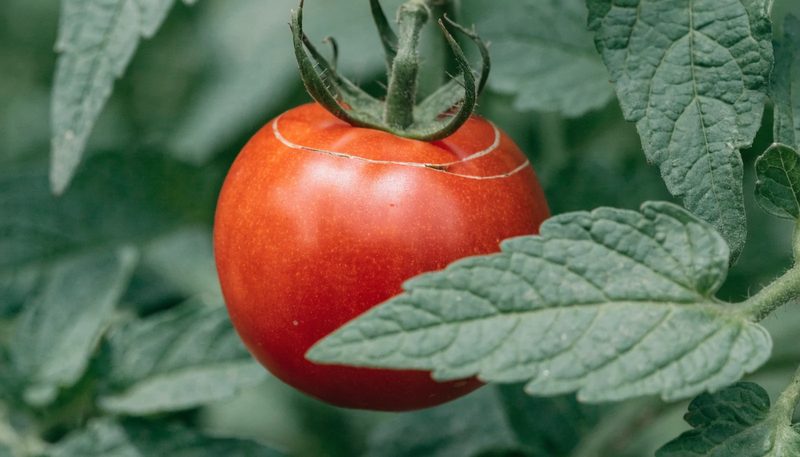
Fruit cracking is a physiological disorder driven by uneven water uptake and weak cell structure. When a dry spell is followed by heavy watering or rain, the fruit rapidly takes up water and swells, but the skin can't keep up and cracks. Calcium and overall cell-wall integrity strongly influence how well fruit resists splitting.
How to identify it
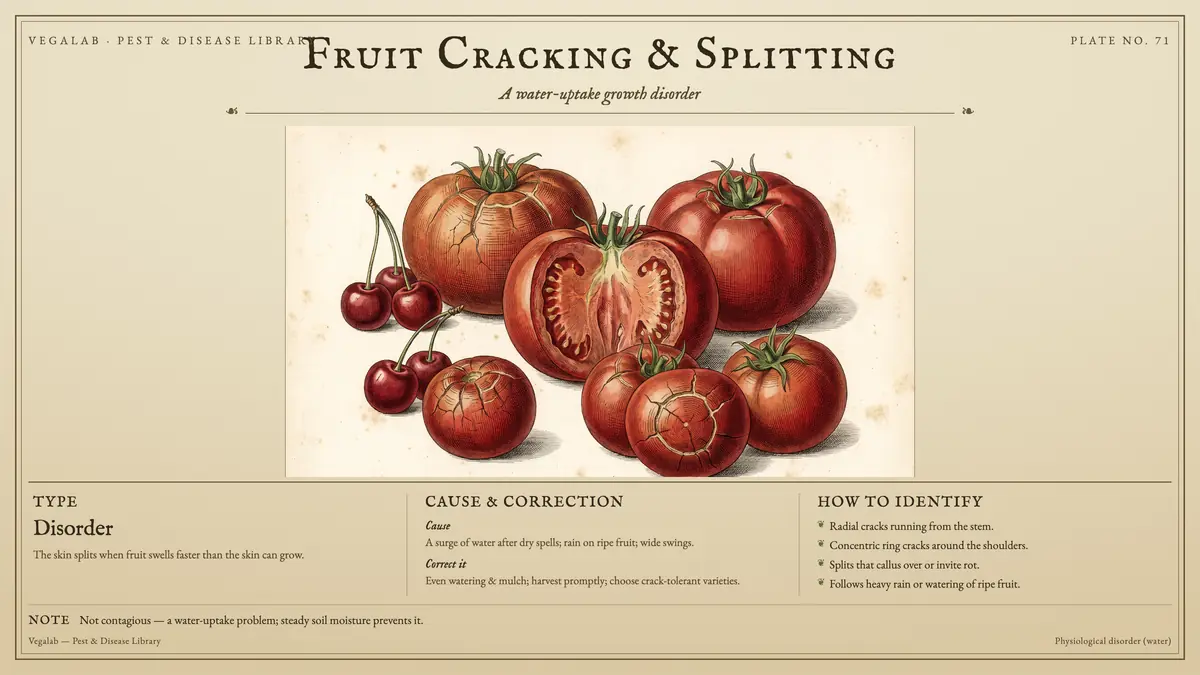
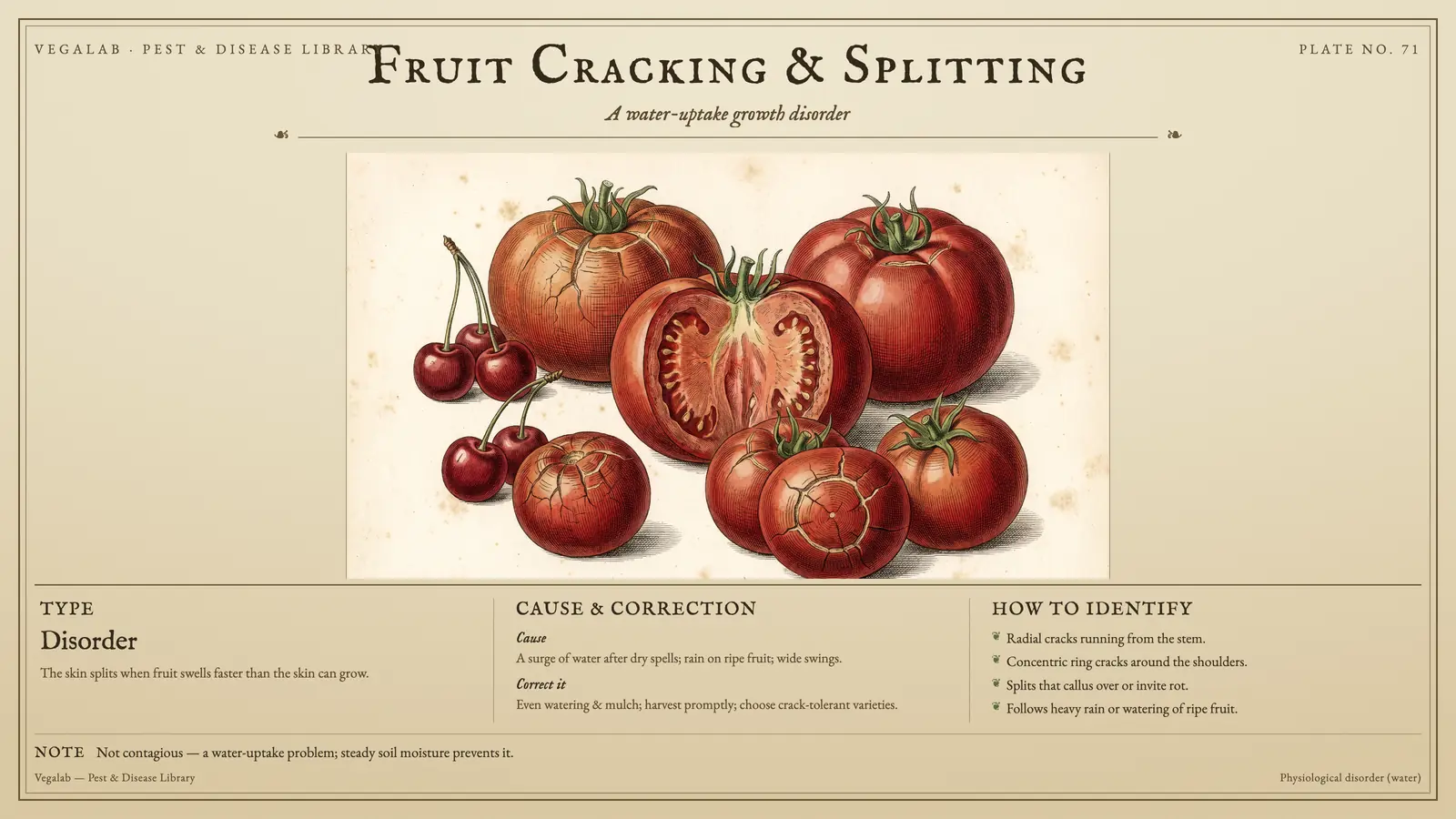
- Splits and cracks in the skin, often radial (from the stem) or concentric (rings)
- Cracking that appears after rain or heavy watering on ripening fruit
- Secondary rot entering through the cracks
- Worse in fast-growing, heavily watered, or calcium-short plants
Conditions that favour it
Fruit cracking is a mechanical failure of the skin, and the mechanism is a mismatch of rates: the interior expands faster than the skin can accommodate, so the skin splits. Everything that causes cracking traces back to that imbalance.
The classic trigger is a rapid change in water availability - a heavy rain or irrigation after a dry period. The roots take up water quickly, it moves into the fruit, internal pressure rises, and a skin that has already hardened or lost elasticity cannot stretch. Rain sitting on the fruit surface is also absorbed directly through the skin in some crops, particularly cherry and tomato, which raises pressure locally and is why rain-cracking can occur without any change in soil moisture.
Skin condition matters as much as water. A skin weakened by sunburn, russeting, mite or insect feeding, powdery mildew scarring, or simply by ageing on the plant cracks at pressures a healthy skin tolerates. Wide day-night temperature swings, high fruit temperature followed by cool rain, and calcium status all affect skin elasticity.
Damage and how it spreads
Cracked fruit is unmarketable and quickly invaded by rot organisms, so a single wet event near harvest can spoil a large share of a crop. Because the cause is water movement and cell-wall strength, prevention focuses on steady watering and building firmer, more resilient fruit rather than spraying for a pest or disease.
Monitoring & scouting
Monitor soil moisture rather than waiting for cracks, since cracking is caused by change and the change is measurable before its consequence is.
Watch the forecast in the final weeks before harvest - rain after a dry spell on a nearly ripe crop is the high-risk event, and several practical responses require anticipation.
Inspect the skin for pre-existing damage: russeting, mite feeding, mildew scarring and sunburn all predispose fruit to crack, so a crop with skin blemishes is at higher risk than the weather alone suggests.
How to control it
- Keep watering even and avoid big swings from dry to saturated, especially as fruit ripens.
- Mulch to buffer soil moisture and harvest promptly as fruit matures.
- Maintain calcium and cell-wall strength through the fruiting period.
- Choose crack-resistant varieties where available.
How to prevent fruit cracking
- Keep soil moisture steady. Consistent irrigation is the primary control. Cracking is caused by fluctuation, so the objective is to avoid the dry-then-wet cycle rather than to keep the crop either dry or wet.
- Irrigate more often and less heavily as fruit approaches maturity, and increase frequency ahead of forecast rain to reduce the size of the change.
- Mulch to buffer soil moisture and reduce fluctuation.
- Protect the skin. Manage mites, insects, powdery mildew and sunburn, all of which weaken the skin and lower the pressure at which it fails. This is an underrated part of a cracking programme.
- Harvest promptly and, in high-risk periods, pick before forecast rain - over-ripe fruit left on the plant is the most crack-prone there is.
- Use rain covers where the economics justify them; this is standard practice in high-value cherry production and is the only measure that addresses direct water absorption through the skin.
- Choose resistant varieties, since susceptibility varies enormously - this is often the most effective long-term decision.
- Maintain balanced calcium and boron nutrition, which contribute to cell wall strength and skin elasticity as part of a programme.
- Avoid excess nitrogen, which produces rapid soft growth and thinner skins.
Once a fruit has cracked it cannot heal, and the crack is an entry point for brown rot, botrytis and other rots - so cracking frequently converts into a disease loss. See Brown Rot of Stone Fruit and Gray Mold (Botrytis).
Reading the crack pattern
- Concentric (radial rings) around the stem end in tomato: associated with fluctuating water supply and wide temperature swings; often on over-ripe fruit
- Radial cracks running from the stem end in tomato: usually a more severe, rapid water-uptake event; deeper and more likely to admit rot
- Cuticle cracking / russeting · a fine network of micro-cracks giving a rough matt finish rather than open splits; caused by prolonged humidity, water on the fruit surface, or repeated small stress events
- Deep single splits in cherry, plum and grape: rapid water uptake, frequently after rain on ripe fruit; often at the stylar end or along a suture
- Growth cracks in root and stem crops (carrot, radish, cabbage, celery): a growth-rate mismatch after a dry period breaks
- Stylar-end and blossom-end splitting in citrus and cucurbits: associated with water and nutrition imbalance during a specific development stage
The shape and position of cracks indicates the cause, which is useful because the responses differ.
Do not confuse cracking with Blossom-End Rot, which is a calcium transport disorder producing a sunken leathery patch rather than a split, though the underlying irrigation instability is often the same.
Why the last two weeks matter most
Cracking risk is not constant through fruit development - it rises steeply as fruit approaches maturity, and understanding why explains where prevention effort belongs.
Three things change as fruit ripens. The skin stops growing while the interior continues to accumulate water and sugars, so there is less capacity to accommodate expansion. The cell walls soften as ripening enzymes act, reducing skin strength. And the sugar concentration inside the fruit rises, which increases the osmotic pull drawing water in - so the same rainfall event moves more water into a ripe fruit than into a green one.
The result is that a crop can pass through the whole season with fluctuating irrigation and no cracking at all, then lose a substantial proportion of the crop to a single rain event in the final fortnight. That is why cracking so often feels like bad luck rather than a management outcome.
The practical consequence is to concentrate effort in that window: increase irrigation frequency and reduce volume per event, watch the forecast closely, pick ahead of predicted rain where quality allows, and avoid letting fruit hang past optimum. Rain covers exist because in high-value crops that final fortnight is worth protecting physically.
See Drought Stress & Stress Cracking for the stress-cycle side of the same problem.
Recommended Vegalab solution: Cellular Boost
Vegalab Cellular Boost is formulated to prevent drought-induced cracking in fruits and vegetables by supporting cell integrity, making it the direct answer to splitting. Pair it with Rigid Boost, which provides pre-harvest support for strong cellular membranes, and Calcium Boost to reinforce calcium-dependent cell-wall strength. Combine these with steady watering for the best protection.
| Role | Product | Use |
|---|---|---|
| Primary correction | Cellular Boost | Cell integrity / anti-cracking |
| Companion / broader pressure | Rigid Boost | Pre-harvest cell-wall support |
| Plant support | Calcium Boost | Soluble calcium correction |
Preventing it next season
Water evenly, mulch to buffer moisture, harvest promptly, and build cell-wall strength through fruiting with Cellular Boost and Rigid Boost. Crack-resistant varieties add another layer of protection.
Claims and product availability vary by jurisdiction. Always read and follow the product label.