

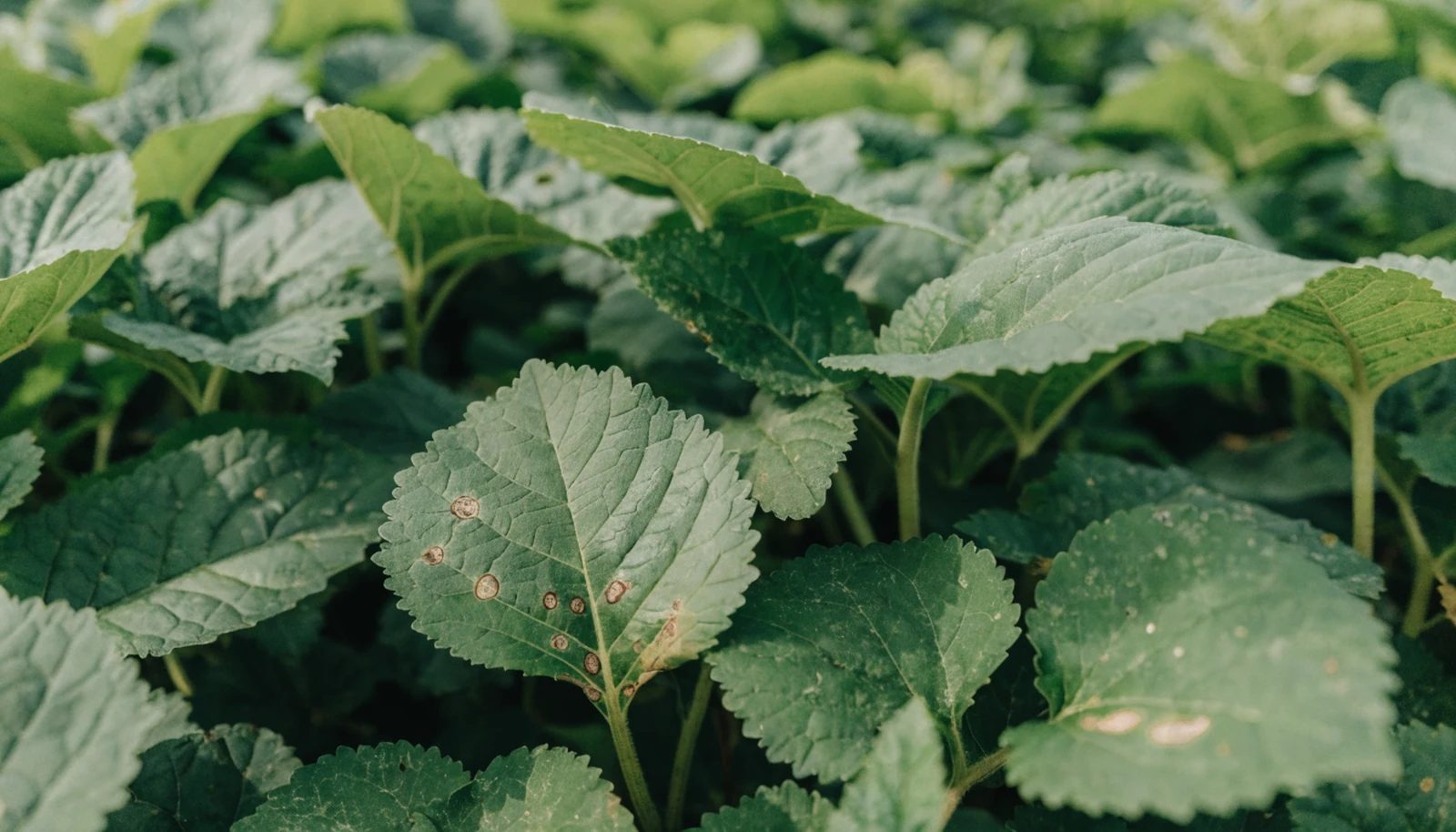
Crops affected
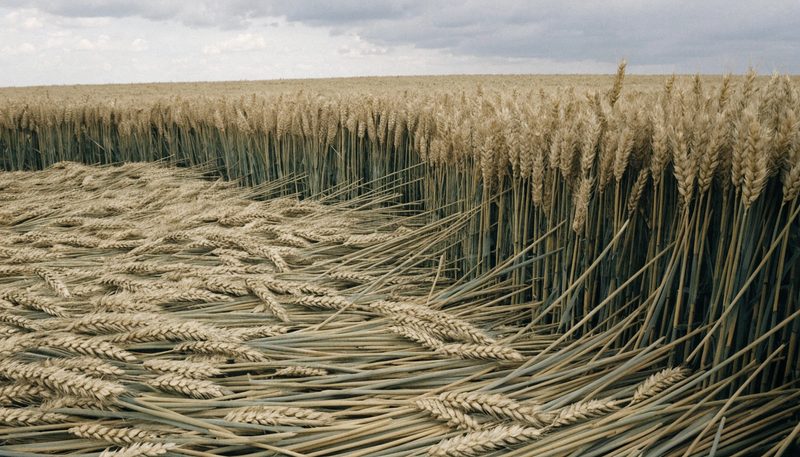
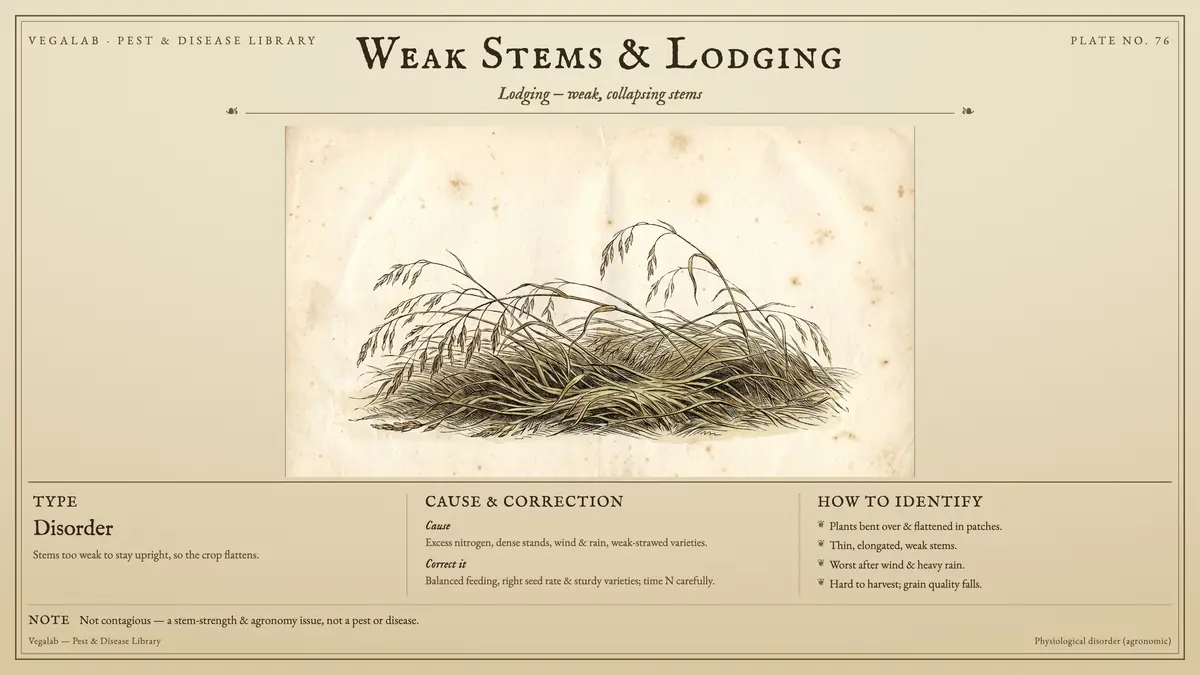
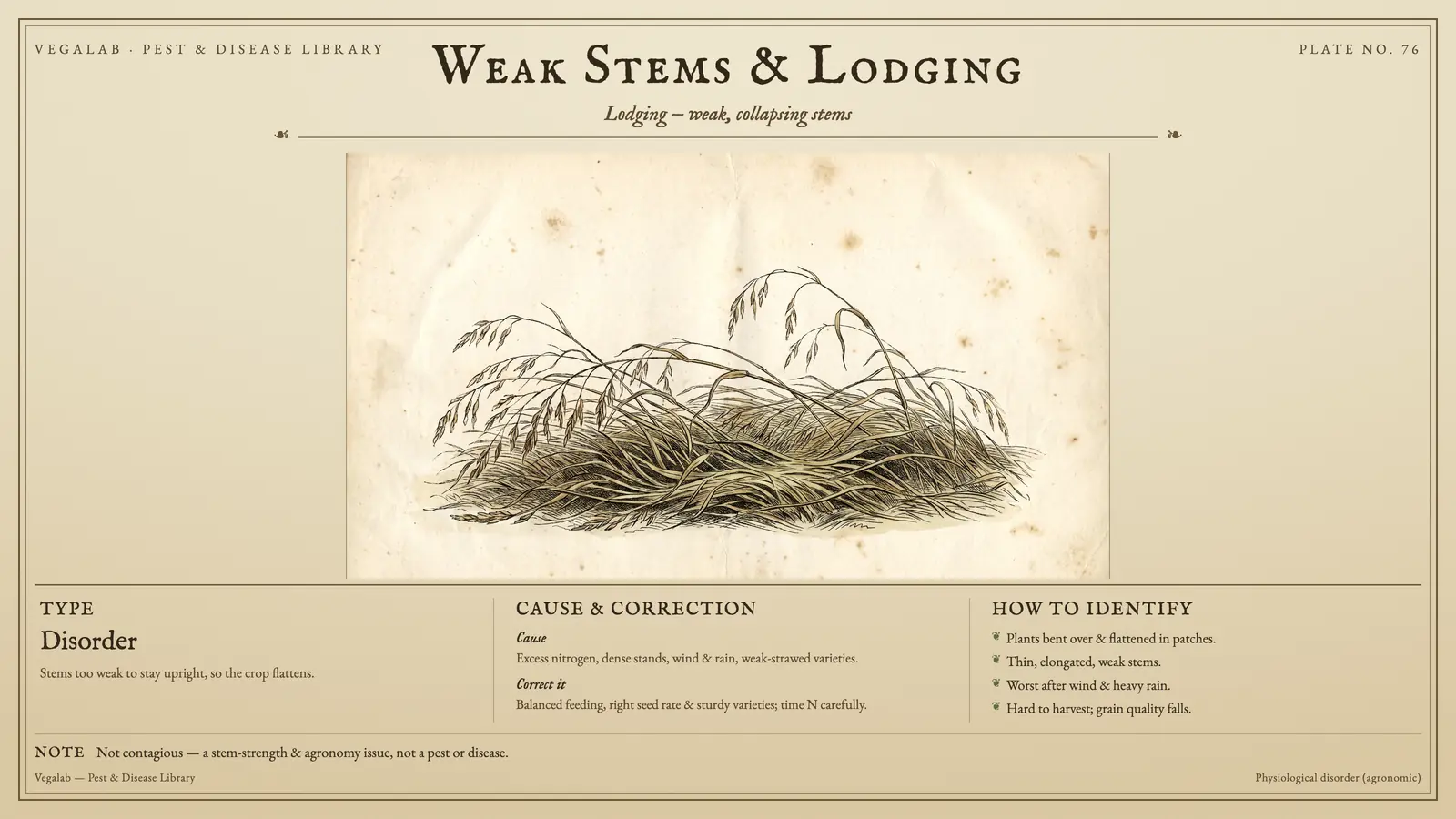
How to identify weak stems & lodging
- Plants bent over & flattened in patches.
What is it?
Lodging happens when stems can't support the plant against wind, rain, and crop weight. It's driven by excessive nitrogen and soft, rapid growth, low light and crowding, and a shortage of the elements (like silica) that stiffen cell walls. Once stems are weak, wind or a heavy rain at a vulnerable stage tips the crop over.
How to identify it
- Plants leaning, bending, or flattened, especially after wind or rain
- Soft, thin, elongated stems that can't hold the plant up
- Worse in over-fertilized (high-nitrogen), crowded, or low-light crops
- Difficult harvest and yield loss where lodging occurs
Conditions that favour it
Lodging is a mechanical failure and it comes in two distinct forms with different causes. **Stem lodging** is buckling of the stem, usually at a weak lower internode. **Root lodging** is the whole plant tipping as the root plate fails in the soil, with the stem intact.
The load side of the equation is wind, rain adding weight to the canopy, and the mass of a heavy head or fruit load - all of which peak late in the season when the crop is tallest and heaviest. The strength side is stem wall thickness and lignification, internode length, and the anchorage of the root system.
Everything that makes stems long, soft and thin-walled therefore increases lodging: excess nitrogen, high plant density, shading and competition, and rapid growth. Everything that weakens the base - stem-base disease, borers, and root damage or shallow rooting - reduces both stem strength and anchorage.
Damage and how it spreads
Lodging reduces yield (lost light interception and grain/fruit fill), slows and complicates harvest, and increases disease as fallen crops stay damp. Because it stems from weak structure, the durable fix is building stronger stems through balanced nutrition and cell-wall-strengthening inputs rather than any single rescue spray.
Monitoring & scouting
Assess standing power before it fails: push a section of crop gently and note the resistance and whether plants spring back, and check stem-base strength and wall thickness by hand.
Inspect the stem base for disease lesions and for insect entry holes and tunnelling, which are common contributors that get attributed to weather.
Record lodging patterns by field zone against nitrogen rate, variety, plant population and sowing date, since that record is what allows next season's decisions to be made on evidence.
How to control it
- Avoid excess nitrogen and overly soft, rapid growth.
- Manage plant density and light for sturdier stems.
- Strengthen cell walls with silica and structural support inputs.
- Time nutrition to build strength ahead of vulnerable stages.
How to reduce lodging
- Match nitrogen to requirement, and split it. Excess nitrogen - particularly late - produces tall, soft, thin-walled stems and long internodes. This is the dominant controllable factor in most lodging.
- Get plant population right. High density produces mutual shading, which triggers stem elongation and thinner walls. Lower populations produce stronger individual stems.
- Choose short and stiff-strawed varieties where lodging is a recurring problem; varietal standing power differs enormously and is often the most effective single decision.
- Ensure adequate potassium and silicon, both of which contribute to cell wall strength and stem rigidity, and avoid the nutrient imbalances that produce soft growth.
- Manage stem-base disease and stem-boring insects, which weaken the structure at exactly the point where it fails. A lodged crop is frequently a diseased or bored crop rather than an over-fertilised one.
- Improve rooting depth and relieve compaction to strengthen anchorage against root lodging - a shallow root plate tips readily.
- Avoid drilling too early or too deep where that produces excessive early growth or weak establishment.
- Consider growth regulators where they are registered and appropriate for the crop and system, as part of a programme rather than a substitute for nitrogen and population management.
- Time harvest promptly on a crop at risk, since standing power declines as the crop ripens and dries.
Lodging costs more than the visible loss: harvest becomes slow and incomplete, grain and fruit quality falls, disease increases in the collapsed canopy, and drying costs rise. The economic loss is usually larger than a field inspection suggests.
Stem lodging or root lodging?
- Stem lodging: the stem is buckled or snapped, usually at a lower internode, with the root plate still firmly in the soil. Points to stem strength - nitrogen, density, variety, stem-base disease, borers.
- Root lodging: the stem is intact and the whole plant has tipped, with the root plate lifted or rotated in the soil. Points to anchorage - shallow rooting, compaction restricting root depth, saturated soil at the critical moment, root disease, or root-feeding insects.
- Brittle snap / green snap: stems break cleanly in a wind event during rapid growth, common in maize, and associated with rapid elongation and certain growth stages
- Insect-related: a tunnel with frass inside the broken stem · the failure point was created by a borer. See Stem Borers.
- Disease-related: discoloured, softened or lesioned tissue at the break point. See Take-All and Rhizoctonia.
The distinction determines which of your management decisions was responsible, and therefore what to change.
Walk a lodged crop and look at ten failure points before concluding. Root lodging after heavy rain on a compacted field is a soil structure problem; stem lodging in a lush dark-green crop is a nitrogen and population problem. The remedies share almost nothing.
Why lodging is a late-season risk from early-season decisions
Lodging happens in a wind and rain event a few weeks before harvest, which makes it feel like weather. It is largely determined by decisions made months earlier, and that gap is why the same fields lodge repeatedly.
Stem strength is set during stem extension, early in the season. The length and wall thickness of the lower internodes - the ones that buckle - are determined by the nitrogen supply, plant density and light environment at that time, and they cannot be changed later. Anchorage is set by rooting depth and soil structure, established during establishment and constrained by any compaction present. By the time the crop is tall and carrying a heavy head, the structural properties are fixed.
What the late season contributes is only the load: canopy weight, rain, wind and crop height. So a season with a wet windy fortnight before harvest reveals which crops were structurally weak; it does not make them weak.
The practical implication is that lodging is managed at drilling and during early nitrogen decisions, and that field records are essential - the fields that lodged this year are the fields to sow to a stiffer variety, at a lower population, with a more carefully split nitrogen programme, next year. Responding after the event is not possible, but responding in the following season is entirely possible and is where the gain is.
See Poor Root Development for the anchorage side, which is the more commonly overlooked half.
Recommended Vegalab solution: Armour Boost
Vegalab Armour Boost is natural silica for building strong, resilient plants - exactly what weak, lodging-prone stems need to stiffen cell walls. Pair it with Rigid Boost for pre-harvest support of strong cellular membranes, and Potassium Pro, since potassium contributes to stem strength and water regulation. Apply through the season to build structure ahead of wind and load.
| Role | Product | Use |
|---|---|---|
| Primary correction | Armour Boost | Silica for tissue resilience |
| Companion / broader pressure | Rigid Boost | Pre-harvest cell-wall support |
| Plant support | Potassium Pro | P-K fruit & flower fertiliser |
Preventing it next season
Balance nitrogen, manage density and light, and build cell-wall strength early with Armour Boost and Rigid Boost. Strong stems set before vulnerable stages prevent most lodging.
Claims and product availability vary by jurisdiction. Always read and follow the product label.