

Crops affected
How to identify poor fruit color & low brix
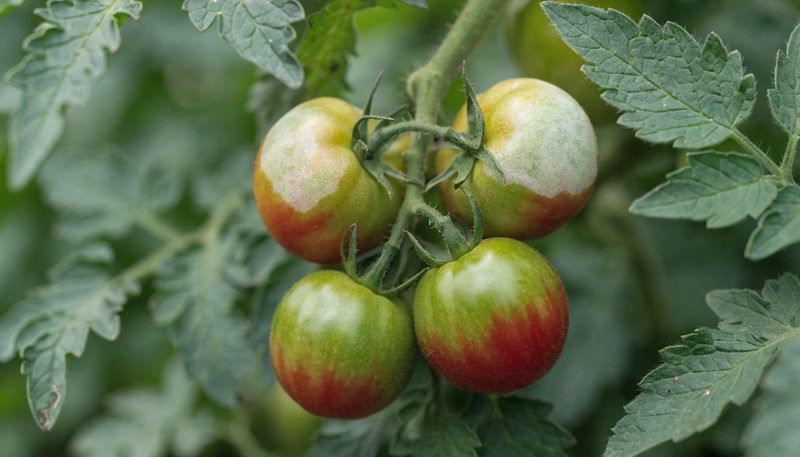
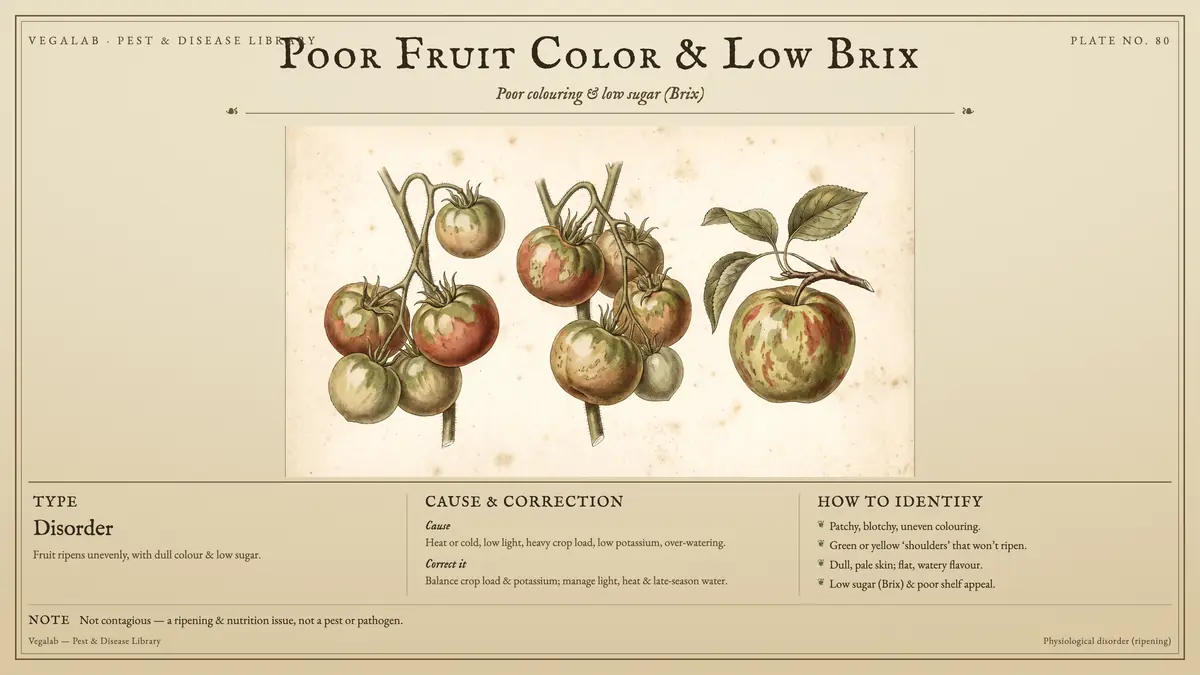
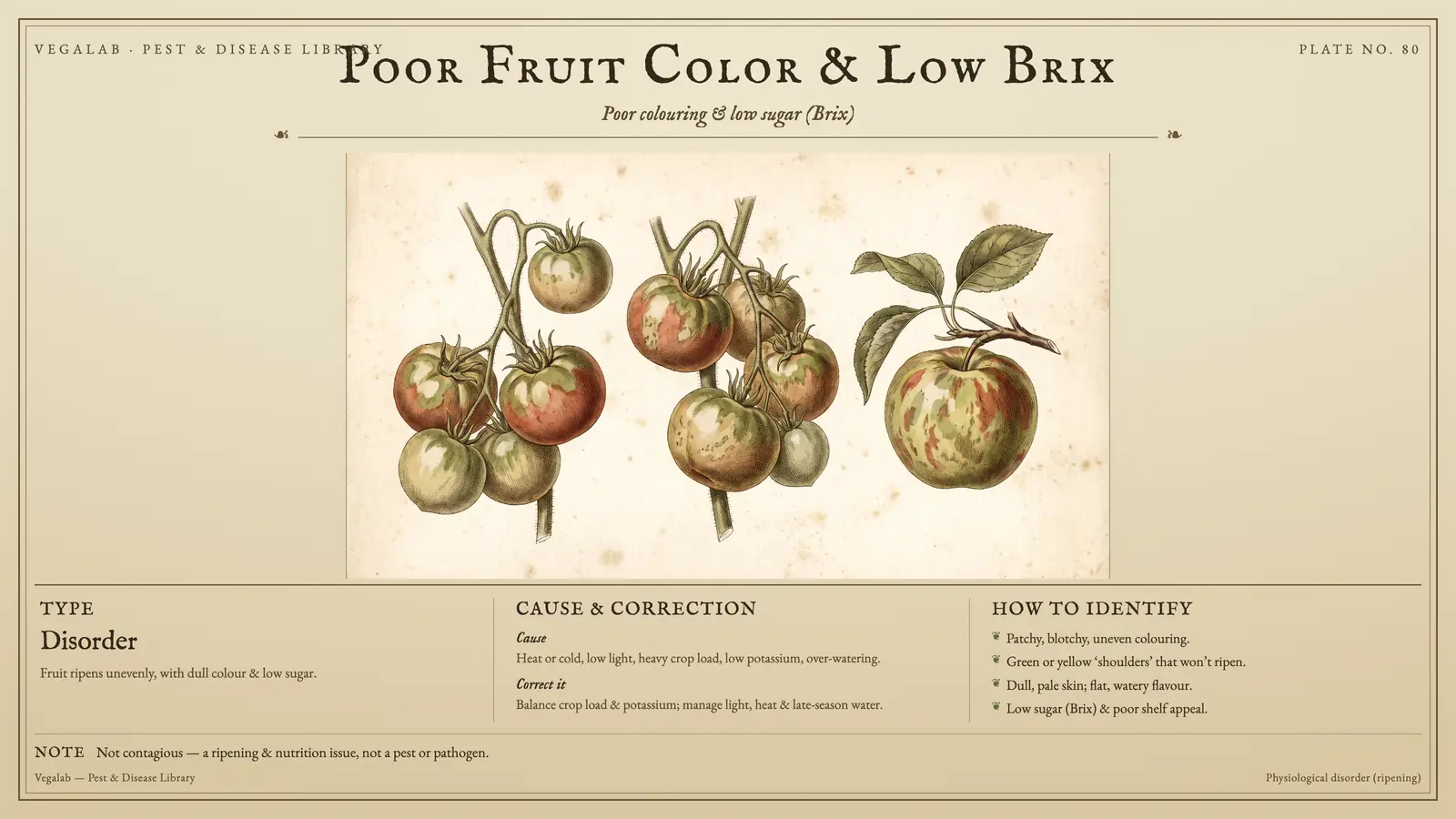
- Patchy, blotchy, uneven colouring.
- Green or yellow ‘shoulders’ that won’t ripen.
- Dull, pale skin; flat, watery flavour.
Note. Not contagious - a ripening & nutrition issue, not a pest or pathogen.
What is it?
Fruit color comes from pigments that develop as fruit ripens, while brix (sugar content) reflects the sugars the plant produces through photosynthesis and moves into the fruit. Both depend on healthy leaf area, good light, balanced potassium and micronutrients, and avoiding stress late in the season. Shortfalls in any of these leave fruit dull and bland.
How to identify it
- Dull, pale, or uneven fruit color at maturity
- Low measured brix and flat, less-sweet flavor
- Fruit that doesn't reach its variety's full color potential
- Often linked to weak late-season leaf health, low potassium, or stress
Conditions that favour it
Colour and sugar accumulation are the final stage of fruit development and they depend on a chain that can break at several points: photosynthesis producing sugars, transport of those sugars to the fruit, and the developmental and environmental signals that trigger pigment synthesis and ripening.
**Light** is the dominant factor for colour in most crops - anthocyanin synthesis in apple, cherry and grape skin is light-dependent, so shaded fruit does not colour regardless of anything else. **Temperature**, particularly the day-night differential, drives both colour development and sugar accumulation; warm nights increase respiration, burning sugars that would otherwise accumulate. **Crop load** determines how much photosynthate each fruit receives. **Nitrogen** in excess delays maturity, keeps fruit green and dilutes sugars. **Potassium** is central to sugar transport. **Water status** concentrates or dilutes: controlled deficit raises brix, excess water at ripening dilutes it. **Canopy health** determines the total photosynthate available, which is why disease and mite damage to leaves shows up as a quality problem.
Damage and how it spreads
Poor color and low brix reduce market value, grade, and consumer appeal, and signal that the plant isn't finishing fruit to its potential. Because these traits depend on late-season plant health and nutrition, a targeted finishing program can meaningfully improve both quality and returns.
Monitoring & scouting
Measure brix with a refractometer regularly through ripening rather than judging by appearance, and sample consistently - same position on the plant, same time of day, adequate sample size.
Assess **light penetration** into the fruit zone, which is the most common limiting factor for colour and the easiest to overlook; measure or estimate the proportion of fruit in shade.
Track leaf area and canopy health alongside fruit measurements, and record crop load, since these three together explain most quality variation between blocks and seasons.
How to control it
- Maintain healthy late-season leaf area and good light exposure on fruit.
- Balance potassium and micronutrients that support sugar and color development.
- Avoid late-season stress and excess nitrogen that delays ripening.
- Use finishing inputs to enhance color and brix as fruit matures.
How to improve colour and sugar accumulation
- Get light into the fruit zone. Pruning, training, summer pruning and leaf removal around fruit are the primary levers for colour in most crops, since pigment synthesis is light-dependent. Reflective mulches are used commercially to light the underside of fruit.
- Manage crop load to the target. Every fruit competes for photosynthate; an overcropped tree or vine produces more fruit of lower quality. Thinning to a load matched to canopy capacity is the most direct trade of quantity for quality.
- Moderate nitrogen, especially late. Excess nitrogen delays maturity, holds green colour, promotes vegetative growth competing with fruit, and dilutes sugars. Late nitrogen is particularly damaging to quality.
- Ensure adequate potassium, which is central to sugar transport into fruit.
- Use controlled water deficit at the right stage where the crop supports it - reducing water during ripening concentrates sugars and improves colour, and is fundamental to winegrape quality. It requires measurement to avoid tipping into damaging stress.
- Protect the canopy. Leaf area lost to disease, mites or nutrient deficiency is photosynthetic capacity lost, and it shows up directly as lower brix. Canopy protection is a quality programme.
- Harvest at the right maturity. Sugars accumulate until harvest; picking early for logistics is a direct quality cost, and no post-harvest treatment adds sugar.
- Work with the climate you have. Warm nights raise respiration and reduce net sugar accumulation, which is why some sites reliably produce better colour and brix than others regardless of management.
No input adds sugar to fruit. Sugar comes from photosynthesis, and every effective measure either increases the supply of photosynthate, reduces competition for it, or improves the transport and signalling that get it into the fruit.
Diagnosing which link in the chain is broken
- Shaded fruit, adequate brix: a light problem · the sugar is there but pigment synthesis is not triggered. Prune, train, remove leaves in the fruit zone.
- Poor colour and low brix together, healthy canopy: likely overcropping · too many sinks for the available photosynthate. Thin harder.
- Low brix with a damaged or sparse canopy: a source problem · insufficient leaf area. Address the disease, mite or nutrition cause of leaf loss.
- Green, delayed, vegetative crop: excess nitrogen delaying maturity.
- High brix but poor colour: temperature or genetics · warm nights or a cultivar-site mismatch; little to be done in-season.
- Diluted brix after irrigation or rain near harvest: a water effect, sometimes recoverable if the crop can hang.
- Uneven ripening within a block: usually light and crop-load variability, worth mapping rather than averaging.
Poor colour and low brix have several possible causes and the corrections differ, so working out which link failed is worth the effort.
Measuring brix without recording crop load, canopy condition and light exposure produces a number without a diagnosis. All four together identify the constraint.
Why quality and yield trade against each other
The relationship between yield and quality is not a matter of attitude or of care - it is a resource allocation constraint, and being explicit about it makes the decisions clearer.
A plant fixes a finite quantity of carbon in a season, determined by its leaf area, the light it intercepts and the length of its season. That carbon is divided among every sink: the fruit, the vegetative growth, the roots, and the reserves for next season. If the number of fruit increases and the total carbon does not, each fruit necessarily receives less - smaller size, lower sugar, weaker colour, and often poorer storage life.
This is why thinning works, and why it is not merely a size adjustment: it reallocates a fixed resource to fewer sinks. It is also why increasing the resource - more leaf area, better light interception, a healthier canopy, a longer season - is the only route to more yield and better quality at the same time, and why anything that damages leaves compromises both.
The commercial question is therefore where on the curve the return is highest for a particular market. A juice or processing crop is paid for tonnes and should be cropped accordingly. A premium fresh-market or wine crop is paid for quality and the optimum load is lower. Growing a premium crop at a processing load, or the reverse, is the actual mistake - not the trade-off itself.
Understanding it this way also explains why 'quality inputs' applied to an overcropped block disappoint. The constraint is allocation, and nothing applied to leaves changes the number of sinks.
See Drought Stress & Stress Cracking for controlled deficit as a quality tool, and Poor Root Development, since root capacity sets the ceiling on canopy and therefore on both yield and quality.
Recommended Vegalab solution: Color Boost
Vegalab Color Boost is a natural fruit and flower color enhancer that lifts color at finishing. Brix Boost is a natural sugar and brix enhancer for sweetness, and Potassium Pro (P-K fruit and flower fertilizer) supports the potassium that drives color and sugar movement. Use as a late-season finishing program.
| Role | Product | Use |
|---|---|---|
| Primary correction | Color Boost | Fruit/flower colour enhancer |
| Plant support | Brix Boost | Sugar / brix enhancer |
Preventing it next season
Protect late-season leaf health, balance potassium and micronutrients, avoid late nitrogen and stress, and finish with Color Boost and Brix Boost as fruit ripens.
Claims and product availability vary by jurisdiction. Always read and follow the product label.