

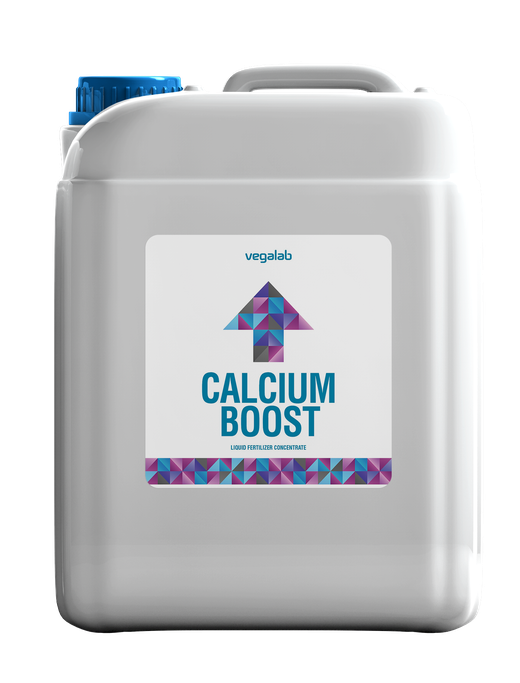
Calcium Boost
Calcium Boost is an advanced soluble calcium supplement that corrects calcium-deficiency disorders such as blossom-end rot, fruit cracking and bitter pit. Absorption-enhancing compounds carry calcium through the cuticle to developing fruit, reaching tissue that ordinary mineral calcium sprays cannot.
Advanced soluble calcium supplement · Soluble Ca²⁺, Highly bioavailable.
- Zero REINo re-entry wait
- Zero PHIHarvest the same day
Advanced soluble calcium supplement from Vegalab Crop Science, powered by Calcium chloride 8.2% + protein hydrolysate, phytic acid. Calcium Boost targets Calcium deficiency, blossom-end rot, fruit cracking, bitter pit.
Shipping $20 + $5 per gallon, calculated at checkout. Online orders up to 50 gallons; contact us for larger loads. Not available for delivery to Canada.
Secure checkout on Shopify. Each store keeps its own bag.
Highly soluble calcium with absorption-enhancing compounds penetrates the cuticle and reaches developing fruit. Corrects calcium-deficiency disorders that mineral calcium sprays cannot address.
| Active | Calcium chloride 8.2% + protein hydrolysate, phytic acid |
|---|---|
| Targets | Calcium deficiency, blossom-end rot, fruit cracking, bitter pit |
| Dilution rate | 1:800–1:500 · 1.25–2 mL/L (4.7–7.6 mL/gal) · 1.0–1.5 L/ha (13.8–20.8 fl oz/acre) |
| Application | Foliar spray, 2–3 times per season |
| Line · Category | Boost · Advanced soluble calcium fertilizer |
- Prevents blossom-end rot in tomatoes, peppers
- Reduces bitter pit in apples
- Improves firmness of stone fruit
- Strengthens cell-wall integrity
| Nutrient | Content |
|---|---|
| Calcium (Ca) | 9.50% |
Derived from: Calcium chloride
Contains: Protein hydrolysate · Phytic acid · Pyroligneous liquor · Sucrose · Vinegar
Why do calcium disorders happen even with calcium in the soil?
Calcium moves poorly within the plant and depends on steady transpiration to reach fruit. So disorders like blossom-end rot, cracking and bitter pit appear in the fruit even when soil calcium is adequate - the calcium simply is not getting to the right tissue at the right time. The fix is not more soil calcium but getting calcium directly into the developing fruit.
How does Calcium Boost reach the fruit?
Calcium Boost (calcium chloride 8.2% with protein hydrolysate and phytic acid) pairs highly soluble calcium with absorption-enhancing compounds that help it penetrate the cuticle and reach developing fruit. This is what lets it correct disorders that conventional mineral calcium sprays - which often sit on the surface - cannot reliably address.
When and how should it be applied?
- Establishment
- Vegetative
- Pre-flower
- Flowering
- Fruit set
- Calcium demand peakFruit development
- Ripening
- Harvest
Apply during Fruit development.
- Method
- Foliar spray
- Rate
- 1:800–1:500 · 1.25–2 mL/L · 1.0–1.5 L/ha1:800–1:500 · 4.7–7.6 mL/gal · 13.8–20.8 fl oz/acre · Work out your rate
- Frequency
- Repeated through the window
- Pack sizes
- 3.8 L, 9.5 L1 gal, 2.5 gal
- Area treated
- 3.8 L treats 2.5-3.8 ha; 9.5 L treats 6.3-9.5 ha1 gal treats 6.2-9.4 acres; 2.5 gal treats 15.6-23.4 acres
- Pre-harvest interval
- Zero - harvest the same day
- Re-entry interval
- Zero - no re-entry wait
The sensitive window for calcium disorders is open through fruit development.
Always read and follow the applicable product label.
Apply as a foliar spray during fruit development, when calcium demand peaks and the sensitive window for disorders is open. Repeated applications through that window keep calcium supplied as the fruit grows. Early, consistent application is far more effective than trying to correct a disorder once symptoms appear.
Which crops and disorders is it for?
Calcium Boost targets calcium deficiency, blossom-end rot, fruit cracking and bitter pit, and has been tested on tomatoes, peppers, apples and stone fruit. These are the classic calcium-disorder crops where a few affected fruit can downgrade a whole block.
How does it protect fruit quality?
By delivering calcium into the fruit during the critical development window, Calcium Boost strengthens cell walls and reduces the physiological disorders that cause culls and downgrades. The protein hydrolysate and phytic acid support uptake, so more of the applied calcium ends up doing useful work in the fruit.
Need a recommendation for your crop or pest?
Contact usFrequently asked questions
What is the application rate for Calcium Boost?
1:800–1:500 · 1.25–2 mL/L (4.7–7.6 mL/gal) · 1.0–1.5 L/ha (13.8–20.8 fl oz/acre) Application: Foliar spray, 2–3 times per season.
Is Calcium Boost suitable for natural or organic programs?
Calcium Boost supplies Calcium chloride 8.2% + protein hydrolysate, phytic acid in a formulation designed to fit low-residue and IPM programs.
What disorders does Calcium Boost fix?
Calcium-deficiency disorders including blossom-end rot, fruit cracking and bitter pit.
Why is it better than mineral calcium sprays?
Absorption-enhancing compounds carry the calcium through the cuticle to developing fruit, where it is actually needed.
What is the analysis?
Calcium chloride 8.2%, with protein hydrolysate and phytic acid.
When should I apply it?
As a foliar spray through fruit development, when calcium demand is highest.
Which crops is it for?
Tomatoes, peppers, apples and stone fruit.
Problems addressed
Supports the root zone where these problems establish. Reference links only - see the label for approved uses.
Pest & disease library
See all plant pests & diseases →
Reference links to identification and management guides. Claims and product availability vary by jurisdiction - always read and follow the product label.
Last updated: