

How to identify salt & ph soil imbalance
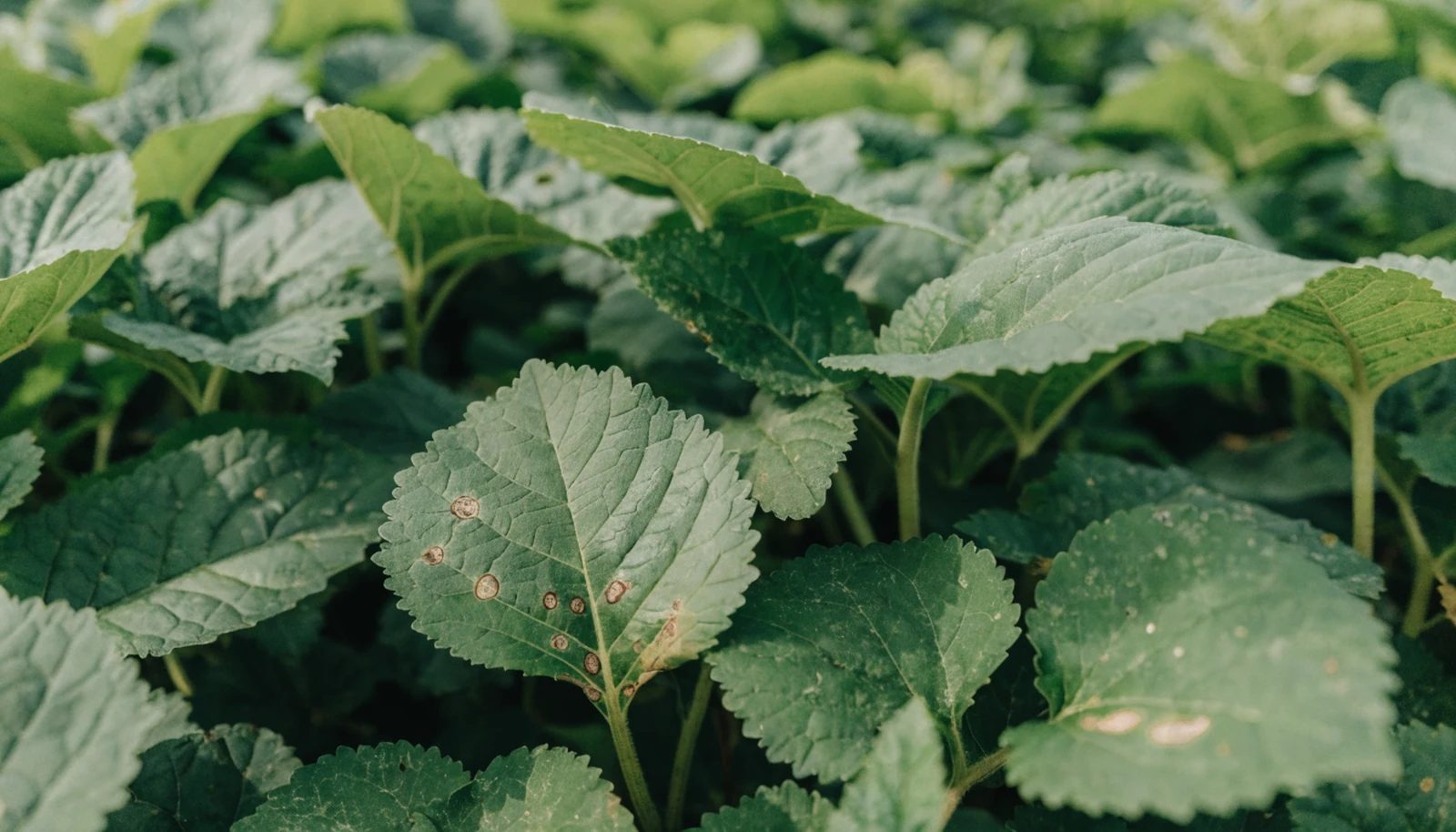
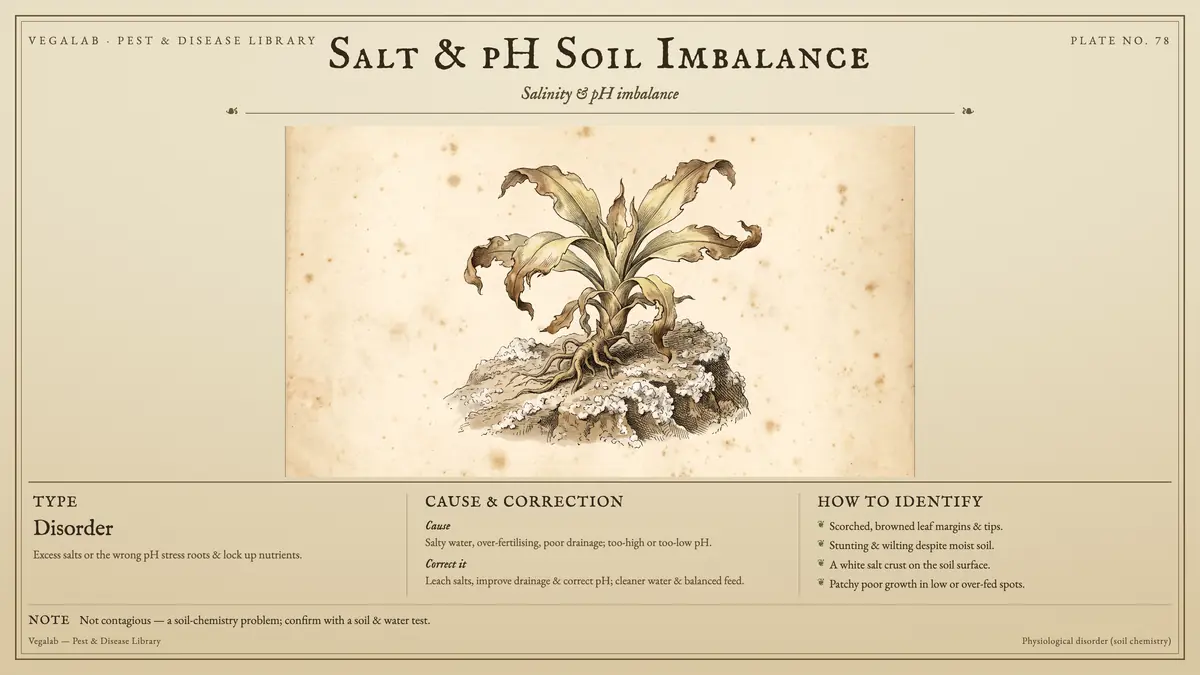
- Scorched, browned leaf margins & tips.
What is it?
Salt buildup (from irrigation water, over-fertilization, or poor drainage) pulls water away from roots and burns tissue, while pH that's too high or low locks up nutrients and disrupts soil biology. Both are common in intensive systems and arid regions with salty water. Because they change nutrient availability, they mimic deficiencies even when fertility is adequate.
How to identify it
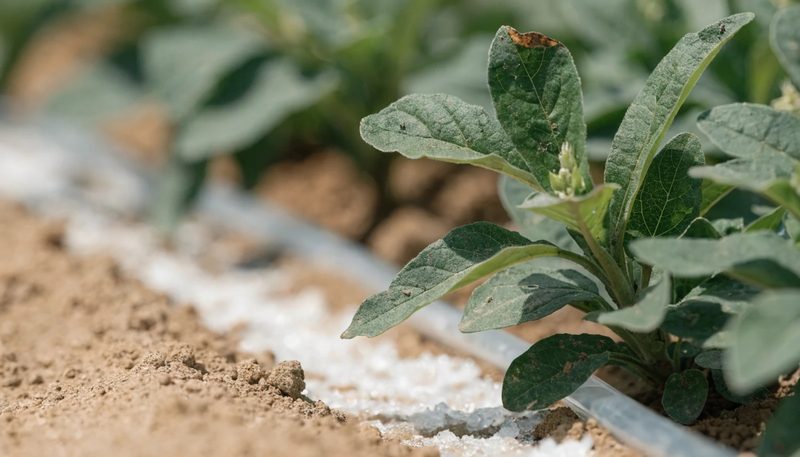
- Leaf-edge and tip scorch (salt burn) and wilting despite moist soil
- Poor, uneven germination and stunted growth
- White salt crust on the soil surface or pot edges
- Nutrient-deficiency symptoms and poor response to fertilizer (pH lockout)
Conditions that favour it
Salinity, sodicity and pH imbalance are three distinct problems that are frequently conflated, and separating them is the whole basis of a correct response.
**Salinity** is a high total concentration of soluble salts, measured as electrical conductivity. It reduces the osmotic potential of soil water, so the plant must expend energy to extract it - water is present but unavailable, producing drought symptoms in a wet soil. Specific ion toxicity (chloride, sodium, boron) adds direct injury.
**Sodicity** is a high proportion of sodium relative to calcium and magnesium on the exchange sites. Sodium disperses clay aggregates, destroying soil structure - the soil crusts, seals, becomes almost impermeable when wet and hard when dry, and infiltration collapses. A sodic soil may have low total salts and still be nearly unusable.
**pH imbalance** governs nutrient availability and biological activity. Low pH brings aluminium and manganese toxicity and locks up phosphorus, calcium and molybdenum; high pH locks up iron, manganese, zinc, copper and phosphorus.
Causes are usually water-related: irrigation with saline water, inadequate leaching, rising water tables, and poor drainage that concentrates salts by evaporation.
Damage and how it spreads
Salt and pH problems reduce water uptake, lock up nutrients, harm soil biology, and cap yield across the board, and severe salinity can make ground temporarily unproductive. Because the issue is the soil chemistry itself, the fix is remediation and rebalancing - adding more fertilizer without addressing it often makes salinity worse.
Monitoring & scouting
Test **EC and pH separately**, and request exchangeable sodium percentage or sodium adsorption ratio where structure is a concern - EC alone will not identify a sodic soil.
Sample by depth and by zone. Salts concentrate at the surface under evaporation and at the wetting front under irrigation, so a single mixed sample can miss both. Look at where in the field the problem occurs - low spots, edges of irrigation, high spots under furrow irrigation.
Test the irrigation water as well as the soil. Water quality is the origin of most developing salinity, and it is the variable with the longest lead time.
How to control it
- Test soil and water for salinity (EC) and pH to confirm the problem.
- Improve drainage and leach excess salts where water quality allows.
- Correct pH toward the crop's optimal range.
- Use soil-remediation and balancing inputs and rebuild biology.
How to manage salinity, sodicity and pH
- For salinity: leach. Apply water in excess of crop demand to move salts below the root zone. This requires functioning drainage - leaching into a soil with a high water table simply raises the salts again. Improving drainage is usually the prerequisite rather than an optional extra.
- For sodicity: replace the sodium. Gypsum supplies calcium to displace sodium from exchange sites, restoring aggregation, after which leaching can remove the displaced sodium. The order matters: amend, then leach.
- For low pH: lime, choosing dolomitic lime where magnesium is also low, and recognising that subsoil acidity is not corrected by surface liming.
- For high pH: acidifying fertilisers, elemental sulphur where practical, and acid injection into irrigation. On calcareous soils, wholesale pH change is often unachievable and the strategy becomes root-zone management and foliar nutrition.
- Improve drainage · the common requirement behind almost all of it.
- Select tolerant crops and rootstocks, which vary enormously; matching the crop to the soil is frequently more economic than changing the soil.
- Manage irrigation to avoid concentration. Adequate leaching fraction, avoiding under-irrigation that concentrates salts, and paying attention to water quality trends.
- Build organic matter, which improves structure, buffering and biological activity in all three situations.
These three problems need different corrections, and applying the wrong one is common and unhelpful - gypsum does little for a saline non-sodic soil, and leaching does little for a sodic soil that will not transmit water.
The most common error is treating a sodic soil as a saline one. If the soil crusts, seals and will not take water, sodium is the problem and gypsum precedes leaching - trying to leach first simply fails.
Recognising which problem you have
- Saline: drought symptoms in a wet soil · wilting, marginal leaf scorch, stunting, and often a white salt crust on the surface. EC high, structure often still reasonable.
- Sodic: structural collapse · surface crusting and sealing, water ponding and refusing to infiltrate, hard-setting when dry, cloudy runoff from dispersed clay. EC may be low; ESP or SAR high.
- Saline-sodic: both, and the amendment order matters - gypsum first, then leach.
- Low pH: stunted roots, aluminium toxicity symptoms, poor nodulation in legumes, phosphorus and molybdenum deficiency despite application.
- High pH: iron and manganese chlorosis on young leaves, zinc deficiency, phosphorus lock-up on calcareous soils.
- Specific ion toxicity: marginal leaf burn progressing inward from the tip, characteristic of chloride and sodium excess and of boron toxicity.
Marginal leaf scorch is the shared symptom of salinity, specific ion toxicity, potassium deficiency and several other problems - it needs an EC test rather than a visual diagnosis. See Drought Stress & Stress Cracking and Micronutrient Deficiency.
Why irrigated agriculture accumulates salt
Salinity in irrigated systems is not usually a soil problem in origin - it is an arithmetic problem, and understanding it explains why it develops on good soils under competent management.
All irrigation water contains dissolved salts, even good-quality water. The crop transpires the water and leaves the salts behind. Unless enough additional water passes through the profile to carry those salts below the root zone, they accumulate - season after season, invisibly at first, then decisively. Applying exactly the crop's water requirement, which sounds like efficient practice, guarantees accumulation.
This is why irrigation planning includes a leaching fraction: a deliberate excess over crop demand, sized to the salinity of the water and the tolerance of the crop. And why it depends absolutely on drainage · leaching moves salts down, and if there is nowhere for them to go, a rising water table brings them back to the surface by capillary action and evaporation, which is how large irrigated areas historically went out of production.
Two consequences for practice. First, water-saving measures that reduce the leaching fraction can create a salinity problem where none existed, so efficiency and salinity management have to be planned together rather than separately. Second, water quality trends matter over years: a supply becoming gradually more saline changes the leaching requirement long before any symptom appears, which is why testing irrigation water periodically is worth the small cost.
Salinity is one of the oldest causes of agricultural land loss and remains among the most significant globally. It is manageable, but only where drainage exists and the leaching requirement is actually applied.
Recommended Vegalab solution: Balance Boost
Vegalab Balance Boost is a soil-remediation and natural balancing fertilizer designed to help correct salt and pH imbalance and restore a healthier root zone. Pair it with Charge Bioboost to rebuild soil biology, Root Boost to re-establish roots in recovering soil, and Micro Boost to restore trace elements that pH lockout made unavailable. Combine with drainage and leaching for lasting results.
| Role | Product | Use |
|---|---|---|
| Primary correction | Balance Boost | Soil remediation & balancing |
| Companion / broader pressure | Charge Bioboost | Soil biology / suppressive soil |
| Plant support | Root Boost | Root development / establishment |
Preventing it next season
Monitor irrigation-water quality and soil EC/pH, maintain drainage, avoid over-fertilizing, and rebalance proactively with Balance Boost and active soil biology from Charge Bioboost.
Claims and product availability vary by jurisdiction. Always read and follow the product label.