

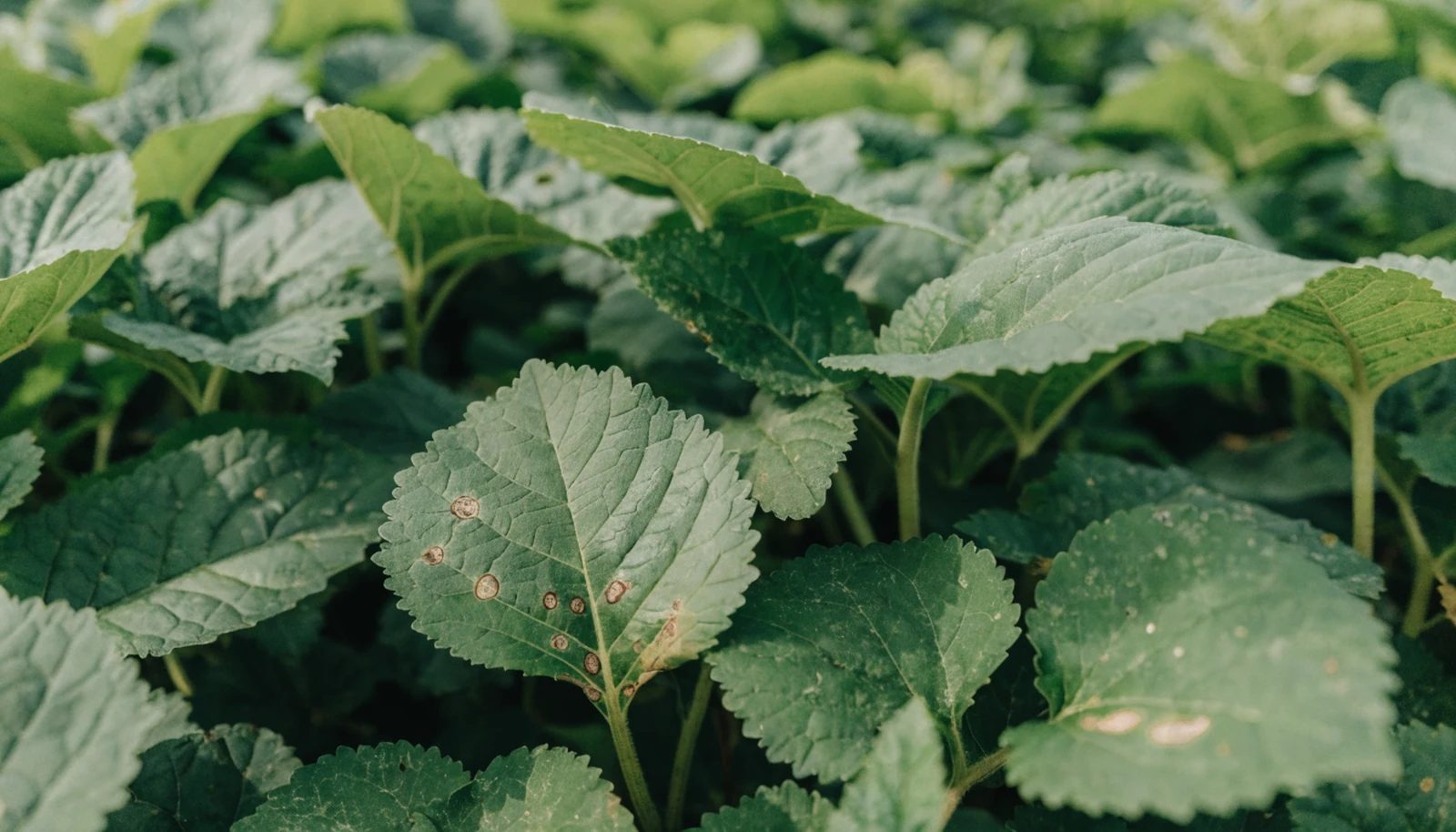
Crops affected
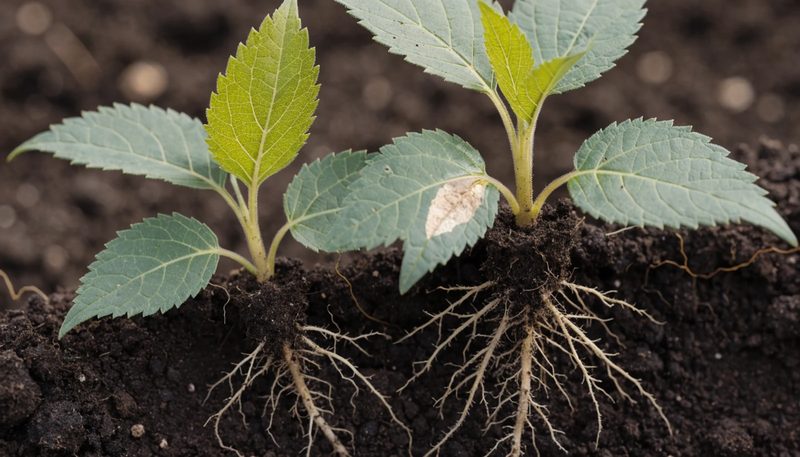
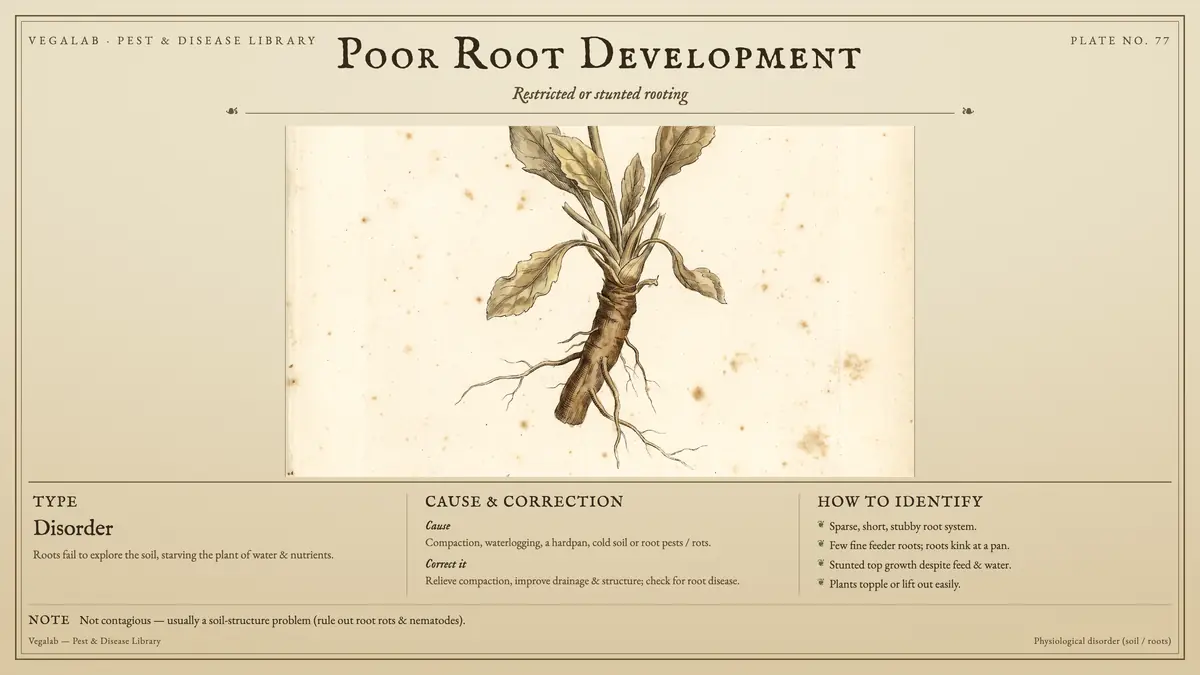
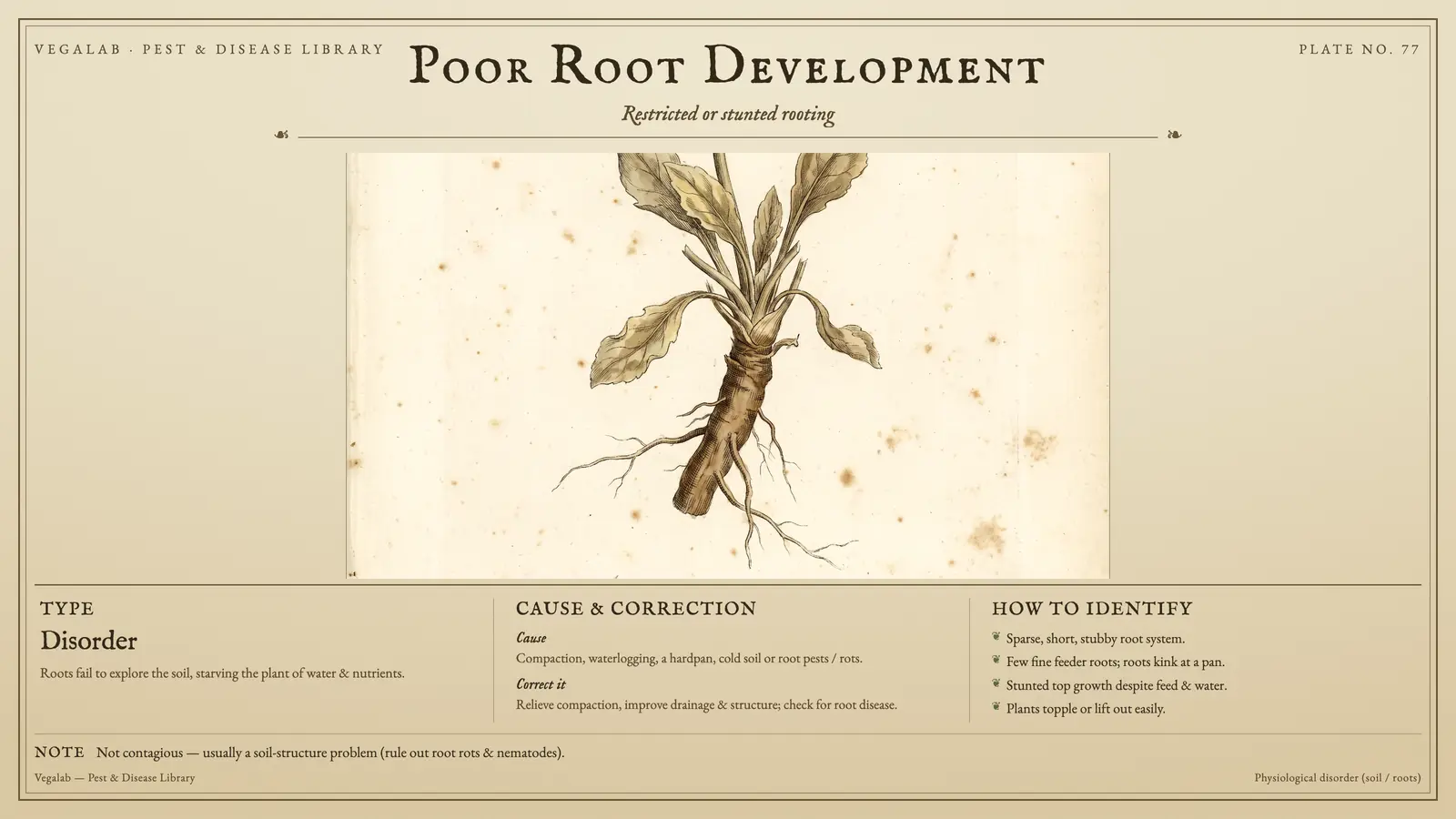
How to identify poor root development
- Few fine feeder roots; roots kink at a pan.
What is it?
Root growth depends on soil structure, biology, moisture, temperature, and the plant's own root-promoting processes. Compacted, waterlogged, salty, or biologically dead soils all restrict roots, as does transplant stress. Because roots drive water and nutrient uptake, poor rooting shows up as broad weakness and stress sensitivity above ground.
How to identify it
- Stunted, slow plants that wilt and stress easily
- Shallow, sparse, or poorly branched root systems when plants are lifted
- Nutrient-deficiency symptoms despite adequate fertility (roots can't take it up)
- Worse in compacted, waterlogged, saline, or low-biology soils
Conditions that favour it
Poor root development is a symptom with a long list of causes, and the useful first division is between **physical**, **chemical** and **biological** constraints - because they look similar above ground and need completely different responses.
**Physical:** compaction and plough pans, waterlogging and poor drainage, container restriction, hardpans, and cloddy or poorly structured seedbeds. These stop roots physically or deny them oxygen.
**Chemical:** acidity with associated aluminium and manganese toxicity, salinity making water osmotically unavailable, sodicity destroying structure, phosphorus deficiency limiting root growth specifically, herbicide residues, and excess ammonium.
**Biological:** root pathogens (*Pythium*, *Phytophthora*, *Rhizoctonia*, *Fusarium*), nematodes, insect larvae feeding on roots, and - importantly - the **absence** of a functioning soil biology and mycorrhizal association.
Roots also respond to signals rather than only to obstacles: a root that meets a compacted or dry zone will often stop rather than push through, so a crop can root shallowly in a soil that would allow deeper exploration.
Damage and how it spreads
A weak root system limits water and nutrient capture, leaving plants vulnerable to drought, deficiency, and disease, and capping yield no matter how well the top is fed. Because so many problems trace back to roots, investing in root development and soil biology pays off across the whole crop.
Monitoring & scouting
**Dig.** This is the whole diagnostic. Excavate a soil pit or take a spade sample and look at the root system - depth, branching, colour, whether roots turn sideways at a specific depth, and where they stop. No above-ground observation substitutes for it.
Use a penetrometer or a knife to locate compacted layers, and note the depth at which resistance rises and roots deflect horizontally - that depth is the constraint.
Test pH, EC and nutrient status, and inspect roots for lesions, galls, rot and insect feeding. Compare a good area of the field with a poor one and look for the difference.
How to control it
- Relieve compaction and improve drainage and soil structure.
- Build soil biology and organic matter to support root growth.
- Reduce transplant stress and avoid salty or waterlogged conditions.
- Use root-promoting inputs to accelerate establishment.
How to improve root development
- Dig a pit and find the actual constraint. Almost every root problem is diagnosable in fifteen minutes with a spade, and almost none is diagnosable from the surface. Roots turning sideways at 20 cm tell you where the pan is; brown rotted roots tell you it is a pathogen; galls tell you it is nematodes.
- Relieve compaction at the depth it occurs. Subsoiling below the pan, in dry enough conditions to fracture rather than smear, and controlled traffic to avoid recreating it. Working a wet soil is what causes most compaction.
- Fix drainage. Waterlogged soil has no oxygen, and roots cannot function without it. This is often the single highest-return investment in a problem field.
- Correct pH. Acid subsoils with aluminium toxicity stop roots as effectively as a physical pan, and liming the topsoil alone does not fix a subsoil constraint.
- Address salinity and sodicity. Where EC is high, water is present but unavailable; where sodium has destroyed structure, gypsum and leaching are the route.
- Ensure phosphorus availability, which specifically drives early root growth, placed where young roots will find it.
- Build soil structure biologically. Organic matter, cover crops with diverse rooting habits, deep-rooting species to open the profile, and reduced tillage all improve the pore structure roots need. Living roots build the channels the next crop uses.
- Support the soil biology and mycorrhizal associations, which extend the effective root system's reach for water and phosphorus.
- Manage root pathogens and nematodes identified in the diagnosis.
- Avoid excess nitrogen early, which shifts allocation to shoots at the expense of roots.
Roots are the part of the crop nobody looks at, and root constraints are correspondingly the most under-diagnosed cause of underperformance. A spade is the most useful diagnostic tool on the farm.
Reading the root system
- Roots deflecting horizontally at a consistent depth: a compaction layer or plough pan at that depth - the depth tells you where to work
- Short, stubby, poorly branched roots: ectoparasitic nematode feeding on root tips, or aluminium toxicity in acid subsoil
- Galls that cannot be rubbed off: root-knot nematode. Nodules that detach cleanly and are pink inside are beneficial nitrogen fixation
- Brown, soft roots that strip to a bare thread: Pythium or another water mould, usually with waterlogging
- Dark sunken lesions on otherwise intact roots: lesion nematode or Rhizoctonia
- Brown discolouration of the vascular ring in the stem base: vascular wilt rather than a root problem as such
- Roots confined to the potting mix shape after planting out: container-bound roots that never explored the surrounding soil - a planting technique problem
- Few fine roots, plenty of coarse: the absorbing surface is gone, which is what causes underperformance despite adequate inputs
Deeper entries: Root-Knot Nematodes, Lesion Nematode, Pythium & Damping-Off, Phytophthora, Verticillium & Fusarium Wilt.
Why a poor root system looks like everything else
Root constraints are the most commonly misdiagnosed problem in crop production, and the reason is structural: the root system determines the crop's capacity to acquire water and nutrients, so when it is compromised the symptoms are exactly those of drought and of nutrient deficiency.
A crop with a restricted root system wilts at midday in a soil with available water, because it cannot reach or absorb enough of it. It shows nitrogen and micronutrient deficiency symptoms on a soil with adequate reserves, because it cannot capture them. It responds poorly to fertiliser and to irrigation, because the limitation is not supply. It grows unevenly across a field, following patterns of compaction, drainage and soil type that are invisible from the cab.
So the field observations - pale patches, wilting, poor fertiliser response, uneven vigour - get attributed to fertility programmes, irrigation scheduling or seasonal weather, and a great deal of money goes into inputs the crop cannot use. The tell is precisely that poor response: a crop that does not respond to an input it appears to need is telling you the constraint is elsewhere.
This is why 'dig a hole' is the first advice of every experienced agronomist, and why it remains good advice. The information is right there and it takes minutes to get.
See Nitrogen Deficiency, Micronutrient Deficiency and Drought Stress & Stress Cracking · all three are frequently root problems in disguise.
Recommended Vegalab solution: Root Boost
Vegalab Root Boost is a natural metabolic root accelerator that drives stronger, faster root development - ideal at establishment and transplanting. Charge Bioboost is a living soil bacterial inoculant that builds the biology roots thrive in, Kelp Boost feeds fast-growing plants and beneficial microbes, and Balance Boost helps remediate salty or imbalanced soils that restrict roots. Together they rebuild the root zone.
| Role | Product | Use |
|---|---|---|
| Primary correction | Root Boost | Root development / establishment |
| Companion / broader pressure | Charge Bioboost | Soil biology / suppressive soil |
| Plant support | Kelp Boost | Microbial food / stress support |
Preventing it next season
Keep soil structure open, biology active, and conditions free of salt and waterlogging, and support establishment with Root Boost and Charge Bioboost. Strong early roots set up the whole season.
Claims and product availability vary by jurisdiction. Always read and follow the product label.