

Last updated:
Flea beetles are tiny jumping beetles, less than 1/10 inch long, that chew shot holes in the leaves of brassica, eggplant, potato and other seedlings.1,2 Protect seedlings by sealing them under fine row covers right after planting, using transplants, planting radish or mustard trap crops and scouting twice a week; keep insecticides as a last resort and follow the product label.2,3,4
How do you identify flea beetles?
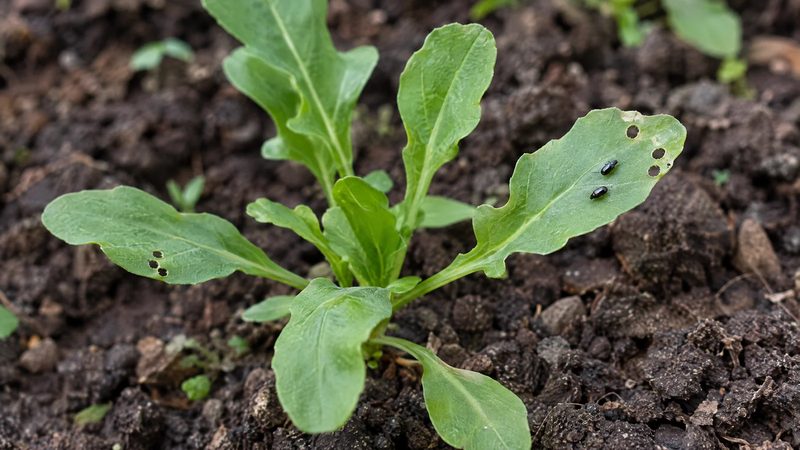
Flea beetles (family Chrysomelidae, subfamily Alticinae) are small, shiny beetles with enlarged hind legs that let them jump like fleas when disturbed.1,5 All are tiny, less than 1/10 inch long.1 Depending on species they are black, brown, bronze, green or metallic blue, and some carry stripes or spots.3,4 Their size, jumping habit and shot-hole feeding make them easy to recognize.1
Dozens of species occur in Colorado alone, and most attack only a few closely related plants, so the crop is a good clue to the species.2 In brassicas, the crucifer flea beetle (Phyllotreta cruciferae) is shiny solid black, about 2 mm long, and the striped flea beetle (Phyllotreta striolata) is black with an amber or yellow stripe down each wing cover.3 On potatoes, tomatoes and eggplant, the potato, tobacco and tuber flea beetles (Epitrix species) are the usual culprits.2,4
| Species | Appearance | Main hosts |
|---|---|---|
| Crucifer flea beetle (Phyllotreta cruciferae) | Shiny solid black, about 2 mm | Cabbage family crops |
| Striped flea beetle (Phyllotreta striolata) | Black with an amber or yellow stripe on each wing cover | Cabbage family crops |
| Western black flea beetle (Phyllotreta pusilla) | Shiny black to dark olive green | Cabbage family crops, wider host range |
| Potato flea beetles (Epitrix cucumeris, E. subcrinita) | Small, dark or shiny bronze | Tomato, potato and other nightshades |
| Tobacco flea beetle (Epitrix hirtipennis) | Brown with black markings | Eggplant, tobacco, potato |
| Tuber flea beetle (Epitrix tuberis) | Tiny, under 1/10 inch | Potato; larvae scar tubers |
| Palestriped flea beetle (Systena blanda) | One of the larger species, about 1/8 inch | Widest host range: squash, beans, corn, lettuce, potatoes |
In North America flea beetle adults become active on warm days in early to mid spring, emerging in late April to early May in Maryland5, and cabbage flea beetles are usually most damaging in June in Colorado2; brassicas planted in summer and fall can face lower pressure3. In the Southern Hemisphere the same spring seedling risk falls about six months later, roughly October to December.
What does flea beetle damage look like?
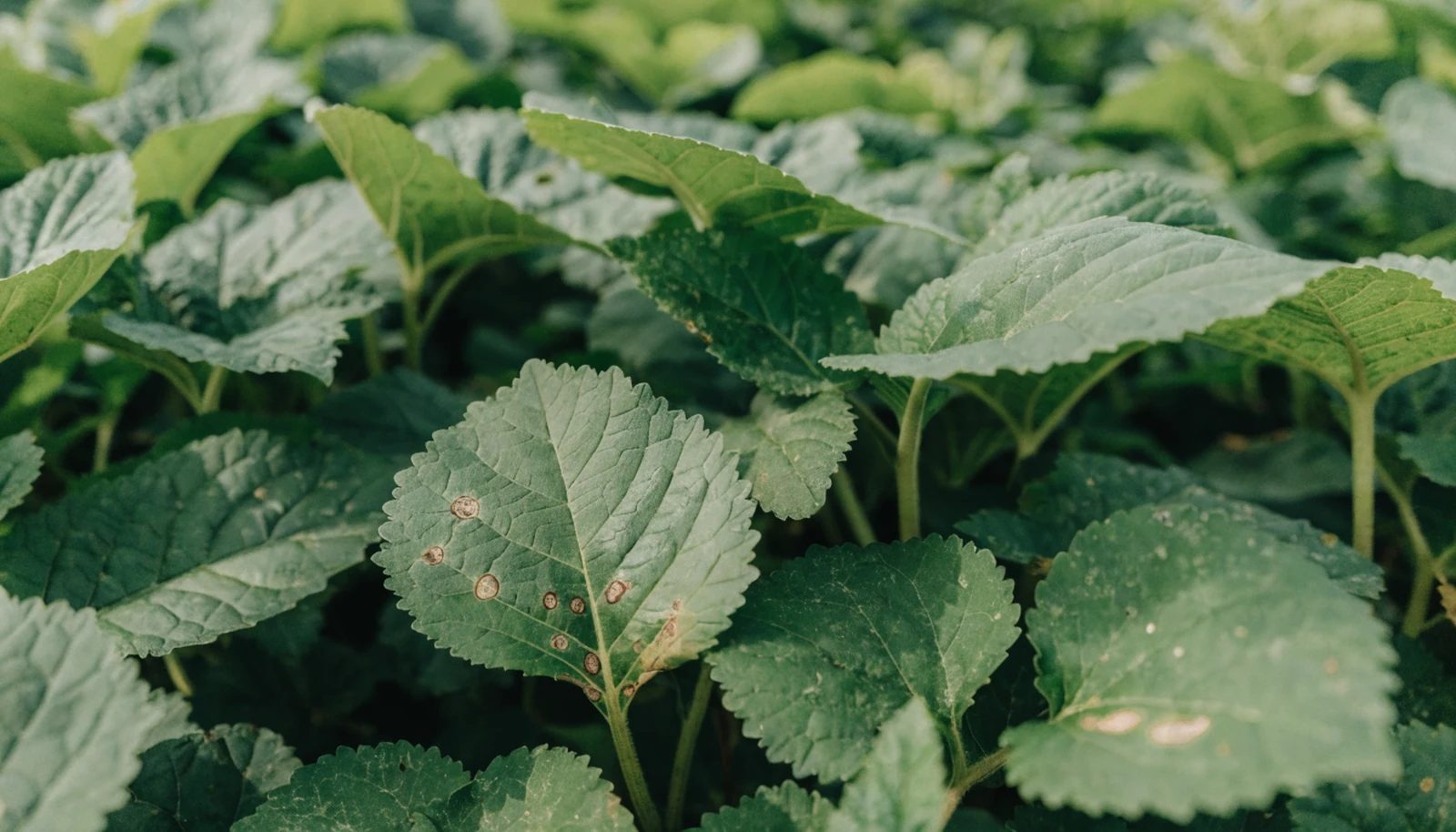
Adults chew small pits in the leaf surface that become round shot holes about 1/16 to 1/8 inch across, as if the leaf had been hit with fine buckshot.2,4 On thick, waxy leaves such as broccoli, the injury shows as pitting rather than holes, and heavy feeding leaves bleached, pitted patches or ragged holes.1,4
Seedlings suffer most. Severe infestations can seriously stunt or kill young plants, while established plants usually outgrow the injury: 20 to 30% or more of the leaf area must be destroyed before yield is affected.2 Leafy greens are the exception, because the holes themselves can make them unmarketable.2,3 Brassicas such as arugula, mustard greens and Chinese cabbage are among the most damaged crops.2 Flea beetles prefer leaves that are smoother, less waxy and higher in mustard oils, so hairier or waxier varieties are less attractive.3
Larvae of most species feed on roots and rarely cause significant damage, with two notable exceptions: tuber flea beetle larvae cut shallow, winding grooves and frass-filled tunnels in potato tubers, and larval feeding can scar sweet potatoes.4,5 Some species also carry plant diseases; the corn flea beetle, for example, spreads Stewart's bacterial wilt of corn.4
When are seedlings most at risk from flea beetles?
Flea beetles spend the winter as adults under leaves, soil clods, plant debris and weeds along field edges, and they become active on warm days in early to mid spring.2,4 In Maryland they are among the earliest insects to emerge, in late April to early May.5 They are strong fliers that move in from weedy borders and can travel long distances to find host plants.2,4
Females lay eggs in the soil at the base of host plants, the larvae feed on roots for about a month, and new adults emerge in late spring to midsummer; many species complete two or three generations a season.2,4 In Colorado, cabbage flea beetles are usually most damaging in June, when they move off winter annual mustard weeds.2 Plants stay vulnerable until about the four to five true leaf stage, so check seedlings at least twice a week until then.4 Brassicas planted in summer and fall can face lower flea beetle pressure than spring plantings.3
How do you protect seedlings from flea beetles?
Row covers are the most dependable protection.6 Install them immediately after seeding or transplanting, before beetles reach the plants, and bury or weight every edge so there are no gaps.3,4 Mesh size matters: frost-protection fabrics exclude flea beetles but can overheat plants in summer, so warm-season crops do better under fine-mesh insect netting.3 Because beetles overwinter in the soil and debris, rotate crops so the covered planting does not follow a host crop, or beetles may emerge under the cover and feed without natural enemies.3,4 For eggplant, drape the cover over hoops so it does not rest on the plants, and keep it on until flowering.5
Field trials support this approach. In Kentucky plantings of arugula and mizuna, spunbonded and woven fine-mesh row covers gave the best control of flea beetles and, in most cases, the highest yields, organic insecticides rarely performed better than unsprayed plots, and conventional insecticides often left greens too damaged to sell.6 Essential oil sprays in the same trial caused crop injury: thyme oil killed the crop, and rosemary and neem essential oils caused mild leaf burn.6
- Use transplants or a well-prepared seedbed so plants grow quickly past the vulnerable stage.2,3
- In home gardens, sow thickly to spread the damage, then thin once plants are established.2
- Keep plants growing fast with good soil, water and nutrition; healthy plants outgrow light feeding.4,5
- Clean up crop residue and mustard family weeds that shelter adults and feed them before crops are planted.3,4
Do trap crops and companion plants work against flea beetles?
Trap crops can work. A trap crop is a more attractive host planted to draw flea beetles away from the main crop, where they can be destroyed or treated.2,4 Radish and daikon are a proven trap crop for broccoli, cabbage and Brussels sprouts, and mustard and pac choi have also been used successfully.2,4 Kentucky guidance suggests planting the trap crop 1 to 2 weeks before the cash crop, as a border around it, on about 10% of the planting area.3
Peer-reviewed results add useful detail. In a UK study, a border of turnip rape drew far more flea beetle feeding than cauliflower in the same position, and in an open field trial the turnip rape trap crop reduced damage to cauliflower, significantly so later in the season when pest pressure was higher.7 In caged experiments, leaving 3 to 6 m (about 10 to 20 feet) of bare soil between trap crop and main crop significantly reduced feeding on the main crop, while adding tomato companion plants did not improve control.7
Companion plants such as bunching onions, dill and marigolds have been used to confuse or repel flea beetles, sometimes combined with a trap crop as a push-pull system.4 The UK trial is a reminder that companion planting does not always add protection, so treat it as a supplement to row covers rather than a substitute.7 Straw, leaf or plastic mulches can interfere with the soil-dwelling stages of flea beetles and may reduce egg-laying.2,4
How do you get rid of flea beetles that are already feeding?
Monitor first. Yellow or white sticky traps show when flea beetles arrive and how many there are, but they do not reduce populations and they also catch pollinators.3,4 Utah State suggests treating seedlings at about 1 to 5 flea beetles per plant, and Kentucky guidance cites treatment when 10 to 20% of a crop shows damage.3,4 Beetles can be collected from foliage with a sweep net or portable vacuum, but they jump readily and reinvade quickly, so collection has to be repeated often.2
Several low-impact materials are used. Kaolin clay and diatomaceous earth have some repellent effect, kaolin needs reapplying after rain, and most diatomaceous earth products are not labeled for use on growing plants.2,5 Spinosad and pyrethrins are allowed in certified organic production, but pyrethrins protect plants for only hours and spinosad for a couple of days, and new leaves that grow after a spray are poorly protected.2,3 Flea beetle resistance to pyrethroids and neonicotinoids has been documented, so insecticides belong at the end of the list.3 Whatever you use, confirm the product is registered for the crop and follow the product label.2
Biological options target the soil stages. Insect-parasitic nematodes (Steinernema and Heterorhabditis species) attack flea beetle larvae in the soil and can lower the next adult generation, and the fungus Beauveria bassiana works best applied in the evening in humid conditions.3,4 Natural enemies such as big-eyed bugs, damsel bugs and lacewing larvae feed on flea beetles, but highly mobile adults limit how much they help.3,4
| Method | Stage it targets | What the evidence says |
|---|---|---|
| Sealed fine-mesh or spunbonded row cover | Adults | Best control and yields in a Kentucky greens trial |
| Trap crop border (radish, mustard, turnip rape) | Adults | Reduced damage to the main crop, more so with a bare-soil gap |
| Companion plants | Adults | Used in practice; tomato companions added nothing in one trial |
| Sticky traps | Adults | Monitoring only; do not reduce populations |
| Kaolin clay or diatomaceous earth | Adults | Some repellent effect; check the label for use on plants |
| Spinosad or pyrethrins | Adults | Short protection (hours to days); organic options rarely beat untreated plots in one trial |
| Insect-parasitic nematodes | Larvae in soil | Can reduce the next adult generation |
Key takeaways
- Flea beetles are tiny jumping beetles whose adults chew shot holes in leaves; seedlings and leafy greens suffer most.
- Established plants tolerate a lot of feeding: 20 to 30% or more leaf loss before yield drops.
- Seal row covers over seedlings right after planting, and rotate so beetles do not emerge underneath.
- Radish, mustard or turnip rape trap crops can pull flea beetles away from brassicas, especially with a bare-soil gap.
- Insecticides give only short protection; if you use one, follow the product label.
References
- Flea Beetles (Home and Landscape)
- Flea Beetles
- Flea Beetle IPM in Brassica Production (ENTFACT-330)
- Flea Beetles on Vegetables
- Flea Beetles on Vegetables
- The Impact of Plant Essential Oils and Fine Mesh Row Covers on Flea Beetle (Chrysomelidae) Management in Brassicaceous Greens Production
- Living on the Edge: Using and Improving Trap Crops for Flea Beetle Management in Small-Scale Cropping Systems