

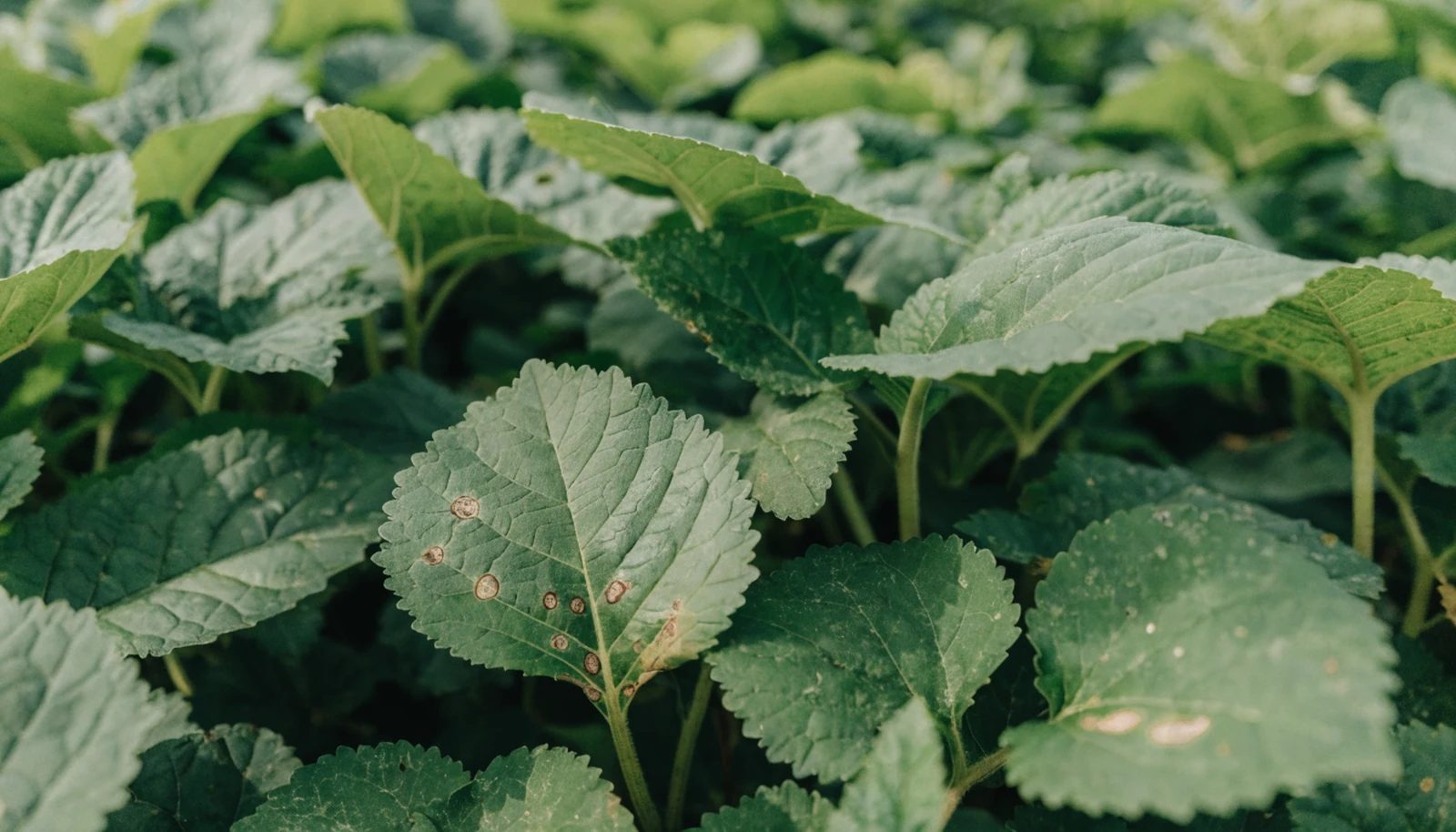
Crops affected
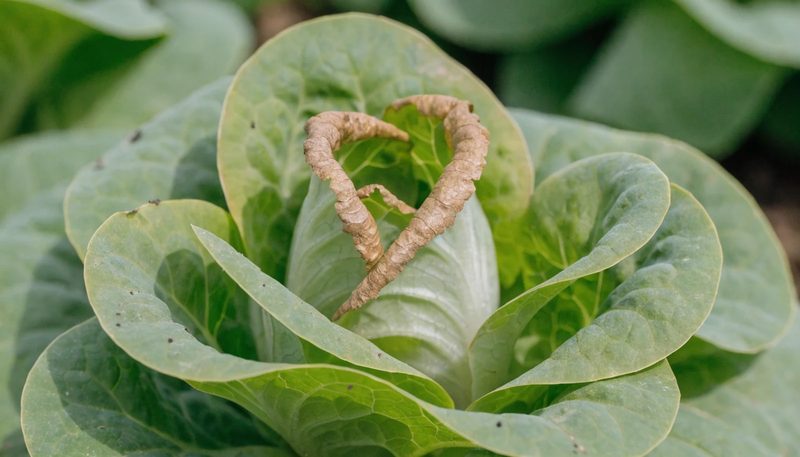
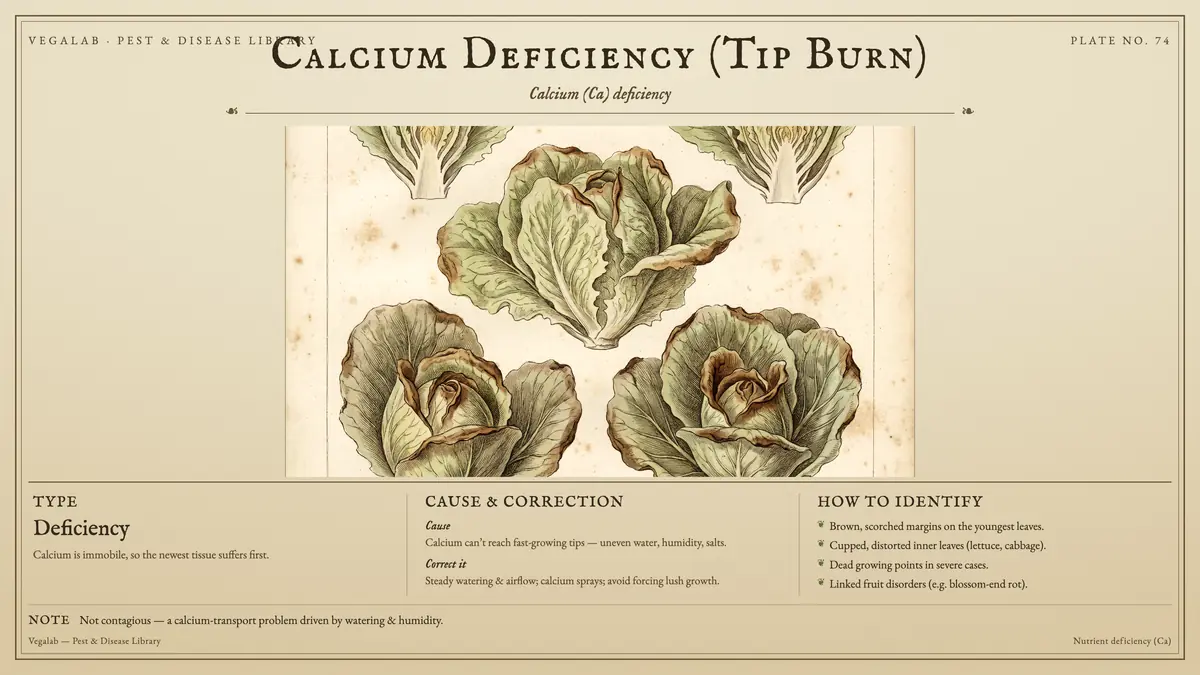
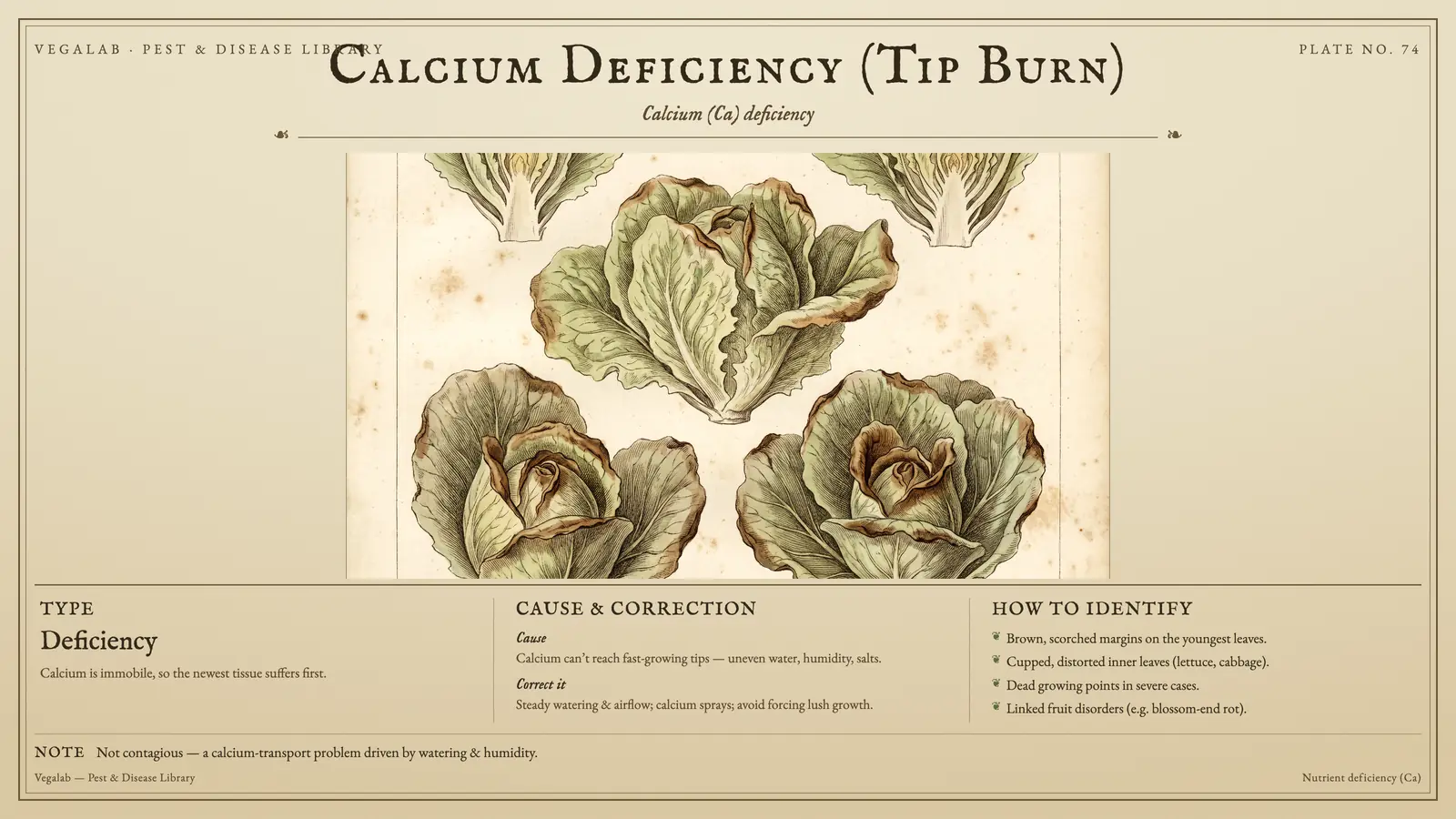
How to identify calcium deficiency (tip burn)
- Cupped, distorted inner leaves (lettuce, cabbage).
- Dead growing points in severe cases.
What is it?
Calcium is an immobile nutrient that moves with water flow into new growth and depends on steady transpiration and even moisture. The plant can't relocate it from old tissue, so deficiency appears in the youngest leaves, shoot tips, and fruit. Erratic watering, high humidity, rapid growth, and root stress all disrupt calcium delivery - often more than low soil calcium itself.
How to identify it
- Brown, scorched tips and margins on new leaves (tip burn)
- Distorted, hooked, or stunted young leaves and growing points
- Disorders in fruit such as blossom-end rot
- Symptoms in the newest growth while older leaves look fine
Conditions that favour it
True calcium deficiency in soil is uncommon in most agricultural situations - the far more frequent problem is calcium that is present but not reaching the tissue that needs it. Calcium moves only in the **xylem**, carried passively in the transpiration stream, and it is **not re-translocated** in the phloem once deposited. So it goes where water goes, and it cannot be moved from an old leaf to a new one.
That single property explains almost every calcium disorder. Rapidly expanding tissue with low transpiration - the inside of a lettuce head, the blossom end of a fruit, the growing point, the interior of a cabbage - receives very little calcium regardless of how much is in the soil. Anything that reduces or destabilises transpiration therefore causes localised deficiency: irrigation fluctuation, very high humidity, heat spikes, damaged or restricted roots, and waterlogging.
Antagonism is the other factor. High potassium, magnesium, sodium and ammonium all compete with calcium at uptake, so a soil test showing adequate calcium alongside very high potassium still explains a deficiency symptom. Low pH reduces availability.
Damage and how it spreads
Calcium shortage deforms and kills new growth, downgrades fruit (blossom-end rot, internal browning), and weakens cell walls so tissue is more prone to cracking and rot. Because delivery depends on even water and transpiration, the fix combines steady watering with readily available calcium rather than simply adding more to the soil.
Monitoring & scouting
Sample the youngest fully expanded leaves and, where the disorder is in a fruit or head, the affected tissue itself - a whole-plant or old-leaf analysis will often look adequate while the growing point is short.
Watch irrigation consistency as the leading indicator rather than soil calcium levels. Records of soil moisture fluctuation predict calcium disorders better than a soil test does.
Check the antagonist ratios in soil and tissue analysis - potassium, magnesium and sodium relative to calcium - rather than reading calcium in isolation. And inspect roots, since restricted or damaged roots are a frequent underlying cause.
How to control it
- Stabilize watering and avoid moisture swings and excess humidity that limit transpiration.
- Provide readily available calcium, including foliar where appropriate, to reach new growth.
- Support boron, which aids calcium movement and uptake.
- Avoid excess nitrogen and potassium that compete with calcium uptake.
How to correct calcium disorders
- Stabilise irrigation first. Consistent soil moisture is the single most effective measure for the localised disorders - tip burn, blossom-end rot, bitter pit - because calcium follows water. Fluctuation between wet and dry is the usual cause.
- Check and correct pH where it is low, since availability falls in acid soils. Liming addresses both pH and calcium supply together.
- Look at the antagonists. Excess potassium, magnesium, sodium or ammonium nitrogen competes with calcium at the root. Reducing an over-generous potassium or ammonium programme frequently resolves a 'calcium deficiency' without adding any calcium.
- Protect and support the root system. Compaction, waterlogging, root disease and container restriction all limit calcium delivery, and no foliar or soil application compensates for roots that cannot take up water.
- Manage humidity and heat under protection. Very high humidity suppresses transpiration and therefore calcium movement; heat spikes raise demand faster than supply.
- Use foliar calcium with realistic expectations. It can help where it lands directly on the affected tissue during its development window - bitter pit programmes on apple are the best-established example · but because calcium is not re-translocated, what lands on a leaf does not move to the fruit.
- Choose less susceptible varieties where the disorder is chronic, since susceptibility varies substantially.
- Add calcium to soil where analysis genuinely shows a shortfall, via lime, gypsum or a calcium-containing fertiliser matched to whether pH also needs changing.
The instinct on seeing a calcium symptom is to apply calcium, and in most cases that is not where the problem is. The question to answer first is whether the soil is genuinely short of calcium or whether calcium is failing to reach the affected tissue - because the corrections are entirely different.
The most common expensive mistake here is repeated calcium application to a crop whose real problem is irrigation fluctuation or root restriction. Diagnose which before spending.
Where it shows up, crop by crop
- Tip burn · brown, dried leaf margins in the youngest leaves and inside heads of lettuce, cabbage and brassicas; the interior of a head transpires very little, so it is chronically calcium-poor
- Blossom-end rot · tomato, pepper, aubergine, melon and squash; a sunken leathery black patch at the blossom end. Covered in detail at Blossom-End Rot
- Bitter pit · apple; small sunken dark pits developing in storage as much as on the tree, often worse in large fruit from lightly cropped, vigorous trees
- Blackheart of celery · death of the growing point in the centre of the head, a classic low-transpiration calcium disorder
- Cork spot · pear; sunken corky areas in the flesh, closely related to bitter pit in apple
- Empty pod and pod tip necrosis · legumes and peanut, where the developing pod is a low-transpiration sink
- Blossom-end and stylar-end breakdown in citrus and cucurbits
Notice the pattern: every one of these is in tissue that transpires little - an interior, a growing point, a fruit end or an enclosed structure. That is the diagnostic signature of a calcium transport problem rather than a soil shortage.
Why big fruit and vigorous trees get bitter pit
Bitter pit in apple is worth a separate explanation because it behaves in a way that seems backwards: it is often worst on the best-looking fruit from the healthiest-looking trees.
Three factors combine. Large fruit have a lower surface-to-volume ratio and a longer distance from the vascular supply to the interior tissue, so the interior receives proportionally less calcium. Light crop loads produce larger fruit and, critically, reduce competition - with fewer sinks, each fruit grows faster, and rapid growth dilutes the calcium arriving. Vigorous vegetative growth competes directly with fruit for calcium, and shoot tips are strong transpiring sinks that win that competition.
So a young, vigorous, lightly cropped tree carrying large fruit is the classic high-risk combination, and a heavily cropped mature tree with moderate vigour is low-risk. High nitrogen and high potassium both worsen it - nitrogen by driving vigour, potassium by antagonising calcium uptake.
The practical programme reflects this: managing vigour and crop load, moderating nitrogen and potassium, maintaining even irrigation, and where necessary a season-long programme of calcium sprays timed through fruit development rather than a single late application. Because bitter pit frequently appears in storage rather than at harvest, the decisions are made months before the symptom is visible, which is why it is managed on risk factors rather than on observation.
See Brown Spot & Cork Spot, which is closely related and often occurs alongside bitter pit.
Recommended Vegalab solution: Calcium Boost
Vegalab Calcium Boost is an advanced soluble calcium supplement that delivers readily available calcium to correct deficiency and the disorders it causes, and Cellular Boost reinforces cell integrity in fruit. Combine with even watering so calcium can move into the new growth that needs it.
| Role | Product | Use |
|---|---|---|
| Primary correction | Calcium Boost | Soluble calcium correction |
| Plant support | Cellular Boost | Cell integrity / anti-cracking |
See crop-specific solutions
Preventing it next season
Keep watering steady, manage humidity for healthy transpiration, balance nitrogen and potassium, and maintain available calcium through demand periods with Calcium Boost.
Claims and product availability vary by jurisdiction. Always read and follow the product label.