

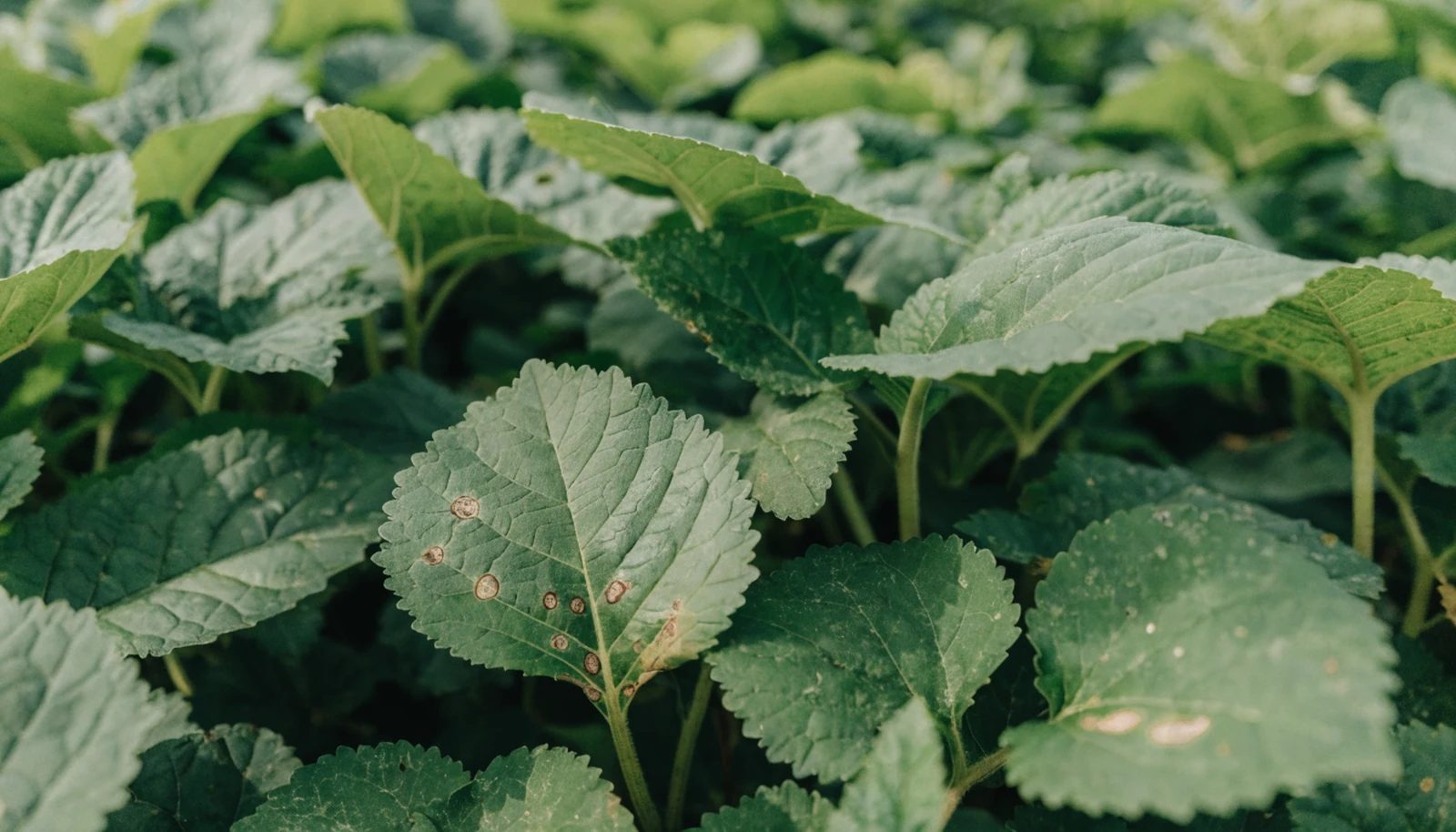
Crops affected
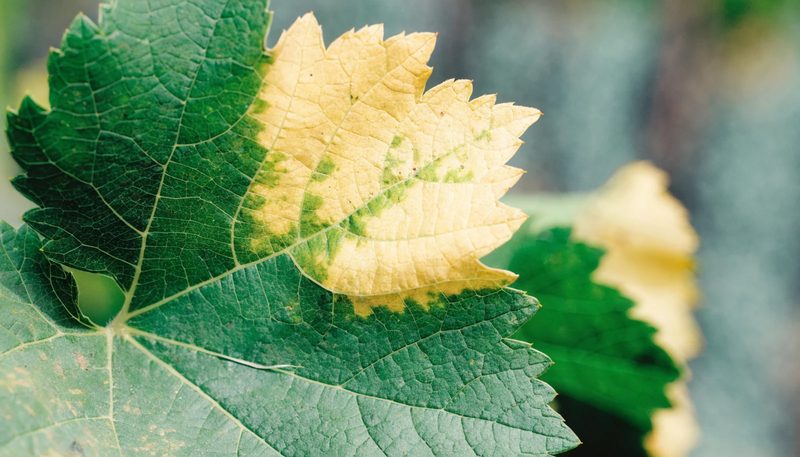
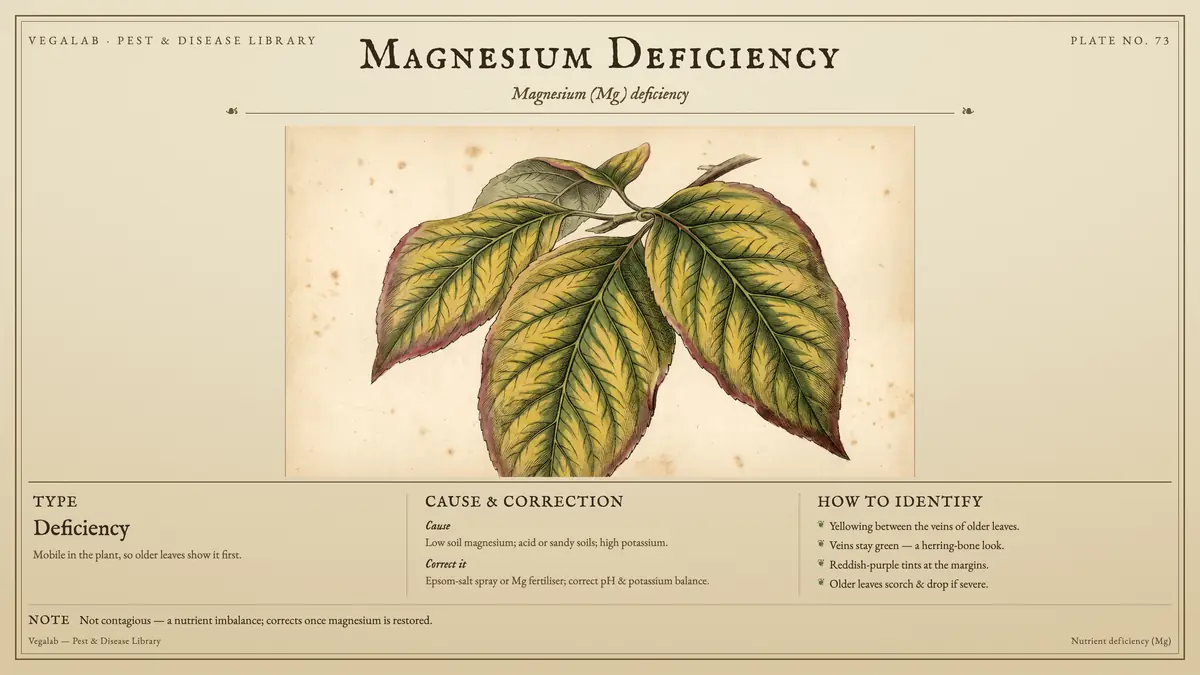
How to identify magnesium deficiency
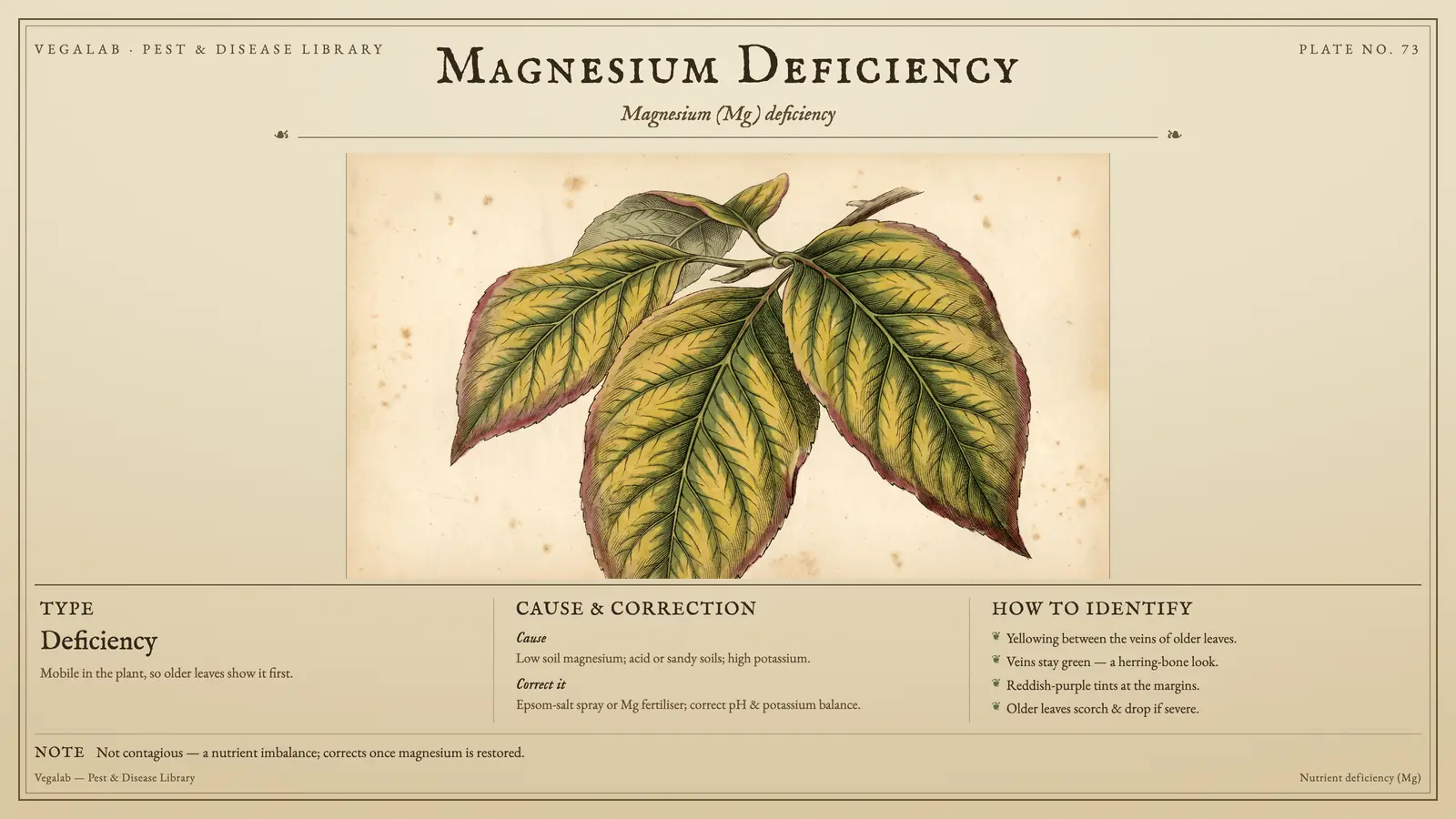
Note. Not contagious - a nutrient imbalance; corrects once magnesium is restored.
What is it?
Magnesium is a mobile nutrient and the core atom of chlorophyll. When short, the plant moves it from older leaves to new growth, so the classic interveinal yellowing appears on the lower, older leaves first. Deficiency is common in sandy, acidic, or high-potassium soils, where magnesium is low or its uptake is blocked.
How to identify it
- Yellowing between the veins of older leaves, with veins remaining green
- Yellowed areas that may turn brown or develop reddish/purple tints
- Symptoms starting low and older and progressing upward
- Common in sandy, acidic, or high-potassium soils
Conditions that favour it
Magnesium is the central atom of the chlorophyll molecule, which is why deficiency produces such a distinctive and immediate colour symptom. It is **mobile in the phloem**, so the plant moves it from older leaves to support new growth - and that is why symptoms appear on **older, lower leaves first**, the reverse of calcium.
Magnesium is readily leached from light, sandy and acid soils, so deficiency is common in high-rainfall areas and under heavy irrigation on coarse soils. It is also strongly antagonised by potassium: an over-generous potassium programme is one of the most frequent causes of magnesium deficiency in an otherwise adequate soil.
Demand rises sharply during periods of rapid growth and heavy fruit load, and heavy-cropping fruit and vine crops frequently show late-season deficiency as the crop draws magnesium from the leaves.
Damage and how it spreads
Because magnesium is central to chlorophyll, deficiency reduces photosynthesis, vigor, and yield, and severe cases cause leaf death. High potassium or acidic, sandy soils can induce it even when total magnesium isn't extremely low. Correcting it restores green color and productivity.
Monitoring & scouting
Sample **older, lower leaves** · sampling only young tissue will miss it, since the plant is stripping the old leaves to supply the new.
Read magnesium against potassium and calcium rather than in isolation. A K:Mg ratio that is too wide explains deficiency symptoms on a soil with adequate total magnesium.
Note the timing: deficiency appearing late in the season under heavy crop load is a demand problem; deficiency early on light acid soil is a supply problem. The corrections differ.
How to control it
- Confirm the interveinal pattern on older leaves; a soil or tissue test helps.
- Apply soluble magnesium for a quick response, foliar or to the root zone.
- Address soil pH and avoid excessive potassium that blocks uptake.
- Keep overall nutrition balanced.
How to correct magnesium deficiency
- Check potassium first. Excess potassium antagonises magnesium uptake and is one of the most common causes of deficiency on soils containing adequate magnesium. Moderating a heavy potassium programme often resolves it without adding magnesium at all.
- Correct pH on acid soils. Dolomitic limestone supplies both magnesium and calcium and raises pH - the appropriate choice where soil is acid and magnesium is low.
- Use magnesium sulphate (Epsom salts) for a quick response, either soil-applied or foliar; it is water-soluble and does not raise pH, making it suitable where pH is already adequate.
- Use foliar application for in-season correction. Unlike calcium, magnesium applied to leaves is mobile in the plant, so foliar treatment genuinely corrects a deficiency during the season - this is one of the more reliable foliar nutrition responses.
- Reduce leaching losses on light soils by splitting applications and avoiding excess irrigation, since magnesium leaches readily from sands.
- Anticipate heavy crop demand. In heavy-cropping vines and fruit trees, plan magnesium supply ahead of the fruit-fill period rather than responding to symptoms in late season.
- Maintain organic matter, which improves cation retention on light soils.
Magnesium is one of the few nutrients where foliar application is genuinely corrective rather than merely supplementary, because it is phloem-mobile. That makes in-season rescue realistic in a way it is not for calcium.
Reading the pattern: interveinal chlorosis
- Magnesium: interveinal chlorosis on older, lower leaves · the tissue between the veins yellows while the veins themselves stay distinctly green, producing a marbled or herringbone pattern. In many species the yellowed areas later turn reddish-purple or develop necrotic patches. Leaf margins may curl upward.
- Nitrogen: uniform pale yellowing of the whole older leaf, veins included, with no interveinal pattern; the plant is generally pale and small
- Iron: interveinal chlorosis too, but on the youngest leaves, and much more severe - often near-white with a fine green vein network; iron is immobile, so new growth suffers first
- Manganese: interveinal chlorosis on young to mid-age leaves, with a less sharp vein contrast than iron and often with necrotic speckling
- Potassium: yellowing and scorching that starts at the leaf margins and tips of older leaves and works inward
Magnesium deficiency produces one of the most recognisable symptoms in plant nutrition, and the details separate it from the other deficiencies that also cause yellowing.
Old leaves plus interveinal yellowing with green veins means magnesium; young leaves plus interveinal yellowing means iron or manganese. See Nitrogen Deficiency and Micronutrient Deficiency.
The potassium–magnesium balance
More magnesium deficiency in commercial horticulture is caused by potassium than by a shortage of magnesium, and the mechanism is worth understanding because it means the correct action is counter-intuitive.
Potassium, magnesium, calcium, sodium and ammonium all enter the root through competing uptake pathways. When one is present in large excess it suppresses the uptake of the others, and magnesium is particularly vulnerable to suppression by potassium. A crop grown on a soil with a perfectly adequate magnesium reserve, receiving a generous potassium programme aimed at fruit quality, can therefore show clear magnesium deficiency in the leaves - and adding more magnesium into that competition is an inefficient way to fix it.
This is why nutrition should be read as ratios rather than as absolute levels. A soil analysis showing high potassium and moderate magnesium is a magnesium deficiency risk even though the magnesium figure looks acceptable, and a tissue analysis will often confirm it.
The practical response is to moderate potassium to what the crop actually needs, and to supply magnesium in a form and timing that avoids the competition - foliar application bypasses root uptake entirely, which is why it works so well here. Where potassium must remain high for quality reasons, planned foliar magnesium through the season is the realistic accommodation.
Heavy-cropping vines, tomatoes and bananas are the crops where this trade-off is most often live, because they all receive substantial potassium for fruit quality.
Recommended Vegalab solution: Magnesium Boost
Vegalab Magnesium Boost is an advanced soluble magnesium designed to correct deficiency quickly and restore chlorophyll production. For broader micronutrient support alongside magnesium, Micro Boost supplies essential trace elements, and Balance Boost helps remediate and rebalance soils where high potassium or acidity is blocking uptake. Apply per label.
| Role | Product | Use |
|---|---|---|
| Primary correction | Magnesium Boost | Soluble magnesium correction |
| Companion / broader pressure | Micro Boost | Micronutrient correction |
| Plant support | Balance Boost | Soil remediation & balancing |
See crop-specific solutions
Preventing it next season
Maintain balanced soil nutrition and pH, avoid excessive potassium, and monitor older leaves on sandy or acidic soils. Magnesium Boost makes it easy to top up magnesium when demand is high.
Claims and product availability vary by jurisdiction. Always read and follow the product label.