


Crops affected
What is it?
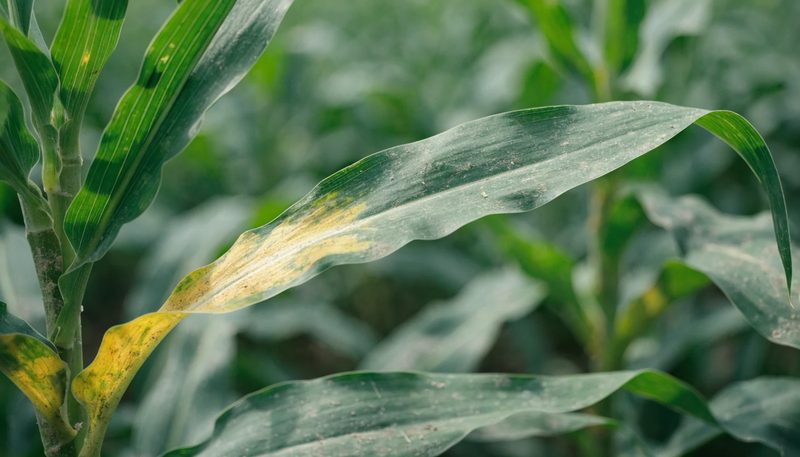
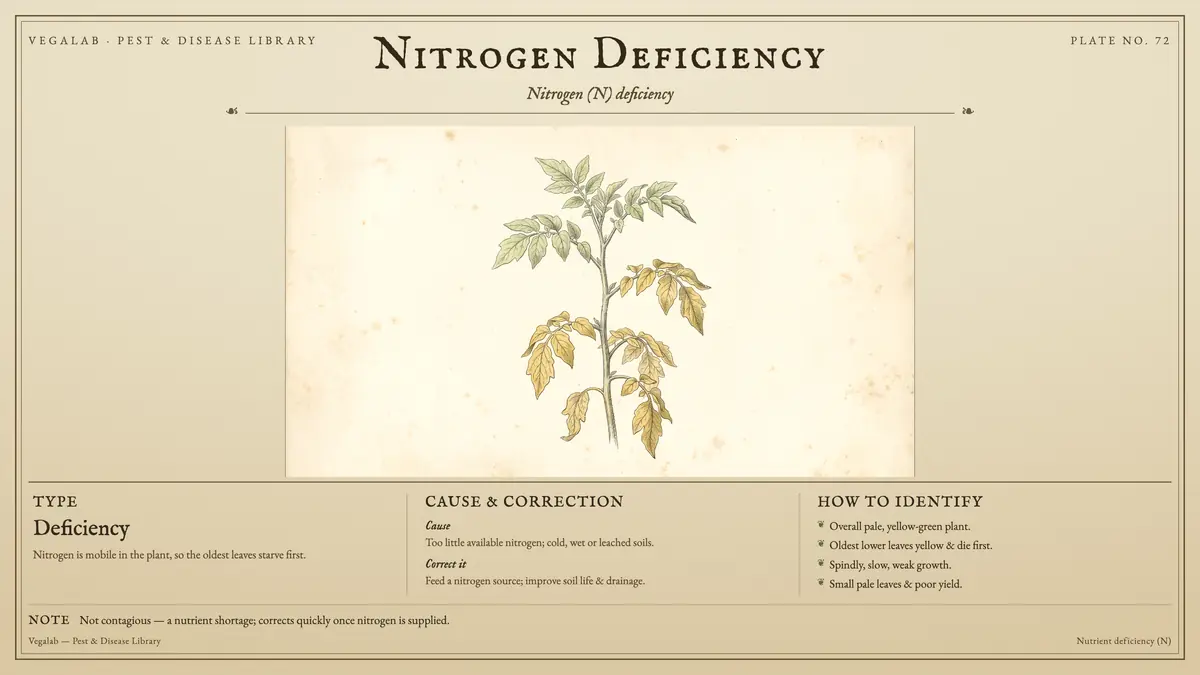
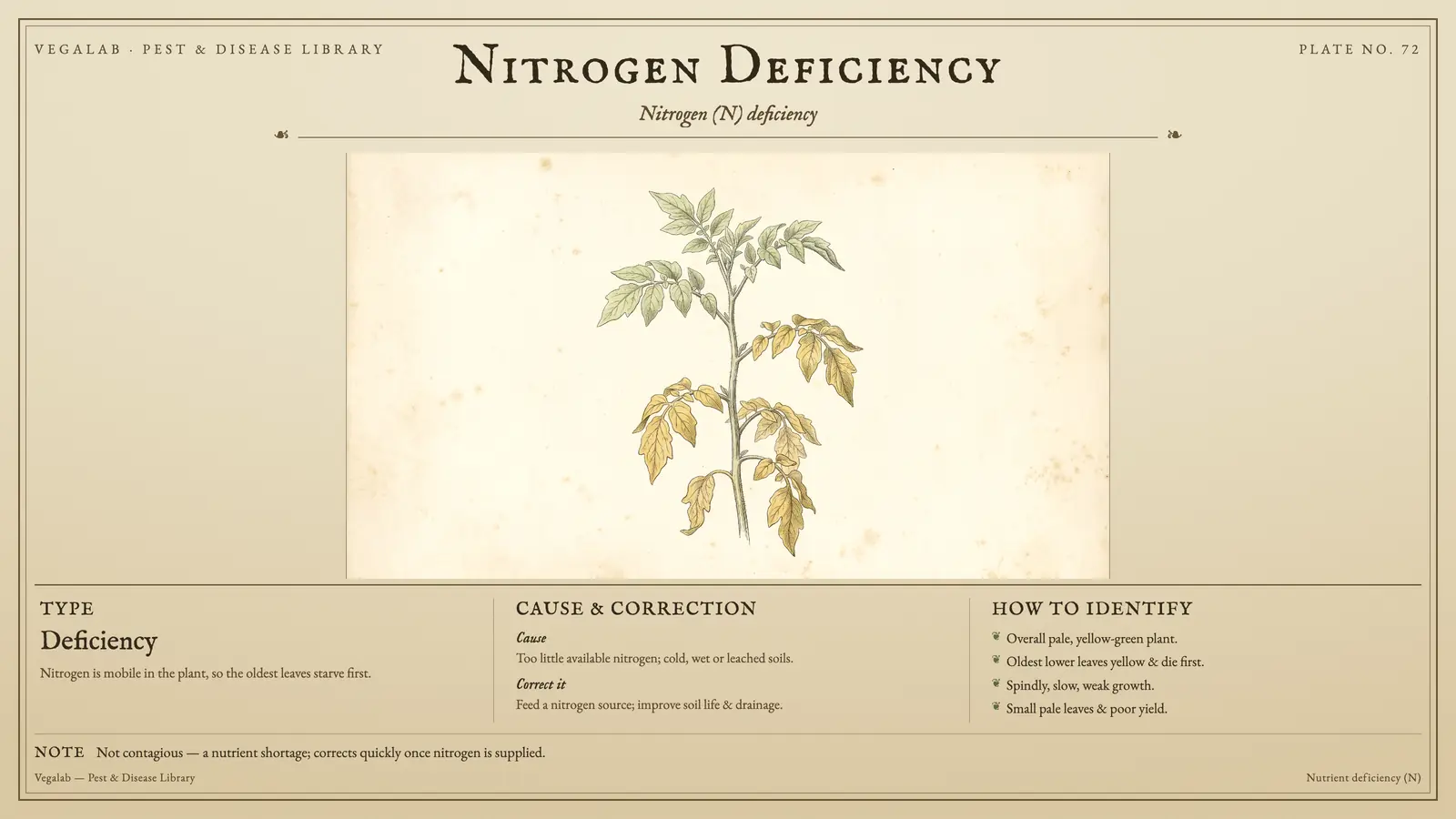
Nitrogen is a mobile nutrient central to chlorophyll and protein, so plants move it from old leaves to new growth when short. That is why deficiency appears first on the oldest, lowest leaves as uniform yellowing. Causes include low soil fertility, leaching after heavy rain or irrigation, and high demand during rapid growth.
How to identify it
- Uniform pale green to yellow color starting on older, lower leaves
- Stunted, slow, spindly growth and small leaves
- Yellowing that progresses up the plant if uncorrected
- Overall lack of vigor and reduced yield
Conditions that favour it
Nitrogen is the nutrient plants need in the largest quantity and the one most easily lost from the system. It is **highly mobile in the plant**, so a deficient crop remobilises nitrogen from older leaves to support new growth - producing the characteristic uniform pale yellowing of the oldest leaves first while the growing point stays greener.
Losses drive most field deficiency: leaching of nitrate on light soils and in wet conditions, denitrification in waterlogged soil, and volatilisation of ammonia from surface-applied urea. Immobilisation is the other common cause - incorporating a high-carbon residue such as straw or sawdust ties up available nitrogen in microbial biomass, temporarily starving the crop.
Cold, waterlogged and compacted soils reduce both mineralisation of organic nitrogen and root uptake, which is why a crop can show deficiency in spring on a soil with adequate reserves and then grow out of it as conditions improve.
Damage and how it spreads
Nitrogen shortage limits growth, leaf area, and yield, and weakens plants overall. Because nitrogen leaches easily and demand peaks during rapid growth, deficiency can develop quickly in sandy soils and wet conditions. Correcting it promptly restores vigor; chronic shortage costs significant yield.
Monitoring & scouting
Sample the **oldest leaves** for visual assessment and follow the crop's standard tissue-sampling protocol for analysis - nitrogen status is one of the more reliably measured nutrients.
Use in-season tools where available: chlorophyll meters, sap nitrate testing, canopy sensing and simple reference strips left over- or under-fertilised for comparison. A well-placed reference strip is the cheapest diagnostic there is.
Distinguish a supply problem from an uptake problem before responding. Waterlogging, compaction, cold soil and root disease all produce nitrogen deficiency symptoms on soils with plenty of nitrogen, and fertiliser does not fix any of them.
How to control it
- Confirm with leaf symptoms (old leaves first) and, ideally, a soil or tissue test.
- Apply available nitrogen to meet the crop's growth-stage demand.
- Split applications to match uptake and reduce leaching losses.
- Maintain balanced overall nutrition so nitrogen isn't the limiting factor.
How to correct nitrogen deficiency
- Establish whether it is supply or uptake. A pale crop on a waterlogged, compacted or cold soil is usually failing to take nitrogen up, not lacking it. Applying more fertiliser to that situation is expensive and ineffective - and on a wet soil it increases losses.
- Split applications to match demand. Matching supply to the crop's uptake curve reduces both deficiency and loss, and is the single most effective efficiency measure available.
- Choose the form and placement for the conditions. Nitrate is immediately available but leaches; ammonium and urea need conversion; surface-applied urea volatilises without incorporation or rainfall. Placement and timing matter as much as rate.
- Account for immobilisation after incorporating high-carbon residues, and add nitrogen to cover it or allow time before planting a demanding crop.
- Fix drainage and compaction, which limit both mineralisation and uptake.
- Use foliar nitrogen for a rapid in-season response where a quick correction is needed; it is fast but supplies a small fraction of total demand and is not a substitute for soil supply.
- Build the organic nitrogen reserve over time with organic matter, legumes in rotation and cover crops - a soil that mineralises steadily is far more forgiving than one dependent entirely on applied nitrogen.
- Support root development and soil biology, since the capacity to capture nitrogen depends on root exploration and on mineralisation by soil organisms.
Excess nitrogen has its own long list of costs - soft growth, aphid and disease susceptibility, delayed maturity, poor colour and storage quality, lodging, and environmental loss. Correcting a deficiency should not become over-correction.
Nitrogen deficiency or something that looks like it?
- Nitrogen deficiency: uniform pale green to yellow on the oldest leaves first, veins included; whole plant small and spindly with thin stems; older leaves may drop early
- Sulphur deficiency: very similar pale yellowing but on the younger leaves, since sulphur is less mobile - increasingly common as atmospheric sulphur deposition has declined
- Waterlogging or root disease: pale yellow crop with adequate soil nitrogen; roots brown or sparse; often patchy and following field topography
- Compaction: pale, stunted, poor rooting depth, often in machinery paths and headlands - a pattern following traffic rather than soil type
- Nematode damage: pale, patchy, poor response to fertiliser, recurring in the same areas each year
- Herbicide carryover or injury: pale and stunted with distortion, often with a sharp boundary matching application
- Cold soil: transient pale colour in spring that resolves as soil warms
A uniformly pale crop is one of the most common field observations and one of the most frequently misattributed, because several quite different problems produce it.
The decisive test is response: genuine nitrogen deficiency responds visibly within a week or two of an available nitrogen application. If it does not, the problem is uptake, roots or something else. See Poor Root Development.
Why a reference strip is worth more than a soil test
Nitrogen is unusually difficult to manage from soil analysis alone, because plant-available nitrogen changes continuously - it is mineralised by soil biology, leached by rain, denitrified in wet spells and taken up by the crop, all on a timescale of days. A soil nitrogen figure is a snapshot of a moving target.
A reference strip is the practical answer and it costs almost nothing. Leave a strip of the field with a deliberately higher nitrogen rate - or, in a well-supplied crop, a strip with none - and compare it to the rest of the field through the season. If the high-nitrogen strip is visibly greener and growing better, the rest of the field is short and will respond. If it looks identical, additional nitrogen would have been wasted.
This turns an uncertain judgement into a direct observation of the thing you actually want to know: whether this crop, in this field, this season, would respond to more nitrogen. It also accumulates value over years, because it calibrates a grower's eye to their own soils.
Chlorophyll meters, sap testing and canopy sensing all address the same question with more precision and more cost. The reference strip requires no equipment and is the reason it remains standard advice in extension programmes worldwide.
The same logic applies to any input whose response is uncertain. A strip left untreated is the cheapest trial available and answers the question that matters - does this field respond?
Recommended Vegalab solution: Nitrogen Pro
Vegalab Nitrogen Pro is an advanced water-soluble nitrogen fertilizer for fast-growing plants, ideal for correcting deficiency quickly and feeding vegetative growth. Where a balanced feed is more appropriate, NPK Pro (all-purpose water-soluble) and Vega Pro (early-season general purpose) supply nitrogen alongside other nutrients. Grow Boost can further amplify vegetative growth once nitrogen is restored. Apply per label and split feeds to match demand.
| Role | Product | Use |
|---|---|---|
| Primary correction | Nitrogen Pro | Water-soluble nitrogen |
| Companion / broader pressure | NPK Pro | Balanced water-soluble feed |
| Plant support | Vega Pro |
Preventing it next season
Match nitrogen supply to each growth stage, split applications to limit leaching, and keep nutrition balanced. Nitrogen Pro and NPK Pro make it easy to feed precisely through the season.
Claims and product availability vary by jurisdiction. Always read and follow the product label.