


Crops affected
What is it?
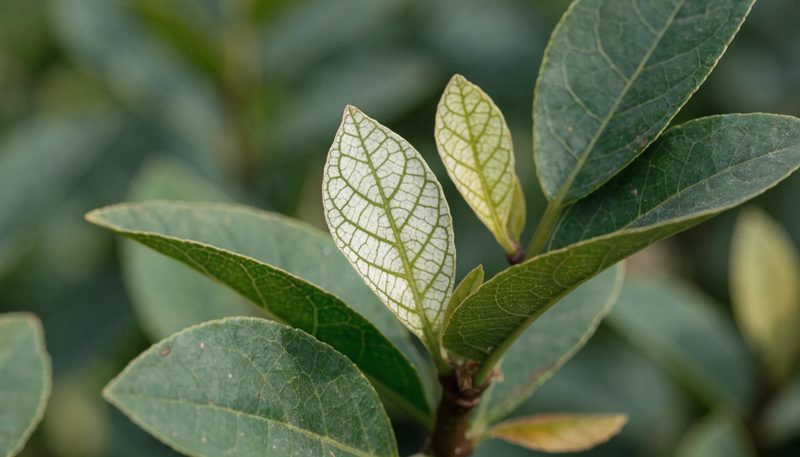
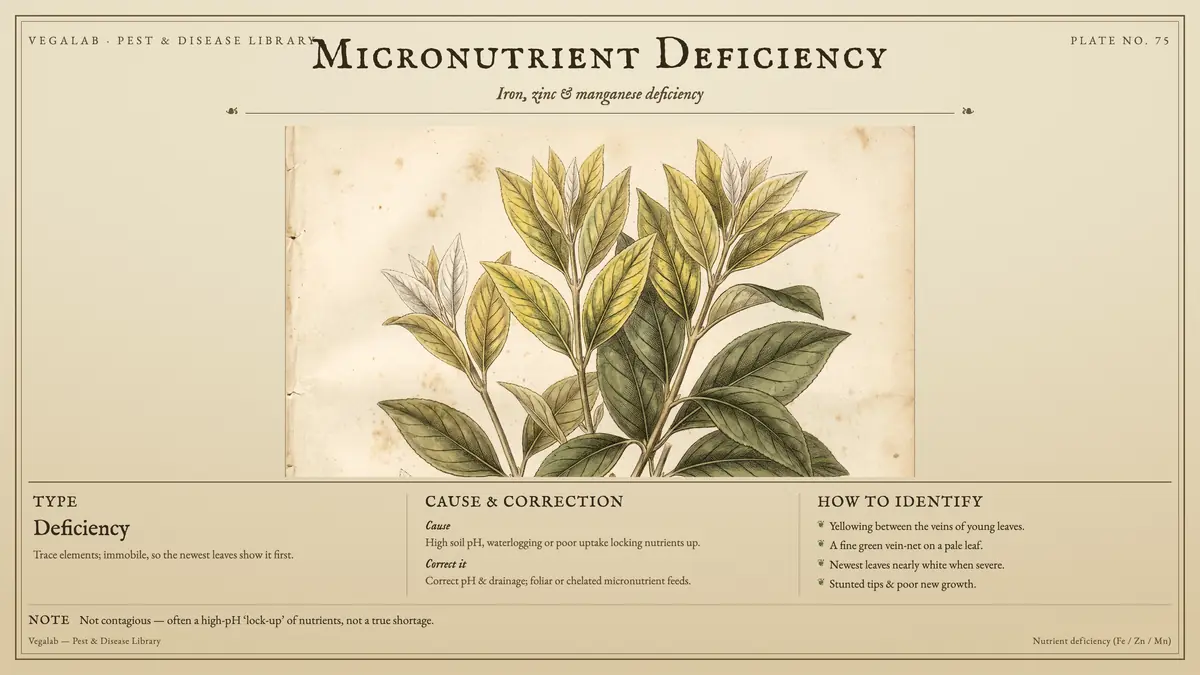
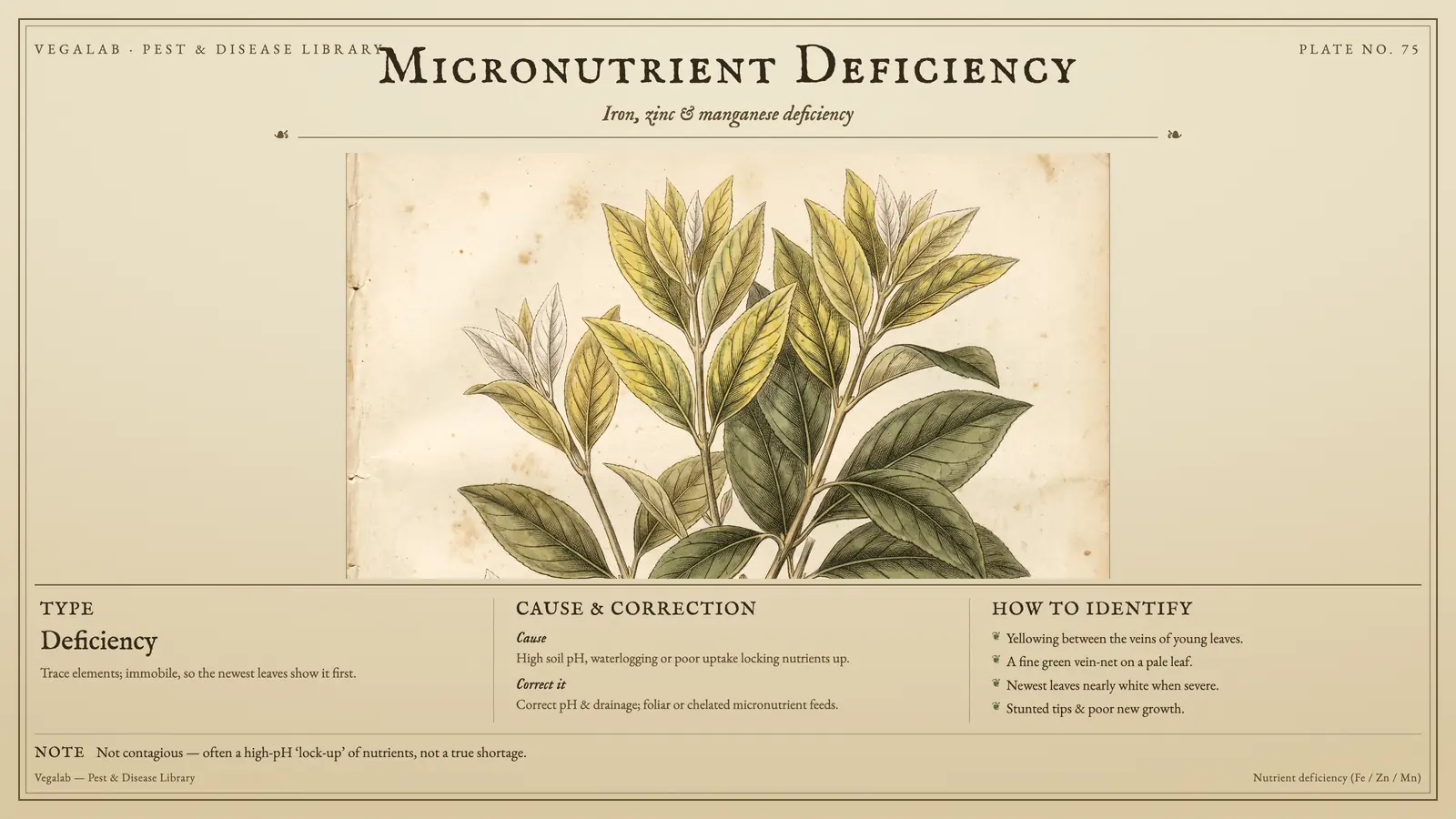
Micronutrients are needed in small amounts but are essential to chlorophyll, enzymes, and growth. Iron and manganese deficiencies typically cause interveinal yellowing on new leaves; zinc deficiency causes small leaves and short, bunched shoots. High soil pH, over-liming, waterlogging, and nutrient imbalances often make these elements unavailable even when present in the soil.
How to identify it
- Iron: interveinal yellowing on the youngest leaves, with veins staying green
- Manganese: similar interveinal yellowing, often a bit further down the plant
- Zinc: small leaves, short internodes, and bunched, rosetted new growth
- Common on high-pH, alkaline, or waterlogged soils
Conditions that favour it
Micronutrients - iron, manganese, zinc, boron, copper, molybdenum, chlorine and nickel - are needed in small quantities but are not optional; each has specific enzymatic or structural roles and none substitutes for another. Deficiency reflects availability far more often than total soil content.
**pH is the dominant control.** Iron, manganese, zinc and copper availability fall sharply as pH rises above roughly 7, which is why micronutrient deficiency is characteristic of alkaline and calcareous soils. Molybdenum behaves oppositely, becoming less available in acid soils. Boron is readily leached from light soils and is the micronutrient with the narrowest margin between deficiency and toxicity.
Other factors: waterlogging affects manganese availability; high organic matter can complex copper and zinc; cold soil reduces uptake of most; and antagonism between elements - high phosphorus suppressing zinc, high zinc or copper suppressing iron - produces induced deficiencies on soils with adequate reserves.
Damage and how it spreads
Trace-element shortages reduce chlorophyll, enzyme function, and growth, cutting vigor, quality, and yield, and severe cases distort and kill new growth. Because the cause is often availability (pH and balance) rather than total quantity, correcting it usually means supplying available, chelated forms and addressing soil conditions.
Monitoring & scouting
Sample the **youngest** tissue for the immobile micronutrients (iron, boron, calcium-like behaviour) and follow crop-specific protocols, since sampling position materially changes the result.
Always interpret tissue analysis alongside **soil pH**, which is usually the operative variable - correcting pH addresses several micronutrients at once, where individual applications address one.
Use the symptom position as the first diagnostic: micronutrient deficiencies mostly show on young tissue because most are immobile in the plant, which distinguishes them from nitrogen, magnesium and potassium.
How to control it
- Identify the pattern (new-leaf interveinal yellowing vs. small bunched shoots) and confirm with a tissue or soil test.
- Apply available micronutrients, foliar for a fast response.
- Address soil pH and waterlogging that lock up trace elements.
- Keep macro- and micronutrient balance to avoid inducing further deficiencies.
How to correct micronutrient deficiencies
- Test soil pH first, and correct it if you can. pH governs the availability of most micronutrients, and adjusting it addresses several at once. On calcareous soils where pH cannot practically be lowered, the strategy shifts to foliar supply and to acidifying the root zone locally.
- Use foliar application for the immobile micronutrients. Iron, manganese and zinc respond well to foliar treatment precisely because it bypasses the soil chemistry that made them unavailable. It is corrective for the treated tissue but must be repeated as new growth appears.
- Use chelated forms for soil application on high-pH soils, where unchelated iron and manganese are rapidly rendered unavailable.
- Handle boron with particular care. The gap between deficiency and toxicity is narrow, boron is mobile and leaches, and over-application causes real damage. Apply little, accurately, and never as a blanket insurance measure.
- Check the antagonisms. High phosphorus suppresses zinc; excess zinc or copper suppresses iron; high pH suppresses most. An induced deficiency is corrected by addressing the excess, not by adding more of the deficient element.
- Improve soil biology and organic matter, which improves micronutrient cycling and availability, and support root exploration - a larger root system encounters more of a scarce nutrient.
- Avoid blanket applications. Micronutrients have narrow optimal ranges and several are toxic in excess. Apply on the basis of analysis and known local deficiencies, not routinely.
Correcting soil pH is almost always more effective and cheaper than repeatedly supplying individual micronutrients into unfavourable chemistry - where it is achievable.
Identifying which micronutrient
- Iron: severe interveinal chlorosis on the youngest leaves, veins remaining sharply green against near-white tissue; classic on calcareous and over-irrigated soils
- Manganese: interveinal chlorosis on young to mid leaves with less sharp vein contrast than iron, often with necrotic speckling; grey speck in cereals, marsh spot in peas
- Zinc: shortened internodes and small leaves (rosetting), interveinal chlorosis, and in maize a broad pale band along the leaf; little leaf in fruit trees
- Boron: death of the growing point, brittle and distorted tissue, hollow or corky stems and roots - hollow heart in brassicas, brown heart in swede, cracked stem in celery, and poor fruit and seed set
- Copper: wilting and dieback of shoot tips, pale twisted young leaves; withertip in cereals
- Molybdenum: whiptail in cauliflower · narrow strapped distorted leaves; poor nodulation in legumes; associated with acid soils
- Chlorine and nickel: rarely deficient in field conditions
Position plus pattern is the key: young-leaf interveinal chlorosis points to iron or manganese; growing-point death and brittleness points to boron; rosetting points to zinc. Confirm with tissue analysis before applying, since several are toxic in excess.
Lime-induced chlorosis: the most common micronutrient problem
On calcareous and high-pH soils, iron chlorosis is the most frequently encountered micronutrient disorder worldwide, and it is worth explaining because the obvious remedy usually does not work.
The soil is not short of iron. Most soils contain very large quantities of it. But at high pH, iron exists in oxidised forms with extremely low solubility, and the plant cannot extract it. Adding iron sulphate to such a soil simply produces more insoluble iron - which is why the standard response fails and why growers conclude the product was ineffective.
What does work operates on availability rather than quantity. Chelated iron - particularly the more stable chelates suited to high pH - keeps iron in a soluble form long enough for roots to take it up. Foliar iron bypasses the soil entirely and greens the treated tissue, though it must be repeated as new leaves appear. Acidifying the root zone locally, through acidifying fertilisers, elemental sulphur or acid injection into irrigation, improves availability in the volume that matters. And avoiding over-irrigation and waterlogging matters more than growers expect, because saturated soil raises bicarbonate concentrations in the root zone, which is a direct cause of the chlorosis.
In perennial crops on calcareous soils the durable answer is genetic: tolerant rootstocks and species vary enormously in their ability to acquire iron under these conditions, and rootstock choice at planting outperforms any subsequent treatment.
In calcareous or high-pH soils, iron may be abundant but unavailable. Soil-applied iron sulfate often performs poorly because iron rapidly becomes insoluble. After diagnosis, use a crop- and pH-appropriate chelate - often EDDHA at high pH - root-zone pH management where practical, or foliar iron for temporary correction.
Recommended Vegalab solution: Micro Boost
Vegalab Micro Boost supplies micronutrients with essential trace elements to correct iron, manganese, zinc, and related deficiencies, with foliar application giving a fast response. Where high pH or imbalance is locking nutrients up, Balance Boost supports soil remediation and rebalancing, and Magnesium Boost addresses companion magnesium shortfalls. Apply per label.
| Role | Product | Use |
|---|---|---|
| Primary correction | Micro Boost | Micronutrient correction |
| Companion / broader pressure | Balance Boost | Soil remediation & balancing |
| Plant support | Magnesium Boost | Soluble magnesium correction |
See crop-specific solutions
Preventing it next season
Manage soil pH and drainage, keep nutrition balanced, and top up trace elements during high demand with Micro Boost. On problem soils, Balance Boost helps keep micronutrients available.
Claims and product availability vary by jurisdiction. Always read and follow the product label.