


What is horticultural oil and when do you spray it?
Last updated:
Horticultural oil is a highly refined petroleum or plant oil mixed with an emulsifier so it can be sprayed in water1. It kills small, slow-moving pests such as scales, mites, aphids and their eggs mainly by coating them1,2. Spray it in late winter as dormant oil, close to bud break, or in the growing season against young scales, mites and whiteflies1,2.
What is horticultural oil made of?
Horticultural oils are usually highly refined petroleum oils combined with an emulsifying agent that lets the oil mix with water, and some plant-derived oils are also used1. Refining removes the impurities linked to plant injury, such as aromatic compounds and compounds containing sulfur, nitrogen or oxygen1. University of California IPM describes these specially refined petroleum products as narrow-range, superior or supreme oils3.
The older names still cause confusion. Horticultural oils formerly went by dormant oils, superior oils or 70-second oils, names that referred to the time of spraying or to how the oils were made2. Modern refining makes today's oils much gentler on plants than older ones, so the broader name horticultural oil is preferred2.
Vegetable oils work too, but the type matters: cottonseed oil is generally considered the most insecticidal, and soybean oil has often given fair to good control of some insects and mites1. Plant-based oils such as neem, canola and cottonseed are acceptable alternatives to petroleum oils for spider mites4.
| Term | Meaning |
|---|---|
| Dormant oil | Oil used on woody plants in the dormant season; now refers to timing, not to a type of oil1 |
| Summer oil | Oil used when foliage is present; also refers to timing1 |
| Narrow-range oil | Highly refined oil with a narrow distillation range; falls in the superior oil class1 |
| Superior oil | Summer-use oil meeting specifications set in 1947; most are now called narrow-range oils1 |
| Supreme oil | Highly refined oil distilling at slightly higher temperatures over a wider range1 |
| Vegetable oil | Oil from oilseed crops such as soybean, canola or cottonseed1 |
In North America, dormant oil goes on in late winter to early spring, from about March into April depending on region, as close to bud break as possible, and summer oil sprays follow scale crawler emergence in late spring and summer. In the Southern Hemisphere, the dormant window falls around August and September.
How does horticultural oil kill insects and mites?
The classic explanation is suffocation. Oils block the spiracles, the air holes insects breathe through, so they die from asphyxiation; oils may also act as poisons that interfere with an insect's metabolism, and they can disrupt feeding, which matters for aphids that spread some plant viruses1. A review of the research argues that suffocation happens mainly when insects are thoroughly sprayed or dipped, and that oils more often change the waxes on the insect's outer cuticle, damaging its waterproofing and letting oil penetrate the body7.
Either way, the oil has to reach the pest. Oil sprays only work on pests they coat, which usually means small, immobile or slow-moving pests exposed on the plant surface when the spray goes on2. Large, mobile insects are not affected2. Missed leaf undersides or small bark cracks give pests a refuge, so thorough coverage is essential2.
Because oils quickly evaporate and leave little residue, they pose few risks to beneficial natural enemies, which lets them fit well with biological control1.
When should you spray dormant oil?
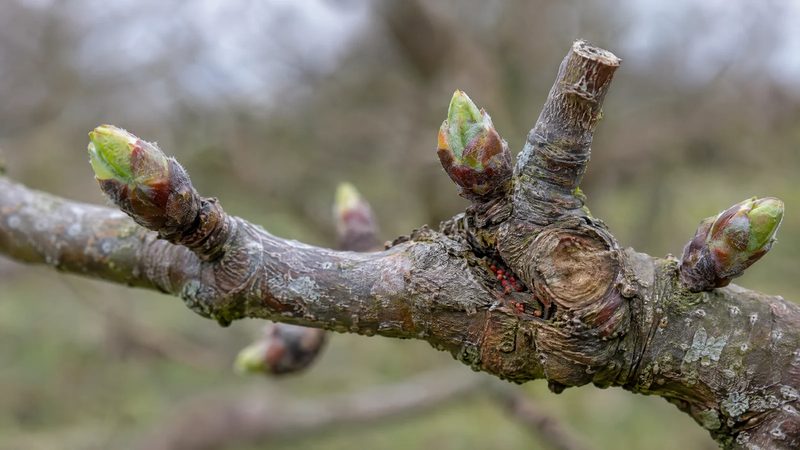
Dormant oil is applied before buds swell and break in late winter or early spring, to kill mites and insects such as scales and aphids that spend the winter on the plant1. Iowa State University Extension places it in late March or April, before leaves or flowers show signs of breaking dormancy2. A common mistake is spraying too early, on the first warm day in February or March, before the insects are actively respiring and susceptible; wait until as close to bud break as possible2.
Some pests call for a slightly later delayed-dormant spray, after buds swell but before they open. University of California guidance uses that window for oak pit scales, sycamore scale and other harder to control species, and spraying the bark of terminal shoots in winter for most other scales on deciduous woody plants3. Do not spray oystershell or olive scales in the dormant season, because their susceptible stages are not present in winter3.
For European red mite (Panonychus ulmi) on fruit trees, the most effective and easiest control is a delayed dormant oil spray from half-inch green to tight cluster, before overwintering eggs hatch5. University of Kentucky guidance gives a window from just before bud swell to half-inch green, and notes that control improves the closer the spray is to egg hatch6.
| Target | Timing | Source |
|---|---|---|
| Most overwintering scales on deciduous woody plants | Winter, spraying the bark of terminal shoots | 3 |
| Oak pit scales, sycamore scale | Delayed dormant: after buds swell, before they open | 3 |
| Oystershell and olive scales | Not in the dormant season; target crawlers later | 3 |
| European red mite eggs on fruit trees | Half-inch green to tight cluster, before egg hatch | 5 |
| General landscape use (Iowa) | Late March or April, as close to bud break as possible | 2 |
Which pests and diseases does horticultural oil control?
Oils remain an important tool for scales, aphids and mites on fruit trees, shade trees and woody ornamentals, and newer oils extend that use to flowers, vegetables and other herbaceous plants1. Dormant applications control aphids that curl leaves in spring, caterpillars that winter as eggs such as leafrollers and tent caterpillars, mites that winter on the plant, and several scales1. Summer applications control adelgids, aphids, eriophyid mites, leafhoppers, scales, spider mites and whiteflies, plus powdery mildew and some aphid-transmitted viruses1.
For scales in the growing season, oil works on deciduous plants when sprayed soon after most crawlers have emerged and most scales are young nymphs, and late spring and summer are also the times to spray citrus, avocado and many other broadleaf evergreens3. Cover twig terminals and leaf undersides where scales sit3.
The list of pests oil does not reach is long. In summer, oils work on insects that are soft and slow, not on late-stage immatures or adults, and many common garden pests, such as apple maggot, cabbageworms and white grubs, are not affected by oil sprays2.
Does horticultural oil work on spider mites?
Yes, as a contact treatment. When a treatment for spider mites is needed, University of California guidance prefers selective materials, insecticidal soap or insecticidal oil, and accepts both petroleum-based horticultural oils and plant-based oils such as neem, canola or cottonseed4. Oils and soaps must contact the mites to kill them, so excellent coverage, especially of leaf undersides, is essential, and repeat applications may be needed4. Oils can kill all mite life stages through suffocation6.
Two cautions apply. Do not use oils on water-stressed plants or when temperatures exceed 90°F, and test the product on a portion of the foliage several days before a full treatment4. Do not apply sulfur within 30 days of an oil spray4.
When can horticultural oil damage plants?
Spray oils carry a small but real risk of plant injury in some situations, and they can stain some surfaces, such as dark house paint1. Drought-stressed plants are at higher risk, and plants that are not stressed are much less likely to be damaged1. Some plants tend to be oil-sensitive: black walnut, cryptomeria, Douglas-fir, hickories, junipers and cedars, maples (particularly Japanese and red maple), redbud, smoke tree and spruce, particularly dwarf Alberta spruce1. Oil also removes the bluish tinge from blue spruce foliage, although the tree's health is not impaired3.
Weather and mixing rules matter as much as the plant. University of California guidance is not to apply oil when it is foggy, freezing (under 32°F), hot (over 90°F), when relative humidity is above 90%, or when rain is expected within 24 hours, and to irrigate plants well before spraying foliage in hot weather3. Do not mix oil with chlorothalonil, sulfur and certain other fungicides, and do not apply oil within 3 weeks of a sulfur-containing spray3. Avoid treating plants in fall until after winter hardening, because fall treatments have sometimes increased winter injury1. Mix the oil exactly at the dilution on the product label, since the wrong rate can damage plants, especially in summer2.
Key takeaways
- Horticultural oil is a highly refined petroleum or plant oil with an emulsifier, and dormant oil now names the timing, not a different product.
- It works only on pests it coats, so it suits small, slow pests such as scales, mites, aphids and overwintering eggs.
- Spray dormant oil as close to bud break as possible; for European red mite, from half-inch green to tight cluster.
- Skip water-stressed plants, oil-sensitive species, freezing or hot days above 90°F, and any sulfur spray window.
- Follow the product label for dilution, timing and plant restrictions.
References
- Insect Control: Horticultural Oils (Fact Sheet 5.569)
- Horticultural Oil Sprays
- Pest Notes: Scales (UC ANR Publication 7408)
- Pest Notes: Spider Mites (UC ANR Publication 7405)
- European Red Mite (Panonychus ulmi)
- European Red Mite (ENTFACT-205)
- Modes of entry of petroleum distilled spray-oils into insects: a review
Frequently asked questions
When should you apply dormant oil?
Apply it in late winter or early spring before buds break, as close to bud break as possible, rather than on the first warm day of February or March2. Spray when temperatures are warmer than 40°F and never during freezing weather1,2. For mite eggs on fruit trees, a delayed dormant spray between half-inch green and tight cluster works best5.