

Crops affected
How to identify pink bollworm
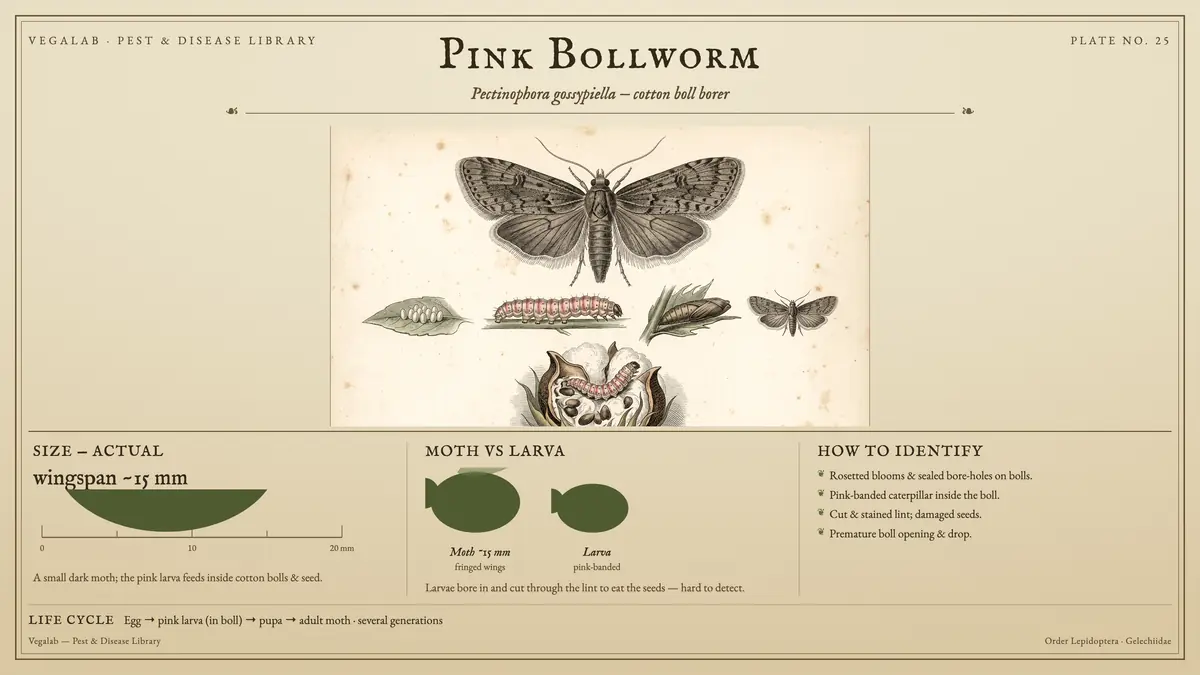
Size. wingspan ~15 mm A small dark moth; the pink larva feeds inside cotton bolls & seed.
Moth and larva. Moth ~15 mm, fringed wings; Larva, pink-banded.
- Premature boll opening & drop.
What is it?
Pink bollworm larvae hatch on or near bolls and tunnel inside, where they are shielded from contact products - making egg-hatch timing and sanitation essential. It is one of cotton's most historically damaging pests worldwide.
How to identify it
- Small entry holes in bolls, often hard to see, with internal tunnelling and damaged seeds/lint.
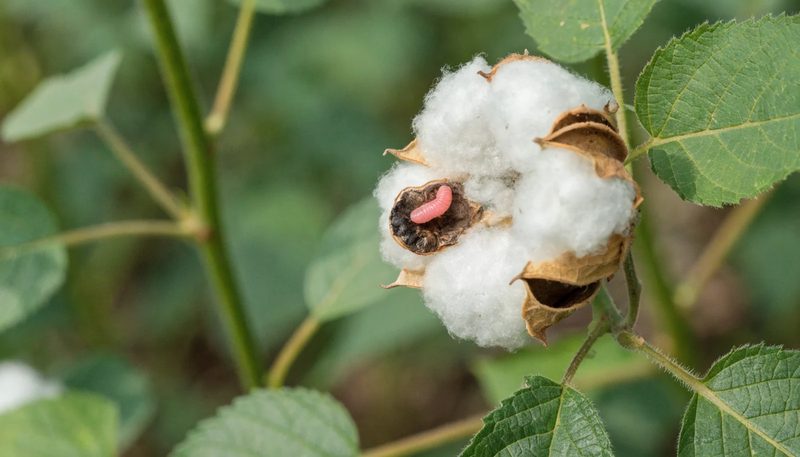
- Pink-banded larvae inside bolls; 'rosetted' (failed-to-open) blooms.
- Stained or cut lint and reduced seed set on cutting bolls open.
- Pheromone-trap catches of adult moths signalling flights.
Life cycle & spread
Several generations per season; larvae overwinter in bolls, seeds and debris. Moths lay eggs on bolls and tender growth, and larvae bore in within days of hatch.
Conditions that favour it
Warm seasons, late-maturing and continuous cotton, and carry-over in gin trash/debris sustain pressure.
Damage and how it spreads
Boll boring destroys seeds and stains/cuts lint, lowering yield and downgrading fibre; entry wounds also admit boll rots.
Monitoring & scouting
Use pheromone traps to time flights and set spray timing; inspect bolls for entries and rosetted blooms; treat at egg-hatch.
How to control it
- Time applications to egg-hatch before larvae enter bolls;
- practise field sanitation and timely crop termination/stalk destruction to cut carry-over;
- rotate modes of action.
How to manage pink bollworm
- Destroy crop residue immediately after harvest and shred and plough stalks. Overwintering larvae in bolls and debris are next season's population, and this is the single most important measure.
- Observe a host-free period. A mandated cotton-free window between seasons breaks the cycle, and it is what makes the other measures work.
- Control volunteer and ratoon cotton, which bridges the host-free period and undoes it.
- Use mating disruption. Gossyplure dispensers across a block prevent males locating females; effective at area-wide scale and much less so on an isolated field.
- Grow Bt cotton where available, with its refuge requirements.
- Harvest promptly and completely, leaving no bolls in the field.
- Coordinate regionally. This pest is managed successfully at area-wide scale and poorly farm by farm.
Pink bollworm was eradicated from commercial cotton in the continental United States and eliminated from the coordinated southwestern U.S.–northern Mexico program area through an integrated program using Bt cotton, sterile moth releases, mating disruption, host-free periods and crop destruction, monitoring, and limited insecticides.
Insecticides alone have a poor record against pink bollworm because the larva is inside the boll within hours of hatching and the entry hole heals over. The successful programmes have all been built on sanitation, host-free periods and mating disruption.
Pink bollworm or cotton bollworm?
- Pink bollworm: small larva, pink in later instars, feeds inside the boll on seeds and lint; entry hole heals and becomes invisible; rosetted flowers; damage often undetectable without cutting bolls
- **Cotton bollworm / Helicoverpa: larger larva, variable green to brown with stripes; feeds on squares, flowers and bolls with obvious large entry holes and copious frass**; attacks many crops beyond cotton
- Practical consequence: Helicoverpa is scouted visually and treated on egg-hatch timing; pink bollworm is monitored by pheromone trap and boll cutting and managed by sanitation and mating disruption. Confusing them leads to the wrong programme entirely.
See Cotton Bollworm.
Post-harvest sanitation: the measure that does the work
- Harvest completely and promptly · leave no bolls in the field, including unopened and immature ones
- Shred stalks immediately after harvest, then plough to bury residue
- Irrigate or cultivate to promote decomposition where the system allows, which kills larvae in buried debris
- Destroy or treat gin trash rather than returning it to fields
- Control volunteer and ratoon cotton through the host-free period · a single ratooned field can undo a district's effort
- Observe the mandated host-free window where one exists, and coordinate the dates with neighbours where it does not
For most pests, sanitation is one useful measure among many. For pink bollworm it is the measure, and the reason is the overwintering biology: larvae survive in unopened bolls, in crop debris, in gin trash and in volunteer plants, and that surviving population is next season's infestation almost entirely. The pest disperses poorly on its own, so what you carry over is what you get.
That is why the successful area-wide programmes all mandated the same sequence, and why it works when applied consistently across a region and much less well on one farm surrounded by others that skip it.
This is the clearest example in the library of a pest where regional coordination beats individual effort. A farm doing everything right beside a farm doing nothing will still be reinfested.
How the eradication programme actually worked
- Bt cotton · population reduction at scale
- Mating disruption · suppresses reproduction in the residual population
- Sterile insect release · only viable once density is already low
- Host-free periods and stalk destruction · removes overwintering carry-over
- Regional mandate and coordination · the component that made the rest enforceable
Pink bollworm is one of very few crop pests to have been genuinely eradicated from a major production region, and the programme is worth understanding because it demonstrates what combining tactics achieves versus applying them singly. Across the southwestern United States and northern Mexico, the pest was declared eradicated after a sustained, coordinated effort - and no single component would have done it.
Bt cotton removed the great majority of larvae wherever it was grown, driving the population down to the level at which the other tactics become effective. Mating disruption across whole districts suppressed reproduction in the residual population that Bt did not reach. Sterile moth releases - mass-reared, irradiated males released in large numbers - swamped the remaining wild males, so the few surviving females mated unproductively. And mandatory host-free periods with enforced stalk destruction removed the overwintering carry-over that would otherwise have rebuilt the population each year.
The sequencing was the insight. Sterile insect release only works at low population density, because the released males must outnumber wild ones heavily; Bt and mating disruption were what created that density. Applied in the wrong order, or individually, none of it would have succeeded.
The transferable lesson is that eradication required area-wide coordination and a sequence of tactics, not a better product. For growers outside eradication zones, the same sanitation and host-free logic remains the most effective part.
Recommended Vegalab solution: Larva Control
Larva Control · natural broad-spectrum larvicide (oxymatrine) applied at egg-hatch, targeting young larvae on bolls and tender growth before they bore in.
| Role | Product | Use |
|---|---|---|
| Primary control | Larva Control |
By crop
Preventing it next season
Pheromone monitoring, timely crop termination and stalk/debris destruction, and treating young larvae before boll entry.
Claims and product availability vary by jurisdiction. Always read and follow the product label.